
Other people’s words about … writing
Seamus went into the hall after Oliver, and they kicked the snow off their boots. Their professor had just come back from the bathroom. He put a hand on Seamus’s arm and said, ‘Great work, Seamus. It’s a good poem.’
‘Was it?’ Seamus asked. The professor’s expression opened just slightly. Oliver patted Seamus on his lower back and returned to the seminar room. It was Seamus and the professor alone in the hall. Seamus could feel himself dripping cold water on the rug.
‘Is that what you need? For someone to tell you that your work is good?’
Seamus flushed.
‘I don’t know what I need. I don’t know what I’m doing. I feel like I’m wasting my time.’
‘Oh, Seamus,’ the professor said, and Seamus looked at him.
‘How do you know?’ Seamus asked.
‘How do you know what?’ the professor retorted, his head jostling a little, like it was a game or a riddle.
‘How do you know you’re not just wasting your time?’
‘If you don’t know the answer to that, then I can’t do anything for you,’ the professor said with a chastening laugh.
Seamus felt that he had been slapped on the nose and called childish. The world grew deep and saturated. It felt as if something vast and Godlike had peeled back the veil of his life and peered in at him. He had gone around giving away all his power, seeking certainty, approval. But that’s what children did. Seamus had been a child, selfish and stubborn in his ways.from ‘The Late Americans‘
by Brandon Taylor
I’ve been thinking again about the process of writing fiction — how a writer takes the story they hear inside their head and puts it into written words. That’s what the process involves for me, at least, most of the time. I hear a story in my mind, a story with a very distinct voice, and I try to translate that story into one that other people can read — a story on paper, a story on a screen. A story, I was going to say, that is tangible. Tangible is the wrong word, though. Perhaps what I mean is, a story that exists in a form that other people can access.
The strange, sad part of this process is that mostly, while the story is still inside my mind, it feels like a very beautiful thing, whereas once it becomes something I can share with other people, it often turns out not to be a beautiful thing at all.
 Lizzie in a pool of sunshine (and a room with a view), Easter 2024.
Unlike Brandon Taylor’s character Seamus in the passage above, I have never studied writing. One of the reasons I haven’t is that I don’t think that studying writing will answer the question that I always have about my own writing, which is the same question that Seamus has, How do you know you’re not just wasting your time? The truth is that you can’t know, which is what (I think) the professor is trying to say to Seamus without actually spelling it out for him. You will never know. If you try to find out, you’re going down the wrong track, asking yourself the wrong question.
A better question, I think, would be, How do you sit with the fact that you don’t know whether you are wasting your time or not? But I don’t know the answer to that, either.
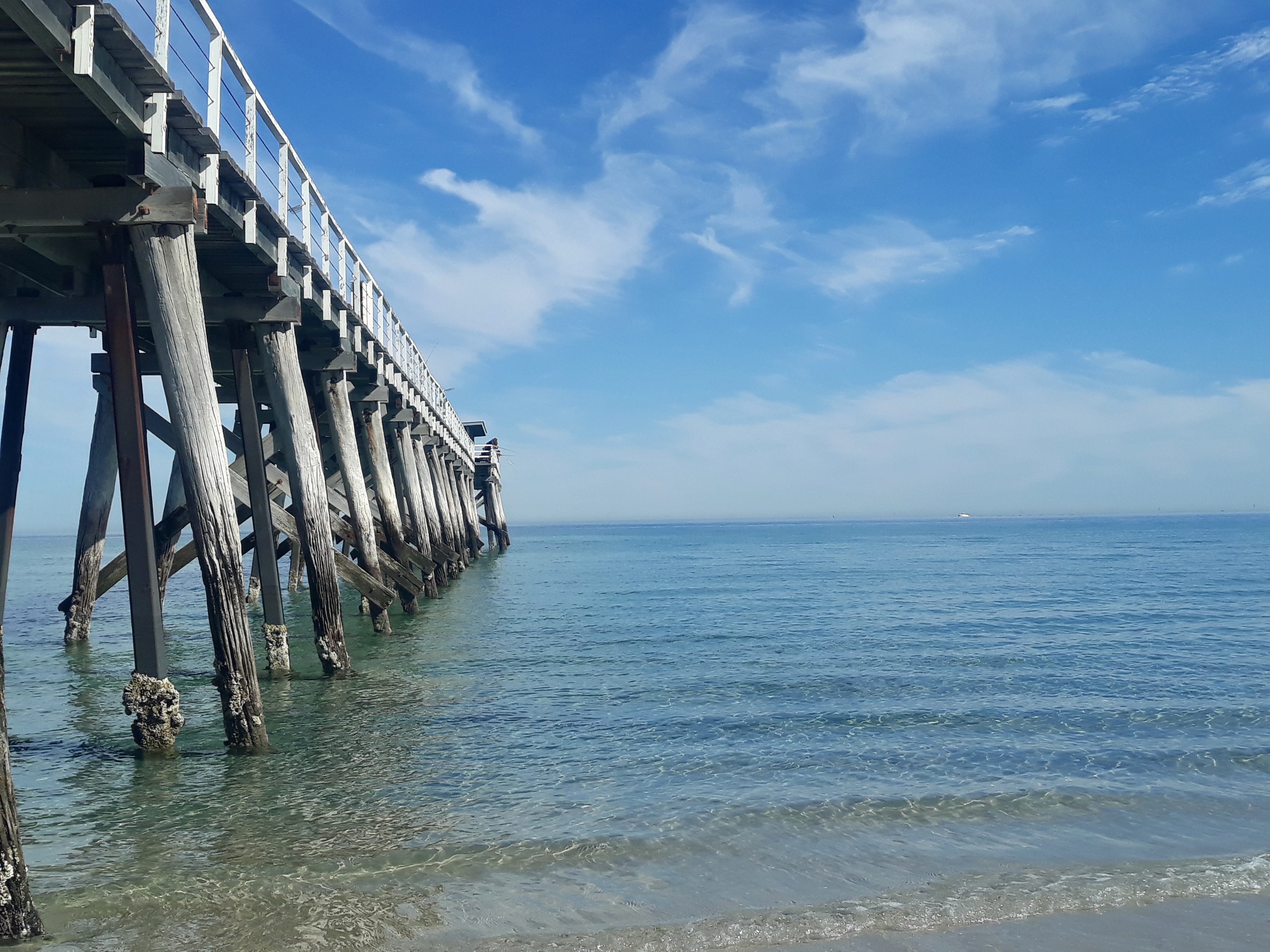 The other side of the jetty from the photo in my last post, Easter 2024.
Since my novella Ravenous Girls came out late last year, I’ve been working on a story centred around the same characters, a sequel of sorts — the next instalment. I don’t know whether it will ever get published; I don’t know whether what I’m writing is any good; I don’t know whether anyone will want to read it. Like Seamus, I keep wanting to ask someone whether I’m wasting my time, but there is no-one who can tell me.
And so, like Seamus, all I can do is sit with the unknowing. There’s nothing else you can do. There’s no other way through.
Lately I’ve been reading …
-
- I thought I needed to know where I was heading with the book, but the more I wrote, the more I realised that so much of the pleasure of writing for me is about following a trail of not knowing: While we are on the subject of writing and not knowing, here is Stephanie Bishop, whose book The Anniversary has been long listed for the 2024 Stella Prize, on writing a book without knowing what kind of book she was writing (or where it would take her.)
- I do, however, believe that writing advice usually says more about the person giving it than the person receiving it: On a similar theme, here is Maura Lammers on how to incorporate other people’s advice about your writing into your writing (or how not to take their advice at all).
- As the world undergoes dramatic environmental shifts, so too does our neurological landscape. Fossil-fuel-induced changes – from rising temperatures to extreme weather to heightened levels of atmospheric carbon dioxide – are altering our brain health, influencing everything from memory and executive function to language, the formation of identity, and even the structure of the brain. The weight of nature is heavy, and it presses inward: When I saw the headline of this article, I thought it was going to be about climate crisis grief and its psychological effects. It’s not, though. In this article, Clayton Page Aldern explores the neurological effects of climate change — that is to say, the biological effects on the brain. What he writes is, frankly, scary.
- The occasional bout of food poisoning was a job hazard, yet it was long-term overconsumption that took the real toll: Corin Hirsch on the stress of being a food critic, and what happened when she quit.




 twenty-one words