Roll and thunder and hiss

Other people’s words about … the sea (again)

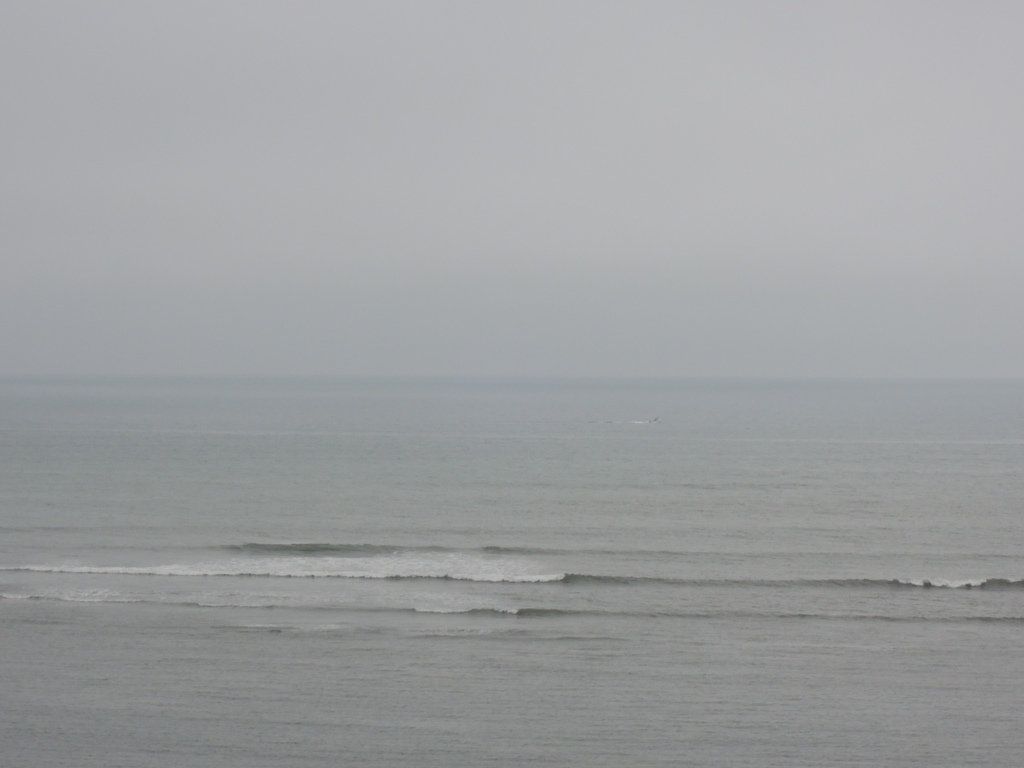
I could see the sea from the terrace, and the lawns. It looked grey and uninviting, great rollers sweeping in to the bay past the beacon on the headland. I pictured them surging into the little cove and breaking with a roar upon the rocks, then running swift and strong to the shelving beach. If I stood on the terrace and listened I could hear the murmur of the sea below me, low and sullen. A dull, persistent sound that never ceased. And the gulls flew inland too, driven by the weather. They hovered above the house in circles, wheeling and crying, flapping their spread wings. I began to understand why some people could not bear the clamour of the sea. It has a mournful harping noise sometimes, and the very persistence of it, that eternal roll and thunder and hiss, plays a jagged tune upon the nerves.

From Rebecca
by Daphne du Maurier

Rebecca is one of my favourite books. The unnamed narrator’s character — shy, very English, young, terribly lacking in confidence — is exquisitely drawn. The plot is an absolute cracker. And if you want to find out how to use short sentences to build suspense (and I mean short! sentences), read the last half of the book. I have never seen them used so effectively. Stop reading at your peril.

The sea looked grey and uninviting

And then there is the sea. It’s almost a character in itself in Rebecca. Here in this quote, and elsewhere, the sea is a dark, brooding presence. We’re not talking sunshine and sun tans and happy childhood memories here. This is a sea that threatens and menaces, that fills the reader with a terrible sense of foreboding.

You know me by now. These won’t be the last words I quote about the sea. But honestly? I think they will always be, for me, up there with the best.

The third year

Beautiful words

I love reading.
I love words.
Maybe you’d noticed?
After all, reading and writing have been two of my core themes on this blog, right from the start.
So.
This year — my third year of blogging (yes, really! twenty-one words has been around for over two years now) — that will be my main focus.
Other people’s words.

A year of reading
A year of reading

Each week, I’ll be posting a quote from something I’ve read and loved,
either recently or long ago.
(Some writers’ words stay in your mind forever.)
Sometimes I’ll post a photo to accompany the quote,
sometimes I’ll post a comment instead.

A cup of tea to accompany reading makes it even better ...
A cup of tea to accompany reading makes it even better …

I hope you’ll find some words here, in the next year, that tickle your fancy;
that make you think;
that make you laugh,
or smile,
or cry;
that make you go to your library and read those other people’s words for yourself.
For me, that’s what reading’s all about.

Note
For readers wondering about my original theme — twenty-one words, after which this blog is named — fear not. ‘Twenty-one’ will still be a theme around here. Watch this space to find out how.

The circle of life

I can’t resist coming back to Kim Leine’s ‘The Prophets of Eternal Fjorde’ today to post a couple more quotes. This time, we are not focusing on intestinal discomfort. (Enough already!)

My constitution would seem to be better than I would have thought, for I have survived two attacks upon my life this winter and may thereby once more look forward to further prolongation of my futile destiny.
(p. 406)

Morten Falck, a Danish missionary, struggles with his own fleshly weakness, with his desires and cravings, and with the despair that comes from leading a life whose purpose is not entirely clear to him.

I cannot go back … I can only go forward, in a ceaseless circle, and my only hope  is that when the circle is complete and the motion halts I shall have arrived at the place that is best for me …
(p. 505)

Life as a ceaseless circle:
Don’t you, too, sometimes feel you are pushing forward blindly, hoping — hoping — that you will one day arrive at a place that makes sense?

The flesh is weak

Other people’s words about … well, elimination

Writers don’t often describe bodily functions in literature (other than sex). After all, reading is about escapism, right?

But in ‘The Prophets of Eternal Fjord’, Kim Leine describes the main character’s afflictions with — ahem — a sensitive colon so evocatively that his physical suffering becomes embedded into the story.

His intestines are in an uproar. He senses the ominous ripple of diarrhoea in the bowel, the quivering alarm of the sphincter.
(p. 114)

Morten Falck is an eighteenth-century missionary in the Danish colony of Greenland.

His bowels emit a series of shrill tones of varying intensity. He grimaces, then collects himself.
(p. 127)

This is a story of suffering, weakness, morality, intestinal discomfort and (perhaps) redemption.

It gushes from him the moment he pulls up his cassock and sits down on the privy seat, a mud-like mass, almost without smell, an inexhaustible landslide of brown. His intestines writhe in agony, and yet there is a considerable element of joy at being able to release, to discharge this spray of filth and empty the bowels. He groans, bites his hand and chuckles. His sphincter blares and squelches, and then there is silence. He feels more is to come and shifts his weight from side to side, bent double, his head between his bony knees, his hands massaging his stomach, but nothing is forthcoming. It is as if something is stuck inside him, a thick log of excrement blocking his passage. But most likely a fold of the intestine, he considers. He recalls images of the corpses he dissected and drew as a young man, and he sees now his own colon in his mind’s eye and the blockage that has occurred. He imagines its slow release and the sudden slop that comes with it. The thought of it helps. A new deluge is evacuated and his anus trumpets a fanfare.
(p. 151)

Seriously, how can you not admire such a vivid description of intestinal torture?
Come on, admit it — we’ve all been there at some time!


Everyday cake

Other people’s words about … cake

The other day, in a dark moment, I was trying to compile a list of things that make me feel better when I’m feeling bad.
(I write these lists often. You can draw your own conclusions about what this says about me!)
DSCN2556
One of the things that’s always on my list of consolations is: CAKE.
Cake never fails, right?
Lovely blogger Stacy Ladenburger talks about this over on her blog Delightful Crumb.
Her solution is something she calls ‘
Everyday Cake’ —
a cake to eat and bake through all life’s trials and tribulations.

DSCN2033

Everyday cake.
Even the idea consoles me …

Note:
I have never posted a recipe on my blog, and don’t intend to. One reason is my self-imposed word limit. It’s hard to publish a recipe in a post that’s 101 words or less.
But if you would like a recipe for everyday cake, I’d try Stacy’s recipes here and here.
And whatever recipe you try, I hope that baking and eating the end-result will console you as I have found it consoles me…

Kinship

Other people’s words about … headaches

One of the things I love about reading is the sense of kinship
you can find in another person’s words.
Sometimes, the smallest phrases from a book sing true.

Since he left, a headache had followed Laura, the kind like a bird that settles and soars.

from ‘Questions of Travel’
by Michelle de Kretser

(p. 177)

Sometimes I, like Laura, get headaches that come over me, varying in intensity —
for a few hours, or days, or weeks.
Medication doesn’t help:
and I’ve learned just to sit the headache out.

… she could feel a headache coming on, the close-fitting, all-over kind like a swimming cap made of lead.

(p. 498)

So I find solace and companionship in these words of Michelle de Kretser.
I may never meet her.
But I know how her world is coloured,
and I know that she is kin.

Self-transcendence

If you are ever in need of an answer or feel a little lost in this great big world, go out there and hit the trails. Leave the Garmin at home and just get out there and be. Connect with nature. Listen to the whispers of breeze in the trees or the ramblings of the nearby stream. Eventually, you will find what you are looking for and perhaps, in time, you will find yourself as well.


The words I’ve quoted above come from the blog So what? I run.
(Read the whole post here.)
For me, they apply whether I’m walking or running.

Because of my knee injury, it’s all about walking for me right now.
And I’m okay with that.

It’s all about the connection with the world around me:
it’s vital.
It’s healing.

And in the spirit of the quote above,
I’m posting today some photos from one of my favourite walks.

You don’t need phones or apps or pedometers or fitbits.
You just need time to look,
to listen,
to breathe.

My hourglass

Slowly, it started to feel as if I had clawed my way back to something resembling a life. It was such a relief to know that I hadn’t finished changing — I wasn’t an hourglass that had timed out, all the grains fallen through. I wasn’t stuck, too soon the best I could ever be.

from ‘Inbetween Days’
by Vikki Wakefield*

Have you ever wondered if you’ve already achieved the best you can?
Have you ever thought that it’s all downhill from here?
If so, perhaps — like me — you will find these words comforting.
I like to think of the grains in my hourglass still trickling through slowly …
… not quite timing out.

*Note:
Vikki is a good friend of mine and fellow writer. Check out her website for more information.

Happy/sad

So, this is my life. And I want you to know that I am both happy and sad and I’m still trying to figure out how that could be.

From The Perks of Being a Wallflower
By Stephen Chbosky

Have you read The Perks of Being a Wallflower?
I came to it a few years ago — later than most people, long after the film was released. I think I thought (cynically) that it was a kind of super-cool rewrite of The Catcher in the Rye. And I don’t like super-cool books.
But it isn’t.
I like Charlie’s voice. The narrative is simple and poignant, and gets at the heart of the loneliness of being an adolescent.
Happy/sad.
That’s not just adolescence, though, is it?

PS Happy birthday to my mother for today! ❤

The chef gets healthy

Other people’s words about … life

Cookbooks are all about food and cooking, right?
But here’s what I found in a cookbook I borrowed from the library recently:

I generally don’t get into the whole ‘life quote’ thing; I pop them in a basket with mason jars and hip-hop yoga. But there’s a snowboarder I follow on Instagram called Kevin Pearce … who listed the non-negotiables in his life and it really stuck with me. I adapted the list to suit my life, but the fundamentals are still the same. When I am disciplined about making time for these rules, I find everything else falls into place easily and I am a better person, inside and out. That’s a good thing, right?
Make space for this:

  • Start the day with exercise.
  • Do yoga or meditate (even just 5 minutes): morning, noon and night.
  • Eat a healthy breakfast, lunch and dinner.
  • Prepare food in advance so there’s no excuse to eat crap.
  • Drink lots of water, at least 2 litres a day.
  • Get outside, look around (not down at your screen) and listen.
  • Be present!
  • Take care of hygiene.
  • Read and learn something new every day.
  • Keep in touch with friends and family.
  • Lead with your heart and keep your mind close behind.
  • Remember that conscious breathing will always centre you.
  • Be appreciative and be patient.
  • Surround yourself with awesome, like-minded people.
  • Sleep and rest, as much as you feel you need.

from ‘The Chef Gets Healthy’
by Tobie and Georgia Puttock

I have to confess: the recipes in the cookbook didn’t do much for me. I like my carbs! (Tobie and Georgia have eschewed carbs in the name of health.)
But I loved Tobie’s list.
It’s a recipe for life, not just for food.
And, as with all the best recipes, you can adapt it and make your own.
It’s a starting-point, I think —
a good one, too.