
Other people’s words about … practising art alone
But you have a little secret: while you are not making Art anymore you are at least drawing every day. To tell anyone about this would be admitting there is a hole in your life, and you’d rather not say that out loud, except in therapy. But there you are, once a day, drawing the same thing over and over: that goddamned Empire State Building [which you can see from the floor-to-ceiling window in your new apartment]. You get up every morning (or afternoon, on the weekends, depending on the hangover), have a cup of coffee, sit at the card table near the window, and draw it, usually in pencil. If you have time, you’ll ink it. Sometimes, if you are running late from work, you do it at night instead, and then you add colour to the sketches, to reflect the building’s ever-changing lights. Sometimes you draw just the building and sometimes you draw the buildings around it and sometimes you draw the sky and sometimes you draw the bridge in the foreground and sometimes you draw the East River and sometimes you draw the window frame around the whole scene. You have sketchbooks full of these drawings. You could draw the same thing forever, you realise. ‘No man ever steps in the same river twice, for it’s not the same river, and it’s not the same man’ is a thing you read once. The Empire State Building is your river. And you don’t have to leave your apartment to step in it. Art feels safe for you again, even though you know you are not getting any better at it, that the work you are making could be sold to tourists on a sidewalk outside of Central Park on a sunny Saturday and that’s about it. There’s no challenge to it, no message, just your view, on repeat. But this is all you can do, this all you have to offer, and it is just enough to make you feel special.
from ‘All Grown Up‘
by Jami Attenberg
I have conflicting responses to the passage above. In many ways, Attenberg’s narrator, Andrea, reminds me of myself, although her creative practice is art and mine is writing. I certainly know what it’s like to stop showing people the material you are creating, to keep your practice to yourself, to see it as your own little secret. And I know the feeling that comes with doing this, too, which Andrea articulates elsewhere in her narrative — that feeling that what you are doing, the material you are creating, the act of creating it, is barely scratching a feverish itch.
Something changed for me about a year ago, though, after which I began tentatively showing people something I’d written — a few people, a very few people. This gave me the courage to do more with that particular piece of writing, and as a result I’m not in the same place anymore as Andrea, although all I can say about that for now is that I do have a piece of writing coming out later this year — a small piece, but a piece nonetheless — and I will tell you more when I can.

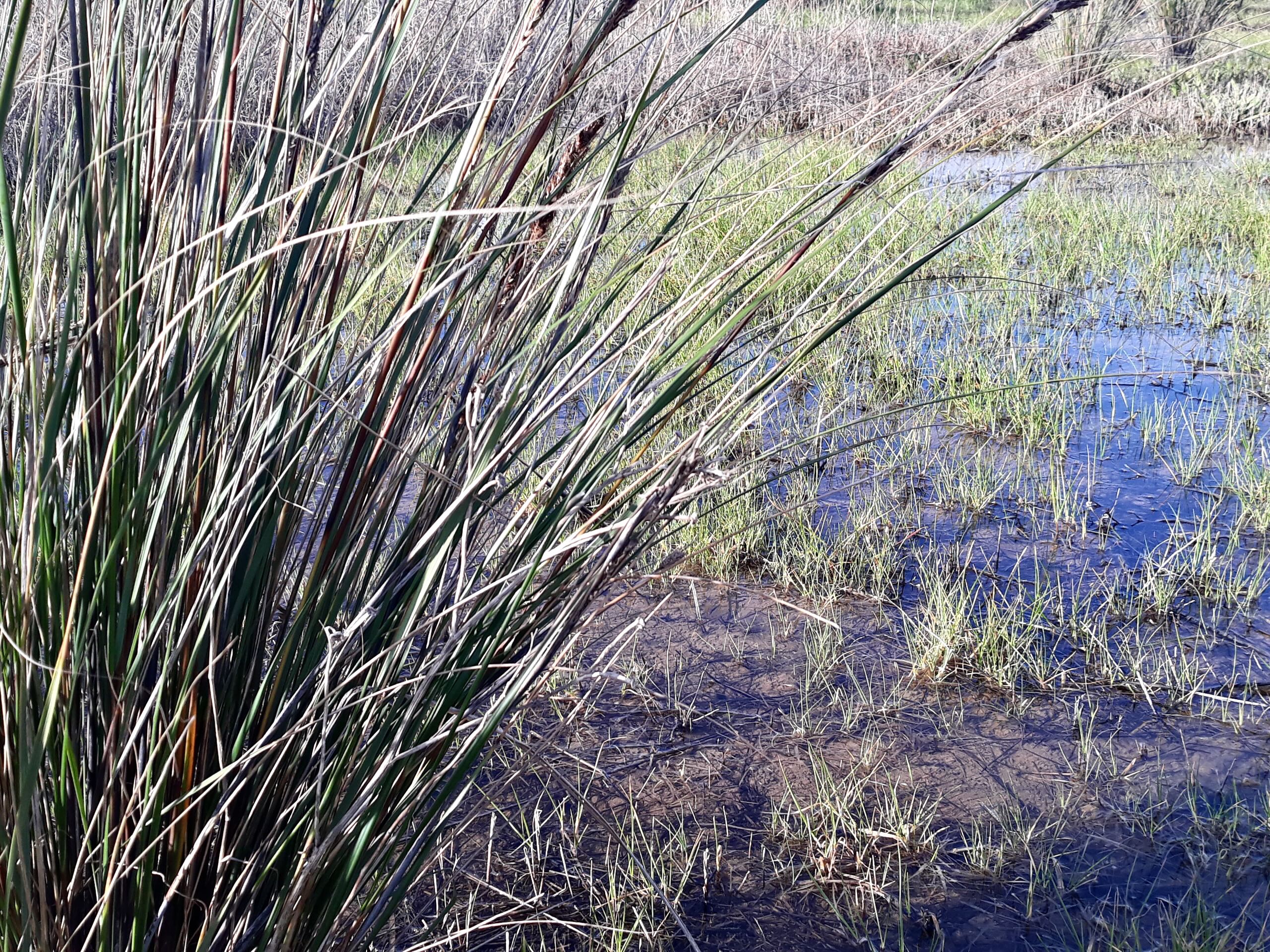
Reeds in the marsh, The Washpool, July 2023.
But even if things hadn’t changed for me, I suspect that I’d still finding myself wanting to argue with Andrea as much as I’d find myself wanting to agree with her. Because the thing that I learned during those years of writing alone, writing unseen, was that there is a value to creating something — art, literature, whatever — that has nothing to do with other people’s opinions, nothing to do with productivity or acclaim or results. What I learned (very slowly, very painfully) is that creating just your view, on repeat can in fact teach you something; it can take you somewhere new in your work. You may not be able to measure the work you create in private; you may not be able to quantify it. But when did art become something we need to measure and quantify, anyway? When did it become an outcome, a product?
I believe, although it’s taken me years to come to this understanding, that the practice of creating has its own value. The work you do as you create something, that feeling you get as you practise it of reaching out, of bringing something into the world, is an act of connection and hope. This is valuable. This is meaningful. And it can — it can — be enough.
Lately I’ve been reading …
It’s a long list today, as I try to catch up on some of my reading over the last few months. I hope you’ll enjoy one or two of the pieces I’ve listed here.
-
- I didn’t believe in writer’s block, but writer’s block sure believed in me. It was a nightmare that wouldn’t end. As dramatic as this might sound, I felt like I was suffocating, dying —- and a part of me really was: While we’re on the topic of writing, here’s Matthew Quick on how he found his way through the writer’s block that assailed him when he became sober.
- I had lost contact with the mental space that running had once opened up for me, where for years I’d soothed my anxieties and depression, reckoned with my own alcoholic past, and incrementally cobbled together a sense of well-being: Caleb Daniloff with a different angle on addiction, not his own but his daughter’s, and on running with her dog after her death.
- You shrugged, those round army green shoulders coming up briefly around your face and then falling again. Me: already in love: Naomi Gordon Loebl contributes to Off Assignment’s wonderful ‘Letter to a Stranger’ series.)
- Harry stood patiently, observing, the way a photographer would. After a few minutes he turned to Dad and called, Hey, you need a hand? Ezequiel-Saint Millan II on a meeting between the man he calls Dad (his adoptive father) and his father (his biological father)
- I also keep thinking about how Blonde is over 700 pages and I never got past the second chapter: Jesse Lee Kercheval on Joyce Carol Oates and on the blurry line between fiction and non-fiction.
- I had been a confident child, but that confidence had slowly drained from me. I started getting nosebleeds, constant nosebleeds. I had known since I was six years old that I wanted to be a writer, so I read a lot, and wrote a lot, but these activities gave me less and less pleasure. I grew very thin. I did not sleep: The writer Joseph Earp on being plagiarised by his writing mentor, John Hughes. I wasn’t aware of the outcry around John Hughes’s plagiarism until I read this piece (some time ago now), but I was fascinated in reading this that Earp moves beyond outrage to something deeper and more conflicted — and ultimately more compassionate.
 twenty-one words