Inner world

Other people’s words about … resilience

I think maybe [my father] liked the worlds in his head better than the real one. As far as I ever knew, he didn’t have any close friends … Once, when I was about nine or ten, I told him I wasn’t very popular at school. He told me that friends were overrated, because the only person you could ever really count on was yourself. Weirdly, that actually made me feel better.

from ‘Thanks for the Trouble
by Tommy Wallach

I am, I suppose, what most people would describe as introverted. There are other words that go along with this kind of description: shy, quiet, aloof, disengaged, uncertain, insecure, antisocial. Those are mostly negative words, I see. Perhaps they are coined by extroverts.

The year that we lived in England, I was at my most introverted: I had no friends at all. (Here’s a question: do you end up without friends because you are introverted, or do you become introverted because you have no friends?) I was fourteen, and I wandered those long school corridors with the white polished floors alone. I wore the wrong clothes, and I had the wrong accent, and I lived life at the wrong pace and the wrong volume. At lunch I sat in one of the stalls in the girls’ toilets, waiting the hour out. I listened to girls coming in and out, the cubicle doors swinging, the toilets flushing. My breath caught on the sweet spray of perfume they doused themselves with as they stood before the mirrors. I listened to their chatter, high and loud and lipsticked. And then I listened to the door to the girls’ room banging shut again, their footsteps receding down the white-floored corridors as they went back to wherever they had come from.

After the first few weeks, one of the school teachers took pity on me, and introduced me to a couple of girls in my class.

‘Go and sit with them at lunchtime,’ he said, with a look on his face that was half-pity and half-exasperation. He was small and balding and chipper. ‘They’re nice girls. They’ll look after you.’

Such well-meaning, misguided intentions! I looked at the two girls and they looked back at me. I could see they were as horrified at the prospect of me spending lunchtime with them as I was. And yet we all did what he said. They took me back to their lunchtime bench, and I sat with them and their friends — that day and the day after and the day after that. For months, in fact, I ate my sandwich with them silently; I sat with them silently; I watched them silently; I listened to them silently. They took to ignoring me, in the end. They went on with their lives — their parties and their gossip and their drinking and their shopping and their boyfriends — while I sat mute beside them, in what seems to me now almost a parody of introversion.

I have often thought back to that year in high school. I’ve thought about how, at night, I lay in the darkness of my bedroom, the one with the wallpaper with pretty sprigs of flowers dotted over it, and longed for popularity and friendship, for someone my own age to count on. I’ve thought about how I believed that I must be faulty in some way — weak, or cowardly, or defective — because I couldn’t do what other people my own age did instinctively: talk. Make connections. Relax. Laugh.

So it astonishes me now, to look back and see a different possibility, a different narrative, from the one I’ve just told. I don’t believe that friends are ‘overrated’, to use Wallach’s word. Still, I wonder: what if I had learned to trust myself during that year? What if I had learned that I was my own friend? What if I had allowed myself to like the world in my head at least as much as the real one? More broadly, what if we could teach all young people to count on themselves in this way? What, then?

I am not sure. But I think it’s important to listen to alternative narratives like the one in the words above: to retell our life-stories to ourselves, to seek out new plots, new endings. I think it’s important to trust your own inner world: to learn to turn to it in times of need, or in times of loneliness. Introversion, in this context, is irrelevant. What’s relevant is resilience. Resilience is all that matters.

Resilience, you will note, is not a negative word.

Some books say

Other people’s words about … self-help

Some books say sing to your plants

Sometimes I am guilty of believing that if I can just read the ‘right’ book, I will know how to change my life. If I can just follow the right advice (and adhere to it), I will know how to live.

That’s the appeal of self-help books, right? You don’t have to think for yourself anymore. You just have to do what the author says, and you’ll find happiness. Success. Wealth. Health. Glory. Inner peace.

Then again …

Some books say start a garden, sing to your plants. Some books say join a book club, take music lessons, start a stamp collection, get a pet. Some books say brew your own beer. Some books say try paintball, enter a local trivia competition, take dance lessons, learn to rumba. Some books say listen to James Brown. Some books say give yourself a hug. Some books say when someone hugs you, let them be the first to let go. Some books say let a dog lick your face. Some books say swim naked. Some books say kiss a stranger. Some books say climb a mountain. Some books say overcome a phobia. some books say change begins with pain. Some books say get busy living or get busy dying. Some books say never say the word try. Some books say there’s nothing you can’t do. Some books say accept your limitations. Some books say don’t take no for an answer. Some books say buy a karaoke machine and invite friends over. Some books say learn a new language. Some books say leave no regrets. Some books say beware a person who has nothing to lose. Some books say do no harm. Some books say never cut what can be untied. Some books say admit your mistakes. Some books say you are not your mistakes. Some books say forgive everyone everything. Some books say never criticise what can’t be changed. Some book say don’t be afraid to say I don’t know. Some books say don’t bore people with your problems. Some books say when someone asks you how you feel, say terrific, never better. Some books say ask questions. Some books say don’t ask too many questions. Some books say carry someone. Some books say let yourself be carried. Some books say there’s nothing to fear. Some books say it’s okay to be afraid. Some books say whistle in the dark. Some books say give more than you take. Some books say God never gives you more than you can take. Some books say God never blinks. Some books say God grant me the serenity to accept the things I cannot change, the courage to change the things I can, and the wisdom to know the difference. Some books say read the Psalms. Some books say if something seems too good to be true, it probably is. Some books say choose your life partner carefully. Some books say tape-record your spouse’s laughter. Some books say that if you live with a partner, one usually dies first. Some books say surrender. Some books say do not go gently. Some books say recognise that you are lost. Some books say put yourself back together piece by piece. Some books say it’s never too late. Some books say it’s not unusual to live to ninety. Some books say you will probably be old for a long time. Some books say you can’t kiss your own ear. Some books say it’s nice to meet someone after a long absence. Some books say reunion is a type of heaven. Some books sat there’s no good in goodbye. Some books say never say goodbye, better to say see you later, see you soon, see you someday, until we meet again.

from The Book of Why
by Nicholas Montemarano

Maybe it’s time for us (me?) to remember that there is no single, right way to live: that for every piece of truth someone offers you, there is another, opposite truth.

But maybe there is comfort in that plurality. Maybe that’s the point. Maybe it’s all about acceptance, and making peace with that acceptance.

And maybe — just maybe — that’s part of the adventure …

Roll and thunder and hiss

Other people’s words about … the sea (again)

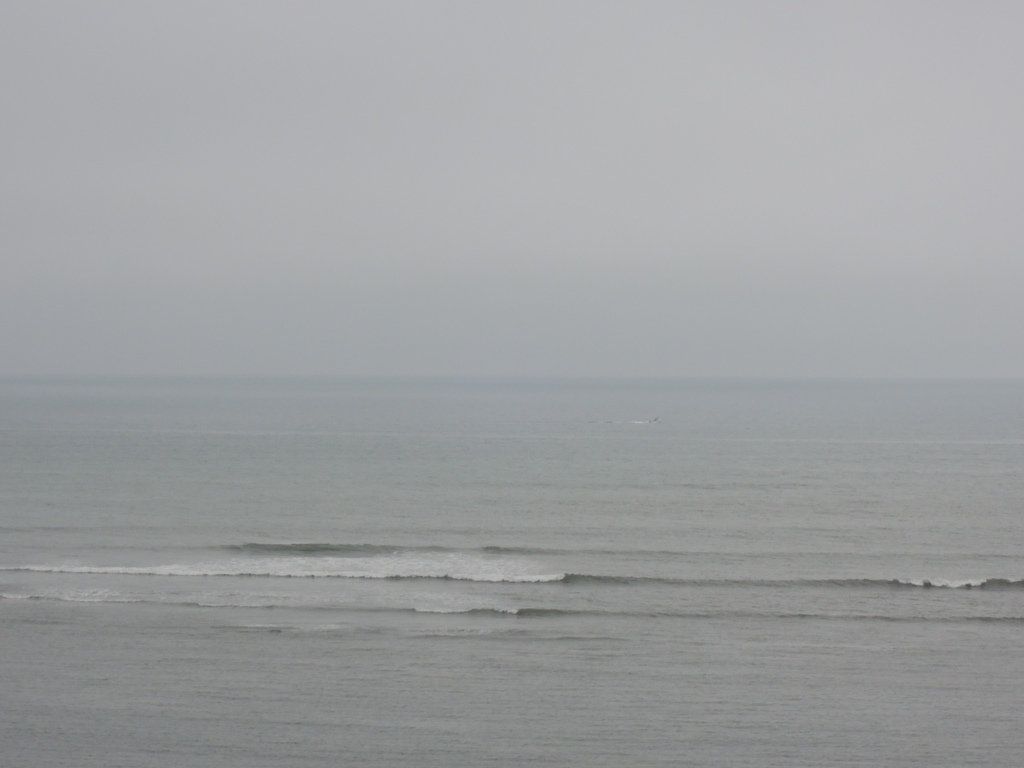
I could see the sea from the terrace, and the lawns. It looked grey and uninviting, great rollers sweeping in to the bay past the beacon on the headland. I pictured them surging into the little cove and breaking with a roar upon the rocks, then running swift and strong to the shelving beach. If I stood on the terrace and listened I could hear the murmur of the sea below me, low and sullen. A dull, persistent sound that never ceased. And the gulls flew inland too, driven by the weather. They hovered above the house in circles, wheeling and crying, flapping their spread wings. I began to understand why some people could not bear the clamour of the sea. It has a mournful harping noise sometimes, and the very persistence of it, that eternal roll and thunder and hiss, plays a jagged tune upon the nerves.

From Rebecca
by Daphne du Maurier

Rebecca is one of my favourite books. The unnamed narrator’s character — shy, very English, young, terribly lacking in confidence — is exquisitely drawn. The plot is an absolute cracker. And if you want to find out how to use short sentences to build suspense (and I mean short! sentences), read the last half of the book. I have never seen them used so effectively. Stop reading at your peril.

The sea looked grey and uninviting

And then there is the sea. It’s almost a character in itself in Rebecca. Here in this quote, and elsewhere, the sea is a dark, brooding presence. We’re not talking sunshine and sun tans and happy childhood memories here. This is a sea that threatens and menaces, that fills the reader with a terrible sense of foreboding.

You know me by now. These won’t be the last words I quote about the sea. But honestly? I think they will always be, for me, up there with the best.

The third year

Beautiful words

I love reading.
I love words.
Maybe you’d noticed?
After all, reading and writing have been two of my core themes on this blog, right from the start.
So.
This year — my third year of blogging (yes, really! twenty-one words has been around for over two years now) — that will be my main focus.
Other people’s words.

A year of reading
A year of reading

Each week, I’ll be posting a quote from something I’ve read and loved,
either recently or long ago.
(Some writers’ words stay in your mind forever.)
Sometimes I’ll post a photo to accompany the quote,
sometimes I’ll post a comment instead.

A cup of tea to accompany reading makes it even better ...
A cup of tea to accompany reading makes it even better …

I hope you’ll find some words here, in the next year, that tickle your fancy;
that make you think;
that make you laugh,
or smile,
or cry;
that make you go to your library and read those other people’s words for yourself.
For me, that’s what reading’s all about.

Note
For readers wondering about my original theme — twenty-one words, after which this blog is named — fear not. ‘Twenty-one’ will still be a theme around here. Watch this space to find out how.

The circle of life

I can’t resist coming back to Kim Leine’s ‘The Prophets of Eternal Fjorde’ today to post a couple more quotes. This time, we are not focusing on intestinal discomfort. (Enough already!)

My constitution would seem to be better than I would have thought, for I have survived two attacks upon my life this winter and may thereby once more look forward to further prolongation of my futile destiny.
(p. 406)

Morten Falck, a Danish missionary, struggles with his own fleshly weakness, with his desires and cravings, and with the despair that comes from leading a life whose purpose is not entirely clear to him.

I cannot go back … I can only go forward, in a ceaseless circle, and my only hope  is that when the circle is complete and the motion halts I shall have arrived at the place that is best for me …
(p. 505)

Life as a ceaseless circle:
Don’t you, too, sometimes feel you are pushing forward blindly, hoping — hoping — that you will one day arrive at a place that makes sense?

Kinship

Other people’s words about … headaches

One of the things I love about reading is the sense of kinship
you can find in another person’s words.
Sometimes, the smallest phrases from a book sing true.

Since he left, a headache had followed Laura, the kind like a bird that settles and soars.

from ‘Questions of Travel’
by Michelle de Kretser

(p. 177)

Sometimes I, like Laura, get headaches that come over me, varying in intensity —
for a few hours, or days, or weeks.
Medication doesn’t help:
and I’ve learned just to sit the headache out.

… she could feel a headache coming on, the close-fitting, all-over kind like a swimming cap made of lead.

(p. 498)

So I find solace and companionship in these words of Michelle de Kretser.
I may never meet her.
But I know how her world is coloured,
and I know that she is kin.

My hourglass

Slowly, it started to feel as if I had clawed my way back to something resembling a life. It was such a relief to know that I hadn’t finished changing — I wasn’t an hourglass that had timed out, all the grains fallen through. I wasn’t stuck, too soon the best I could ever be.

from ‘Inbetween Days’
by Vikki Wakefield*

Have you ever wondered if you’ve already achieved the best you can?
Have you ever thought that it’s all downhill from here?
If so, perhaps — like me — you will find these words comforting.
I like to think of the grains in my hourglass still trickling through slowly …
… not quite timing out.

*Note:
Vikki is a good friend of mine and fellow writer. Check out her website for more information.

The chef gets healthy

Other people’s words about … life

Cookbooks are all about food and cooking, right?
But here’s what I found in a cookbook I borrowed from the library recently:

I generally don’t get into the whole ‘life quote’ thing; I pop them in a basket with mason jars and hip-hop yoga. But there’s a snowboarder I follow on Instagram called Kevin Pearce … who listed the non-negotiables in his life and it really stuck with me. I adapted the list to suit my life, but the fundamentals are still the same. When I am disciplined about making time for these rules, I find everything else falls into place easily and I am a better person, inside and out. That’s a good thing, right?
Make space for this:

  • Start the day with exercise.
  • Do yoga or meditate (even just 5 minutes): morning, noon and night.
  • Eat a healthy breakfast, lunch and dinner.
  • Prepare food in advance so there’s no excuse to eat crap.
  • Drink lots of water, at least 2 litres a day.
  • Get outside, look around (not down at your screen) and listen.
  • Be present!
  • Take care of hygiene.
  • Read and learn something new every day.
  • Keep in touch with friends and family.
  • Lead with your heart and keep your mind close behind.
  • Remember that conscious breathing will always centre you.
  • Be appreciative and be patient.
  • Surround yourself with awesome, like-minded people.
  • Sleep and rest, as much as you feel you need.

from ‘The Chef Gets Healthy’
by Tobie and Georgia Puttock

I have to confess: the recipes in the cookbook didn’t do much for me. I like my carbs! (Tobie and Georgia have eschewed carbs in the name of health.)
But I loved Tobie’s list.
It’s a recipe for life, not just for food.
And, as with all the best recipes, you can adapt it and make your own.
It’s a starting-point, I think —
a good one, too.

About a dog

Other people’s words about … pets

No words from me today — just a quote.
Anyone reading this who has a dog will, I think, smile and nod in recognition.

The dog stretched out and dropped his head onto my lap. Instantly he began to snore and I admired his opportunism and the detail of his design. The seams of his eyelids and the way they met perfectly, sealing him shut. The backward slant of tufty eyelids; a dense ridge of tiny hairs. And the odd crazy whisker that sprouted from his head, feeling its way out into the world. I flicked one and he twitched but he knew it was just me. And with my other hand I stroked him long and hard and felt the thick grease of his fur rise and coat my hand. He soothed me; he always did.

From In my house
by Alex Hourston

Reading Elizabeth Taylor (again)

Other people’s words

I’ve talked before about the writer Elizabeth Taylor: her pithy, devastating prose.

How’s this?

The town seemed to her to be England at its worst, full of people trying to enjoy themselves and not managing it for various reasons — perhaps chiefly those of the weather and the deeply-rooted dullness it had caused.

from ‘The Soul of Kindness
by Elizabeth Taylor

One sentence says so much, doesn’t it?