Other people’s words about … the writing self
Now that I am nearing the end of this writing, I anticipate feeling bereft despite the achievement of having resolved something with my mother and my father. What can I do next? I wonder what would arise if I had a conversation with the writing part of myself. But even as I prepare to ask what to do next I know that the writing has to come from something deeper, something mysterious, something more elusive. We cannot look for it. It finds us. When asked what inspired her to write her novel, the writer said that the idea had come to her in the car on the way to her grandfather’s funeral.
I know now that when we sit with the question we become receptive to answers that present themselves to us.
From The Secret Landscapes, by Clara Brack
Will you forgive me for quoting a paragraph that comes close to the end of Clara Brack’s fascinating book? This isn’t, after all, its final paragraph; these are not quite the last words. And I am not, in quoting them, revealing any secrets or spoilers.
When I first read this passage, I was at a point in my own writing, in the manuscript I’m currently working on, when I had finally found a way through a particularly ‘stuck’ period. I’d spent weeks, maybe months, reading the last few chapters I’d written and finding them stale; I’d questioned myself over and over, both about what I was writing about and how I was writing it. What had finally got me through that period of questioning was the realisation that I’d strayed too far into engaging with my rational self, when what I needed to do was the opposite.
I know that the writing has to come from something deeper, something mysterious, something more elusive, Brack writes, and it was this realisation that I’d just (re-)discovered for myself. We cannot look for it. It finds us. Indeed.
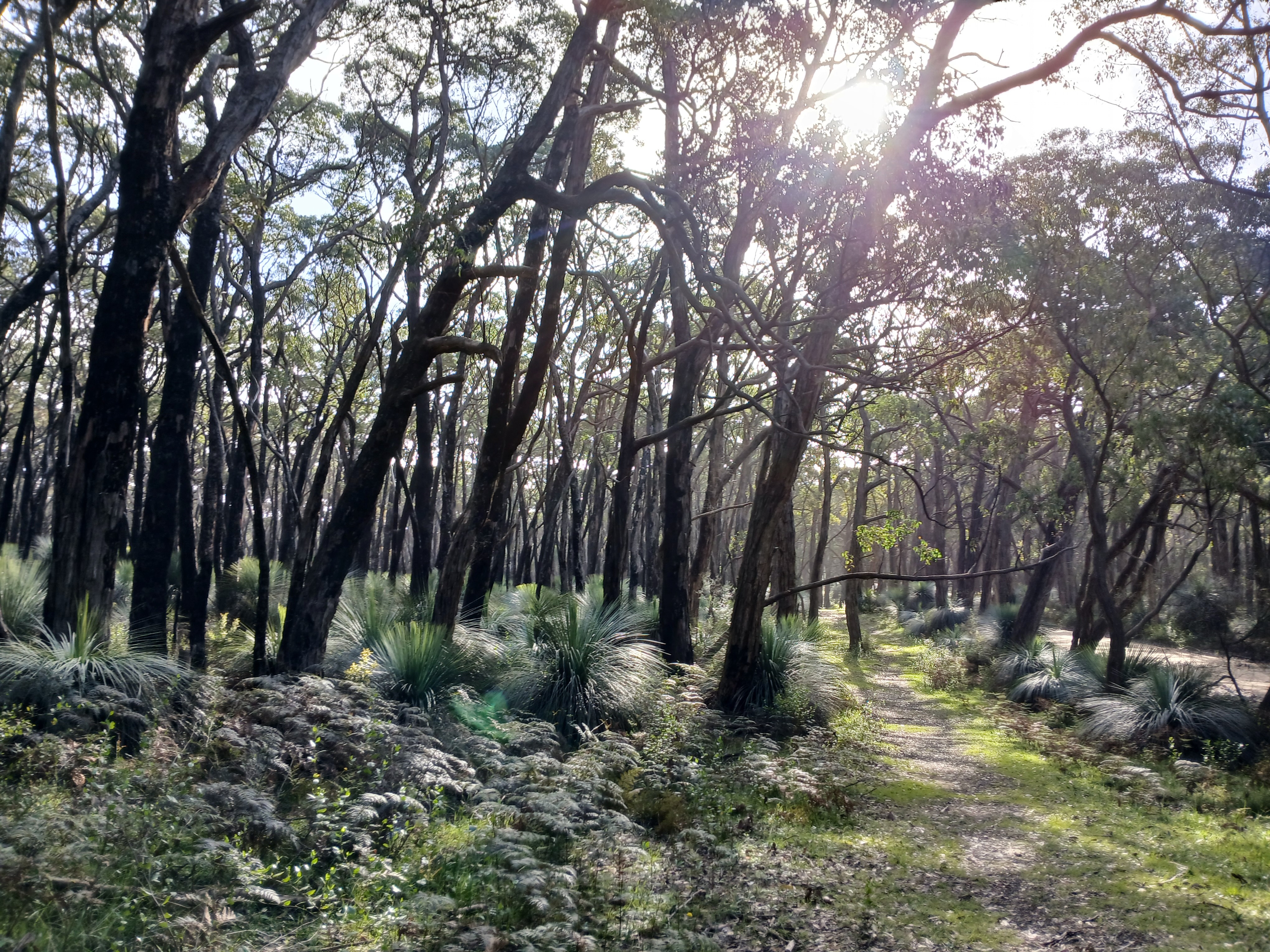
Deep Creek, September 2026.
The subtitle of The Secret Landscapes, a book in which Brack explores her experience of growing up as the oldest daughter of the artists John Brack and Helen Maudsley, is On Not Pleasing Your Mother. To Brack, the source of art for each of her parents was, in different ways, a response to their own childhoods — in essence, a subconscious longing not to please their mothers, a longing that was for each of them an eternally tappable source.
Even so — for Brack, just as for me reading Brack — the mystery remains. Where did her parents’ art come from? Where does Brack’s own writing come from? We can never truly know. We can only sit with the questions and be receptive to the answers that present themselves.
Lately I’ve been reading …
(poetry, stories and the occasional essay from around the internet)
- Abigail is aware that their house is beautiful, special. Almost white wooden floorboards run the length of the house, large windows and doors with grids, silver frames on the walls with paintings of birch trees. Maybe she knows from her parents, maybe it’s just something in the air, something solemn and careful, a feeling that you might break something if you make a sound or a sudden movement. She walks the wooden floors with care: ‘The Pendulum’, a short story by Ea Anderson.
- Please try to go / to hell frequently / because you will / find the light there / yes yes — please / try to kiss the ideas / that you find there / yes yes: ‘Center of the Universe,’ a poem by Hannah Emerson.
- Now they are strangers who have, over time, become friendly neighbors and maybe something more: ‘Tomatoes and Oil Paintings’, a piece of flash fiction by Anna Vangala Jones.
- This all reminds me of my swimming lessons as a kid, when I told the instructor that I didn’t like being touched. Mamí asked me if the instructor could touch me to save me from drowning. Life is complicated: ‘The Arborist’, a short story by Luis Ortiz.
- I’d thought for years that I was a novelist, but novel writing had begun to induce in me an almost frantic boredom. I kept writing novels and then throwing them away. It took me a while to understand that this was because I was being obedient to an idea; as I’d set myself up as a novelist, that was what I had to be: ‘Life at Its Most Free’, an essay by Tegan Bennett Daylight.
- Ever since they opened up a falling club in our town, there’s little else that Theresa will do: ‘A Quick Word about My Life’, a piece of micro fiction by Trent England.
- The cat watched us from the porch railing with his usual offended interest: ‘Goldfinch’, a piece of flash fiction by Doug Lawson.
- I thought, if I worked here I would hate dogs, too. I could hear them—the dogs in the kennel—huffing and whining. I pushed open the door and listened. There was only a little noise, a scratching of paws on the floor and a wet, slurping hiss, like someone swallowing a lot of saliva: ‘Julia and the Dog’, a short story by Irene Rebello.

