Elusive/Receptive

Other people’s words about … the writing self

Now that I am nearing the end of this writing, I anticipate feeling bereft despite the achievement of having resolved something with my mother and my father. What can I do next? I wonder what would arise if I had a conversation with the writing part of myself. But even as I prepare to ask what to do next I know that the writing has to come from something deeper, something mysterious, something more elusive. We cannot look for it. It finds us. When asked what inspired her to write her novel, the writer said that the idea had come to her in the car on the way to her grandfather’s funeral.

I know now that when we sit with the question we become receptive to answers that present themselves to us.

From The Secret Landscapes, by Clara Brack

Will you forgive me for quoting a paragraph that comes close to the end of Clara Brack’s fascinating book? This isn’t, after all, its final paragraph; these are not quite the last words. And I am not, in quoting them, revealing any secrets or spoilers.

When I first read this passage, I was at a point in my own writing, in the manuscript I’m currently working on, when I had finally found a way through a particularly ‘stuck’ period. I’d spent weeks, maybe months, reading the last few chapters I’d written and finding them stale; I’d questioned myself over and over, both about what I was writing about and how I was writing it. What had finally got me through that period of questioning was the realisation that I’d strayed too far into engaging with my rational self, when what I needed to do was the opposite.

I know that the writing has to come from something deeper, something mysterious, something more elusive, Brack writes, and it was this realisation that I’d just (re-)discovered for myself. We cannot look for it. It finds us. Indeed.
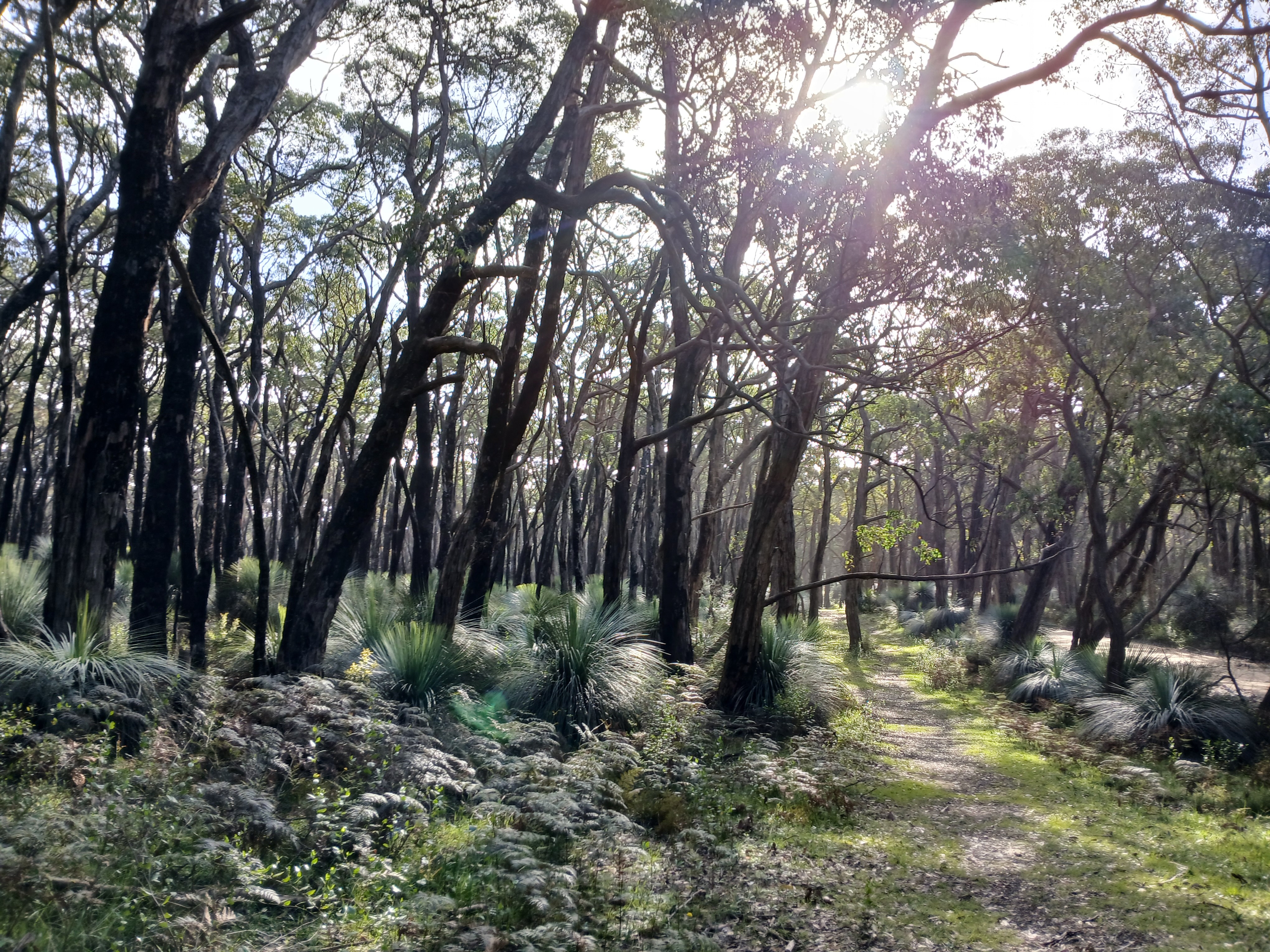
Deep Creek, September 2026.

The subtitle of The Secret Landscapes, a book in which Brack explores her experience of growing up as the oldest daughter of the artists John Brack and Helen Maudsley, is On Not Pleasing Your Mother. To Brack, the source of art for each of her parents was, in different ways, a response to their own childhoods — in essence, a subconscious longing not to please their mothers, a longing that was for each of them an eternally tappable source.

Even so — for Brack, just as for me reading Brack — the mystery remains. Where did her parents’ art come from? Where does Brack’s own writing come from? We can never truly know. We can only sit with the questions and be receptive to the answers that present themselves.

Lately I’ve been reading …

(poetry, stories and the occasional essay from around the internet)

Thrum

Other people’s words about … writing a novel

I love King’s description in the passage above of that moment when you’re writing a novel and you begin to find things resonating across the manuscript — especially when those resonances are unexpected. For me, this is one of the reasons I write. These moments, when I find the little repeating motifs and echoes in my manuscript, are a form of recognition, an acknowledgment of my purpose. This is what I am writing about, I find myself thinking: This is my story.

I’ve been working on a novel-length manuscript now for a couple of years and I know in my heart that, like King’s narrator Casey in Writers & Lovers, it will take me at least a couple more years to finish the current draft (especially as I keep getting distracted by writing short stories). I know that by that point each chapter will carry with it memories of different places and times, different moods in my life. And like Casey, I know that it’s the little ‘knot of stubbornness that’s still inside me’ that will sustain me through all of this.

This is my story, I will keep telling myself: This.

Coastal vegetation, 2026.

Lately I’ve been reading …

Mirror

Other people’s words about … hunger

The narrator in the passage I’ve quoted above from Katherine Brabon’s novel Body Friend isn’t anorexic — her illness is of another kind, some kind of autoimmune illness that Brabon leaves unnamed throughout the novel. Still, I’m fascinated by the way the narrator’s thinking in this passage aligns itself with a kind of anorexic thinking pattern, a pattern that Brabon identifies instead as a cliché of gender. The thoughts the narrator expresses here, the murky shame she feels, remind me of the way I used to think about my body, my hunger, my appetites, my eating patterns when I was still experiencing the symptoms of anorexia (both before and after treatment — indeed, for years after treatment).

My first boyfriend, when I was in my early twenties, was a tall, naturally thin guy (very thin) whose appetite waxed and waned; he would eat nothing for hours, opting to smoke cigarettes instead, and then he’d suddenly become ravenous and eat his way through what seemed to me vast quantities of food, the equivalent of several meals at once. He didn’t exercise much, perhaps because he wasn’t a natural athlete.

My second boyfriend, meanwhile, whom I met in my late twenties, was a slow eater, someone who put his fork down between bites, to talk, to smoke, to drink. He didn’t always finish what was on his plate; if he’d had enough, he stopped eating, which seemed miraculous to me, evidence that he felt a freedom from compulsion around food and eating that I couldn’t imagine ever feeling myself. He loved exercising — he had been a runner in his twenties, until injury forced him to stop, and he shaped his days instead around surfing and cycling and swimming.

With both of them, doubting my own hunger, suspicious of my own greed, I would, like Brabon’s narrator, mirror their eating patterns. I would skip breakfast, even though doing so made me feel faint within a couple of hours. I would try to leave some food on my plate, even if I wanted to eat it all. I would try to slow down the speed at which I ate. When I was with my first boyfriend, I didn’t exercise much at all. Moving in with my second boyfriend, though, I took up cycling and swimming. I did these things because I knew instinctively that they, my boyfriends — the habits they had formed that determined the way they lived their lives — were right, whereas I was inherently wrong.

Native pelargoniums on the beach path, Taperoo, January 2025.

What drives this kind of thinking — or what drove it for me, anyway — is self-hatred and fear. I had believed for years that my appetites were out of proportion, that they needed curbing, taming; it was this belief that had led me into an eating disorder in the first place. I didn’t yet understand that appetite is a tricky word (a signifier, to borrow Brabon’s word), and that it can refer to things beyond food, things like desire and longing and hope, so that in trying to tame my appetite for food, I was also trying to tame those other appetites, the ones that truly frightened me.

Brabon’s narrator is experiencing other fears than the fears I experienced, and yet I think her fear has a similar source to the fear that I felt — fear of her own body, of what it can do if left to itself. Fear of its inherent faultiness. Its inherent gluttony. Fear that, if left to our own resources, we are like the cat that eats until it vomits, no better than that, equally repulsive.

Even today, I still feel those same fears sometimes (perhaps, after all, that’s where the gender cliché comes in), but I no longer feel the compulsion to mirror myself in someone else’s habits. And I am deeply grateful for this.

Lately I’ve been reading …

Disappear

Other people’s words about … identity

I grew up as a member of a generation that didn’t recognise people who have the kinds of feelings that Ed expresses in the passage I’ve quoted above, a generation that didn’t have the words that a person like Ed — a person who feels that the body they were born into doesn’t reflect their true gender — might need to reach for. That is to say, the vocabulary that Ed and his friends use in Oisin McKenna’s novel, Evenings and Weekends, isn’t a vocabulary that I or my contemporaries used or even had access to. As a corollary of this, the space that Ed and his friends occupy in the world isn’t a space that many people knew how to occupy when I was in my teens and early twenties.

This isn’t to say that people didn’t question their gender identity in those years, only that the conversation around gender identity barely existed. As a consequence, many people — many, many people — didn’t recognise that it might be a conversation they wanted to have, either with themselves or with others.

And yet when I read the passage above, I am moved less by Ed’s uncertainty about his gender than by his unwillingness to be labelled. In theory, the language of gender identification that’s available to him, which wasn’t available to people of previous generations, should free him to articulate his identity, but in practice he finds the labels as constraining as they are freeing.

For better or for worse, this is the power of language. It gives us the tools to express ourselves, but in doing so it determines the way we experience the world. I’m no discourse analyst but this, I think, is what Ed is struggling most deeply with. Kudos to McKenna for finding a way to put it so succinctly and movingly in fiction.

Still, for me the most devastating thing about this passage is that even though Ed has the language to express the way he feels, he remains ultimately so unhappy, so desperate, that his deepest, truest, most instinctive response is to wish to be obliterated. 

The language may have changed, but the sadness, the desperation, hasn’t. What Ed wants is to be invisible. Indeed. I don’t have any answers, but I’m glad that novelists like McKenna are brave enough to explore these ideas, because they matter. As language changes, so does the world, and if fiction can help us to explore the consequences, then fiction, too, matters.

Lizzie, January 2025. (Okay, so, unlike Ed, she may not have words or language to express herself … but she is still a very effective communicator!)

Lately I’ve been reading …