
Other people’s words about … the deeper truth
At dinner, my mother had asked about my own life. I had said that Laurie and I were wondering about whether or not to have children. My mother said that we should, that children were a good thing. At the time, I had agreed. But what I really wanted to say was that we talked about it often, while cooking dinner or walking to the shops or making coffee. We talked about every aspect over and over, each of us adding tiny life-like details, or going over hundreds of different possibilities, like physicists in endless conjecture. How hurtful would we be when we were both exhausted and sleep-deprived? How would we go for money? How would we stay fulfilled while at the same time caring so completely for another? We asked our friends, all of whom were frank and honest. Some of them said that it was possible to find a way through, especially as their children got older. Others said that all the weakest points of our relationship would be laid bare. Others still said that it was a euphoric experience, if only you surrendered yourself to it. And yet really, these thoughtful offerings meant nothing, because it was impossible, ultimately, to compare one life to another, and we always ended up essentially in the same place where we had begun. I wondered if my mother had ever asked these questions, if she’d ever had the luxury of them. I had never particularly wanted children, but somehow I felt the possibility of it now, as lovely and elusive as a poem. Another part of me wondered if it was okay either way, not to know, not be sure. That I could let life happen to me in a sense, and that perhaps this was the deeper truth all along, that we control nothing and no-one, though really I didn’t know that either.
from ‘Cold Enough For Snow‘
by Jessica Au
If you are someone who loves books, who loves reading — if you are someone to whom reading is fundamental to your life — you will know what I mean when I say that there are certain books, a handful of books, that, when you read them, change your life. Jessica Au’s Cold Enough For Snow is one of those books for me. It made me feel, when I reached the end of it, that I was seeing the world differently: its textures, its colours, the way I breathed the world in. There is a quality to Au’s writing, to the story she is telling, that is as lovely and elusive as a poem — and this is the kind of writing that changes the world for me.
Other books that have had the same effect on me? As I say, there are just a handful. Garth Greenwell’s What Belongs To You is one: Greenwell, with his layered sentences built of clause piled upon clause, writes about shame in a way that, for me, no other writer comes close to. Also: Sally Rooney’s Conversations With Friends, Katherine Brabon’s The Shut Ins, Bryan Washington’s Memorial, Alexander Chee’s Edinburgh.
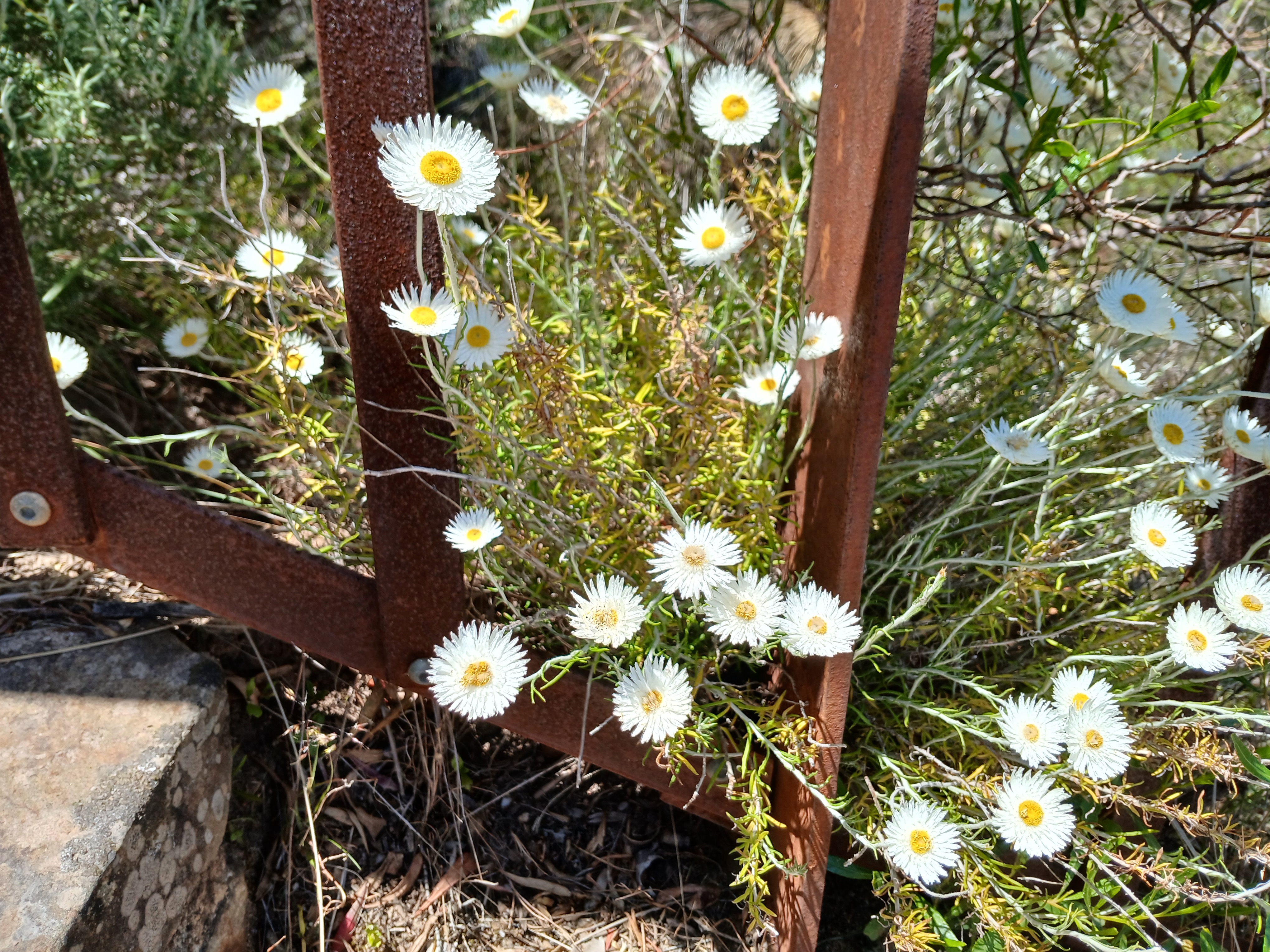 Everlasting Daisies, Morialta Falls, November 2024.
Each of the books I’ve named above is different from the others, but what they all share, I think, is a certain interiority. Whether through Rooney’s flat, prosaic narrative and dialogue or Washington’s choppy, plain sentences, we see the world through the eyes of their characters — and in doing so, we see the world anew.
I can think of no higher praise for a writer than to say of their writing: This has changed my world. So, I’m curious. What are the books that have changed your world? Drop a comment below — I’d love to know.
Lately I’ve been reading …
I’ve gone back through some of my oldest bookmarks for some of the pieces listed below. Even now, years after bookmarking them, these pieces still resonate with me in some way. I hope they do for you, too.
-
- You shrugged, those round army green shoulders coming up briefly around your face and then falling again. Me: already in love: Naomi Gordon Loebl writes a letter to a stranger.
- What I realised along the way was that to actually write the book would force me to grow, and that was my reason for not giving up: Melissa Coss Aquino on why publishing her first novel at the age of 53 doesn’t mean she wasn’t already a writer in the preceding decades.
- I’m hopeful there’s a world where we can turn back the clock, but I think a lot of people are addicted to convenience and have convinced themselves it saves time that they use in better ways. Instead, we’re fucking scrolling TikTok: Emily Stewart, on why shopping local is best … and why most Americans don’t do it anymore.
- Most people do not run. Most people who run do not run long distances. Most people who run long distances do not run extremely long distances. And most people who run extremely long distances do not decide to do so on a 400-meter track for 24 hours straight: Stephen Lurie tries his hand at running round and around a 400m track for 24 hours … a form of running I will never attempt but was curious to read about.
- What I like most about Rooney’s writing is how each sentence builds like a brushstroke: on its own, any particular line can seem pedestrian. Assembled together, we get whole scenes of otherwise banal parties and bus rides, glances cast and bodies rearranged, all rendered to a storybook-like effect: I’m a fan of Sally Rooney’s novels (although sometimes despite myself) and in this piece, written before the publication of Rooney’s latest novel, Intermezzo, Delia Cai captures one reason why.
- Sometimes — and this was a tragic element to contemporary life — you experienced something deeply intimate with a person, and it was this very experience of intimacy which foreclosed all possible intimacy in the future. That was, you used it all up in one go right up front, and there was nothing left. He felt a little sad about that: I didn’t mention Brandon Taylor’s books above, but I could have. Here, a story by him, called ‘Warehouses’. In his newsletter, Sweater Weather, Taylor says about writing this story, which is the second in a series centred around the protagonist Per: ‘I wrote these Per stories earlier this year when I was trying to process some rather … difficult personal feelings and when I was trying to write fiction that was less pessimistic on the project of human connection. I wanted to write someone who was not so hemmed in by cynical social programming, someone almost naive and open to contact with others even though he doesn’t really know how to begin it. I wanted to write someone nice, for a change, easy to like.’
- Indeed, a lot of what we’re identifying vaguely as ‘sadness’, is rage: Phoebe Stuckes ponders the sad-girl novel phenomenon. Spoiler alert: men write sad novels, too, but they are seen as serious rather than infantile.


 twenty-one words