Words unfurled

Other people’s words about … paths

This is what is behind the special relationship between tale and travel, and, perhaps, the reason why narrative writing is so closely bound up with walking. To write is to carve a new path through the terrain of the imagination, or to point out new features on a familiar route. To read is to travel through that terrain with the author as guide — a guide one may not always agree with or trust, but who can at least be counted upon to take one somewhere. I have often wished that my sentences could be written out as a single line running into the distance so that it would be clear that a sentence is likewise a road and reading is traveling … Perhaps those Chinese scrolls one unrolls as one reads preserve something of this sense. The songlines of Australia’s native aboriginal peoples are the most famous examples conflating landscape and narrative. The songlines are tools of navigation across the deep desert, while the landscape is a mnemonic device for remembering the stories: in other words, the story is a map, the landscape a narrative.

So stories are travels and travels are stories.

from ‘Wanderlust
by Rebecca Solnit

Last year, a theme I returned to often on this blog was paths. I had decided not to make a New Year’s Resolution for once: instead, I thought, I would learn to find, and then follow, my own path. Paths became a metaphor for me; once I began to look, I found them in the most startling and beautiful moments. There were paths in the sea, paths across the sky, paths to the horizon, paths trodden by other creatures than myself, making their way through the bush.

Path through the sky

Perhaps it was a theme painfully obvious in its metaphors. Less painfully obvious is the metaphor Rebecca Solnit employs in the passage above. To consider one’s job as a writer to be the task of carving a path for one’s readers to follow: what a wonderful thought. What an honour.

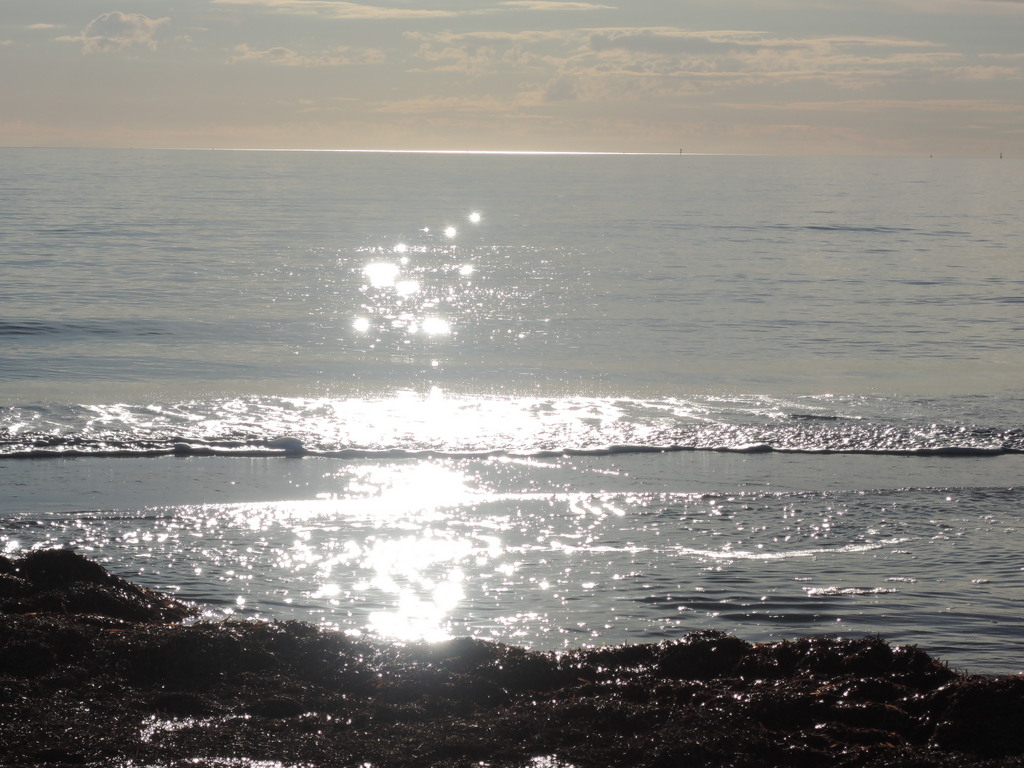
The sun's path over the sea
Path of the sun

I was interested in Solnit’s comparison with the songlines of the First Australians. In these days of serious debate about cultural appropriation, I considered long and hard whether it would be appropriate to include that part of the quote. In doing so, I found an explanation which seemed genuine and made sense to me. You can read it here.

Path across the sea
Path across the sea

Landscape as narrative. This is something I have long believed in, right down to my core. When I go for a bushwalk in a place that is familiar to me, a track I’ve walked many times before, part of the joy I find in my wandering is in the act of observing how the seasons have wrought changes on the place since the last time I was there — how rain brings forth wildflowers, for example; and how those wildflowers differ in variety and in abundance, depending on that year’s rainfall. It feels then as though I am following a narrative which is both part of me, as a creature on this earth, and also greater than me. Songlines are not mine to appropriate, but the sense of a story, and the sense of the sacred, is everyone’s to share.

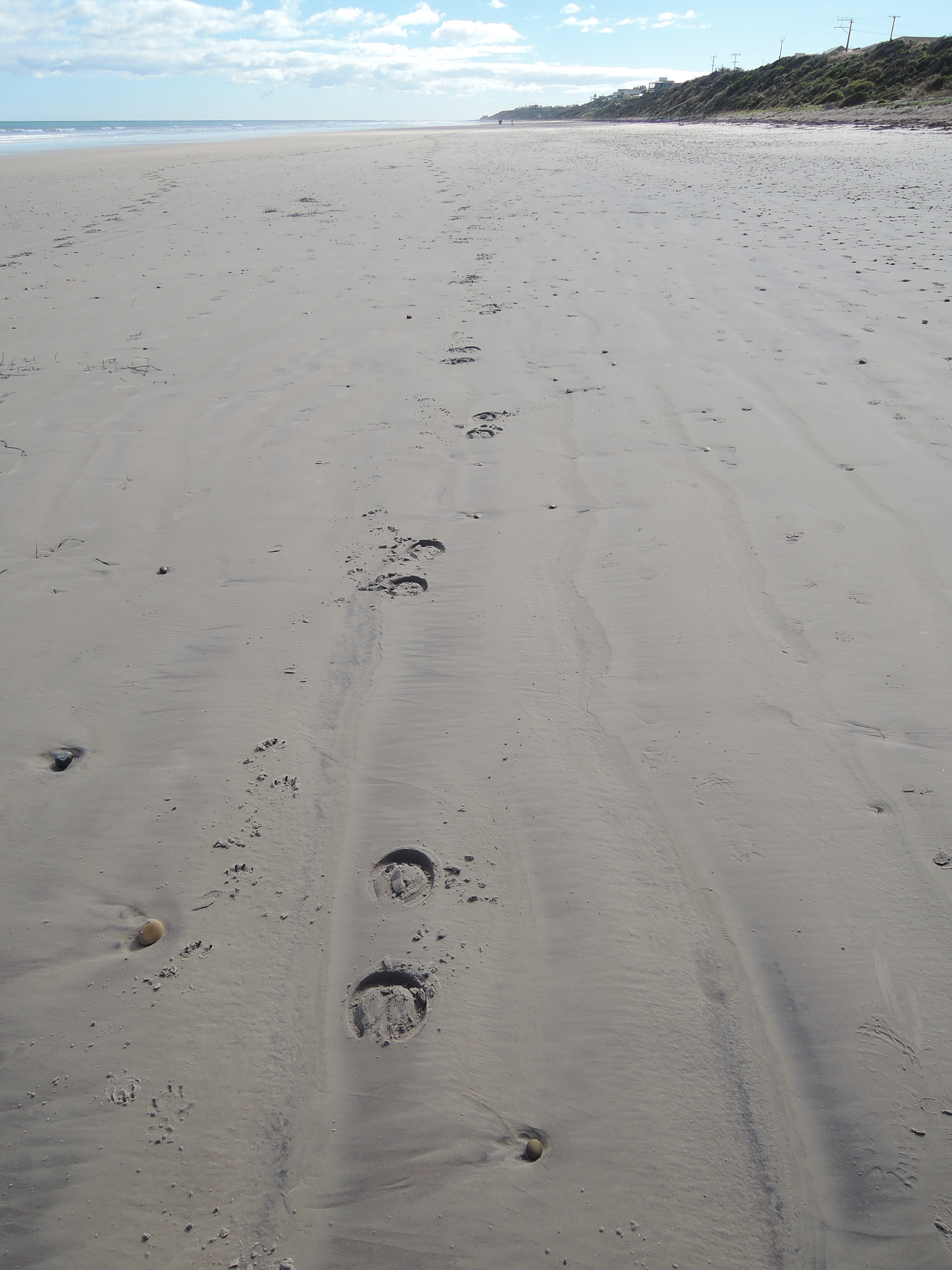
Other creatures' paths
Other creatures’ paths

But story as map: that’s something I hadn’t considered before. I am both a reader and a writer,and I am intensely aware, in both roles, of the contract between the two. The writer makes a promise; the reader holds the writer to it. I like the idea of viewing this contract as a map. It explains the sense of awe I feel as a reader, and the sense of humility I feel as a writer.

Path across the sand

In the end, we each tread our own path across our own landscape, using our own map.

But it is nice to know there are guides along the way.

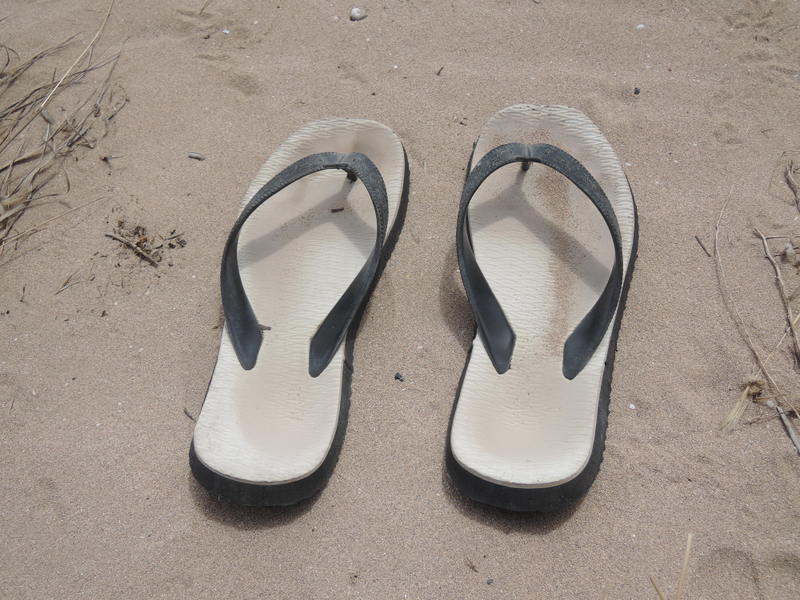
Tread your own path ...
Tread your own path …

Happy new year, everyone!

A shock of pleasure

Other people’s words about … the sea

The narrow trail I had been following came to an end as it rose to meet the old grey asphalt road that runs up to the missile guidance station. Stepping from path to road means stepping up to see the whole expanse of the ocean, spreading uninterrupted to Japan. The same shock of pleasure comes every time I cross this boundary to discover the ocean again, an ocean shining like beaten silver on the brightest days, green on the overcast ones, brown with the muddy runoff of the streams and rivers washing far out to sea during winter floods, an opalescent mottling of blues on days of scattered clouds, only invisible on the foggiest of days, when the salt smell alone announces the change. This day the sea was a solid blue running toward an indistinct horizon where white mist blurred the transition to cloudless sky.

from ‘Wanderlust
by Rebecca Solnit

Rebecca Solnit’s words remind me of my own jaunts to and from the sea. So, no more words from me today — just a gallery of pictures I’ve taken over my own years of oceanside ramblings. You’ll recognise many of these pictures from earlier posts, no doubt, but collected here they convey, I hope, the many moods of the sea.

(Hover over the pictures to see their connection to the words above.)


The beauty of blogging

Other people’s words about … blogging

I never intended to be a blogger. The name alone is enough to put anyone off — ‘blog’ is an ugly word — and besides, I’ve always been about as tech-savvy as an aardvark. Then one of my oldest and closest friends started a blog and the scales fell from my eyes. I realised that, in the right hands, a blog, which I’d lazily assumed to be an outlet for opinionated egos or a medium for look-at-me wittering, could actually be a thing of beauty, a repository of interesting and original thought, of humour and pleasure, of amiable interchange among friends …

from ‘In Praise of Blogging
by Nigel Andrew
featured in the Literary Review magazine, August 2016

Do you remember when blogging first began? It wasn’t so long ago, was it? — somewhere in the late nineties, perhaps. I remember being deeply suspicious of bloggers and their blogs, at least at the start. They were so … trendy. Instant. Shallow.

Right?

Here is where my blog might take you ...
Here is where my blog might take you …

For me, blogging was the beginning of social media, of which I was originally — and indeed still remain — very wary. What could be good about instant publishing? About uncensored, unfettered writing? About unedited writing? (A disclaimer here: in my non-blogging life, I work as an editor. Perhaps my horror at the thought of unedited writing has an aspect of self-interest to it … )

Nigel Andrews continues:

Blogging at its best is essentially an extension of the essay form: brief and provisional, feeling its way through a subject, written with care but relaxed and not over-polished. One difference is that a blog post is published instantly and by the author; it takes its place in a conversation (with luck) and the blogger establishes his place in a community of taste and thought (ditto). This has its risks, but there is something deeply satisfying about it. Another difference is that technology enables a blog post to open out in ways not possible in the printed essay: for instance, through hyperlinks embedded in the text, or through pictures, video and audio …

I’m glad my original opinion about blogging turned out to be wrong. Blogs can be warehouses of mediocrity, egocentrism and vitriol. But, as Andrews — known on his own blog as Nige — says, they can also be places where people write with wit and tenderness, with beauty and sagacity, with passion and honesty and verve. Bloggers can take you to worlds you might not otherwise visit. I love that about them.

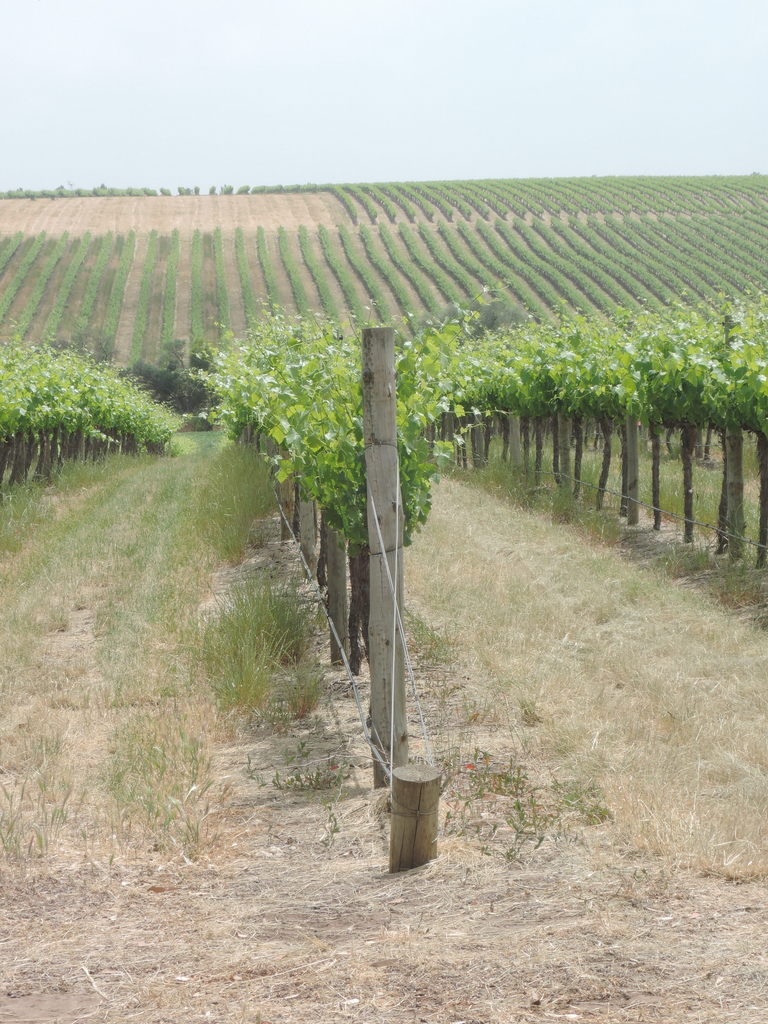
Here is where my blog might take you ...
… or here …

The blog world is vastly wider and richer than I ever imagined, Andrews says. I’m with him here, too. I have cooked new recipes from some of the blogs I read (here, for example, and here); I’ve learned about art and craft (here); I’ve marvelled over the joys and wonders of nature (here); I’ve found fellow booklovers (here); I’ve envied women of my age who run long distance (here); I’ve sympathised with the health woes of women younger than I am (here).

One aspect of blogging that I struggle with, though, is its conversational side: the participatory nature of it, the community. Don’t get me wrong: I love being part of the blogging community, and I love feeling as though I am getting to know the bloggers whose posts I regularly read. I love that there are readers and fellow bloggers who take the time to comment on my blog; I love that, in replying to them, I have in a sense ‘met’ them. They and their blogs have enriched my world.

... or here ...
… or here …

But I am still, at heart, an old-fashioned reader. For me, reading is an activity that I engage in privately. The silent communion I find with the writer of whatever it is I’m reading: that, right there, is for me the joy of reading. I read with my mind and my heart and my soul. And those things — my mind, my heart, my soul — are mine, and mine alone. So I rarely comment on other bloggers’ posts, or give feedback to them, or praise them, or, heaven forbid, criticise them.

This means, I am glad to say, that you could never call me a troll. But you could, apparently, call me a lurker.

... or here.
… or here …

Seriously? When did the act of reading become some kind of dialogue? When did reading obligate a reader to correspond? Isn’t reading an escape from all of that?

I take comfort in Andrews’s thoughts towards the end of his essay on blogging:

Much else that used to be in blog form has also made the transition into other social media. Could it be that the ‘death of the blog’, which seems to have been predicted ever since blogging began, is now happening? I doubt it; I think it’s more that those who were using the blog form to pick fights, project their egos or drone on about their everyday lives are migrating to media better equipped for such purposes: Twitter, Facebook, Instagram, Snapchat and the rest (neophilia is a strong driving force here). This might, one hopes, leave the blogscape open to those who blog because the form is a perfect fit for what they want to do and who are impervious to the whims of technology. If blogging is unfashionable, so much the better, I say. So many of the best things, like so many of the best books and writers, are.

I’m a reader, a writer, an editor: all of those things. And I’m also — yes, still/always/despite everything — a blogger. I see my blog as an extension of the best parts of me. However contradictory it may seem after what I’ve just said, my blog is an effort to express myself. To educate myself. To introduce my readers to things they might not otherwise have encountered on my side of the world (like some of the things pictured in today’s post). And I see it as an effort to try, in my writing and my posting and my life, to reach towards some kind of beauty.

... or here.
… or here.

In case you wondered, you are, as always, very welcome to comment … 🙂

Snatched phrases (on books)

‘A book is a heart that only beats in the chest of another.’

from ‘The Faraway Nearby
by Rebecca Solnit

Sometimes, when I’m reading, a small phrase or a sentence will catch my eye, hidden away in the middle of the paragraph, or at the bottom of a page. Perhaps the words in that phrase snag my attention because they are beautiful; or perhaps the thought behind the phrase is beautiful — complex and lingering — despite the simplicity of the actual words.

I write these phrases down in a notebook and treasure them, as you might a necklace your mother gave you when you were a young woman, or a china teacup that once belonged to your grandmother. Sometimes, when I’m writing them down, the word ‘stolen’ creeps into my mind: there is something about the act of recording them which makes me feel I have snatched them from their creator and reappropriated them as mine, storing them inside my heart.

Snatched phrases: today’s post, quoting Rebecca Solnit’s beautiful words about books, is the first in an occasional series here with this theme. However you think of these words, whatever your definition of the word ‘stolen’, they are yours now, too. Writers write for others, after all; writing is about the transmission of words and ideas from a writer to his or her readers — readers like you and me.

And they are not really stolen at all, these words. It feels that way at first, because they are so precious and so beautiful. But in fact, it is the other way around: the words have stolen our hearts. To read is to be captured, over and over again. I can think of no better form of thievery.

The reader

Other people’s words about … books

She has always been the reader — no-one else in the family is that interested. She had carted her books from house to house as a student, the boxes growing in number each time, keeping them because she could not imagine doing otherwise, and because she thought that there was something permanent in a book, that it lasted forever. But now, when she takes an older paperback out to reread or loan, she is surprised at how fragile it has become, the paper threatening to tear in her hands if she turns the page, tiny black specks embedded in its tissue pages; bugs, probably. She should have cleared them out, she thinks. Packed them up in boxes for recycling. No-one would want them when she was gone.

From ‘Between a Wolf and a Dog
by Georgia Blain

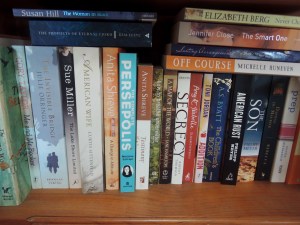
I grew up in a house in which every room contained a bookcase or a wall lined with bookshelves. I remember kneeling in front of those shelves as a child, scanning them, trying to make sense of the order in which they had been shelved, trying — with a child’s sense of incomprehension — to understand the titles. There were lots of orange paperback spines (oh, those old Penguin classics!). There were fat, hardback dictionaries — volume after volume of them. There were thick novels with white covers and raised lettering. There were books with titles like Fear of Flying, which didn’t seem to be about flying at all. There were books with titles containing words like ‘teach’ and ‘literature’ and ‘linguistics’ and ‘semantics’.

And none of these books had pictures in them.

DSCN2822

I made a vow when I was about seven or eight years old that I would never, ever read an adult book. The books on my parents’ shelves seemed to be about — or to come from — a disturbing adult world: a world of which I knew I wanted no part. And so the first time I read a book without any illustrations, I felt half-proud, and half-afraid. Was I crossing over to adulthood now, after all? Could I stop myself? It seemed not. Reading, in the end, was more than just enjoyable: it was essential.

As a young woman, I lived for many years in a series of rented houses and share households. My housemates and I each had our own bedroom, but we shared saucepans and bowls and TVs and washing machines. We talked about the films we wanted to see, the music we liked to listen to, the books we had just read. We cooked for each other and shared bottles of cheap red wine and chardonnay. We borrowed novels from the local library, and bought tattered secondhand paperbacks from the local op shop.

During those years, I stored any books I owned on a makeshift shelf that I’d constructed by putting bricks on my bedroom floor and laying a plank of wood over the top of the bricks. Later, I went through a phase where I decided that lettuce crates were a cool way to store my books. I couldn’t bring myself to buy a proper bookshelf. I was afraid, I think, of making the commitment. A bookshelf spelled permanency. It spelled adulthood. It spelled turning into your parents. I wasn’t going to do that. (Why, I wonder, are we so fervently against turning into our elders when we are young? Now I would be honoured to think I was, or am, like either of my parents.)

DSCN2825

I don’t remember exactly when I gave in to owning a bookshelf: to growing up, to admitting, happily, that I shared my parents’ passion for literature. I am glad that I did, though. The books on my shelves may one day fade, their pages tearing, their covers warping with damp. They may seem meaningless to anyone else. And yet there is something permanent in them: there is something that lasts forever, despite their physical frailty.

Reading transports to you another world: a world of someone else’s creation. It makes you feel things — sadness, joy, anger, bewilderment. Writers share their worlds with us; their books are their gifts. Those gifts leave an imprint on us. You can’t store that imprint on a plank of wood resting on a brick. You can’t stack it in a lettuce crate. And you certainly can’t pack it up and recycle it.


Inner world

Other people’s words about … resilience

I think maybe [my father] liked the worlds in his head better than the real one. As far as I ever knew, he didn’t have any close friends … Once, when I was about nine or ten, I told him I wasn’t very popular at school. He told me that friends were overrated, because the only person you could ever really count on was yourself. Weirdly, that actually made me feel better.

from ‘Thanks for the Trouble
by Tommy Wallach

I am, I suppose, what most people would describe as introverted. There are other words that go along with this kind of description: shy, quiet, aloof, disengaged, uncertain, insecure, antisocial. Those are mostly negative words, I see. Perhaps they are coined by extroverts.

The year that we lived in England, I was at my most introverted: I had no friends at all. (Here’s a question: do you end up without friends because you are introverted, or do you become introverted because you have no friends?) I was fourteen, and I wandered those long school corridors with the white polished floors alone. I wore the wrong clothes, and I had the wrong accent, and I lived life at the wrong pace and the wrong volume. At lunch I sat in one of the stalls in the girls’ toilets, waiting the hour out. I listened to girls coming in and out, the cubicle doors swinging, the toilets flushing. My breath caught on the sweet spray of perfume they doused themselves with as they stood before the mirrors. I listened to their chatter, high and loud and lipsticked. And then I listened to the door to the girls’ room banging shut again, their footsteps receding down the white-floored corridors as they went back to wherever they had come from.

After the first few weeks, one of the school teachers took pity on me, and introduced me to a couple of girls in my class.

‘Go and sit with them at lunchtime,’ he said, with a look on his face that was half-pity and half-exasperation. He was small and balding and chipper. ‘They’re nice girls. They’ll look after you.’

Such well-meaning, misguided intentions! I looked at the two girls and they looked back at me. I could see they were as horrified at the prospect of me spending lunchtime with them as I was. And yet we all did what he said. They took me back to their lunchtime bench, and I sat with them and their friends — that day and the day after and the day after that. For months, in fact, I ate my sandwich with them silently; I sat with them silently; I watched them silently; I listened to them silently. They took to ignoring me, in the end. They went on with their lives — their parties and their gossip and their drinking and their shopping and their boyfriends — while I sat mute beside them, in what seems to me now almost a parody of introversion.

I have often thought back to that year in high school. I’ve thought about how, at night, I lay in the darkness of my bedroom, the one with the wallpaper with pretty sprigs of flowers dotted over it, and longed for popularity and friendship, for someone my own age to count on. I’ve thought about how I believed that I must be faulty in some way — weak, or cowardly, or defective — because I couldn’t do what other people my own age did instinctively: talk. Make connections. Relax. Laugh.

So it astonishes me now, to look back and see a different possibility, a different narrative, from the one I’ve just told. I don’t believe that friends are ‘overrated’, to use Wallach’s word. Still, I wonder: what if I had learned to trust myself during that year? What if I had learned that I was my own friend? What if I had allowed myself to like the world in my head at least as much as the real one? More broadly, what if we could teach all young people to count on themselves in this way? What, then?

I am not sure. But I think it’s important to listen to alternative narratives like the one in the words above: to retell our life-stories to ourselves, to seek out new plots, new endings. I think it’s important to trust your own inner world: to learn to turn to it in times of need, or in times of loneliness. Introversion, in this context, is irrelevant. What’s relevant is resilience. Resilience is all that matters.

Resilience, you will note, is not a negative word.

Some books say

Other people’s words about … self-help

Some books say sing to your plants

Sometimes I am guilty of believing that if I can just read the ‘right’ book, I will know how to change my life. If I can just follow the right advice (and adhere to it), I will know how to live.

That’s the appeal of self-help books, right? You don’t have to think for yourself anymore. You just have to do what the author says, and you’ll find happiness. Success. Wealth. Health. Glory. Inner peace.

Then again …

Some books say start a garden, sing to your plants. Some books say join a book club, take music lessons, start a stamp collection, get a pet. Some books say brew your own beer. Some books say try paintball, enter a local trivia competition, take dance lessons, learn to rumba. Some books say listen to James Brown. Some books say give yourself a hug. Some books say when someone hugs you, let them be the first to let go. Some books say let a dog lick your face. Some books say swim naked. Some books say kiss a stranger. Some books say climb a mountain. Some books say overcome a phobia. some books say change begins with pain. Some books say get busy living or get busy dying. Some books say never say the word try. Some books say there’s nothing you can’t do. Some books say accept your limitations. Some books say don’t take no for an answer. Some books say buy a karaoke machine and invite friends over. Some books say learn a new language. Some books say leave no regrets. Some books say beware a person who has nothing to lose. Some books say do no harm. Some books say never cut what can be untied. Some books say admit your mistakes. Some books say you are not your mistakes. Some books say forgive everyone everything. Some books say never criticise what can’t be changed. Some book say don’t be afraid to say I don’t know. Some books say don’t bore people with your problems. Some books say when someone asks you how you feel, say terrific, never better. Some books say ask questions. Some books say don’t ask too many questions. Some books say carry someone. Some books say let yourself be carried. Some books say there’s nothing to fear. Some books say it’s okay to be afraid. Some books say whistle in the dark. Some books say give more than you take. Some books say God never gives you more than you can take. Some books say God never blinks. Some books say God grant me the serenity to accept the things I cannot change, the courage to change the things I can, and the wisdom to know the difference. Some books say read the Psalms. Some books say if something seems too good to be true, it probably is. Some books say choose your life partner carefully. Some books say tape-record your spouse’s laughter. Some books say that if you live with a partner, one usually dies first. Some books say surrender. Some books say do not go gently. Some books say recognise that you are lost. Some books say put yourself back together piece by piece. Some books say it’s never too late. Some books say it’s not unusual to live to ninety. Some books say you will probably be old for a long time. Some books say you can’t kiss your own ear. Some books say it’s nice to meet someone after a long absence. Some books say reunion is a type of heaven. Some books sat there’s no good in goodbye. Some books say never say goodbye, better to say see you later, see you soon, see you someday, until we meet again.

from The Book of Why
by Nicholas Montemarano

Maybe it’s time for us (me?) to remember that there is no single, right way to live: that for every piece of truth someone offers you, there is another, opposite truth.

But maybe there is comfort in that plurality. Maybe that’s the point. Maybe it’s all about acceptance, and making peace with that acceptance.

And maybe — just maybe — that’s part of the adventure …

The third year

Beautiful words

I love reading.
I love words.
Maybe you’d noticed?
After all, reading and writing have been two of my core themes on this blog, right from the start.
So.
This year — my third year of blogging (yes, really! twenty-one words has been around for over two years now) — that will be my main focus.
Other people’s words.

A year of reading
A year of reading

Each week, I’ll be posting a quote from something I’ve read and loved,
either recently or long ago.
(Some writers’ words stay in your mind forever.)
Sometimes I’ll post a photo to accompany the quote,
sometimes I’ll post a comment instead.

A cup of tea to accompany reading makes it even better ...
A cup of tea to accompany reading makes it even better …

I hope you’ll find some words here, in the next year, that tickle your fancy;
that make you think;
that make you laugh,
or smile,
or cry;
that make you go to your library and read those other people’s words for yourself.
For me, that’s what reading’s all about.

Note
For readers wondering about my original theme — twenty-one words, after which this blog is named — fear not. ‘Twenty-one’ will still be a theme around here. Watch this space to find out how.

The flesh is weak

Other people’s words about … well, elimination

Writers don’t often describe bodily functions in literature (other than sex). After all, reading is about escapism, right?

But in ‘The Prophets of Eternal Fjord’, Kim Leine describes the main character’s afflictions with — ahem — a sensitive colon so evocatively that his physical suffering becomes embedded into the story.

His intestines are in an uproar. He senses the ominous ripple of diarrhoea in the bowel, the quivering alarm of the sphincter.
(p. 114)

Morten Falck is an eighteenth-century missionary in the Danish colony of Greenland.

His bowels emit a series of shrill tones of varying intensity. He grimaces, then collects himself.
(p. 127)

This is a story of suffering, weakness, morality, intestinal discomfort and (perhaps) redemption.

It gushes from him the moment he pulls up his cassock and sits down on the privy seat, a mud-like mass, almost without smell, an inexhaustible landslide of brown. His intestines writhe in agony, and yet there is a considerable element of joy at being able to release, to discharge this spray of filth and empty the bowels. He groans, bites his hand and chuckles. His sphincter blares and squelches, and then there is silence. He feels more is to come and shifts his weight from side to side, bent double, his head between his bony knees, his hands massaging his stomach, but nothing is forthcoming. It is as if something is stuck inside him, a thick log of excrement blocking his passage. But most likely a fold of the intestine, he considers. He recalls images of the corpses he dissected and drew as a young man, and he sees now his own colon in his mind’s eye and the blockage that has occurred. He imagines its slow release and the sudden slop that comes with it. The thought of it helps. A new deluge is evacuated and his anus trumpets a fanfare.
(p. 151)

Seriously, how can you not admire such a vivid description of intestinal torture?
Come on, admit it — we’ve all been there at some time!