
Other people’s words about … writing about life
‘We cannot know.’ If used sparingly, this is one of the strongest phrases in the biographer’s language. It reminds us that the suave study-of-a-life we are reading, for all its detail, length and footnotes, for all its factual certainties and confident hypotheses, can only be a public version of a public life, and a partial version of a private life. Biography is a collection of holes tied together with string, and nowhere more so than with the sexual and amatory life. For some there is nothing easier than understanding the sex life of someone you’ve never met, and easier still when they’re conveniently dead; or in posthumously adding another conquest to the dance card of a known Don Juan. Others simplify things by maintaining that human sexual habits have always been more or less the same, the only variables being the degree of hypocrisy and cover-up.
But sex is a world in which self-deception can so easily present itself as objective fact, and ‘brutal honesty’ is no more likely to be true than shy evasiveness or sentimental melodrama as an explanation of what really took place. Oscar Wilde may have been a ‘posing sodomite’, but such evidence as we have suggests he preferred intercrural sex, and if so was not technically a ‘sodomite’ at all. We cannot know. Sara Bernhardt was a nymphomaniac. Oh, but she was also incapable of orgasm. Until she had the problem fixed by means of an ingenious surgical implant — which is reliably attested by that ‘hysterical duplicitous gossip’ Jean Lorrain, and then recorded in the [j]ournal of Edmond de Goncourt, whose views on women were old-fashioned to say the least. We cannot know. Robert de Montesquiou was a flamboyant homosexual, except that his biographer thinks he was too coldly fastidious to indulge his Hellenic urges, while [Samuel] Pozzi’s biographer thinks he may have been impotent from around 1884, and remained so. We cannot know. Pozzi had a reputation as ‘an incorrigible seducer’, a doctor who slept with his patients, who may even have used his consultations as foreplay. He also kept all the letters he had received from women over a sexual career of half a century or more. Yet after his death, Mme Pozzi instructed her son Jean to burn them all. So we cannot know a large amount … We may speculate as long as we also admit that our speculations are novelistic, and that the novel has almost as many forms as there are forms of love and sex.from ‘The Man in the Red Coat‘
by Julian Barnes
Many years ago, my mother and I embarked together on a reading project for a year, our own little book club before book clubs were a thing. Our reading theme was American novels, and we took it in turns to pick a novel, one by one over the course of the year, which we each then assiduously read; afterwards, we caught up over coffee to talk about it. I remember this year with great fondness as a time of shared reading and conversations, conversations that began with reading and literature but moved on, as all good conversations do, to other things. Art. Love. Life.
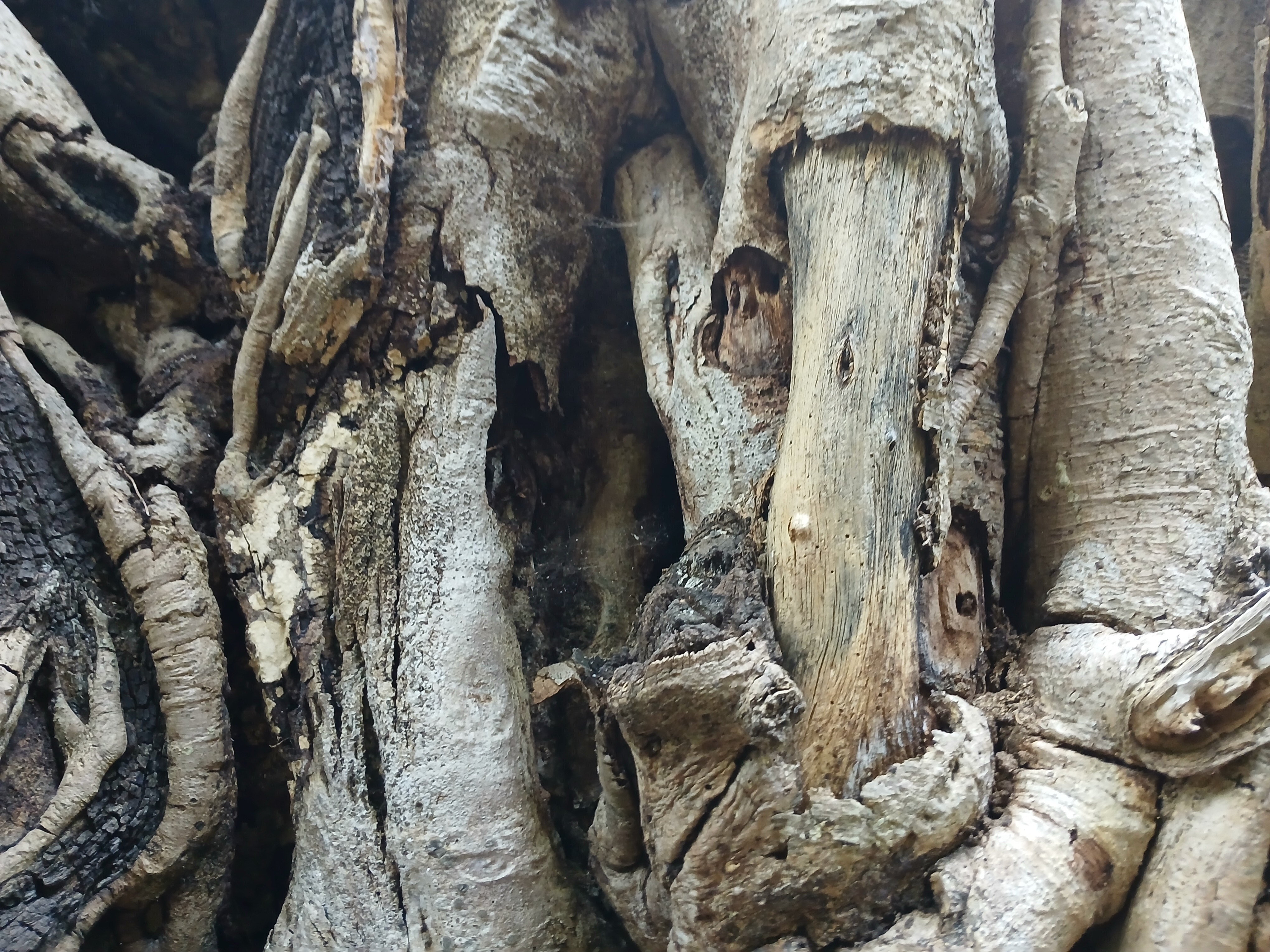 Knotted trunk, Lameroo Beach, Darwin, August 2024.
Recently we’ve begun another reading project together, one that we hope will involve some writing further down the track. As a result, my reading choices, which usually tend to fiction only, and generally to contemporary literary fiction at that, have widened. I’m reading fiction and non-fiction, works by contemporary writers and works by long-dead ones, works by women and works by men. Hence The Man in the Red Coat, which I might not otherwise have come across.
We cannot know. I’ve quoted Barnes at length here (which I hope he will forgive me for) because I love the virtuosity of this passage, the way he begins with a simple assertion, a certain truth, and then moves on in the space of a couple of paragraphs to cover themes at once intimate and specific to the period he is writing about (the Belle Epoque) but also meta-textual, concerning the art of biography itself, that collection of holes tied together with string. (What a lovely image that is.) And then, somehow, we arrive at the end of this flight of thought with another assertion, equally simple but bold, about the essence of novels and fiction.
We cannot know. Indeed.
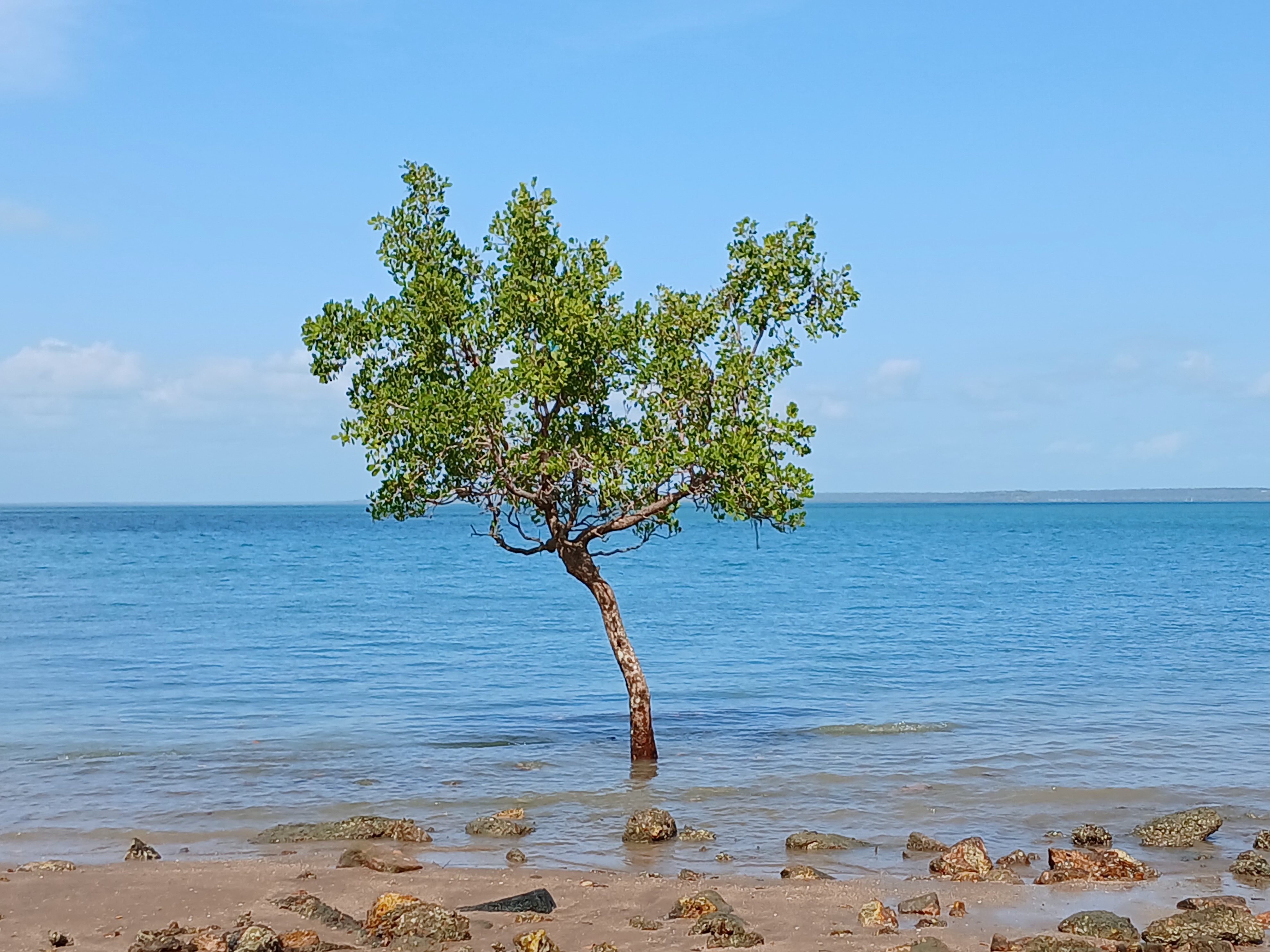 Mangrove tree at Lameroo Beach, Darwin, August 2024.
The photographs in this post, like the ones in my previous post, come from a recent trip I took to Darwin. I’d never been to Darwin before and was only there fleetingly on this occasion, but I fell in love with it, all of it. Darwin in the dry season: place of sunny days, rainforest-lined beaches, mangroves and vines and bush-stone curlews. When you visit somewhere new, you see things through a stranger’s eyes, which is to say that you don’t see its inner workings, its inner truth. Does that mean that you see its truth or something else, your own hypothesis of the place? We cannot know. But oh, the privilege of having the opportunity to see it anyway.
Lately I’ve been reading …
-
- From then on, [Hannah} Whetzel ate exactly 40 cheerios before every run, which became a team joke: Christine Yu on negative coaching and toxic team cultures and how they affect female athletes.
- As a former IDF soldier and historian of genocide, I was deeply disturbed by my recent visit to Israel: Omer Bartov, Israeli-born academic and former IDF soldier, on Gaza and what he calls the logic of endless violence. In this nuanced essay, Bartov explores why, despite his deep connection to Israel, he is adamant that the war in Gaza must stop.
- I knew I was signing up for the isolation of being the only vegan at a family cookout or party, but I didn’t expect to rarely interact with other Black vegans at plant-based restaurant meetups, food festivals, and Facebook groups. I’m not alone in feeling that way: Noella Williams on why we need to decolonise veganism.
- In two days, on 6 June, I’d be forty. My head was sore with two things: a vain dread of getting older and the work I needed to do to cure the problems in my third novel. I wasn’t worried about seeing the neurologist. Not one bit. Whatever this inflammation was, medicine would wipe it out. I was glad to know the symptoms weren’t phantoms. They were glitches and they’d be cured: M J Hyland, in a piece dating back to 2012, on living with Multiple Sclerosis.
- It has been a peculiar and exasperating five years. I’m a writer. I do other things but writing feels like my main reason for being on the planet: Another writer, Mark Haddon, also on the theme of illness, this time on writing and not writing, running, heart surgery. long Covid and brain fog.
- The universe is not only queerer than we suppose, it is queerer than we can suppose: Cat Williams explores nature and the non-binary.
 twenty-one words