Other people’s words about … not eating
Mae doesn’t look convinced, but she hands me another bowl, which I pass to TJ. He holds it in the space between us, locking eyes.
You didn’t take any, he says.
I took plenty, I say. I’m stuffed.
No. I watched you.
You must’ve blinked.
Then try some more.
I just told you–
Don’t be a dick, says TJ.
Boys, says Mae.
Her voice is terse enough to shut us up.
Mae holds our gaze until we’ve settled. Then she pours more wine into her coffee mug, twirling her food with a fork.
It’s been too long since we’ve been together, says Mae. Let’s make it a nice evening.
So TJ shoves the bowl of tomatoes my way. I scoop more onto my plate. Then I take bites from the spaghetti and the chicken, and it’s all delicious, and the three of us eat silently, until there’s something like a hum between us.
Is the bathroom still in the same place, I ask.
Mae points down the hallway. I don’t look at TJ when I stand. But once I’ve locked the door behind me, I turn on the faucet, and it’s maybe another five seconds before all that food leaves me.from ‘Family Meal‘
by Bryan Washington
When I was a teenager receiving treatment for an eating disorder, people had certain fixed ideas about what kind of person was likely to experience anorexia. By ‘people’, I mean not just family and friends but doctors, psychiatrists, medical researchers. Anorexics, people thought then (because that was what we called people with anorexia in those years, anorexics, a label that many people would now object to), were generally white, middle-class, well-educated, high-achieving, likeable young women with a tendency towards perfectionism.
Perhaps, back then, this was true. Or perhaps, more likely, if you were anorexic but you happened to be male, poor, uneducated, older than twenty-five, queer, or a person of colour — or any combination of these things — then your anorexia went unrecognised. Undiagnosed. Untreated.
We know better than this now, I am thankful to say.

Fringe Lily, December 2023.
In the passage I’ve quoted above, Cam, one of the narrators of Bryan Washington’s second novel, Family Meal, is grieving the loss of his boyfriend, Kai, who died in unexpected, violent circumstances. Cam is Black and queer; he is also addicted to many things, including drugs, sex and, yes, starving himself. He is surrounded by friends who see what he is doing to himself and try to talk to him about it, try to show him that they see, and that they care, and that he doesn’t need to be alone. It takes him a long time to see this for himself, though.
Cam’s experience of struggling with food is different from mine, and that’s partly because of who each of us is — precisely because I did, after all, fit most of the anorexic stereotypes I’ve listed above — although it’s also partly because everyone’s struggle with food is, simply, different. But I am so glad, so glad, that contemporary literature that includes stories about anorexia and disordered eating has broadened to include other stories than ones like mine.
And it’s funny how, no matter what your background, no matter what your life experience, the feelings don’t change. I’m fucking suffocating from the weight of myself, Cam writes.
I remember feeling exactly the same.
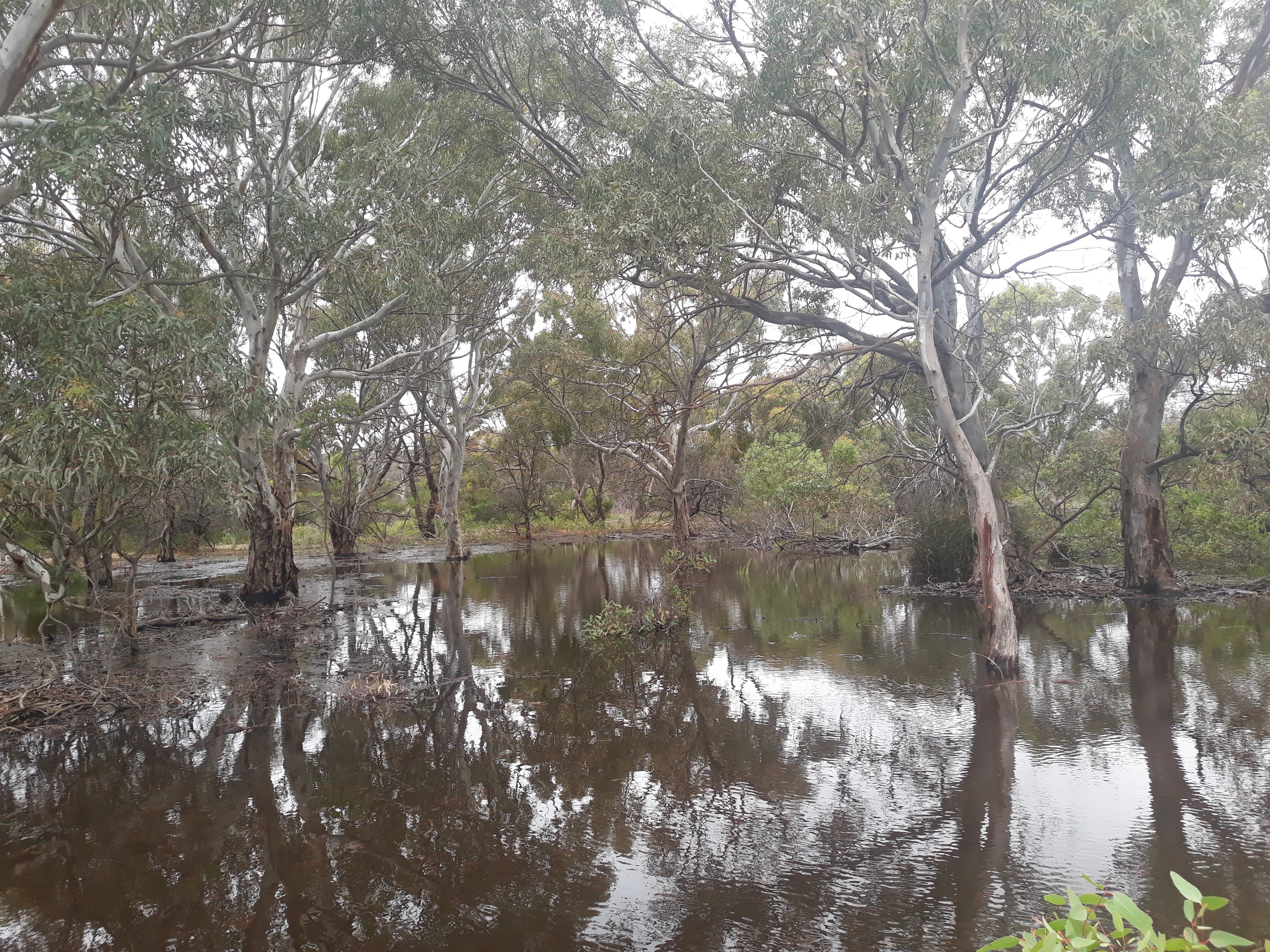
After the rain, Flooded scrub, November 2023.
Lately I’ve been reading …
-
- It never occurs to me to be bored of repetition because to me, there is no place closer to the divine than in the repeated utterance, the paper folded back again and again, the same cup for the same coffee made in exactly the same way. Its novelty that exhausts me. I suppose I also don’t have the arrogance to assume that I can exhaust something totally in just one go. Who am I to say that I’ve gotten everything out of it the first time around: Brandon Taylor explores why, as a writer, he values exploring the same story more than once. As with much of what Taylor writes, I love what he has to say here. Does a writer need to write something new each time they write a new book? Or is each book a chance to go deeper into the themes that most interest a writer, to re-examine them, to learn anew? I will go on thinking about the questions Taylor poses in this post for a long time.
- Burton has written a vivid, intimate sketch of 1980s adolescence – and a clear-eyed reflection on the traumatic experience of loving someone with a severe eating disorder. Fuelled by emotion recollected in tranquillity, it’s a coming-of-age story of remarkable compression, compassion and nuance: I was stoked to receive a lovely review of my novella, Ravenous Girls, in The Age and the Sydney Morning Herald newspapers today. It’s short but sweet, and I’m very grateful.
- Today there are a couple of varieties of tourist reviled more than we. The British, who can’t be helped; the Australians, who, because they’re good-looking, have no idea that they’re just like the British, and so are, on top of the drunken doofishness, cocky; and the Germans: Lauren Oyler explores Marienbad, with hilarious results.
- Since 1970, according to one large-scale synthesis of national bird surveys, U.S. bird populations have declined by close to 30 percent, a loss of nearly three billion animals. The culprits are many, but glass is among the most catastrophic, second only to cats as a direct killer: Ben Goldfarb, on why Chicago is the world’s most lethal city for birds — and how easy it could be to change this.
 twenty-one words
Great review, congrats! 👏🏼
Thanks, Eliza!