
Other people’s words about … hunger
I aligned my body with Tomasz’s in the early days, when we first met. When he would move his body, ride his bike, commute to work, I would join him. If he slept in, then I would try to do the same, even though I’ve never been able to sleep through any morning. And I aligned my body to his hunger. Hunger as perhaps our original pain. Though conscious of participating in clichés of gender, I would not say I wanted to eat, was embarrassed, needing too much, was sure of it. And so we would have coffee first thing and only later, hours towards lunch, would we eat. Often I didn’t know if I was hungry and yet I ate at the designated times. Hunger by the minute hand’s salivation. There was some murky shame behind this, some inkling that our capacity to eat when we are not hungry is our greater hunger, our great undoing, danger and sadness, our signifier. Only some animals do this, become gluttons when they live with us. The birds who cannot stop pecking, pecking at their seed because it’s there, all there in front of them. The cats who eat until they vomit. They need us to stop them eating and they need us to feed them. We are the same but we are the hand that feeds us.
Perhaps I aligned myself with Tomasz’s body because his seemed to me to be good. As though I wanted to find another body to live by, because mine could only do wrong. Doctors were surprised at the tenacity of [my] illness. ‘It’s aggressive,’ they would say, and then they’d write the same in my file: ‘a severe and aggressive manifestation’.
From ‘Body Friend‘
By Katherine Brabon
The narrator in the passage I’ve quoted above from Katherine Brabon’s novel Body Friend isn’t anorexic — her illness is of another kind, some kind of autoimmune illness that Brabon leaves unnamed throughout the novel. Still, I’m fascinated by the way the narrator’s thinking in this passage aligns itself with a kind of anorexic thinking pattern, a pattern that Brabon identifies instead as a cliché of gender. The thoughts the narrator expresses here, the murky shame she feels, remind me of the way I used to think about my body, my hunger, my appetites, my eating patterns when I was still experiencing the symptoms of anorexia (both before and after treatment — indeed, for years after treatment).
My first boyfriend, when I was in my early twenties, was a tall, naturally thin guy (very thin) whose appetite waxed and waned; he would eat nothing for hours, opting to smoke cigarettes instead, and then he’d suddenly become ravenous and eat his way through what seemed to me vast quantities of food, the equivalent of several meals at once. He didn’t exercise much, perhaps because he wasn’t a natural athlete.
My second boyfriend, meanwhile, whom I met in my late twenties, was a slow eater, someone who put his fork down between bites, to talk, to smoke, to drink. He didn’t always finish what was on his plate; if he’d had enough, he stopped eating, which seemed miraculous to me, evidence that he felt a freedom from compulsion around food and eating that I couldn’t imagine ever feeling myself. He loved exercising — he had been a runner in his twenties, until injury forced him to stop, and he shaped his days instead around surfing and cycling and swimming.
With both of them, doubting my own hunger, suspicious of my own greed, I would, like Brabon’s narrator, mirror their eating patterns. I would skip breakfast, even though doing so made me feel faint within a couple of hours. I would try to leave some food on my plate, even if I wanted to eat it all. I would try to slow down the speed at which I ate. When I was with my first boyfriend, I didn’t exercise much at all. Moving in with my second boyfriend, though, I took up cycling and swimming. I did these things because I knew instinctively that they, my boyfriends — the habits they had formed that determined the way they lived their lives — were right, whereas I was inherently wrong.

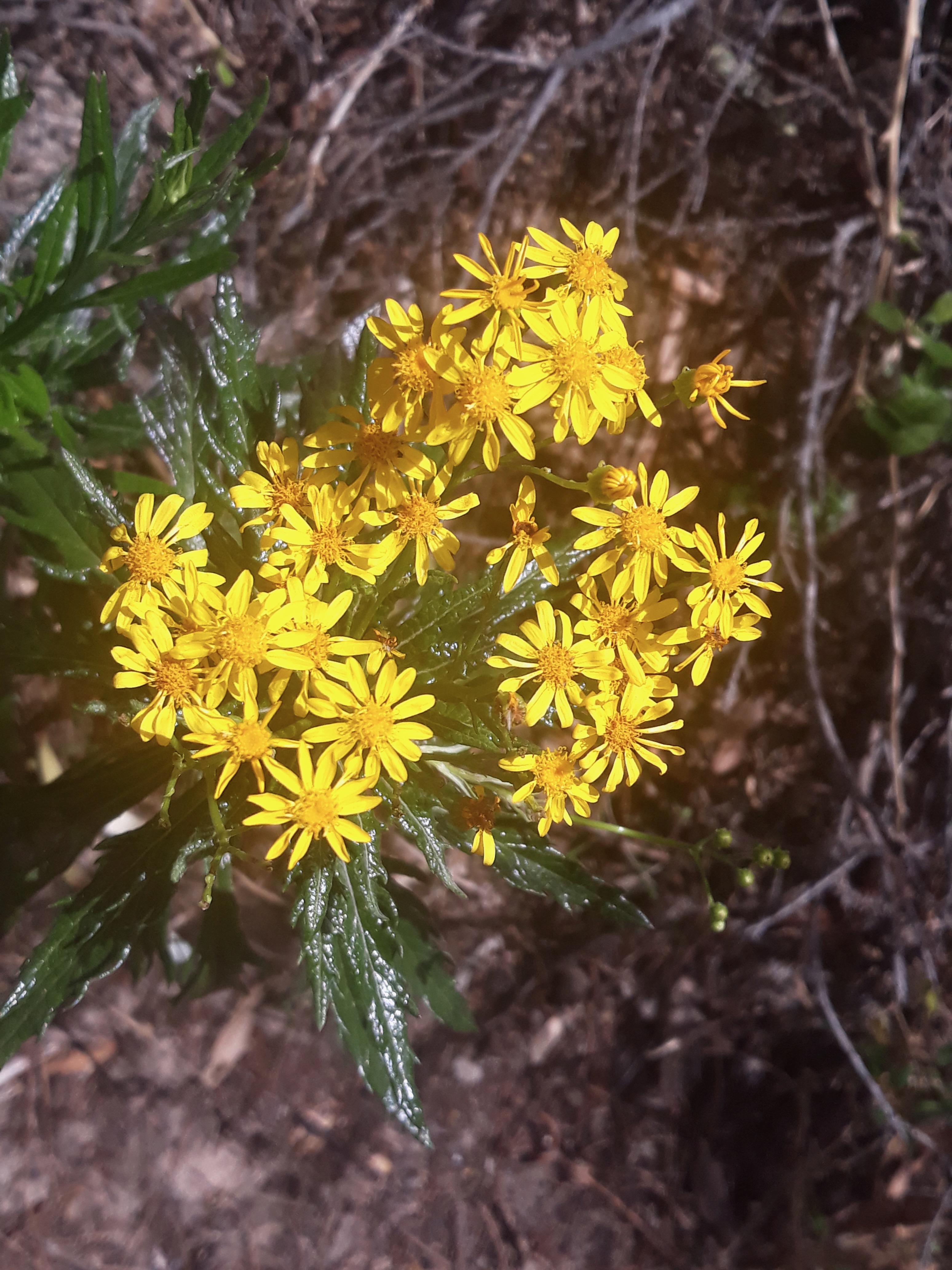
Native pelargoniums on the beach path, Taperoo, January 2025.
What drives this kind of thinking — or what drove it for me, anyway — is self-hatred and fear. I had believed for years that my appetites were out of proportion, that they needed curbing, taming; it was this belief that had led me into an eating disorder in the first place. I didn’t yet understand that appetite is a tricky word (a signifier, to borrow Brabon’s word), and that it can refer to things beyond food, things like desire and longing and hope, so that in trying to tame my appetite for food, I was also trying to tame those other appetites, the ones that truly frightened me.
Brabon’s narrator is experiencing other fears than the fears I experienced, and yet I think her fear has a similar source to the fear that I felt — fear of her own body, of what it can do if left to itself. Fear of its inherent faultiness. Its inherent gluttony. Fear that, if left to our own resources, we are like the cat that eats until it vomits, no better than that, equally repulsive.
Even today, I still feel those same fears sometimes (perhaps, after all, that’s where the gender cliché comes in), but I no longer feel the compulsion to mirror myself in someone else’s habits. And I am deeply grateful for this.
Lately I’ve been reading …
- People sometimes treat my fiction, which often uses material from my life, as though it were a transcription of my experience. It isn’t. It has always been clear to me that my books are, and that I want them to be, fiction; all three of them are full of invention. When people ask me, as they sometimes do, how much of a novel is ‘true,’ it feels like a category error. The ideas of true and false don’t map onto the literary object we’re supposedly discussing. Lived experience has been utterly transformed. It’s like looking at someone’s oil painting and asking, ‘How much of that is flax?’: Garth Greenwell in conversation with Meghan O’Rourke about his third novel, Small Rain. I am a huge fan of Greenwell’s writing; his ability to write about the experience of embodiment, like Katherine Brabon’s, floors me.
- But this week the third independent publisher in less than six months has merged with a multinational: Alice Grundy explores why Australia’s independent publishing scene is in dire straits.
- In theory, this could amount to nothing: an order to look into something that quietly fades away: Zack Beauchamp explores Donald Trump’s first day in power, and the resulting threats to democracy. I try to avoid writing about Trump and politics in America today in general in my blog; frankly, they sicken and horrify me in equal measure. But here’s a start.
- The air was so hot and the winds so powerful. The fires just spread and spread: Carolyn Kellogg describes evacuating her house in Los Angeles during the recent wildfires — and the books she chose to take with her.
- I had few friends. I had a huge following. The balance was not sustainable: August Lamm, on how to give up your smart phone. I don’t consider myself addicted to my smart phone – many of the strategies Lamm suggests are ones I already use – but even so, I found some things to think about here.










 twenty-one words