
Other people’s words about … other people’s writing
Most of the articles that Leah’s housemates were reading and talking about in the kitchen were also clearly a product of this system. Either they made arguments about ‘justice’ and ‘representation’ that were so flatly predetermined and simple as to make Leah want to crack a pencil in half or they were written in gesturing and floaty theory-ese that was outrageously divorced from the relevant concerns of being a person. Either they purported to know everything, tacking all the problems at once and offering vague, useless answers, or they tackled nothing, risked nothing, tried for nothing.
But books were no better. Most of the books that lined the front window of the volunteer-run bookstore on the avenue were either practical guides to overcoming compulsory monogamy and white supremacy or neatly contained novels about pretty people struggling to fall in love, or stay in love, or have a child, or lose weight (a shocking number of the books lefties loved revealed a plain hatred of fatness), or lose weight after having a child. The viral book reviews, shared in their housemate group chat, were almost always written by viciously smart Brooklyn-based writers who panned any book they deemed too ambitious or emotional — offensive on principle it seemed — in clipped, sarcastic prose. Only smallness of scope and affective numbness were aesthetically acceptable.
From ‘Housemates‘
By Emma Copley Eisenberg
I think this is one of the best critiques I’ve read about the written world today. How do we escape the aesthetic smallness of scope and affective numbness? I don’t know, but I think Eisenberg is onto something here.

Taperoo Beach, March 2025.
Leah, one of the two main protagonists of Housemates, is fat and queer and in love with her housemate Bernie, who is attracted to Leah but not driven to pursue the attraction, or at least not initially. And here again Eisenberg questions our social mores, the platitudes we repeat to ourselves and to others, this time about the discourse of sexuality. Was she more or less comfortable among queers than she was among everyone else? Bernie asks herself. About the same, came the answer. But if she really listened, really paused, there was another answer, which was: less. The style. The discordance, the mismatching, the pride, the attracting of attention and the comfort in that attention, the physicality to dance, to fuck, to march. The physical in Bernie felt meant for other uses.
Leah and Bernie move in a world where people pride themselves for being other, for not living according to the usual socially accepted order. And yet their world, too, demands acceptance and conformity to certain philosophical and sexual tenets. I love how Bernie has the courage to question the over-sexualised expectations that she perceives the people around her to have of themselves and others. The physical in Bernie felt meant for other uses. Now that’s a celebratory sentence if there ever was one.
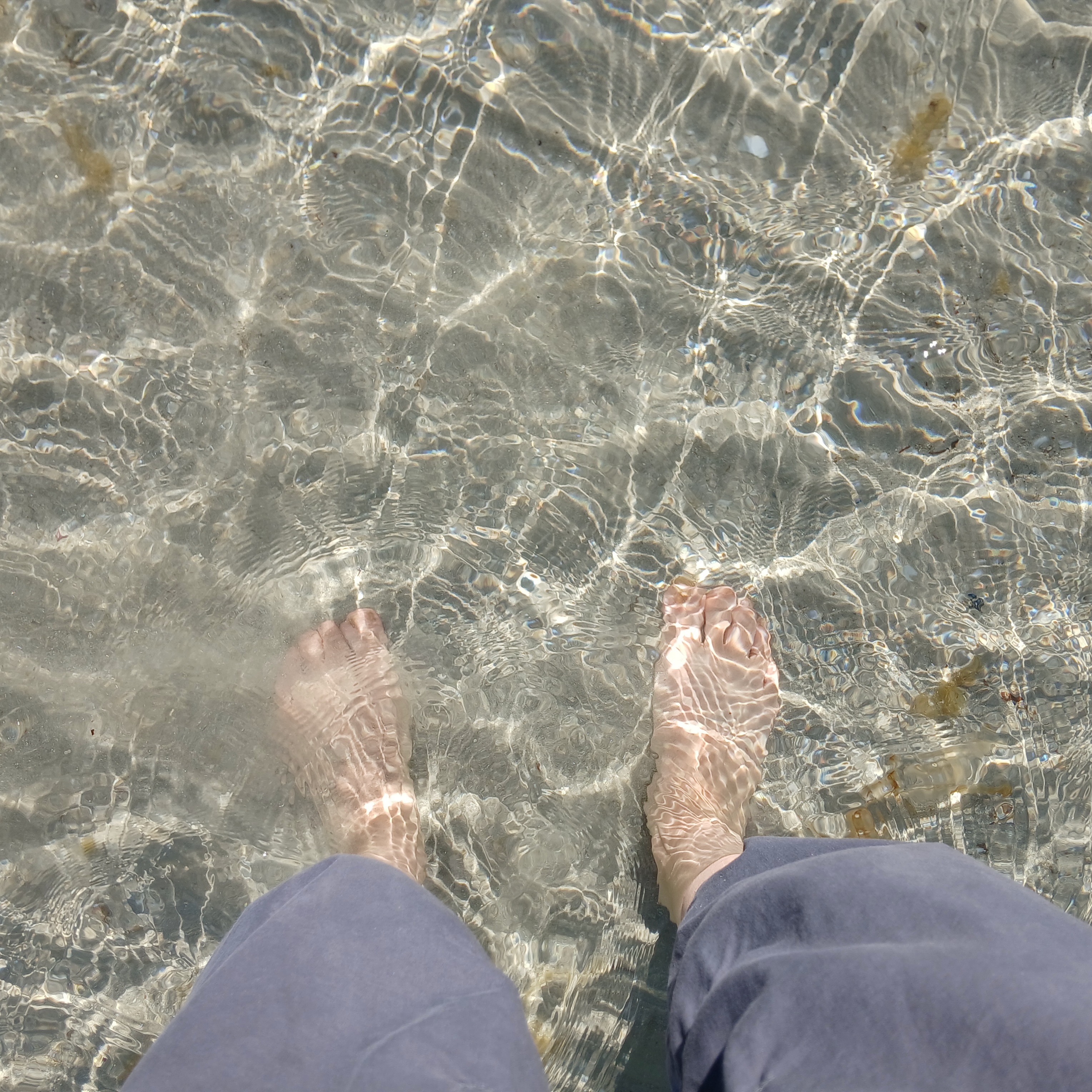
Taperoo Beach, March 2025.
Lately I’ve been reading …
- Styron’s disconsolate characters live in a world which is itself afflicted with melancholia, an entire existence clinically depressed: Greg Cwik remembers the works of William Styron, whose memoir, Darkness Visible, I remember reading in my very early twenties.
- I am, to date, a slow writer—my debut novel took ten years. My second, nine. There was overlap between those years, but still. Upon finishing a book draft, I feel no sense of accomplishment: there are so many more to go. Meanwhile, as is true for any number of artists, my well-being is predicated on that of my writing. The first depends on the second. I think sometimes of what Honoré de Balzac said when he ran into his writer friends at the end of a day. He didn’t inquire how they were doing; instead, he asked if they’d worked well that day, since, if they said yes, it necessarily followed that his friends were thriving: R O Kwon on the benefits of powerlifting and how it helps her cope with writing … and with life.
- I wish I could tell you in simple terms what it is we make together, she and I. The names there are tend to be a bit off-key. We’ve cared for each other, durably and devotedly, for decades, but we are not ‘family’ in the eyes of any relevant authorities, and certainly not a couple. (She’s a lesbian; I’m a straight man.) We’re not roommates or lovers or coparents. We are not co-owners of a condo, a couch, a dog. It’s true that we’re both professors and so maybe, on somebody’s HR spreadsheet, we go down as ‘colleagues’: Peter Covellio, on indefinable friendships.
- Medicine knows one thing about you and decides it therefore knows everything about you – or, at the very least, it has a single frame within which it pictures every single thing about you: Fiona Wright, on how her late-stage diagnosis of autism affected her anorexia.
- While eating disorders can (and do) develop on the basis of body image, they are often adaptive, which means the person engages in those behaviors for reasons other than weight loss: While we’re on the this theme, Maggie Slepian explores the long-term course of eating disorders and comes up with the conclusion that recovery is often out of reach. I’ve linked to this article because I am interested in eating disorders and have written about them myself, both on my blog and in my fiction. But this piece troubles me for many reasons. In the first half, Slepian details all the strategies she used when she was severely anorexic to lose weight — there are so many triggers here, I don’t know where to start. (The only thing she doesn’t do is list her lowest weight, but that seems tokenistic.) Beyond that, though, I am tired by Slepian’s conclusion that recovery — by which she means mental recovery as well as physical recovery — isn’t possible. I have read numerous pieces by former anorexics who say the same thing, and I disagree My belief is that, at least in some of these cases, the writers of pieces like this simply haven’t lived long enough (yet) to outlive their eating disorders. In my case, I continued to experience mental symptoms for twenty years after I was initially diagnosed, which was a long time after I had physically recovered. But twenty years in, the disordered, depressing thoughts did fade and within twenty-five years they were gone, and they have never returned. Recovery is possible, at least for some of us. It just takes a long, long time and it doesn’t look the way people expect it to.









 twenty-one words