Unrequited

Other people’s words about … a woman’s desire

The meat was ready, steaming, when I lifted the lid of the pot. As I sliced it up I pictured meeting the ambassador in the hotel room. First, he will open the door and clasp me in his arms, I decided, putting a plate in front of my husband. He will kiss the hollow of my throat very softly, and then he will gaze upon me, I decided, like he did today, but with much more tenderness. I cut my potatoes up into tiny pieces. My husband chewed and chewed, with the mouth that never kissed me. He will lay me down on the soft white bed and undo the buttons slowly, I decided. He will kiss my eyelids. I will place my hands on his smooth back, I decided as I chewed. I will clutch him to me but not too hard, not like a drowning person. The light will be dim. The bedding will be spotless. He will tell me that he has seen what nobody else has ever noticed. He will say, ‘It’s you I’ve wanted all along, Elodie. I see you, Elodie. You. You.’

from ‘Cursed Bread
by Sophie Mackintosh

I came back to Elodie’s story again today, having quoted from it once before. Elodie’s story continues to compel me — her longing for her husband to desire her, to see her, oh, to want her. Though Elodie is young and has her life ahead of her, I wonder whether the feelings and desires she expresses in her narrative, those feelings and desires that in her tiny village community are so forbidden, are a little like those an older woman might feel, a woman my age, on realising that the desires she once thought might be realised are now out of reach.

I wonder.

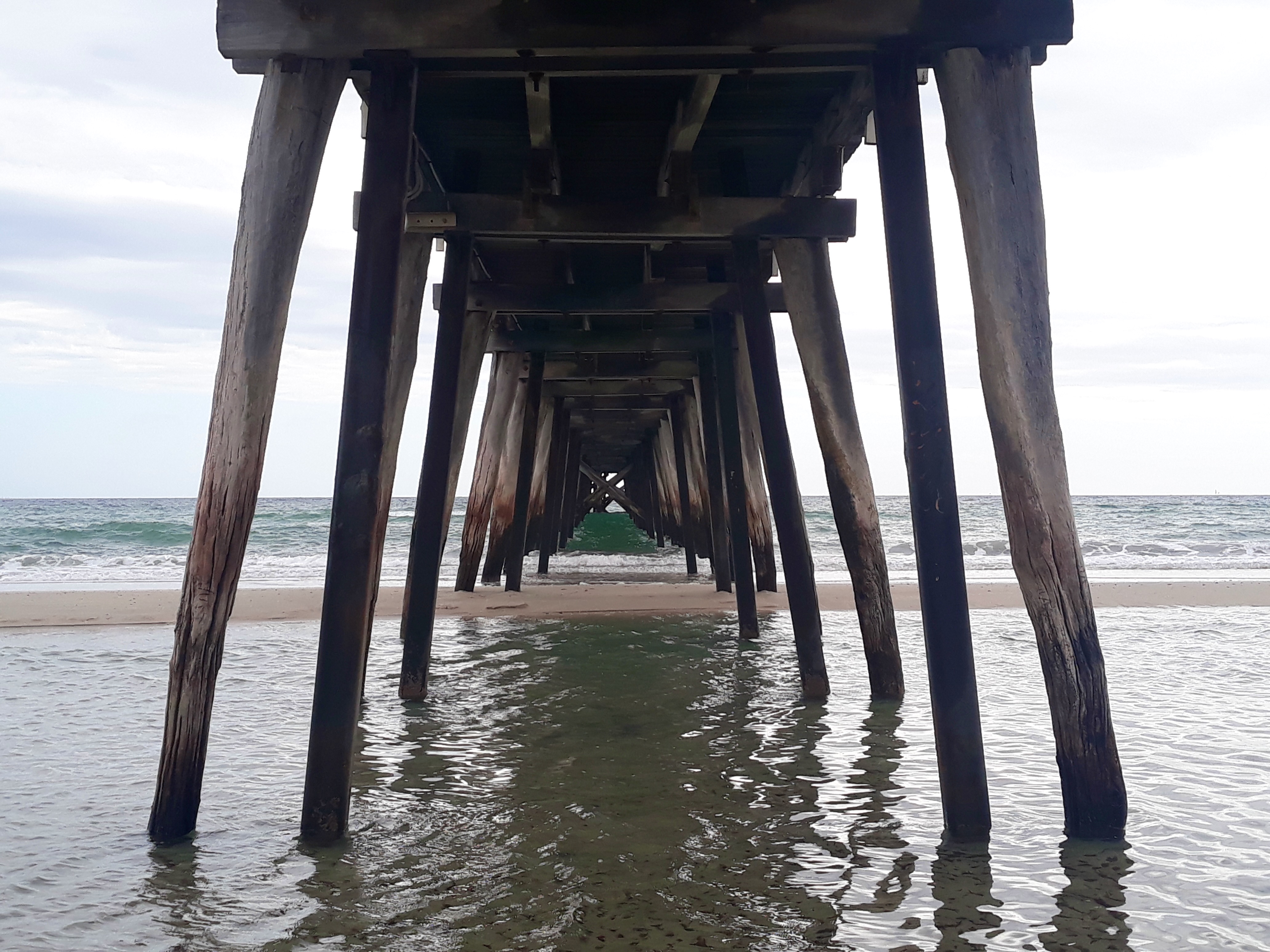
Largs Bay Jetty, May 2024.

I’ve spent the last few weeks quietly. Post-Covid, I still feel tired. It’s a funny kind of tiredness, not so much a feeling of lethargy as a feeling of being tissue-thin, emotionally and physically. I don’t know how else to describe it. Still, I’ve been walking and reading and even writing (a little), and I had a quiet moment of celebration a couple of weeks ago when I saw ten hooded plovers at Aldinga Beach.

Yes, ten. I have never seen so many before, and I walked home feeling quietly jubilant.

Bracken fern, May 2024.

Lately I’ve been reading …

Disjunction

Other people’s words about … getting divorced

I went to a gymnasium most afternoons between half past five and dinner time, because exercise kept me clearheaded writing copy in the daytime, and fresher-looking through the evening. The gymnasium had a running track on the roof. Going round and round it, regarding the view of upper Broadway electric light signs, or thinking that the person who invented the sweat shirt had no sense of design, or just counting off twenty laps to the mile, and debating detachedly whether to be energetic and run three miles, or lazy and stop at two, I felt very contented. Thump, thump, thump, around a board track. It was a simple occupation, but an absorbing one.
That feeling of running, of having been running endlessly, so that I was breathless, yet must go on running forever, seemed to sum up my life. Running through days of posing as an efficient young business woman, through nights of posing as a sophisticated young woman about town. Running from the memory of Peter, toward something or nothing, it did not matter which.

from ‘Ex-Wife
by Ursula Parrott

You could think, reading the passage above, that you were reading something from a book by a contemporary female author, a Millennial or a Gen Z writer, that you were reading a modern sad-girl novel. But you would be mistaken. Ursula Parrott published her wonderful novel, The Ex-Wife, in 1929. I am astonished at how true Patricia’s story, and Patricia’s voice, still rings now.

I read The Ex-Wife just before I came down with my first bout of Covid, and now, picking the novel up again and reading the words from it that I’ve quoted above, which so struck a chord with me at the time I read it, I wonder if I’ll ever run again the way Patricia describes, which is the way I remember running. Thump, thump, thump. I know that everyone feels like this after Covid, and I assume that it will pass. Still, the feeling of disjunction between the me who read Parrott’s novel a few weeks ago and the me writing this post is jarring.

Norfolk pine trees and autumn sunshine post-Covid, April 2024.

In The Ex-Wife Patricia’s husband has just broken up with her and she is trying to make sense of being, yes, an ex-wife. Though divorce is now far commoner than it was when Parrott wrote her novel; and though we accept the idea of wives committing adultery as much as we do the idea of husbands doing so; and though many women no longer feel the need to marry at all — still, it seems to me that Patricia’s feelings reflect what a young, heartbroken woman might feel now in a similar situation. Patricia feels betrayed by her ex-husband Peter, who leaves her after she confesses to him that she has slept with another man (even though he has, all along, been sleeping with another woman); she loves him, still, as much as she hates him; she wants to move on but can’t; and meanwhile she tries to make her way as a young, single, independent woman through the world. How familiar does all of that sound?

I am grateful to live in a world post-third wave feminism. I am grateful to live in a world that has allowed the #MeToo movement to happen finally. And yet. And yet. There is still so much that needs to change in this space. So very much.

Cuddly Covid companion, April 2024.

Lately I’ve been reading …


We’ll see

Other people’s words about … getting sick

In the laboratory on the other hand it is rare that something totally out of the blue occurs. You set your own conditions and to a large extent the future is predetermined. Only some of the details are fluctuant. And even if something unexpected does occur you can usually work out the mechanism, uncover a logic that is always present in nature even if we don’t see it a lot of the time. Whereas in the clinic it sometimes felt as if there was not logic at all and that, when you were talking to the patients about what might happen to them, trying to answer their questions and so on, you might as well read their horoscope. “We’ll see,” you would say whenever a patient asked something as basic as “Will it work, doctor, the treatment?” or “What will happen?”, entirely reasonable questions, you might think, but completely unanswerable. “We’ll see,” you could only say, “we’ll see.”

from ‘This Living and Immortal Thing
by Austin Duffy

I used to be one of those people who loved watching medical dramas on TV — the ones set in emergency departments or in GP clinics or centred around a class of student surgeons. (You know the ones I mean.) It wasn’t the medical crises they depicted that I loved; it was the human dramas that the writers of the show wrote around those medical crises, the love stories, the broken hearts, the moral dilemmas — all those.

I’ve grown weary of those medical dramas, though. I don’t know if that’s just because I’ve become a more seasoned and cynical TV watcher overall or because I am more conscious now, as an older woman, of my own real-life encounters with the medical system. Whatever the reason, though, I recently very much enjoyed watching the TV dramatisation of Adam Kay’s memoir, This Is Going To Hurt (which I read some years ago). It’s a series I can highly recommend, even for the most seasoned watcher of medical dramas. (For starters, it’s so much more than a medical drama.)

Another jetty photo! March 2024.

[It felt as though] you might as well read their horoscope, writes Austin Duffy’s narrator, an oncologist turned clinical researcher, in the passage I’ve quoted above. He captures here something I once thought I’d found in the medical dramas I watched (until I saw through their paper-thin, highly sexualised plots). We seek treatment from doctors for our illnesses and frailties, Duffy’s narrator reminds us, but they, our doctors, are only frail, too. Most of the time — I truly believe this — they are working in the dark, making the best guesses they can about how to make us better. Sometimes they get it right; sometimes they get it wrong.

Austin Duffy is himself an oncologist, and he writes beautifully about the medical world and how it intersects with the other parts of our lives, our hopes and longings and dreams. I find it humbling to read the reminder he gives us, through his narrator, that our bodies write their own narratives — and that sometimes (mostly?) all that we, like his narrator, can say about the course of our illness is … ‘We’ll see.’

Lately I’ve been reading …

My novella, Ravenous Girls, is a story about two sisters in the 1980s, one of whom is receiving treatment for anorexia. Outside of fiction, there is some fascinating, erudite and nuanced writing about anorexia and eating disorders, as the articles I’ve linked to below all demonstrate. Each of these pieces, in their own way, moved me and made me think.


Becoming

Other people’s words about … leaving home

Much as I love my mother, much as I love that fabulous fridge, the free heating, the coffee grinder with whole, organic beans, much as I love reading on the sofa while she shifts and grunts over her Sudoku, I really did need to get away.

Meanwhile, some oozing, inner self knew what I was doing when I loaded up the boot of her car and broke her heart. When I made my mother drive me across town to a damp room in a run-down street, whose only attraction was the fact that she was not in it. I was going to fall apart. I had been so good, I had done all the things. Now, I wanted to sleep under a hedge and wake to the rain.

I also wanted to move out of this crap, overpriced town but I had not figured out where to go yet, so I was in a house in Ballybough that belonged to someone’s dead granny, first of all with Lily and, when she left for London, with her friend Stuart and one other randomer in the box room. Every time I went online, I found light-flooded interiors with potted plants the size of our kitchen. Outside, the red-brick streets were starting to look curated and I was just flicking through a life that wasn’t mine. Just flicking through.

from ‘The Wren, The Wren
by Anne Enright

I remember going away, leaving my childhood home, like the narrator in the passage above, Nell, does when she leaves her mother Carmel. I found it harder to break away than Nell and so I bought a plane ticket and flew overseas, because that was the only way I could make myself leave —- it required money; it required fear; it required loneliness; it required a non-refundable, one-way plane ticket to the other side of the world. I am not speaking figuratively here. As soon as I was on that plane, I felt afraid but I could not jump out —- that’s the thing about planes; you can’t jump out —- and so I went on flying away, leaving home (although, like Nell, I grew up and came home again eventually).

Path to the beach, Silver Sands, March 2024.

Last year I turned fifty-three and yet the stories that most move me, the books I most often read, are still, even now, about young people coming of age —- or if not young people, then people at moments in their lives when they become bigger or older or wiser or sadder, when they become in essence someone new, which is after all another form of coming of age. Perhaps what I mean is that I love stories of becoming.

Being fifty-three is a time when you come of age in another way. It is, you know, especially for women. I am right in the throes of that now, my last coming of age, perhaps.

It’s funny in some ways, because all the things I taught myself to do when I was younger, all the things I taught myself to do in order to grow up and look after myself and find a way of moving through the world with more ease (which is perhaps the very definition of finding a way to grow up) no longer work, not at fifty-three. My coping mechanisms, that is to say, are no longer effectual at helping me to cope — not because they no longer work, I don’t think, but because I simply can’t do them anymore.

Crooked tree and seat, The Washpool, March 2024.

For example.

You teach yourself to be intimate with other people -— a man you love, a friend you adore, another friend you trust. You teach yourself to be fit and strong. You teach yourself to drink a little wine every now and then, because it helps you to relax. You teach yourself to be okay with solitude. You teach yourself these things -— I taught myself these things -— but now these things, most of them, are slowly becoming inaccessible to me, simply by virtue of the fact that I am fifty-three. And fifty-three, I am finding, says no to these things. Physically, I mean. It says no.

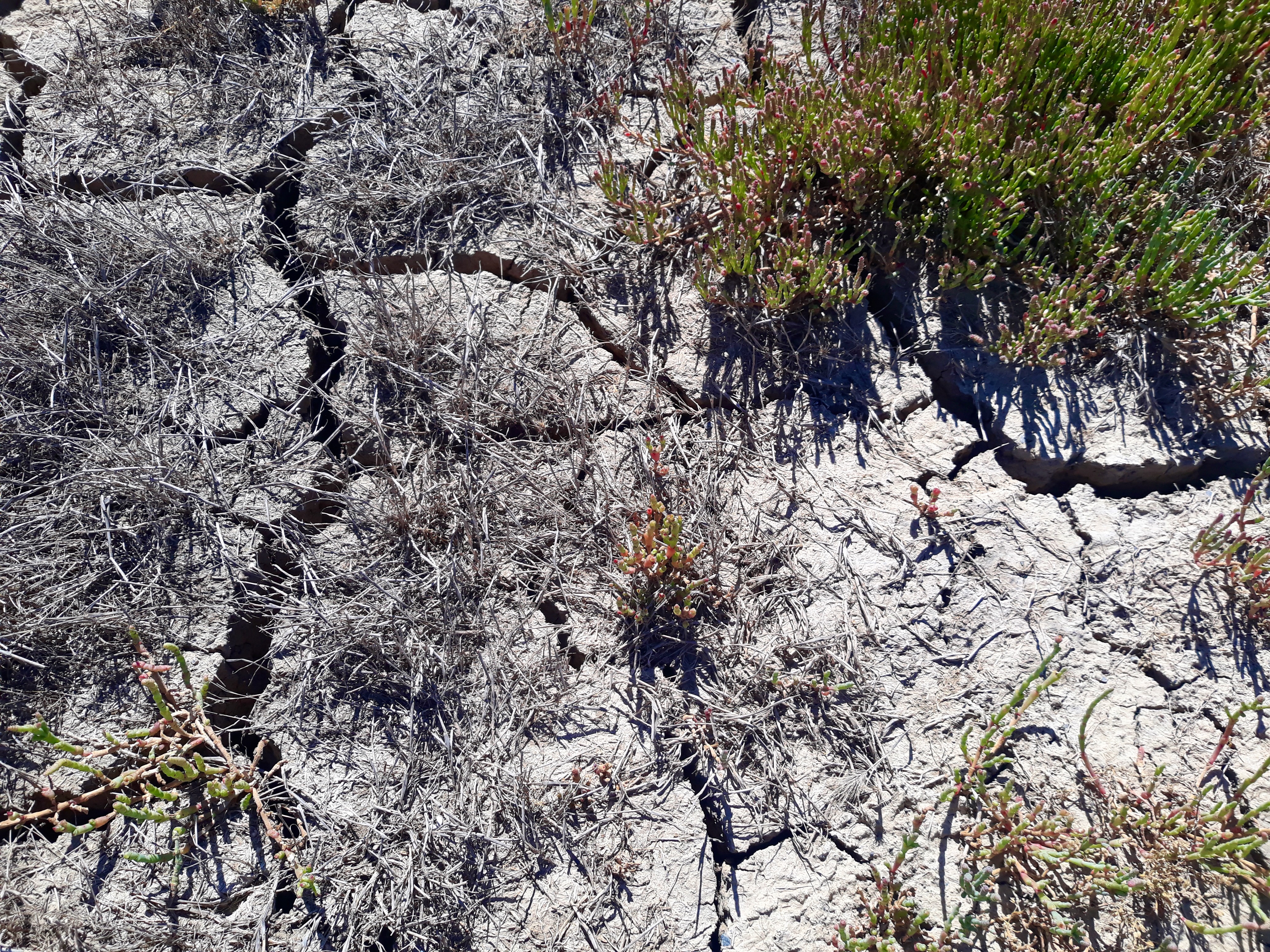
Cracked mud, March 2024.

So I look down the tunnel of my fifties and I see what every other fifty-year-old before me has seen, no doubt. And I do not feel, no matter what decision I make, as though I am growing bigger or wiser or sadder or in any way newer. I am growing older, definitely. There is that.

But then there are books like The Wren, The Wren. Because I lied a little when I said that all the coping mechanisms I taught myself as a younger woman no longer work for me. One of them still does. I read. I read. I read.

Lately I’ve been reading …

Community

Other people’s words about … social media and the internet

My suitcase was a water bottle, a P60, my clothes without a wardrobe and brutalised with creases — but, I thought, I should not be complaining, there was always someone who had it worse than me. Whenever I forgot, I looked at my phone or self-flagellated with the Guardian. There was a proliferation of opinions on Twitter about what it took to be a good, inclusive, progressive person, but I read such lists and threads on the cusp of going to Waitrose or preparing for sleep, whereupon they were quickly replaced with other lists: sliced bread to be bought, teeth to be brushed. When I remembered I had forgotten them, I felt like a terrible person anew. I wanted to discuss this with someone, but there was never any time. Quickly, I realised the absurd wealth of the places I had been in over the past year: rooms in which such discussions could be played with in theory, without urgency, at any time, and then set aside to be taken up at a later date. The internet was one such room: a constant, useless distress in my pocket. I had resolved to stop looking at my phone if I could help it; to turn off my notifications and live less theoretically.

from ‘Three Rooms
by Jo Hamya

We all bewail the role of social media and the internet in our lives while continuing to use it unceasingly, it seems to me, but I found the passage above by Jo Hamza’s narrator particularly poignant.

Recently, I read online about what some people are calling the ‘Nazi problem’ on Substack. I gather, from my brief research (online, of course), that Substack has been accused of not proactively removing Nazi content, and that as a result, people are now querying whether it’s an acceptable platform to continue to publish on. Some of the opinions I read (again, online) were by people who had only recently moved from another platform to Substack, and they were expressing exhaustion at the thought of moving to yet another platform.

I sympathise. I think it’s impossible to keep up with all the news about the relevant platforms. I prefer to work towards longevity and sustainability in one or two spaces — either the spaces you are most comfortable with or the spaces that you feel are most suitable for what you are writing about. For that reason, I’ve been writing this blog since 2014 here on WordPress, and I don’t intend to move away.

I hesitate to use the word community (despite its very common usage in this context), but nonetheless, here I am, still blogging away. And here you are, some of you, still reading my posts. So thank you. Truly, thank you ❤️.

Beach tree and seaweed, Island Beach, Kangaroo Island, January 2024.

I’ve spent the first couple of weeks of 2024 quietly, catching up with family and working. Since the publication of my novella, Ravenous Girls, in 2023, I’ve begun writing something new, a continuation in the story of the characters I introduced in Ravenous Girls. I am a slow, doubtful writer, and the publishing world is, in contrast, a fast, uncertain world, but I am quietly enjoying my writing these days — for the moment, at least.

And if there’s one thing I’ve learned about writing over the last few years, it’s that you have to celebrate the moments of joy and hope. They are rare and tentative and they quickly disappear, but they happen — every now and then.

PS On that note, if you are curious about my novella or my writing process, you can listen to me in conversation with Elizabeth Walton over on WordRoom, where we discuss novellas, anorexia, literary prizes, the difference between YA novels and literary fiction for adults … and much more.

Lately I’ve been reading …

Inkling

Other people’s words about … self-perception

The evening was cold with a bolt of black cloud over the dome of the courts. Inside, a maitre d’ approached. He led me to a high marble table with several stools and a can of light on a chain.
Thankyou, I said. I’m waiting for two more.
They were already late. I wondered if the robust twists of bread stacked in a basket to my left were real or fake. I didn’t see anybody that I knew. The food was expensive but I would not be paying for it. At times like this I simply felt too large. I am not a large person but I felt too large, as if I’d bloated, as if I were rangier and wider and more ungainly than other people.

from ‘This Happy
by Niahm Campbell

I’ve experienced the feeling that Niamh Campbell’s narrator describes suddenly coming over her in the passage above — the feeling of largeness, of having an outsized body in comparison to other people’s bodies — so many times in my life that I’ve lost count. Till now, though, I’ve always assumed that it was one of those quirks that is unique to people who have lived with an eating disorder.

It’s certainly true that one of the motivations behind my anorexia was a longing to shrink my body. And I’m not alone in this; over the years I’ve met other people with anorexia who have expressed the same motivation. In fact, back when I was a teenager, in the early days of my treatment, the nurses frequently used to say to me and my fellow anorexic patients, ‘You deserve to take up space.’ It was a kind of motto they came out with when we were feeling low, when we said hateful things about ourselves; they would chant it at us — in an effort to distract us, or perhaps to dissuade us, or even, impossibly, to cure us.

You deserve to take up space.

Those words, that chant, never quite resonated with me. My sense of largeness didn’t feel spatial; it felt physical and embodied, the way one person might have a louder voice than another, or coarser hair. Still, even as the feeling came over me — even as at certain moments it took up all my awareness — I understood that it wasn’t an accurate one. At heart, I knew even then that my body wasn’t any larger than anyone else’s, and that it was my perceptions that were distorted rather than my body. It was just that I didn’t know how to adjust those perceptions.

In many ways, I think, I still don’t. Instead, I’ve learned to ignore my perceptions, to see them as a false signal blinking at me that I choose to ignore. Maybe that’s a rudimentary way of dealing with them, but it’s the most effective response I’ve come up with.

Branch across the path, December 2023.

Because today is the last day of the year, the last day of 2023, I’m going to move on now to an entirely different topic. I want to finish this post with a beautiful poem by Lisa Holstein called ‘Happy New Year’. The poem comes from her collection Dream Apartment; its words are poignant and filled with sadness but also beauty, and so I can’t think of any better ones with which to bring in the new year.

Is it selfish to wish for more than to survive?
I see you, bare arms gleaming in the sun-

struck snow, I see the browned roast
you brought to your wine-stained lips

the stack of books you read, and those boots
that last fall you loved yourself in.

I see you in them again on this roll call
morning stroll through what intimate data

strangers tell me about their lives.
Once upon a time I asked them to

or they asked me, who can recall,
I’m into it, I guess. I like to watch,

at least, I can’t seem to stop, but I can’t
bear to share, so I’ll tell you here:

the cat finally came home last night—
spooked by so many fireworks barking,

he hid somewhere unsearchable for a while
no matter how I called and called.

He chose me, I like to say since the day
I found him starving on the porch.

I know the night is full of unsteady boats
on cold seas and horrible cages

and people far more alone than me
I’m sorry for your loss, your cancer,

the accident you had no way to see coming
and the one you did have an inkling of

I’ve learned how important it is to say
because of how difficult it is to say

and how loudly loneliness fills the silence
although, like anything, it depends—

for instance, I still can’t unhitch my breath
from even the softest whisper of your name.

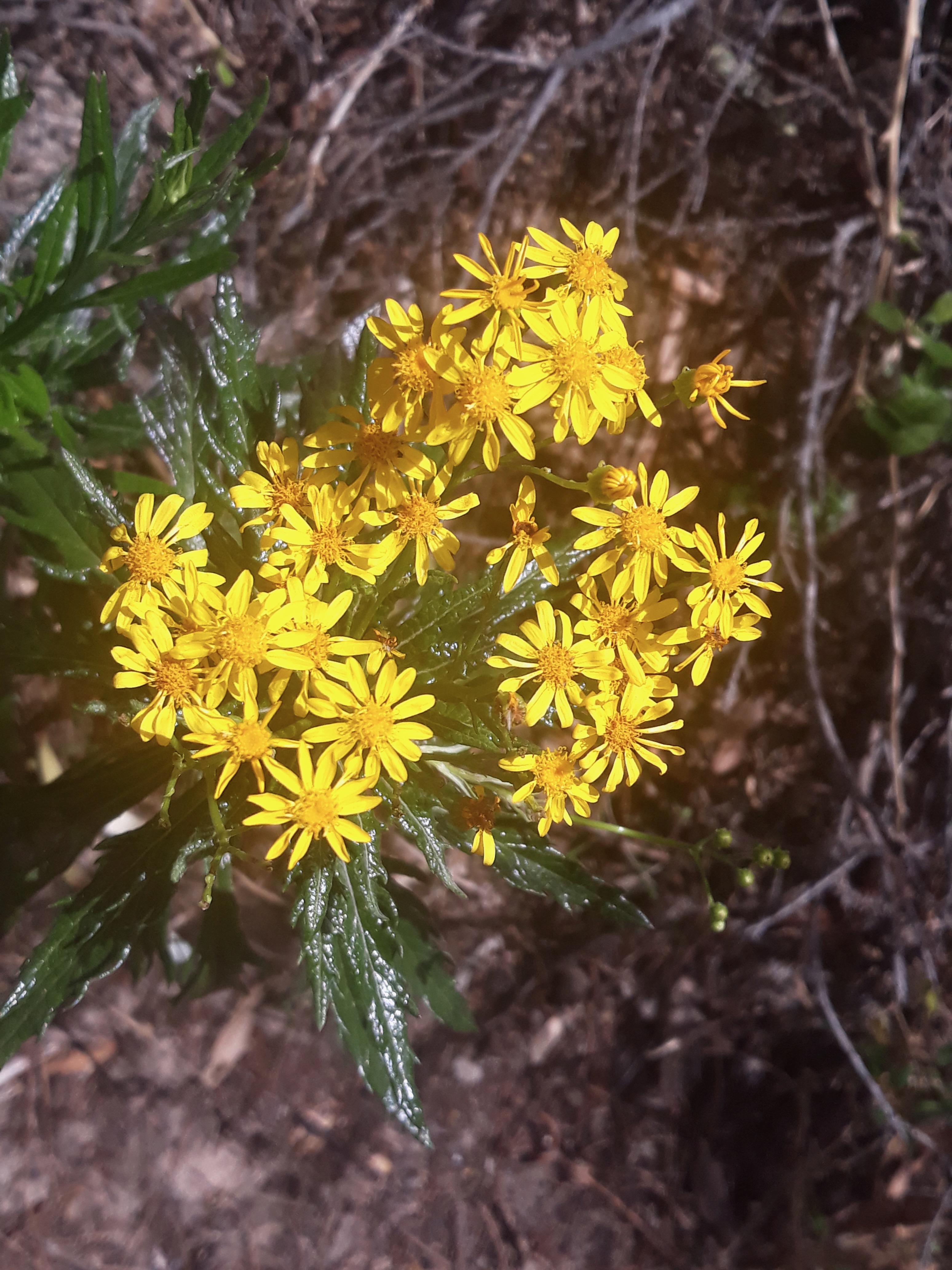
Late groundsel flower, December 2023.

Lately I’ve been reading …

All that food

Other people’s words about … not eating

Mae doesn’t look convinced, but she hands me another bowl, which I pass to TJ. He holds it in the space between us, locking eyes.
You didn’t take any, he says.
I took plenty, I say. I’m stuffed.
No. I watched you.
You must’ve blinked.
Then try some more.
I just told you–
Don’t be a dick, says TJ.
Boys, says Mae.
Her voice is terse enough to shut us up.
Mae holds our gaze until we’ve settled. Then she pours more wine into her coffee mug, twirling her food with a fork.
It’s been too long since we’ve been together, says Mae. Let’s make it a nice evening.
So TJ shoves the bowl of tomatoes my way. I scoop more onto my plate. Then I take bites from the spaghetti and the chicken, and it’s all delicious, and the three of us eat silently, until there’s something like a hum between us.
Is the bathroom still in the same place, I ask.
Mae points down the hallway. I don’t look at TJ when I stand. But once I’ve locked the door behind me, I turn on the faucet, and it’s maybe another five seconds before all that food leaves me.

from ‘Family Meal
by Bryan Washington

When I was a teenager receiving treatment for an eating disorder, people had certain fixed ideas about what kind of person was likely to experience anorexia. By ‘people’, I mean not just family and friends but doctors, psychiatrists, medical researchers. Anorexics, people thought then (because that was what we called people with anorexia in those years, anorexics, a label that many people would now object to), were generally white, middle-class, well-educated, high-achieving, likeable young women with a tendency towards perfectionism.

Perhaps, back then, this was true. Or perhaps, more likely, if you were anorexic but you happened to be male, poor, uneducated, older than twenty-five, queer, or a person of colour — or any combination of these things — then your anorexia went unrecognised. Undiagnosed. Untreated.

We know better than this now, I am thankful to say.

Fringe Lily, December 2023.

In the passage I’ve quoted above, Cam, one of the narrators of Bryan Washington’s second novel, Family Meal, is grieving the loss of his boyfriend, Kai, who died in unexpected, violent circumstances. Cam is Black and queer; he is also addicted to many things, including drugs, sex and, yes, starving himself. He is surrounded by friends who see what he is doing to himself and try to talk to him about it, try to show him that they see, and that they care, and that he doesn’t need to be alone. It takes him a long time to see this for himself, though.

Cam’s experience of struggling with food is different from mine, and that’s partly because of who each of us is — precisely because I did, after all, fit most of the anorexic stereotypes I’ve listed above — although it’s also partly because everyone’s struggle with food is, simply, different. But I am so glad, so glad, that contemporary literature that includes stories about anorexia and disordered eating has broadened to include other stories than ones like mine.

And it’s funny how, no matter what your background, no matter what your life experience, the feelings don’t change. I’m fucking suffocating from the weight of myself, Cam writes.

I remember feeling exactly the same.

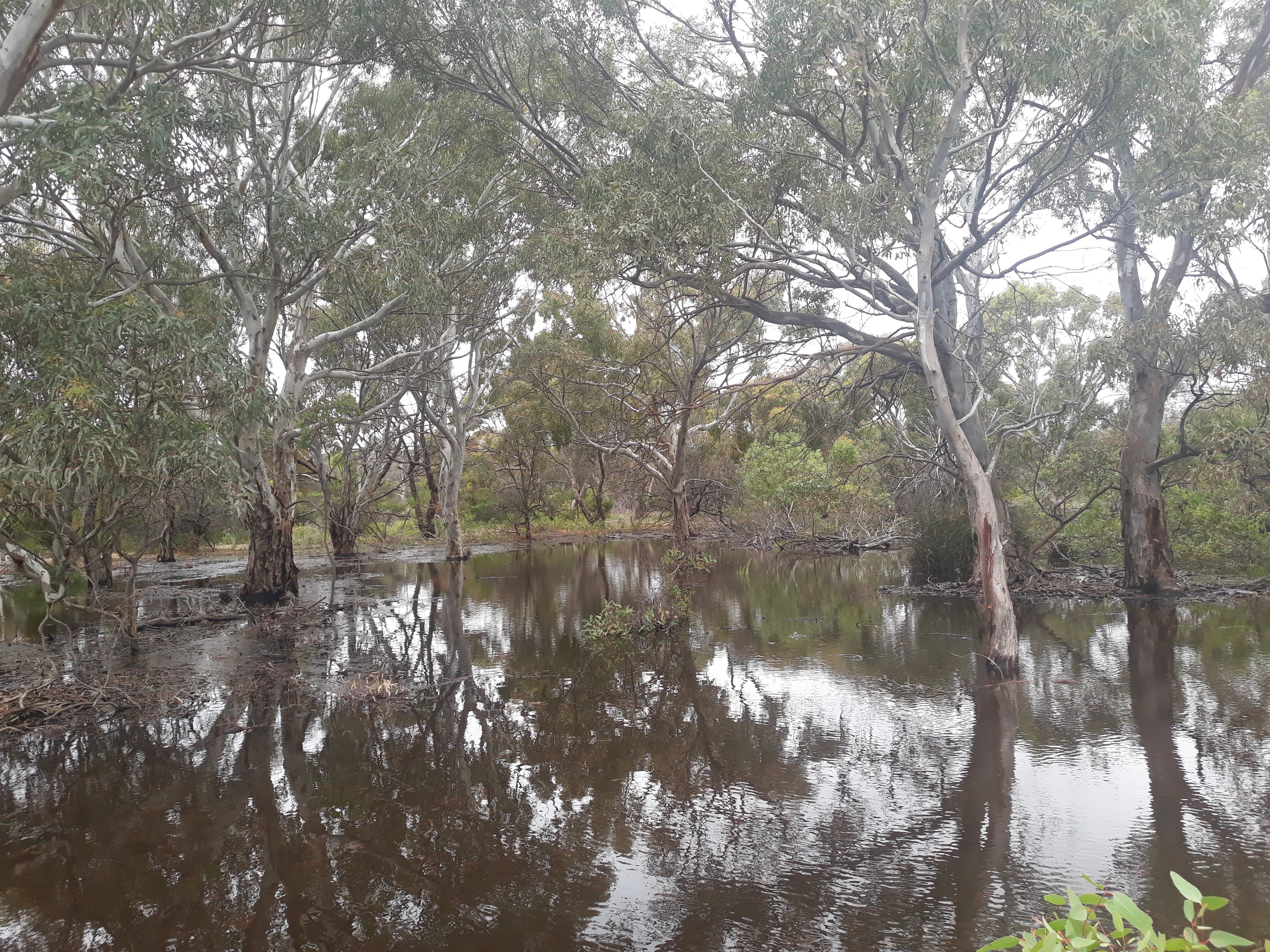
After the rain, Flooded scrub, November 2023.

Lately I’ve been reading …

Fumbling

Other people’s words about … growing up

I also felt like I was being pushed into a world where I didn’t understand the rules. The summer before we moved, a bunch of my friends at camp were caught kissing boys behind our cabin with their T-shirts off. I didn’t even know why a girl would take her T-shirt off with a boy, but I knew it was very wrong to do so, because they all got into big trouble. I’d started going to after-school ballroom dancing lessons in New York, which was something kids from my part of Manhattan did, maintaining an Upper East Side fantasy that we all still lived in an Edith Wharton novel. At the last dance, a boy put his hand on my bottom. Again, I couldn’t understand why a boy would want to touch my bottom, but I knew I didn’t like it. But I also knew that admitting I didn’t like it — like admitting I didn’t know why a boy would want to see my chest — would make people laugh at me. So I said nothing to him, to anyone.

from ‘Good Girls: A Story and Study of Anorexia
by Hadley Freeman

One of the things I loved about Hadley Freeman’s memoir Good Girls is that, as well as recounting the years during which she lived with anorexia, she also recounts her life post-anorexia, post-‘recovery’. While the story she tells of her rapid and precipitous descent into anorexia in early adolescence is vivid and poignant, it’s the rest of her story that most spoke to me — the years during which she maintained a pattern of restricted eating that wasn’t quite anorexia but also wasn’t quite wellness or sanity, the years when she lost herself to drug addiction, the years, finally, when she began to come to some kind of peace with herself.

It’s time that eating disorder narratives did this more often, I think. I said nothing … to anyone, Freeman writes in the passage above, and, elsewhere, So much of anorexia is about suppressed conversations. But I think this is as true, if not truer, of those years when a person who has survived anorexia begins to make their way back into life, those years when a person begins to try to make something of their life other than an anorexic one. (And they are years. For most people, the transition away from anorexia is long and slow and painful.) We need, in our narratives about anorexia, to engage with the whole experience, not just one part of it, the most clearly visible part. We need to tell the whole story. I hope that in the future there will be more writers like Freeman who do so.

Looking out onto Lake Burley Griffin, Canberra, November 2023.

I’ll return to this theme in future posts, because there’s so much to unpack here, and because it’s one of the things I was most conscious of when I wrote my novella, Ravenous Girls. In fact, though, what most drew me to the passage I’ve quoted in today’s post is something else. Here Freeman, describing her pre-anorexic period, her pre-adolescent years, writes, I also felt like I was being pushed into a world where I didn’t understand the rules. This is how I felt, too — at twelve years old, at thirteen, even at fourteen. I was what people kindly describe as a late bloomer, which is to say that I entered adolescence reluctantly, lingering in childhood for as long as I could, wishing that I could somehow stay a child forever. Teenage rituals, those fumbling intimacies between boys and girls that Freeman describes here, puzzled me. I knew this marked me out as different, or at least I believed that it did, and so, like Freeman, I remained quiet. I regret this quietness now. I see, looking back, that I was muting myself, retreating into a silence that wasn’t healthy or sustainable. As Freeman notes, it’s in suppressing conversations that anorexia steps in, and that was certainly true for me.

Ravenous Girls isn’t only a story about anorexia, though that’s a part of it. It’s a story about silence and muteness. Perhaps these are themes I’ll continue to explore for the rest of my life. It’s a theme that endlessly fascinates me.

For sale, November 2023.

Lately I’ve been reading …

I wrote a book!

I’m breaking from the usual format here on my blog today to announce some exciting news:

Yes, I wrote a book! Or, to be more precise, a novella.

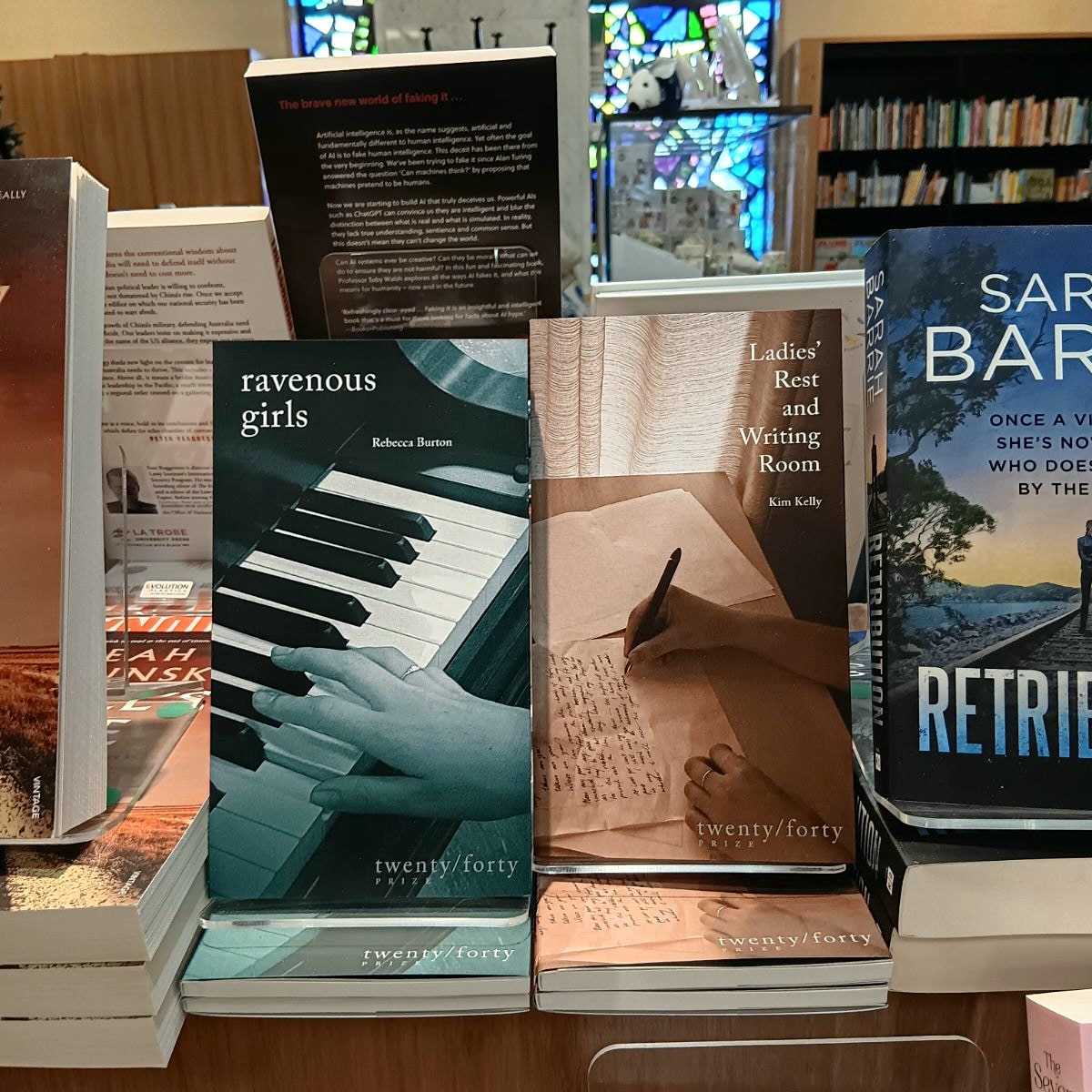
Called Ravenous Girls, it’s one of the two winners of the inaugural 20/40 Publishing Prize, and its official release date is today.

Ravenous Girls tells the story of two teenage sisters who grow close over the course of a summer holiday in the mid-1980s when one of the girls is admitted to hospital with anorexia. Narrated by the younger sister, Frankie, later in her life, it explores the chasms that lie between adolescence and adulthood, sickness and health, intimacy and loneliness —- and how the events of that summer will affect the two girls for the rest of their lives.

Long-time readers of my blog will know that this book has been a long time coming. I can’t begin to tell you how thrilled and excited I am to have won the 20/40 Publishing Prize and to see my title in print.

I’m keeping things short and sweet for today (because, you know, celebrations are in order). I’ll be back again soon with my usual kind of post, but in the meantime, for those who are interested, you can find out more about Ravenous Girls and the 20/40 Publishing Prize here, buy Ravenous Girls here, or buy both of the prize-winning novellas here. (I’m usually somewhat camera-shy, but for anyone interested, you can watch an interview with me, fellow Prize-winning author Kim Kelly and publisher Julian Davies of Finlay Lloyd here — just scroll down to the bottom of the screen to find the videos.)

PS Congratulations to Kim Kelly, author of the other winner of the 20/40 Publishing Prize this year, The Ladies’ Rest and Writing Room, which is set in the bustling streets of 1920s Sydney and tells the story of two young women, each having suffered devastating loss, who are thrown together by unexpected circumstances.

Loss

Other people’s words about … doing what we love

It was a lie that Timo had not loved [playing] piano enough. He had loved it very much, but in a way that was difficult to describe. It was apophatic — he could only describe it through its negation. He only understood how much he loved the piano after he had given it up. Even that decision in hindsight seemed arbitrary, a whim. An act of petulance. But he had loved it, and he still did. Every day, he felt like a struck tuning fork, vibrating all the time. Except that it wasn’t pitch he was tuned to but something else, some horrible frequency cutting through the universe. Loss, he thought. It was loss.

from ‘The Late Americans
by Brandon Taylor

In the passage above, Taylor’s character Timo is a graduate student in Iowa who used to study music but then gave up. Sometimes, when he is on his own in the apartment he shares with his boyfriend, Fyodor, who works at a meat-packing plant, he sits listening to classical music recordings, losing himself in the music he so loves. But when Fyodor comes home, Timo switches the music off immediately, mid-piece, refusing to talk to Fyodor about this thing he so loves — refusing, also, to allow Fyodor to share in a part of him that in many ways still feels like the truest part of himself.

The Washpool, September 2023.

When I read the words I’ve quoted above, I thought about the times that I’ve given up writing over the years. Though I’m not beginning to claim that I am as talented a writer as Timo is a musician, nonetheless, writing for me has always been a channel of creativity, a tool that helps me make sense of and navigate the world. I don’t know why, honestly. I do know that I have a longing to make something beautiful (though this is another impulse I don’t really understand), and that writing is the only way I know how to (try to) do this. Maybe that’s why, every time I’ve ‘given up’ writing ‘for good’, I’ve returned to the practice later.

I’ve written before about how I’ve learned over the years to value my writing practice for the practice itself rather than for any measurable outcome. That’s partly what I’m saying again here, in response to the words I’ve quoted today. But it’s more than that, too. What Taylor expresses so beautifully is the same sense of loss I always feel when I stop writing. His image of a tuning fork vibrating to the wrong frequency describes this feeling beautifully. At the same time, I’d also describe the feeling another way, as a feeling of being muted. Silenced. When I don’t write, I feel as though I have lost my voice: I feel as though no-one hears me.

I understand, as a writer who is published very infrequently, that few people hear me, anyway. But writing is my way of speaking to the world, and not writing is the opposite of that. Not writing feels like grief.

The Washpool, September 2023.

Meanwhile, I’ll be back soon with another post about writing, and with a little piece of news, the news I’ve been hinting at for months now. Watch this space! ❤

Lately I’ve been reading …