Loss

Other people’s words about … doing what we love

It was a lie that Timo had not loved [playing] piano enough. He had loved it very much, but in a way that was difficult to describe. It was apophatic — he could only describe it through its negation. He only understood how much he loved the piano after he had given it up. Even that decision in hindsight seemed arbitrary, a whim. An act of petulance. But he had loved it, and he still did. Every day, he felt like a struck tuning fork, vibrating all the time. Except that it wasn’t pitch he was tuned to but something else, some horrible frequency cutting through the universe. Loss, he thought. It was loss.

from ‘The Late Americans
by Brandon Taylor

In the passage above, Taylor’s character Timo is a graduate student in Iowa who used to study music but then gave up. Sometimes, when he is on his own in the apartment he shares with his boyfriend, Fyodor, who works at a meat-packing plant, he sits listening to classical music recordings, losing himself in the music he so loves. But when Fyodor comes home, Timo switches the music off immediately, mid-piece, refusing to talk to Fyodor about this thing he so loves — refusing, also, to allow Fyodor to share in a part of him that in many ways still feels like the truest part of himself.

The Washpool, September 2023.

When I read the words I’ve quoted above, I thought about the times that I’ve given up writing over the years. Though I’m not beginning to claim that I am as talented a writer as Timo is a musician, nonetheless, writing for me has always been a channel of creativity, a tool that helps me make sense of and navigate the world. I don’t know why, honestly. I do know that I have a longing to make something beautiful (though this is another impulse I don’t really understand), and that writing is the only way I know how to (try to) do this. Maybe that’s why, every time I’ve ‘given up’ writing ‘for good’, I’ve returned to the practice later.

I’ve written before about how I’ve learned over the years to value my writing practice for the practice itself rather than for any measurable outcome. That’s partly what I’m saying again here, in response to the words I’ve quoted today. But it’s more than that, too. What Taylor expresses so beautifully is the same sense of loss I always feel when I stop writing. His image of a tuning fork vibrating to the wrong frequency describes this feeling beautifully. At the same time, I’d also describe the feeling another way, as a feeling of being muted. Silenced. When I don’t write, I feel as though I have lost my voice: I feel as though no-one hears me.

I understand, as a writer who is published very infrequently, that few people hear me, anyway. But writing is my way of speaking to the world, and not writing is the opposite of that. Not writing feels like grief.

The Washpool, September 2023.

Meanwhile, I’ll be back soon with another post about writing, and with a little piece of news, the news I’ve been hinting at for months now. Watch this space! ❤

Lately I’ve been reading …

Grasp

Other people’s words about … reading

After most of my long days at work, I would arrive back at the flat, pour myself a glass of wine or vodka and read, mainly short stories and poetry. I wasn’t reading novels because I didn’t want that kind of continuity; I didn’t want to carry over any part of narrative from one day to the next. Sometimes I read poetry in languages I didn’t fully understand — with a sense of the meaning, but reaching for it, grasping after it. One of my other pleasures was smoking, but I didn’t dwell or savour; I narrowed it down to lighting up and the first few drags — after that I lost interest. I read like I smoked: fixating on my new favourite in its entirety to begin with and then honing in on the exact phrase or phrases that gave me the fix, then reading only for those, discarding the rest and when that poem had been emptied out, moving on to the next.

from ‘Signs of Life
by Anna Raverat

I’m not a smoker and I love reading novels far more than I do short stories or poetry, but still, I found myself smiling in recognition when I read the narrator’s description in the passage by Raverat above about her approach to reading. I experience myself, these days, as a greedy reader — greedy for beautiful words, phrases, images, moments, greedy for the fix they give me, while often the plot or theme of a novel remains distant or abstract to me.

Pathway, Sellicks Beach, July 2023.

Reading has been an important part of my life for as long as I can remember, though the reasons for its importance to me has varied over the years. These days, it feels like an escape for me from the world, or perhaps more accurately an escape into someone else’s world — that world they create with their words. And, like anyone addicted to their fix, I’m not about to give it up.

Little green bench (a place to read in when the warmer weather returns?)
Sellicks Beach, July 2023.

Lately I’ve been reading …

Today’s reading list is exclusively about animals and pets — for all the animal-lovers out there! xo


Ravaging

Other people’s words about … growing older as a woman

The things they don’t tell you about menopause are multiple and ever-changing, newly horrifying with every fresh wave.

I know there are positives. Apparently you no longer care what people think about you. Apparently you have come into your power, you are a wise elder, you don’t give a shit about what anyone else might say.

Only you do. The thing no-one tells you about menopause is that you look like you don’t care because your face is set that way, because you get used to trying not to care until you imagine it is true. But you do care. It is ravaging and you do care, you really do.

from ‘Fat Girl Dancing
by Kris Kneen

I can’t think of a time when I didn’t care about what other people think about me. I have always been someone who cares too much about this, who compares myself with others and finds myself wanting in every way I can think of to be found wanting.

This hasn’t changed as I’ve got older. Like Kneen, I’ve heard the truisms around ageing; I’ve listened to and read the interviews in which famous older women tell their interviewer that at fifty/sixty/seventy they feel wiser/calmer/happier/more beautiful than at any previous stage in their life — and I’ve believed them. (Let it be said, I am somewhat suggestible when it comes to what other people say. It comes with the territory.)

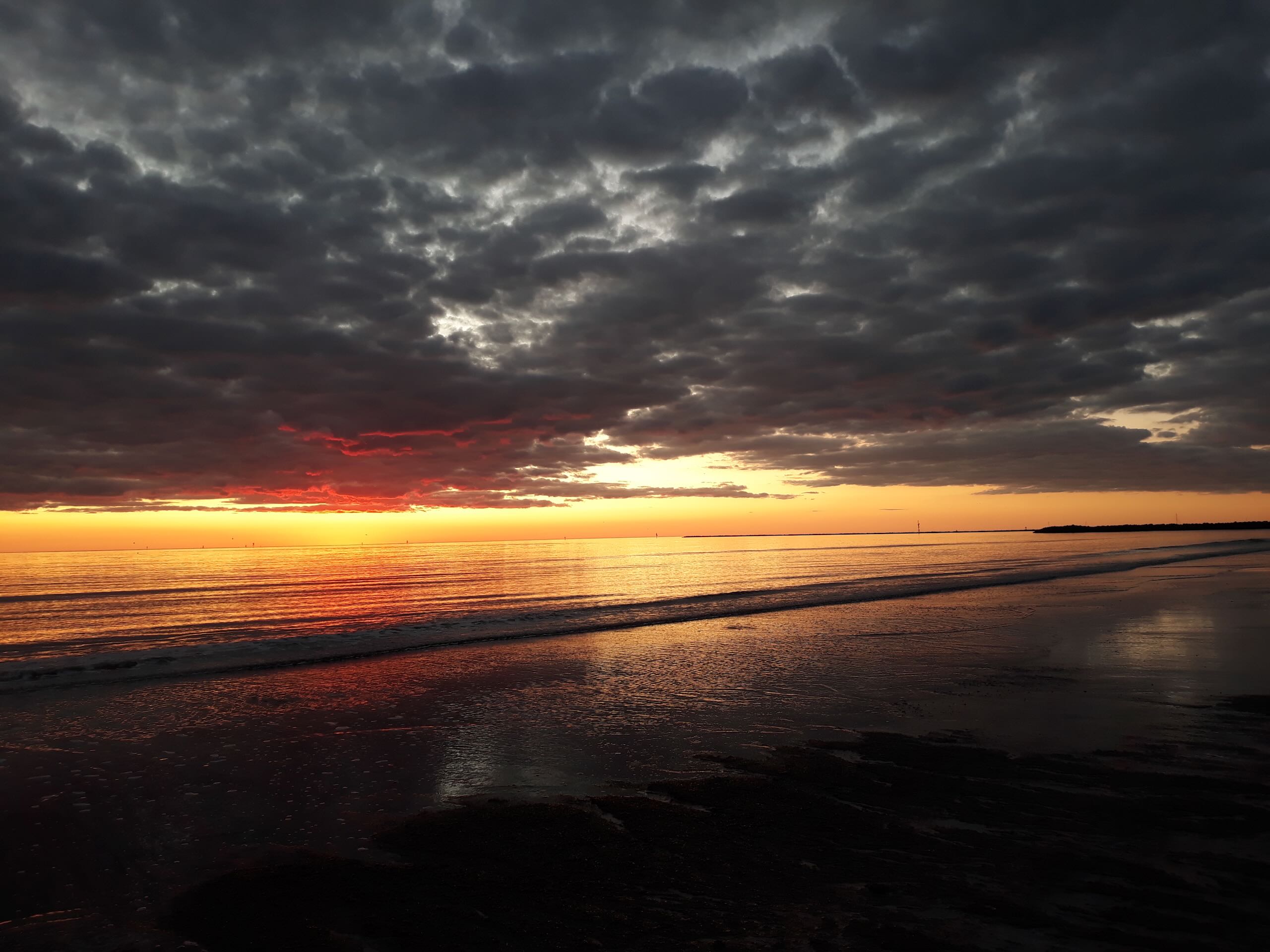
Sunset, Taperoo Beach, June 2023.

I was thinking, when I first read Kneen’s words, about writing a post here about how we as women are objectified; about how that’s why, when we reach menopause, we feel the way Kneen describes; about how, though objectification feels odious, being silently discarded feels even worse. But this morning as I sat down to write this post, I found that what I wanted to say was something else.

What I really want to say is that one of the things I have come to realise as I grow older is that the pieces of received wisdom I’ve absorbed over the years rarely work for me when I try to apply them to myself. Over and over again over the years, I’ve had to discard those generalisations — about living, about being a woman, about growing older, about finding some level of happiness or contentment or peace — and find my own truth.

At fifty-two, I certainly don’t feel that I am coming into my power, and I could not feel further from being a wise elder. But I do know that in the years that lie ahead of me, if I am lucky enough to live them, I will continue to need to find my own path through life. I will continue to need to turn away from those truisms and pieces of received wisdom about how my life should appear to me. And I will continue to need to be less suggestible. Because I do care; I really do. I always will.

Black and white, Taperoo Beach, June 2023.

Lately I’ve been reading …

Solace

Other people’s words about … stepping outside

I went outside. Often I walked till the late hours. The sky’s was a darkness I could deal with. I wanted to stop living by the measures of everyone else: before and after, death and life, sea and self. Being out there — in towns where I spoke to no-one, in green deserted parks, along the edge of the gulf’s water — allowed me to turn inwards. It reflected the silence I felt in me. I wanted to be outdoors for good. Yes, I went outside.

from ‘The Memory Artist
by Katherine Brabon

Pasha, the narrator of Katherine Brabon’s novel The Memory Artist, is a Russian man in his mid-thirties, a writer trying to make sense of his life post-glasnost, post-perestroika. While the story in Brabon’s novel is about the effect of political repression on people, and particularly on artists, I found uncanny echoes in Pasha’s voice of my own thoughts and feelings (although not, clearly, in response to any political repression or trauma, neither of which I have experienced).

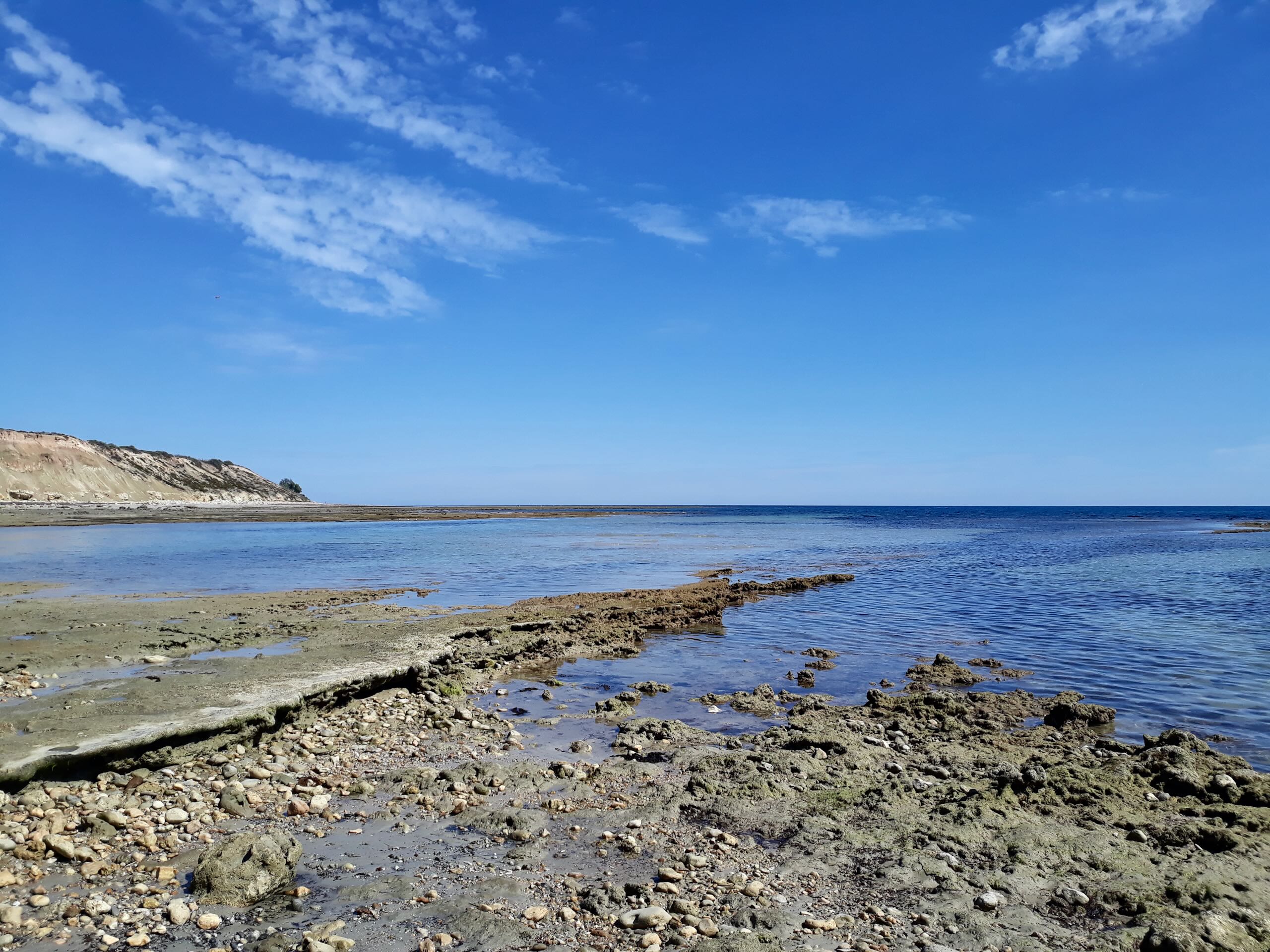
Sky and Sea, Snapper Point, April 2023.

I wanted to stop living by the measures of everyone else, Pasha writes, by which he means not that he wants to stop living, but that he wants to accord his own values to this life he is living. Where he finds it most possible to do this is outside, under the great arch of the sky.

It’s a similar impulse, I think, that makes running so appealing to me — running through the scrub, running on the beach, running beside the sea. It’s outside where I find some of the things I most long for in life: silence, neutrality, the sense that I could (if I went on running long enough, if I stayed outdoors long enough) dissolve.

Sometimes, when I’m inside going about my day — working, sleeping, eating, showering — I remind myself that the sky is just a few steps away, literally at my feet. It feels to me like the very definition of solace.

Sun and shadow, Aldinga Beach, April 2023.

Lately I’ve been reading …

An apology of sorts: today’s list is lengthy, I know, but it’s been a while since I last posted here, and meanwhile I’ve been enjoying my online reading! I hope you will dip in and out of the list below and find something that you enjoy.

Please

Other people’s words about … chronic pain

I told [my parents] how that afternoon I had actually gone and seen another psychologist [for help with my chronic migraine]. I was just feeling so low and so down, and a friend had recommended her, and she could squeeze me in. I told her the pain would come and the pain would go, and that I couldn’t control it, that some days I would be fine, more than fine, ecstatic, but that other days the pain would return and I would slide into a depression so deep I could not see my way out. I told her I felt like a rat in an experiment, a rat made to drink water — sometimes the water was normal but other times the water shocked with an electricity so violent that I would swear never to drink it again, but then I would see everyone else drinks water and I would wonder why I couldn’t do that too. I told her I just wanted to drink the water. Sometimes I could, but mostly I couldn’t and I never knew when. I told her I just wanted to know why. It had been years since I’d had the initial migraine, but even now, right then, the pain had returned and I couldn’t read or write or — I told her I was sick of being an experiment, that I just wanted answers, someone to help. Then I asked her if she could help. I asked if she’d ever heard of anything like this before and then I told her please. I said, Please, I would just really appreciate it if you could help, and she just smiled and told me she’d seen it all before. Then she got out a piece of paper and a pen and told me to rewrite negative self-thoughts as positive self-thoughts. I asked her what she meant. She said, Well, you could rewrite ‘I am worthless’ as ‘I am special’; ‘I am alone’ as ‘I am loved’; ‘I am useless’ as ‘I am capable’. And then she sat back and pushed the pen and paper towards me and told me to try. I told Mum and Dad I just got up and left, then — because I knew she was just the same as everyone else — full of bullshit just like the whole world was full of bullshit. I told them it was like I was eight years old, and everyone was playing pretend.

from ‘Train Lord
by Oliver Mol

There was a period in my life some years ago when a headache settled over me which, despite all the cures and treatments I tried in response to it (both conventional and alternative) would not fade away. Unlike the chronic headache that Oliver Mol describes seeking treatment for in the passage above, my headache wasn’t a migraine: the pain I experienced was of a milder kind, what doctors call a tension headache. This meant that, unlike Mol, I could still function. That is to say, I could still present to the world an image of myself functioning. Unlike him, I could still read and write; I could still watch television and use computers; I could still get myself to work.

Still, the pain during that period was omnipresent. It varied in intensity: sometimes it was faint, just a light tingling sensation at the edge of my eyelids or (oddly) inside my nose; sometimes it was strong and persistent, as though someone had lodged a heavy, blunt object (a hammer? a mallet?) into the top of my head and was pressing this object — pressing and pressing it — down into my skull. Sometimes the headache made me feel dizzy and sick, and this, because of my phobia about vomiting, triggered bouts of anxiety that weakened my ability to cope with the pain. On days like that, I felt desperate. I made a mask of my face in social contexts; I disappeared from my desk at work to cry behind the closed door of a toilet cubicle; I made excuses and went home early from gatherings (or didn’t go to them at all). I felt myself, or the person I thought of as myself, slowly disintegrating.

I hadn’t known until then how much my sense of myself as a social creature, and as a socially worthy creature, was predicated on an assumption of my good health. I’ve since learned that this is an experience common to people experiencing chronic pain or illness, but I didn’t know that then.

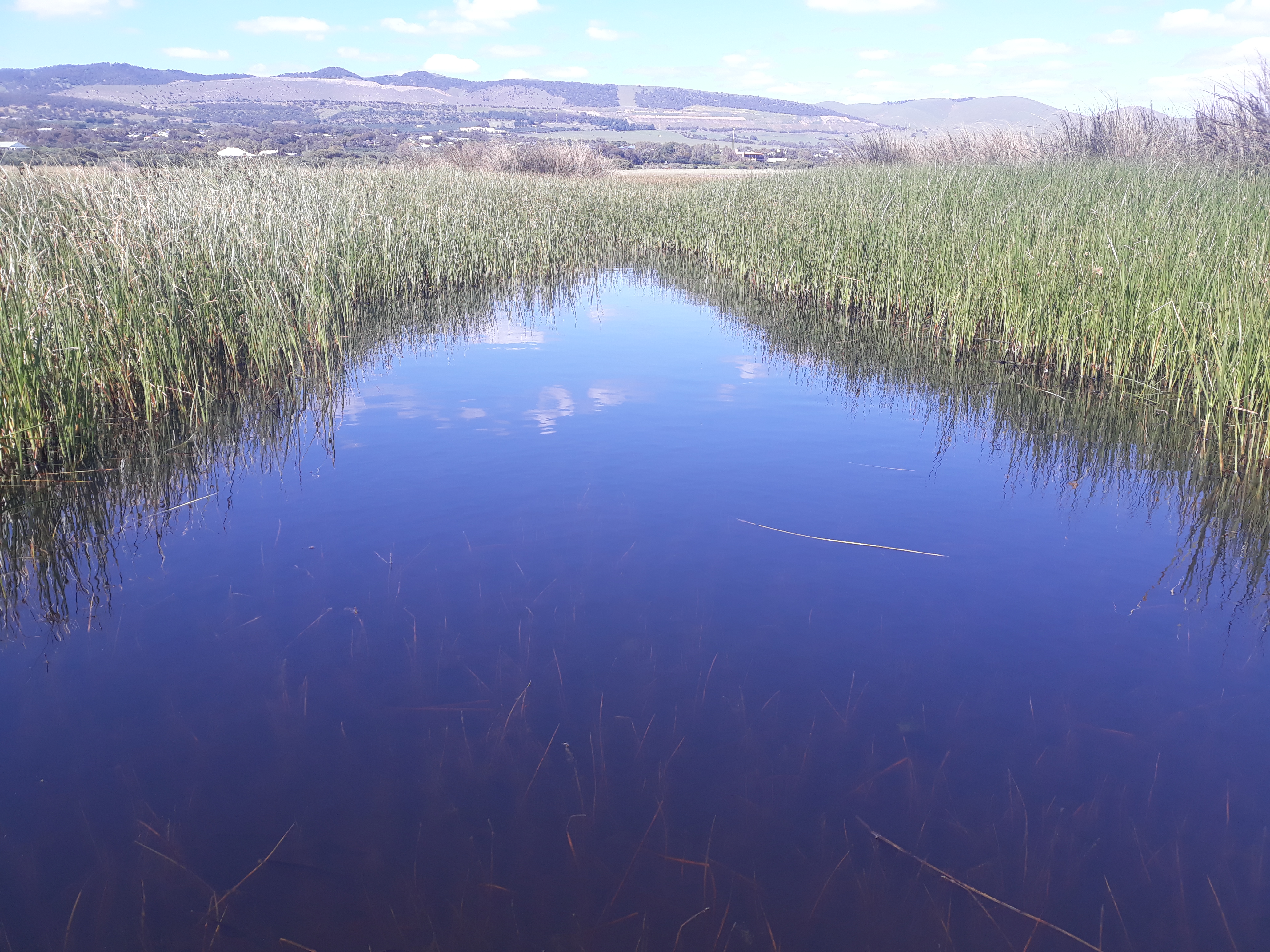
Aldinga Scrub, summer flooding, January 2023.

Mol’s migraine lasted ten months initially (although later it returned for another few months). My headache faded away around the two-year mark. I still don’t know why, really — whether the cure was due to something I did, or to one of the treatments I tried, or simply to plain luck. Sometimes it returns, settling over me for a day, or a few days, or a week, or a few weeks — but eventually it leaves again. And because of this, because the pattern has changed, because I know now, or at least allow myself to assume, that the pain is only temporary, I have learned simply to wait it out when it visits. To let it run its course.

And yet. That word: temporary. And then I told her please, Mol writes, and that’s what it feels like, even now, when I’m in the midst of a long headache: a prayer to someone, anyone, to make sure that the pain is only temporary, that it won’t take over again the way it did for those two years. Because once you’ve felt it, you never forget it: the way pain changes you, the way it writes itself on you, the way it renders you powerless. The way it robs you of yourself.

This, I think, is what Mol’s psychologist failed to see. Perhaps the worst thing, when you are experiencing chronic pain or illness, is the sense of betrayal that accompanies your pain. You feel, first, as though your body has betrayed you, this body you have been lucky enough never really to have thought about before, which until now has performed for you mostly without pain or grievance; and then, second, as though the people around you — the ‘experts’ you have consulted — have betrayed you, too, with their so-called treatments and cures, with the promises they make you, with the money they take from you, all to no end; and then, third, as though the world itself has betrayed you, in its refusal to operate in a way that is manageable or meaningful for you in your pain.

If, in the end, you are lucky enough to get relief from your pain, what you never quite forget is that when you were in pain, you changed. You no longer knew yourself. You became a person who said, Please.

Lately I’ve been reading …

Speak

Other people’s words about … despair

She sat across from him. For some reason, he removed his glasses and set them on the gold table. His naked eyes were as dark as the burnished leather they sat on and held a startling amount of despair. The effect struck her as indecent, as if he’d disrobed. ‘Put your glasses back on,’ she wanted to tell him. ‘For God’s sake.’

from ‘Vacuum in the Dark
by Jen Beagin

I’ve been thinking a lot recently about the things people say to each other and the things they don’t. And about subtext, which is not quite the same thing but is part of it all the same.

Over the last couple of years, having written and submitted a middle-grade fiction manuscript to my agent which has as yet to find a home with a publisher, I’ve been writing a literary fiction manuscript. I haven’t mentioned this here till now, in part because my writing in that area is still so new and tentative, and in part because when I say the words, ‘I am writing a literary fiction manuscript’, all I hear is my own internal mocking laughter.

You? says the voice in head, that little internalised voice. How could you possibly presume to have something to say in the literary fiction field? How could you assume that much writing talent of yourself? That much wisdom?

Bracken fern, light and shadow, January 2023.

It’s impossible to say whether what I’m writing will ever be something complete, let alone publishable. That’s the risk any writer takes, whether they have had previous books published, as I have, or not. But what I am writing about in that manuscript is in part what Jen Beagin describes so beautifully in the passage I’ve quoted above: our unwillingness to witness each other’s despair. Our inability to talk about it or bring it to light. Our constant need to reassure each other with upbeat, optimistic conversation and good cheer.

I am not by nature a cheerful person. Nor am I an optimist. Nor am I a skilled conversationalist. At fifty-two, I still find myself getting midway through a conversation with another person, only to realise that I have revealed too much of myself: my fears, my doubts, my sadnesses. (Actually, ‘I still find myself’ is the wrong way to put this; in fact, the right way to put this would be, ‘I increasingly find myself’.) Maybe this isn’t evident to the person I’m talking to, or maybe it is. I’m never sure. But I often feel like the man Beagin describes in the passage above: glasses off, the truth in my eyes revealed. This is not a comfortable place to find myself.

But increasingly I believe in the importance of confronting the secrets we see in other people’s eyes. I believe in meeting those secrets head-on. I believe in talking about them. Perhaps what I am saying here is that secrets don’t have to be the subtext to the conversations we have with other people: they can be the essence of our conversations. They can be where we meet.

Common everlasting flowers, January 2023.

Lately I’ve been reading …

Roar

Other people’s words about … country and city life

Ramesh was used to the sounds of the suburbs. He never noticed barking dogs or level crossings. On the train to work every morning he turned up the volume of his audiobook so it was louder than other passengers’ mobile phone conversations. But [tonight he was in] the country [and it] roared. He could hear the air move in the trees. He had grown up in Croydon, moved to Glasgow at seventeen, back to London at twenty-three, then Sydney at thirty-six. As a child he’d stood outside his parents’ bedroom listening to his father’s whistling snore. He liked living in places where he could hear others alive. He reached for his phone where it sat charging. For an instant he saw his hands illuminated in the bluish light of its screen. He set his rain sound app to the setting called ‘Harbour Storm’.

‘What are you doing?’ Henry croaked. His face was pressed to the pillow. ‘You don’t need that tonight.’ 

Ramesh opened his mouth to argue, then he heard the rain outside, like gunfire on the corrugated iron roof.

from ‘Pulse Points
by Jennifer Down

I love this passage, not because I’m in accordance with Ramesh, but for the opposite reason. I love the ‘roar’ of the country. I spend most of my time living in a house in the suburbs. It’s close to the beach, which I love, but it’s even closer to the railway line, a line that trains zip up and down every half an hour from five in the morning until midnight.

Sunset, early August 2022.

I don’t mind the sound of trains, actually — as suburban sounds go, I find it vaguely comforting — but when I leave my house to stay outside the city, to visit Aldinga Scrub or to camp in Yorke Peninsula, I feel a knot inside my chest of which I wasn’t even aware releasing itself.

Sounds I love when I am away from the city: the dull roar of the ocean at the end of the road (yes, another roar). The whistle of a hot wind through the trees. A frogmouth letting out its low, persistent, booming call at dusk. A shrike thrush singing. A magpie warbling. Frogs croaking. Insects clicking in the grass. And, yes, like Ramesh, the rain drumming on the roof.

Still, the photo accompanying my post today, like so many of my photos on this blog these days, comes from the suburban beach at the end of the street I live on. The sand is being eroded away and there are car parks dotted along the coast line and on most weekends a food truck selling hot donuts sets up shop during daylight hours.

But it’s still the beach. It’s still wide and beautiful and open and … The sea still roars.

Lately I’ve been reading …

It’s a lengthy list today, because I’ve been reading far more than I’ve been posting. But I hope you find something interesting below.

Revelation

Other people’s words about … secrets

‘Philip,’ [his mother Rose] said. ‘There are things I could tell you.’
‘Tell them,’ Philip said.
‘No.’
‘Why not? I’m prepared.’
She turned, looked at [Philip’s father Owen] slumped on the sofa. ‘Because I don’t believe that just because something’s a secret it therefore by definition has to be revealed,’ Rose said. ‘Keeping certain secrets secret is important to — the general balance of life, the common utility.’

From ‘The Lost Language of Cranes

by David Leavitt

I have always been fascinated by people like Philip’s mother Rose in the passage above: people who keep their own counsel. I have a tendency to do the opposite — to over-share, to talk to people for advice, to feel guilty if the life I lead isn’t entirely transparent. I’m not sure why. I may just be wired that way, but I suspect that years of therapy during adolescence and early adulthood ingrained this way of being in me. When you are used to talking things through with someone on a weekly basis, it can feel odd — unsafe, even — once you stop.

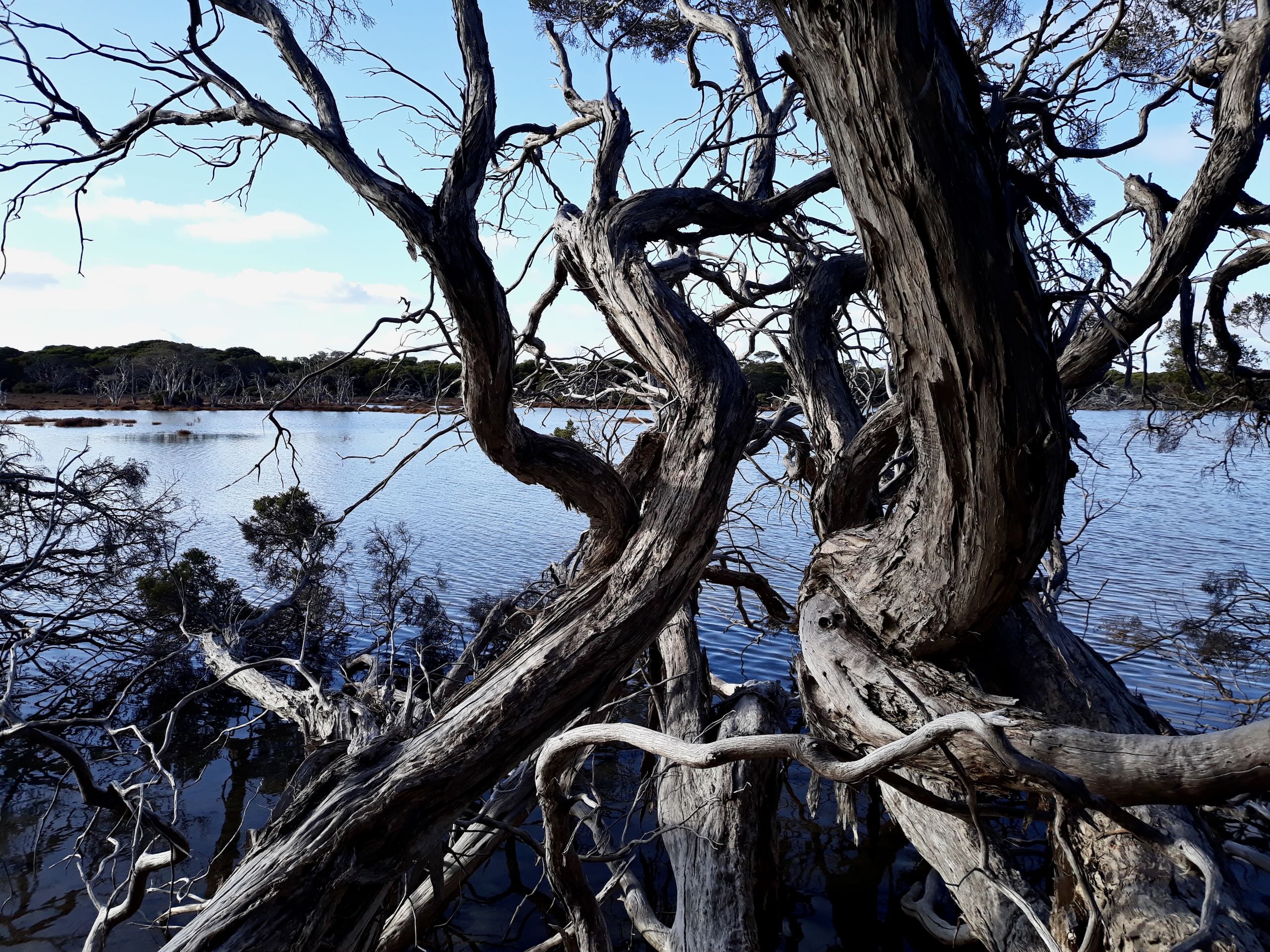
Gnarled trunk, early July 2022.

I like Rose’s matter-of-fact statement that secrets don’t have to be revealed. Sometimes, when I am uncertain about a course of action or a decision I have to make, I think of the oath that I’m told doctors must take: ‘First, do no harm.’ I find this oath, applied to life in general, one of the most useful creeds I know.

And so I find myself thinking that Rose may be right. If keeping a secret doesn’t harm anyone, then why feel compelled to reveal it? Why not learn to live in silence with one’s own truths?

Waterways, early July 2022.

Lately I’ve been reading …

Only connect: One moment apart

Other people’s words about … connection

‘We should probably go back [to the party].’
‘We?’ Lionel shook his head. ‘You can do whatever you want. I think I’ll hang out here for a while.’
Charles sighed then. There, [standing] resting his cheek against the wall, he looked a little helpless. Lionel mirrored him, turning, resting his cheek against the cool plaster.
‘You mind if I hang?’
‘Suit yourself. Not my house,’ Lionel said, but then he saw it. Relief. Charles was shy too.
‘Okay, tough guy.’
Lionel felt their breathing sync. The eye contact had reached the point of being ridiculous, but it wasn’t uncomfortable or uneasy. Lionel wasn’t even sure if they were seeing each other anymore. His own eyes had gone slightly crossed, and Charles broke up into blurry segments. But they were in another moment apart. They had returned to their own tempo, just the two of them. Lionel felt free of other people’s expectations for how he should act and be. He felt free of his expectations for himself.
It was like kindness, as simple as that.

From ‘Filthy Animals

by Brandon Taylor

In my last post a couple of weeks ago, I wrote about not having the words to describe the life I live now, the life so many of us live now. And that hasn’t changed. I’m still feeling quiet, still waiting things out. In a sense, I think the whole world is in a waiting phase right now as we move into the third year of the coronavirus pandemic.

I feel as though I’m waiting myself out, too, until things make more sense again.


Port Adelaide, February 2022.

Meantime, moments like the one Brandon Taylor describes in the passage I’ve quoted above continue to bring me succour. As Taylor tells it, this is a moment passing between two people, a moment of wordless understanding. Whatever happens next to Charles and Lionel, we know that they will be richer for this moment they have shared.

When I read about moments like this, I feel richer, too.


Aldinga Beach, February 2022.

Lately I’ve been reading …

Wordless

Other people’s words about … the things we say

All that talking, years of reading: There was a time I thought that all language might contain something of value, but most of life is flat and boring and the things we say are too. Or maybe it’s that most of life is so much stranger than language is able to make room for, so we say the same dead things and hope maybe the who and how of what is said can make it into what we mean.

From ‘Want

by Lynn Steger Strong

I’ve been posting less and frequently on my blog over the last few months, I know. And it’s not, as you might think, because I have become more active on other (more instant) social media, though I can see the appeal of posting photographs (excluding selfies) on Instagram. 


Spring flowers, Aldinga Scrub, 2021.

In fact my quietness on this blog is more to do with the fact that most of life is so much stranger than language is able to make room for, as Lynn Steger Strong puts it so wonderfully in the passage I’ve quoted above. The Covid-19 pandemic, now entering its third year globally, has left me feeling, in the truest part of me, wordless. I am surviving, for which I am grateful. I am getting on with my life. But I don’t know how to put that into words very well, or at least not in the form of a blog post. I enjoy blogging, and I like my space in the blogosphere, so I hope that this phase will pass. But in the meantime … here I am, not finding the language I need to say what I want to say.


Pathway, Aldinga Scrub, 2022.

Another reason for my quietness on this blog is that I’ve been doing a different kind of writing in my spare time recently, which is to say I’ve started writing fiction again. As I mentioned in my previous post, last year I submitted the manuscript of a middle-grade novel to my agent, who is currently trying to find a publisher for it. (No luck yet.) And now, somehow, I find myself writing a novel for adults. I don’t know whether any of the fiction I’ve written since the beginning of the pandemic will ultimately be publishable, but somehow, entirely unexpectedly, it seems that I’ve found the courage to try again, and because of that very unexpectedness, I’m allowing myself to honour my courage for now and see what happens.

Life continues, albeit quietly and unexpectedly, I suppose is what I’m saying. Sometimes I have the words for it and can compose a blog post about it and sometimes I don’t. But I will keep trying. That’s a promise.


Wordless, 2022.

Lately I’ve been reading …