The labrador and the mandala

Other people’s words about … mindfulness and meditation

I am not a fan of ‘mindfulness’. I have tried. I have really, really tried. I was first taught it in a hut in Cambodia, by a smiley, wizened old monk. The main thing I remember, as I sat cross-legged on a very hard cushion, was trying not to think about the pain in my hips. Then there was the chi gong instructor on the holistic holiday in Skyros. Then there was the hairy American at the Thai spa I thought might be a cult. By then I was used to searching for my ‘inner smile’, but I drew the line at laughing on demand while flexing the muscles of my pelvic floor.

From ‘The Art of Not Falling Apart’
by Christina Patterson

As I’ve mentioned before, I go back and forth on the topic of meditation. These days, I feel both less caustic and less flippant about it than Christina Patterson describes feeling in the passage above, but still, overall, ambivalent.

But I do respect the practice of being present, which is, I believe, the essence of the Western interpretation of mindfulness. I see the value in being able to sit with your thoughts and feelings, being able to observe those thoughts and feelings and then let them pass. Over the years, I’ve come to understand that wellbeing, at least for me, isn’t about happiness, or clarity, or contentment. It’s about co-existing: with the good, the bad, the ugly. It’s about living despite these things. Living anyway.

Some time ago, I wrote a post about how my feelings had changed, over the years, with regards to writing a journal. At the time I wrote that post, I couldn’t seem to overcome the disgust I had come to feel at the thought of returning to writing in my journal regularly, as I had when I was younger. I felt unable to bear the repetitiveness of my thoughts, spelled out on paper. I understood that journal writing had at one point served a purpose for me — the purpose of venting, and also, sometimes, of clarifying my thoughts — but that it no longer served that purpose. Or rather, that that purpose no longer served me.

This year, I contemplated trying yet again to return to a daily meditation practice. But instead, at the last moment, I decided to take the principles of meditation — that is, bearing witness to my thoughts and feelings and then letting them go — and to apply them to writing in my journal. At the time, I wasn’t sure why this decision, which felt so spontaneous, also felt so right; but I see now, a couple of months down the track, why it did. Writing in my journal each day, I’m starting to see how my thoughts and feelings and mood ebb and flow. It’s not all about despair, after all. Sometimes I write with sadness; sometimes I write with joy. Sometimes I write with boredom. Sometimes I write about myself and my inner world; sometimes I write about the things I’ve seen as I’ve gone about my day — that is, my external world.

And what I write about doesn’t puzzle me or bother me anymore. Writing so frequently, so — sometimes — inanely, I’ve learnt not to impose judgement on anything I write. I just write it, and let it go. That, to me, is, as I’d hoped, exactly what meditating is about (just without all the candles and mantras and breathing exercises).

But there are other things I like about writing (almost) daily in my journal, too, things I hadn’t anticipated. One is, I feel as though I’m not losing my life anymore. In years to come, I’ll be able to look back at these pages, as I look back now at the pages that I wrote in my twenties, and remember the woman I was. I’ll be able to remember the life I lived, the things that happened, the people I loved and lost. To me, that feels like a good thing. I’ve always wanted to live a life rich with memories, even if those memories are incredibly trivial and insignificant. Writing in my journal again is making that possible.

And finally, it’s a writing practice, too. The more I write, whatever kind of writing that is — journal writing, or blog writing, or fiction writing, or essay writing — the more I learn how to say what I want to say, and what it is, exactly, that I want to say. Journal writing, random and undisciplined as it is, is part of that process.

In the end, if nothing else, it’s another way to learn.

My 12-year-old labrador is clearly a Buddhist in training

Lately I’ve been reading about …

Meanwhile, here’s what I’ve been reading online lately:

Astonished

Other people’s words about … ageing

When I was thirty, I felt sure that a paradoxical reward awaited me at sixty, if I made it that far. Having never had any beauty to lose, I reasoned, I’d be exempted from mourning its loss. But as I’ve grown older, this proposition has turned inside out. I see now that I did have at least some beauty — not much, but some — and exactly because I had so little, I could hardly afford to lose it. Now, at this inconvenient moment, I realise that I do care about my looks. I find myself spending more energy compensating for my inadequacies than I used to. I search for becoming clothes. I color my hair. I experiment, in a gingerly [sic] way, with makeup. I suspect these efforts don’t do a lot for me, though they do make some difference, if only in letting people know I’m trying.

From ‘At Sixty-Five’
by Emily Fox Gordon

I am closer to fifty years old than I am to sixty-five: my fiftieth birthday is next year, 2020. And yet, already I understand that inconvenient moment Emily Fox Gordon describes in the passage above.

When I was a young woman — that is to say, when I was in my twenties and thirties — I went makeup-free. I washed my (uncoloured) hair and let it drip dry; I applied nothing other than sunblock to my skin (not even moisturiser). And, oh, I bought all my clothes from op-shops: jeans, shirts, trousers for work, jackets. I still remember the pretty, floral-patterned strappy dress I once bought from my local St Vincent’s op-shop to wear to a relative’s wedding, which cost $3. I happened to be very thin at that time, because of a digestive illness, and within six months of the wedding, I was well again, which meant that I could no longer fit into it. But I kept that dress for years afterwards. Every now and then, I would pull it out of my wooden chest to look at it: to run my fingers over the soft, thin, flowered fabric.

$3! To prepare for the wedding, I’d pulled the dress over my head twenty minutes beforehand, brushed my hair and tied it back in an elastic band, slipped on a pair of sandals (the only pair I owned), and then spent a couple of minutes debating over whether I’d need a (secondhand) jacket or not, because it was an outdoor wedding, and there was a cool breeze blowing through my window. And then I left for the wedding.

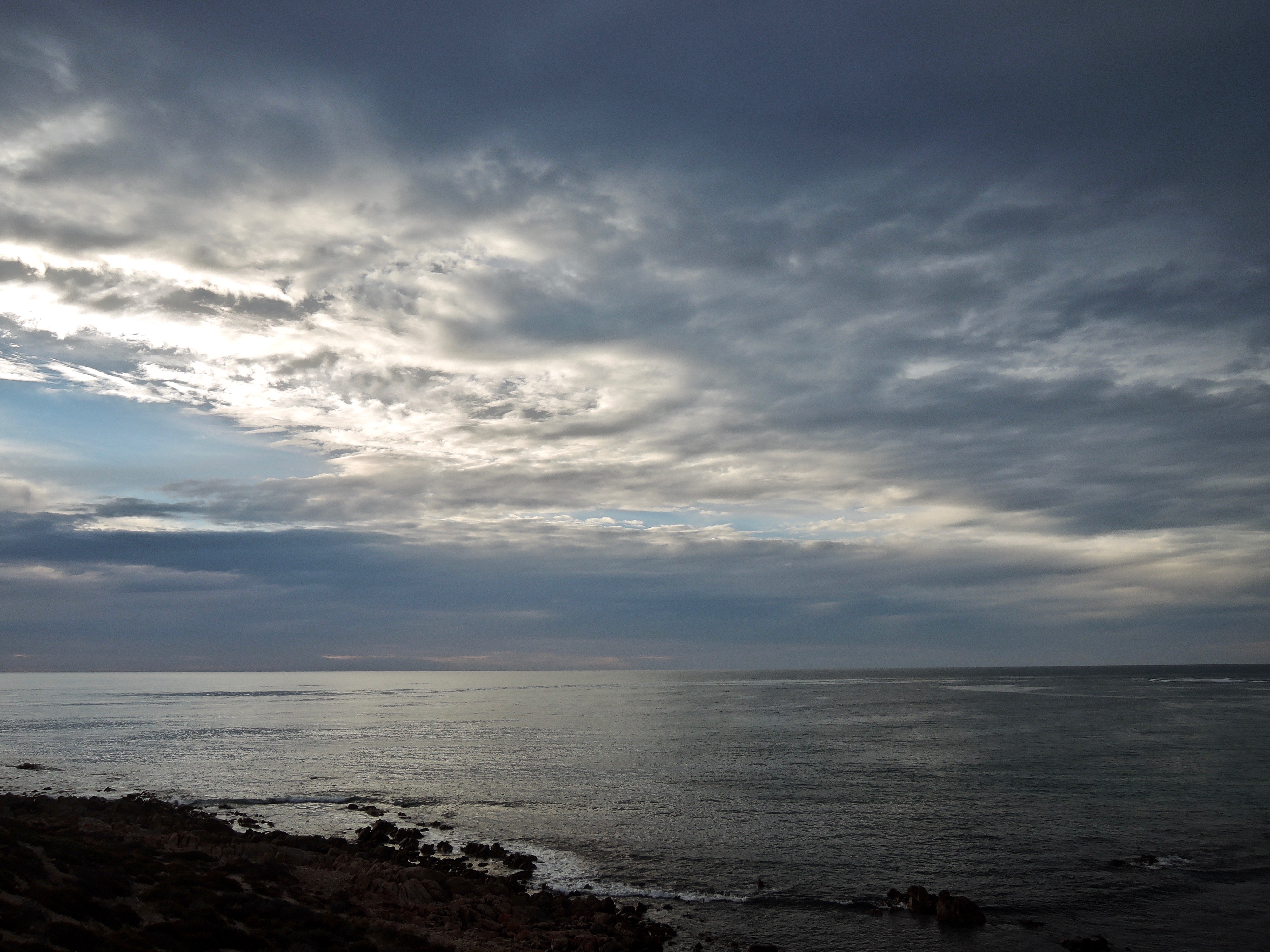
Yorke Peninsula: View from the cliffs

If you had asked me during those years what guided my fashion style, I would have said — very proudly, very innocently — that I went for a ‘natural’ look. What I wouldn’t have said, because I didn’t yet realise it, was that I went for a young, natural look. I didn’t yet understand that the word ‘natural’, when it comes to a woman’s beauty, her appearance, is synonymous with the word ‘young’. I couldn’t have understood it back then. I was too young.

*

I found Fox Gordon’s essay in The Best American Essays 2014, a copy of which I borrowed from my local library to take with me on my latest trip to Yorke Peninsula. (Yes, I’m still enjoying reading essays.) It is a short essay, as essays go, but it is wise and witty and forthright, and almost every word in it rings true for me. (You can read it in its entirety here.)

Thirty years ago I assumed I would take the eccentric route as I aged, become one of those bluff, outspoken, truth-telling old women people claim to admire, even as they avoid them. That would have been in keeping with my strong contrarian impulse. But instead of growing bolder and more heedless, I seem to be growing more circumspect, more nervously observant of the proprieties, more conscious of other people’s feelings.

Now that I’m (almost) fifty, I, too, find myself becoming more circumspect, both in the way I dress and in the way I speak and act. I feel [my age] in my invisibility to strangers, Fox Gordon writes. And it fascinates me — no, let me be honest here: it astonishes me — that as women like Fox Gordon, women like me, grow more invisible, we grow in tandem more worried about how other people perceive us. This is a contrarian impulse that we could, perhaps, never have predicted when we were younger — again, precisely because we were younger.

Yorke Peninsula again: Clouds, reflected

*

The day after I got back from Yorke Peninsula, I rode my bike to Semaphore, where I often go to buy my groceries and to borrow my library books. I parked and locked my bike outside the sushi shop, bought a sushi roll, and then wandered down the main street towards the library. There was a woman at the ATM as I walked by, her back to me as she withdrew her cash. She was around my age, or perhaps a little older: tall, lean, wearing easy, worn clothes, her hair tied back in a long, straight, grey ponytail. She had a slender face but a strong profile: short eyelashes, pointy nose. No makeup, as far as I could tell. I glanced at her as I walked by — once, and then again. Then again.

I thought of Fox Gordon. I thought of the old(er) woman I hope I will one day become. It came to me, then, that I was looking right at her, my role model, standing at the ATM in all her natural, worn, grey beauty.

There is room, I believe, for all of us. We can be contrarian, if we dare.

Yorke Peninsula again: Three clouds


Lately I’ve been reading about …

Meanwhile, here’s what I’ve been reading online lately:

An open and shut case

Other people’s words about … signs

[The waitress] leans over our table and turns the sign in the window so that it says CLOSED on the outside. But on our side, perfectly positioned between Mabel’s place and mine, it says OPEN. If this were a short story, it would mean something.

From ‘We Are Not Alone’
by Nina La Cour

I am the kind of person who, like Marin, the narrator in the passage above, can’t help seeing life through symbols and signs: I see metaphorical OPEN and CLOSED signs in my own life every day.

Lately, as some of you know, I’ve been released (at least for now) from the routine of salaried office work. I’m not answerable to an employer any more; I don’t have to be at the office at a particular time, or sign on and off at the beginning and end of my shift, or conform to a certain dress code, or take my lunch hour at a stipulated time for a stipulated duration. All of which implies a certain freedom, the kind of freedom I’ve often craved.

But I do have to hustle. If I want to get work as a freelancer, I have to go out and seek it, something I never had to do as a salaried employee. And in the daily transactions of that hustling — contacting people, letting them know of my existence and of the work I do, following up their responses, thinking of new people to contact and new ways to work — it’s all too easy to see signs everywhere I look. Someone doesn’t answer my email? That’s a CLOSED sign. Someone writes back, saying it’s lovely to hear from me? That’s an OPEN sign.

And so on.

It’s exhausting and exciting, both those things at once, and I don’t know yet where it will take me or what it will lead me to — or whether, ultimately, it will be sustainable. But for now, it’s early days, and I’m giving it a chance, and I still believe there might be some OPEN signs on the path ahead of me …

Signs and symbols: The way forward?

Lately I’ve been reading about …

Meanwhile, as always, I’ve been reading! Here’s the recent digest:

What it means to be free

Lately I’ve been reading about … how to write

Last year, I stopped writing. At the time, I wasn’t sure if I had stopped writing forever, or if it was just for a while. In my heart, I was convinced it was forever. I felt sad, but also strangely certain. I felt, very strongly, that I had come to the end of the writing I could do, and that I had to learn to let go. To move on.

A few months later, I lost my job as the Senior Editor at a university press. I felt far less sanguine about losing my job than I did about stopping writing, because it wasn’t my decision. And because I loved my job. And because I didn’t know what I would do next, or how I would earn an income. If I’m honest, I still feel all of those things now. I still don’t know what will come next.

But for now, I’m taking a break; I’m not actively job-seeking. I’ve been spending my time building a website to set myself up as a freelance editor, and … I’ve been writing again, working on an old manuscript that I thought I had abandoned forever, and feeling — at least sometimes — as though I might actually, one day, be able to finish it.

Look up. Let go. Move on.

I feel freer now to write than I did last year, or indeed than I did during the years preceding that. I don’t know why this is, except that, without the regular schedule of getting up and going to work four or five days a week, without the commitment to a tiring and demanding (though rewarding) job, my mind feels clear. And the clarity gives me courage. I feel brave enough, suddenly, to take a risk again in the creative sphere, to take the risk of failing.

Because I see now, though I didn’t see it last year when I was still deeply enmeshed in my work, that my fear of failing as a writer had, in the last few years, grown very strong. It had become, at least as far as writing was concerned, incapacitating.

It’s true that not all hardworking writers publish. Often the circumstances that drive the industry are out of our control. But the willingness to write through what might seem to be an unending succession of drafts — however you define “draft” — is one factor that you can control.

From ‘What if All Writing is Just Drafts, Forever?’
by Joseph Scapellato
At The Literary Hub

One of the things that’s so tricky about writing is that there are no rules, no surefire ways to creative success. Some writers write every day, without fail, setting themselves a target (whether that’s a word count, or a certain number of hours they spend at their desk, or a publishing deadline). They write draft after draft, like Joseph Scapellato in the passage I’ve quoted above (which you can read in its entirety here), and in doing so they find a way through to the other end: to the finished book.

But, like Heather Havrilesky in the passage I’ve quoted below (which you can read here), other writers approach writing in a less disciplined way, determined to seek only the joy, only the moments of flow.

Why is my routine so messy, random, and kind of lazy? It’s because I don’t force it anymore. I feel like my brain now knows that I don’t actually have to work that much, I just have be in front of my computer for those times when everything is flowing and it’s possible to hit that high note. I’m not going to torture myself the rest of the time.

From an interview with Heather Havrilesky
At Extraordinary Routines

Clearly, there is no one, right path that every writer must go down in order to write a book. What wasn’t clear to me until very recently, though, is that there isn’t even one, right path that an individual writer must go down in order to write a book. The process, at least for me, this particular individual writer, is a learning one. It changes with the book you’re writing, and with the years, and with the state of your (physical, mental, emotional, spiritual) health.

I still don’t know whether I’ll finish writing the book I’m currently writing, which I began so many years ago. Even if I do finish it, I still don’t know if it will be publishable. But for now, I’m grateful to be experiencing a feeling of freedom again, the freedom to be myself, whatever that means, to write because I want to write, without becoming enmeshed in either hope or despair.

Betrayed

Other people’s words about … anxiety

It took me years to work out that what the experts tell you isn’t always right, no matter how expert they may be, nor how much you may have paid them to tell you what they’ve told you. Fiona Wright explores this theme in the passage below, in relation to her own experience of searching for a cure for her anxiety — a cure that the experts she has consulted have not, despite their expertise, as yet been able to help her find.

This was not supposed to be the lesson that I learnt, she writes. And that, right there, is the power that those so-called experts can hold over us: that they can make us feel that way; that we can come to believe, from them, that there is a lesson — one particular lesson and no other — that we are supposed to learn.

It’s enough, I think, to struggle with poor health, mental or physical or both, without also coming to feel a failure for not responding to the treatment or advice that the experts offer us. Betrayal is the word Wright uses — a strong word, but it is apt.

This feeling, I was right to be nervous, is to me the worst of all the things I think and feel out of anxiety, at least in part because it feels like a cruel joke. Clinical psychologists insist that the problem with anxiety is that the anxiousness — that tension in the gut and shoulders, the clamped jaw and cramping rib cage, the wildly circulating thinking and breathless panic — is always disproportionate, always misplaced; that the fear itself, that is, is always worse than the thing that makes us afraid. And so the treatment focuses on exposure, on deliberately coming into contact with the things we fear and then coming out the other side unscathed in order to learn the hollowness of the focus (and locus) of our fear. So when I get this feeling — I was right to be nervous — it always feels like a betrayal: this was not supposed to be the lesson that I learnt.

From ‘A Regular Choreography
in ‘The World was Whole’
by Fiona Wright

Wildly circulating

Note:
Fiona Wright is an Australian poet and writer. In her essays, she writes with candid, almost forensic insight into her experience of living with chronic physical and mental illness. You can read more of her work here.

This is my work

Other people’s words about … the sea

Vale, Mary Oliver. I’m not a fan of all of her work — not by a long shot — but I do love the way she observed and wrote about nature: intimately, intricately, affectionately, quietly, humbly.

I go down to the shore in the morning
and depending on the hour the waves
are rolling in or moving out,
and I say, oh, I am miserable,
what shall—
what should I do? And the sea says
in its lovely voice:
Excuse me, I have work to do.

I Go Down to the Shore
by Mary Oliver

That lovely voice

Raw

Other people’s words about … making art

What is it that makes some artists productive all their lives, while others founder at the slightest hurdle, convinced of their own lack of talent? Are those who continue to produce art more gifted? Or are they simply more certain of themselves?

But perhaps her ambition outweighed her abilities, or else her perfectionist’s unappeasable eye scuttled what talent she had, for at art college she soon discovered she was no longer the best student — and indeed could not even capture the attention of her teachers … She was full of self-doubt, forced to recognise that a modicum of talent got you so far and no further, and that while she had imagined she was climbing the mountain, in truth she was only ever at the bottom.

From ‘The Landing
by Susan Johnson

A long time ago, just after I had had my second novel for young adults published, I talked with a woman who had just had her own first novel published. She told me that the thing she worried about most, as a writer, was that she would run out of time. She had so many more novels inside of her, she told me: so many ideas. What if she didn’t live long enough to write them all down?

I wonder now: was it an awareness of her own talent that enabled my writer friend to ask this question, or was it simply self-confidence? I don’t know. What I do know is that this was ten years ago, and she has written and published several more novels since then, and time does not appear to be running out for her. Not at all.

She made one last, honourable effort to become a full-time artist, but nothing she made satisfied her, nothing seemed original or bold or magnificent enough, everything was only half good. She strove for an aesthetic perfection she could never reach, and every day she did not reach it was a misery, the febrile pressure she placed on herself impossible to bear. She could not transfer to the canvas the perfect illuminated world inside her head; she was her own harshest critic and could not accept work she knew was not first rate. In the end, art had to be wonderful or nothing; there was no in between.

Perhaps an artist’s talent will wither away and die unless she nourishes it with a certain, requisite amount of self-confidence. Or perhaps her productivity has more to do with her courage and fortitude — with her dogged determination to carry on, free of caring — as Penny, the character about whom Susan Johnson is writing in the passages I’ve quoted in today’s post, finally discovers.

And Penny will pick up her paintbrush in an ecstasy of release … [S]he will try to make whatever she is making, imperfectly and full of mistakes. She will take long-service leave; not certain what she is going to do with what remains of her life, but certain she is making something manifest, exploiting to the best of her abilities — or the worst! — her raw materials. She is herself, no-one finer. She might travel, or she might not; her project might come to something, or it might not, but, suddenly, she will be free of caring. She will see how far she can take a line for a walk.

Perfect illuminated world

A year of words

Other people’s words about … other people’s words

I’ve been thinking about reading again recently — what it means to me, what it gives to me, why, even though it’s a solitary activity, it makes me feel connected to the world. I like Sarah Clarkson’s use of the word journey, in the passage below, to describe the act of reading. Reading, like life, is a journey. You never know where it might take you.

Reading, rather, is a journey. Reading is the road you walk to discover yourself and your world, to see with renewed vision as you encounter the vision of another … Reading is a way to live.

From ‘Book Girl
by Sarah Clarkson

Reading is a journey

PS It’s good to be back in the blogging world. I’m changing the format of my posts slightly this year, but it’s still all about celebrating other people’s words. So … here’s to another year! xo

Tip your head back and look up at the sky

Other people’s words about … the sky

Axel … breathed out, trying for calm. He tipped his head back, looked at the sky, wide and empty of trouble. His heart slowed. The moment passed.

From ‘Shell
by Kristina Olsson

Oh, that beautiful sky …

No time like now

Other people’s words about … cages

At not yet thirty, she can feel her life shrinking into the gentle sameness of her days and she knows she is pacing back and forth in a comfortable cage of her own construction. She needs someone to bump against, to disrupt things. she can’t go on like this, she knows. She must resolve the tension between longing and fear.

From ‘The Fragments
by Toni Jordan

I’m back! I’ve missed blogging. I’ve missed you all, too.

And I’ve gone on collecting other people’s words, gone on taking photographs of the world around me, gone on wanting to have a place to keep the words I’ve collected and the pictures I’ve taken. So I’ve decided, rather than ending this blog completely, as I first planned to do, to pop in every now and then with a quote I love or a photograph I’ve taken. I’d like to keep the practice up, and I hope that some of you will continue to enjoy reading the words I’ve found, or seeing the photographs I’ve taken, as you might have done in the past.

Last year, as some of you may remember, I lost my job. In the end, instead of looking for a new job straight away, I decided I would take a few weeks or months off first. And so that’s what I’ve been doing in the weeks since I last wrote: living on my savings and trying out, meantime, new habits, new practices. I’m trying to disrupt some of my old ways, like Caddie in the passage I’ve quoted above; I’m trying to stop pacing back and forth in a comfortable cage of [my] own construction; I’m trying to let my life expand, rather than to shrink. There’s no time like now!

Because there is always a way through … always

Thank you for accompanying me so far on my blogging journey. Thank you, too, to the readers who wrote to me and encouraged me to keep posting, if only sporadically: who told me I was missed. I hope you all find pleasure in the posts that are still to come.

Rebecca xo