The end of the story

Other people’s words about … writing

April has never really known loneliness until now; she has had all tastes of its dregs, like cold milky coffee curdled at the bottom of the cup, but she has always had faith in the fact that it would pass. Now, she is not so sure. And this loneliness is entangled with her failure as a musician, another certainty in her life that seems to have gone.

Most days, she tries to write.

She sits by the window with her guitar and picks idly at notes, strumming chords underneath, humming to herself as she does so. But nothing ever sticks, and she feels as if she is just pretending, playing alone outside a room she can no longer enter.

from ‘Between a Wolf and a Dog
by Georgia Blain

I did something I had never expected to do this week: I stopped working on the book I’ve been writing, on and off, ever since my last novel was published in 2010. Actually, I stopped writing fiction altogether, at least for now.

The novel I’ve been writing all these years has gone through many, many permutations: I’ve written it as a ghost story for young adults; as a reworked ghost story for middle-grade readers; as a love story for ‘new’ adults’; as a coming-of-age story for women my own age. I’ve written it in the first person and in the third person, and in past tense and in present tense. I’ve written it using pen and paper, and Microsoft Word, and Scrivener.

I’ve written it. And written it. And written it.

All the time I’ve been writing this novel, I’ve been telling myself that the doubt I feel in myself, and in my ability to write a third novel — this third novel, anyway — would pass. But it hasn’t. Sometimes it’s quietened down for a period, but then it’s flared up again. And over the years, like April, the sense of inner loneliness I carry with me — which is in part an aspect of being me, Rebecca Burton, and in part an aspect of being me, a human being — has slowly become ensnared with the doubt I feel about my writing. [N]othing ever sticks, and she feels as if she is just pretending, playing alone outside a room she can no longer enter. Yup. Yup. Yup.

Ever since I wrote my first novel and it was accepted for publication, I’ve believed, with all of my heart, that writing books was something I would do for the rest of my life, because that’s what writers do, right? It’s what they want to do. It’s their privilege, and their gift. Or so the story goes.

But I just don’t think I believe that particular story anymore. That’s what I finally realised this week, after all this time. I don’t think — as April thinks, in this passage which I have loved so much for so long — that I am a failure as a writer, or as a person, if I stop writing, for a while, or forever. I think the world is bigger than that.

I don’t know what the future holds for me if I’m not a writer anymore — for now, or for a while, or forever. But you know what? Unlike April, I want to find out.

It’s a big, big world.

Chasing clouds

‘It took me years to see that path and to find my pace.
When I finally got moving, I hoped I might be able to run forever.’

From ‘The Long Run’
by Catriona Menzies-Pike

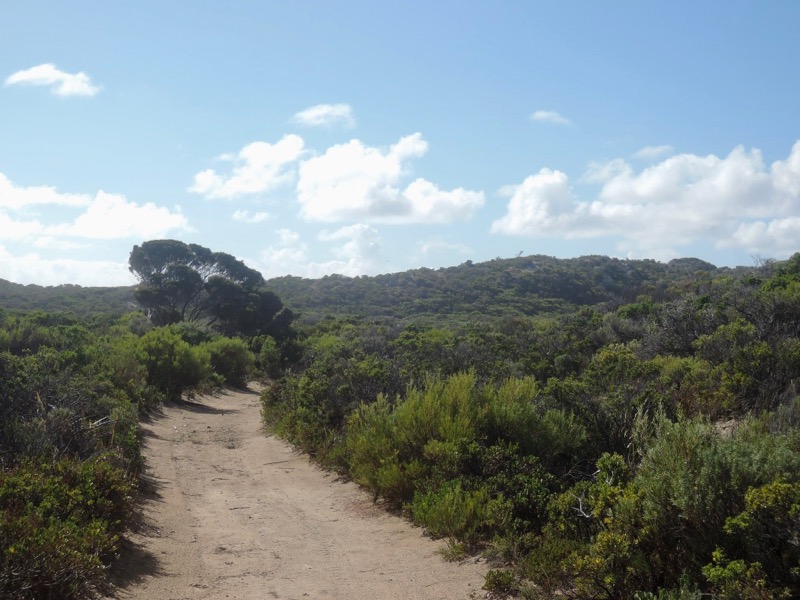
I recently spent a week holidaying in one of my favourite spots, near a clifftop in the Yorke Peninsula region. It was mid-Autumn, and the weather, like the view, changed every day, sometimes every minute.

During one of the sunnier hours, I went for a run in the bushland that lies behind the dunes and cliffs. I took off my running shoes and ran barefoot along the winding sandy track that rises and dips through the scrubland. Despite the lack of rain in the previous months, the bushland here seemed to me quite lush (at least by South Australian standards).

I finished my run at the base of the highest dune, and then I trundled up to the top of the dune to look down on the beach and shoreline below.

It was a moment of silver seas and blue skies — a moment worth celebrating.

Prayer

Other people’s words about … books

After Bunty died, days slid into one another like the colours in a sunset. Whole afternoons passed as Christabel drank tea in the kitchen … If there was a book in front of her, she would look away frequently and forget to turn its pages — she no longer read in the old, urgent way. The taste for reading had started to withdraw from her; she felt it pulling gently away, like a tide. Books contained hard truths, waiting like splinters in their pages. Over the years, many had lodged in her unnoticed. Little anticipations of life’s awfulness, they might have served as a defence against it but pierced instead with knowledge of damage, error, waste.

From ‘The Life to Come’
by Michelle de Kretser

CS Lewis once wrote that we read fiction and literature to seek an enlargement of our being; we read because [w]e want to see with other eyes, to imagine with other imaginations, to feel with other hearts, as well as with our own. I don’t subscribe to Lewis’s Christian practices and beliefs, but I do — oh, I do — subscribe to his views on reading.

And so Michelle de Kretser’s words in the passage above affected me deeply. I cannot imagine a life in which [t]he taste for reading had started to withdraw from me; the thought that the truths I treasure finding within a book’s pages might begin to feel like splinters horrifies me.

Reading for me is an activity that provides solace. The solace comes most strongly from finding kinship within the pages of the books I read: kinship with the book’s characters, and, vicariously, with the book’s writer, who created the characters. That’s not quite what Lewis is saying, but it’s part of it, I think: it’s hidden in his words. When de Kretser’s character Christabel finds herself losing the taste for reading, losing the urgency that was inherent for her in the act, what she is really experiencing is loss. Loneliness. Desolation.

If I was a praying person, as Lewis certainly was, I would offer up a prayer here, in response to de Kretser’s words. I would pray: Please don’t let me ever experience this particular form of loss.

I would pray: Please don’t let me lose the companionship of books.

I would pray: Please don’t let the tide go out.
Please.

Prayer

Downpour

Other people’s words about … having sad thoughts

Understand, for instance, that having a sad thought, even having a continual succession of sad thoughts, is not the same as being a sad person. You can walk through a storm and feel the wind but you know you are not the wind.

That is how we must be with our minds. We must allow ourselves to feel their gales and downpours, but all the time knowing this is just necessary weather.

From ‘Reasons to Stay Alive’
by Matt Haig

It was Toni Bernhard who first introduced me, in her book How to Live Well with Chronic Pain and Illness, to the idea that moods are like the weather: impermanent, changeable. She writes elsewhere:

In ‘How to be Sick’, I call it Weather Practice. I like to think of emotions and moods as being as changeable and unpredictable as the weather. They blow in; they blow out. Working with this weather metaphor allows me to hold emotions and moods more lightly, knowing that, like the weather pattern of the moment, they’ll be changing soon. One moment, life looks grey and foreboding; the next moment, a bit of brightness — maybe even a rainbow — begins to break through.

Both Bernhard and Haig are covering the same theme here, a theme that is one of the basic tenets of any kind of mindfulness practice. But while I like Bernhard’s clear, practical prose, there is something about Haig’s phrasing (despite his erratic sense of grammar) that particularly speaks to me.


Necessary weather. Those two words, paired together, feel to me immensely comforting, and true. I murmur them to myself on days when my mind and my mood feel clouded and grey like the clouds pictured in today’s post.

Call these words a mantra, if you like. They bear repeating.

Chasing clouds

‘Some athletes love to talk about what a simple sport running is.
They say that all you need is a pair of sneakers.
That’s not true.
What you need is some freedom of movement
and the ability to see a clear path ahead of you.
It took me years to see that path and to find my pace.
When I finally got moving, I hoped I might be able to run forever.’

From ‘The Long Run’
by Catriona Menzies-Pike

Around about a year ago, I wrote a post on this blog in response to lawyer-turned-long-distance-runner Robyn Arzón’s book Shut Up and Run. In that post, I wrote, in angry contradiction to Arzón, about the virtues of taking things slowly, of living humbly, of letting things unfold gently, whether or not your life is unfolding as you wish it would, or as you think it should. (You can read the post — which, by the way, I still stand by — in its entirety here.)

Here’s the thing about running, though, as an activity, as a practice: it lends itself to metaphors. That’s why so many runners, like Arzón and Menzies-Pike, write about it. Speed, distance, endurance, cadence, rhythm, pace — all of those things can be metaphors for something else: for life. It took me years to see that path and to find my pace, Menzies-Pike writes, of her running. And: When I finally got moving, I hoped I might be able to run forever.

Don’t tell me she’s not talking in metaphors.

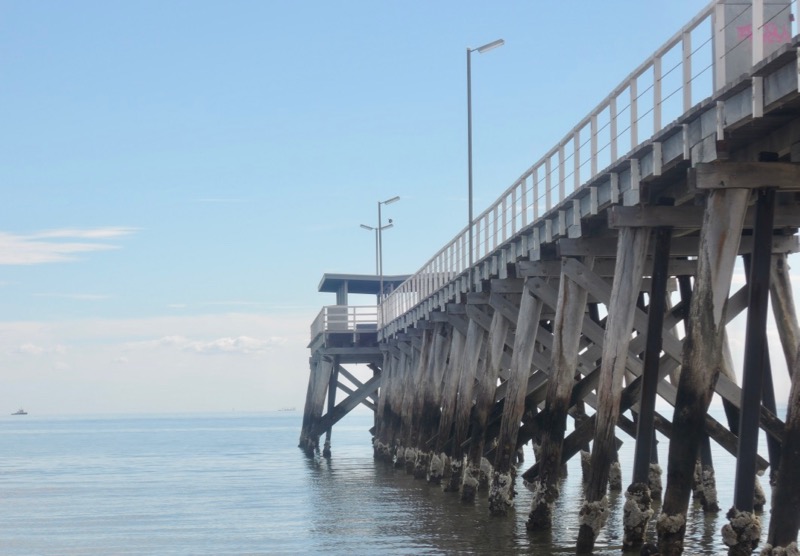
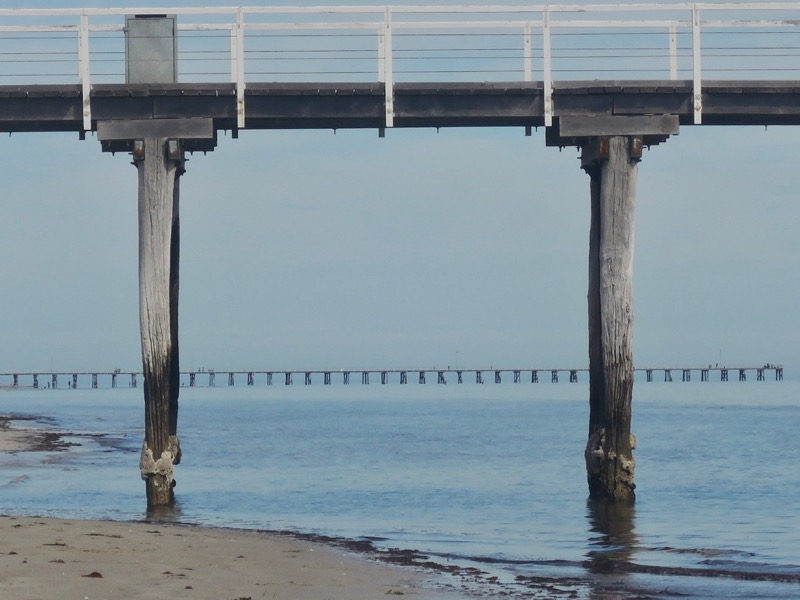
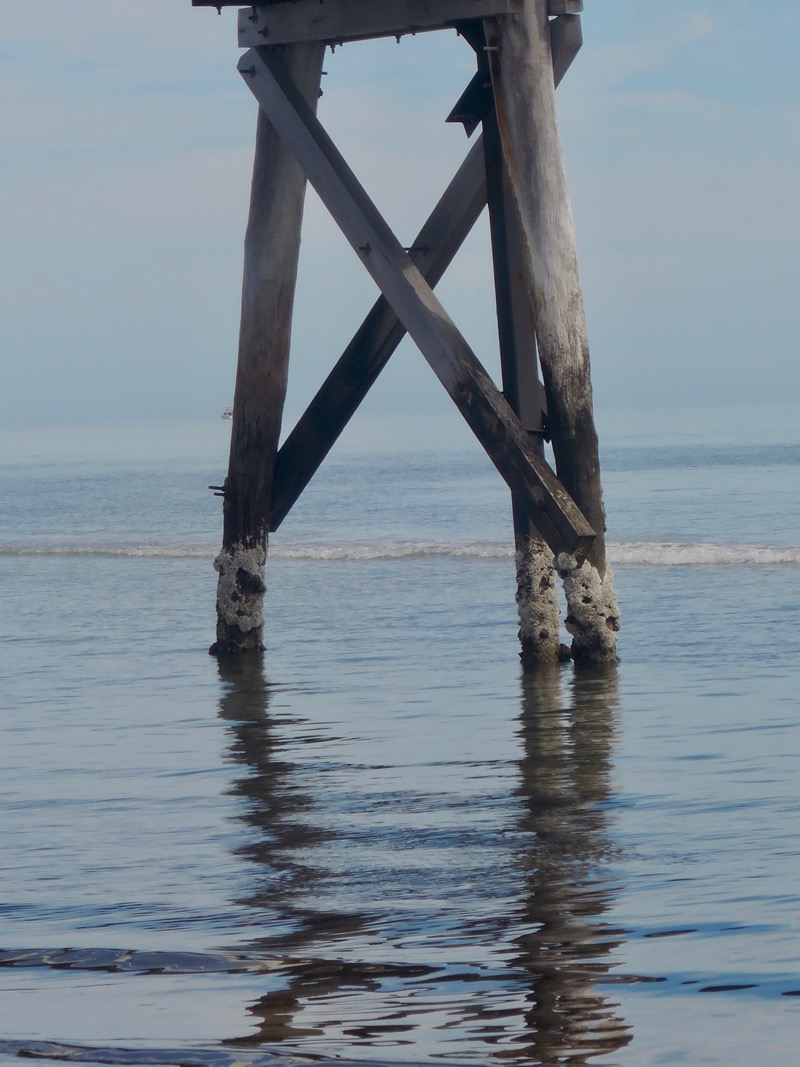
As for me, I stopped mid-run — on a gorgeous, warm, still day last week; a day when all of coastal Adelaide seemed to be bathed in soft sunshine — to take the photos you see in today’s post. Afterwards, I put my camera away and lingered at the shore a while, before wandering back from the beach to the foreshore path and setting off again, back home.

Days like that — days of running beneath a soft blue sky, beside a silken blue sea — are days, simply, to be grateful for, days that feel as though they are unfolding as they should, or at least as you wish they would.

And so this post is the first in a new series on my blog entitled Chasing clouds. It is a companion series to my Out and about series, in essence. The theme in that series is walking; the theme in this one is running. Running, for me — like walking — is about wandering, about wondering. It is about chasing clouds.

Of course I’m using metaphors. Running, for me, is about hope.

Passage

Other people’s words about … sorrow

… I tried to keep busy. I haunted bookstores, sat in cafés, drinking coffee and smoking. As the weather got colder, I went often to the Gardner Museum — for the humidity, for the scent of jasmine in the courtyard.

But of course, the truth was that I was depressed, and that waiting for me the moment I stilled was a sorrow that filled my time amply with its emptiness, that kept me very busy even as I lay open-eyed on my bed or sat at my desk staring out at the houses across the street. I tried my hardest never to still.

From ‘While I was Gone’
by Sue Miller

You know the kind of depression Miller is describing here, right? It is not so much a clinical thing, requiring medical consultations and diagnosis and treatment, as it is a thing of sorrow, of emptiness, of lacklustre wakefulness. Of restlessness. Sudden, fleeting moments of despair.

I tried my hardest never to still, Miller says, simply. You’ve done that, too, right? — tried to match the sense of endless mental pacing with an equal sense of physical pacing.

Just as there are no diagnoses or treatments, I don’t think there’s any kind of cure. I find, as with so many difficult things, that it’s mostly a matter of waiting the thing out, giving it passage, allowing yourself to see it through.

And that, for me, is where I find the stillness that Miller’s narrator describes herself trying so hard to flee. The act of waiting, of riding something out, is itself paradoxically an act of stillness. Sometimes, just knowing this can be enough.

The world out there.

And then there’s always the matter of looking up, every once in a while. Of reminding yourself that there is a world out there, to which you will return. In a moment. In an hour. In a few weeks.

In time.

Miracle

Other people’s words about … running

Soon, he is at the base of the mountains, his heart rate is at least 140, and the peaks tower over him like wild, hungry beasts. It is this moment in which Russ understands himself best. In which he could easily say, my name is Russ Fletcher, I am a man living a certain sort of life, and I am happy.This gasping moment is free of obligation, of expectation and that bruised yellow past. It is only Russ and his beating man’s heart, Russ and the cloud of his breath as it unfurls white in the cold morning, Russ and the burn, burn of his legs. The needle-prick attention of his mind, as it focuses on blazing extremities. Running, Russ is okay. Running, he moves forward.

From ‘Girl in Snow
by Danya Kukafka

I have a chequered history with running, but recently, I’ve taken up the habit on my own terms. Here’s how it goes: every day, either before or after work, I make the effort to stroll down the road to the beach, and then, once I’m on the sand, a few metres from the shore, I break into a run for a few minutes. Often, honestly, I run for only five minutes or so before slowing down, turning around and heading back home. I guess it’s as much about getting fresh air into my lungs, moving my limbs a little before or after sitting at a desk all day, feeling sand crumble beneath the soles of my feet, as it is about anything you might want to call ‘fitness’ or ‘athleticism’.

Occasionally, though — once or twice a week, if I’m lucky — I run for a longer time, for twenty minutes or so, taking my camera with me (so that I can stop along the way to take photos like the ones in this post). No matter how slowly I run, or how heavy my legs seem to become, or how tired I was beforehand, or even, some days, how sub-par I felt before I set off, there is always a moment on these runs when I feel, like Russ in the passage above, that I understand [my]self best, a moment when I feel free of obligation, of expectation, of that bruised yellow past.

A couple of years ago, when I first took up running again after a lapse of twenty years, I hoped to run for much longer times, to run much further distances. That seemed to be what every other runner did, after all. And that’s what I wanted to be: a runner.

But running is like everything else in life: what works for other people isn’t necessarily what works for me. And over the last two or three years, I’ve learned — at first to my bitter (childish?) disappointment, and then, slowly, to my joy — that I can find a way to run on my own terms and still find pleasure in it. Still find release. Still find hope. And reason. And courage. And peace. And, like Russ, who runs when he’s both joyous (as in the first quote) and terribly sad (as in the next quote), freedom.

Russ runs. He takes off down the sterile … streets … All he can do now is push — move his body, sweat it out, keep inching forward. For now, he focuses on his own limbs and the miracle ways in which they serve him. The freedom of the open Colorado sky.

I thought at first, when I couldn’t run the distances I wanted to run, the distances I thought I should run, the way everyone else seemed to, that I was giving up. It took me a while to understand that finding a way to run that worked for me wasn’t so much about giving up as it was about learning to surrender.

Surrendering is not the same as giving up. I didn’t understand this before. I am glad that I am beginning to now.

Out and about: the last summer days

‘When you’re walking the view shifts and changes.
Walking’s a form of hope.’

from ‘The World Without Us
by Mireille Juchau


Here’s the thing I always forget as summer draws to a close and the annual grey-weather dread steals over me: there are moments, at this time of year, when the wind drops, and the sea becomes shining and silken and blue.

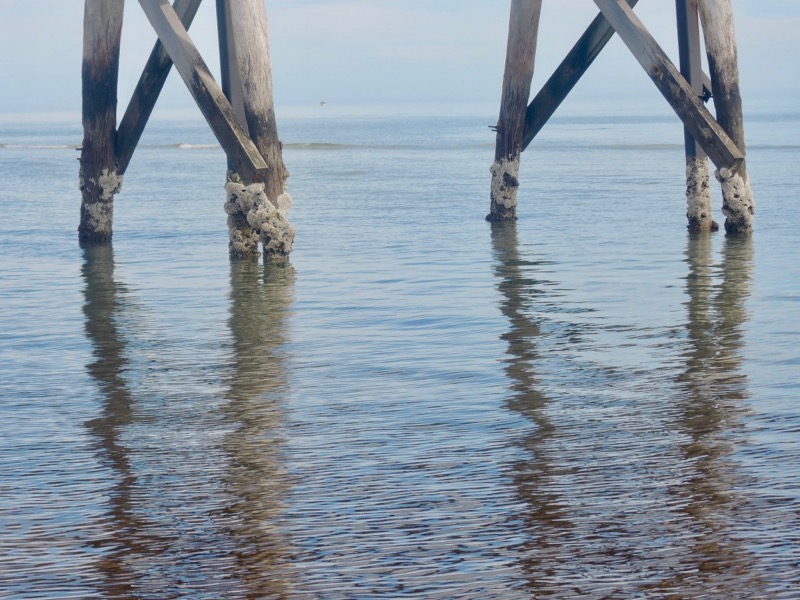
I took the photos in today’s post as I wandered the beach at Largs Bay one afternoon a few days ago, in the week before Easter. The day was so still, and the tide so low, that the pine trees along the Esplanade were reflected in small pools of seawater that had formed between the sandbar and the main ocean …

… and out on the water, ships hung suspended in blueness, somewhere between sea and sky:

It was an afternoon that reminded me that there’s joy and beauty in every season — yes, even in the seasons you’d rather not be heading into …

On labour

Other people’s words about … loneliness

Dad’s dying had been like a long labor, the work mostly his, but the experience for me was as profound, as isolating, as the labor of birth. For weeks after my son was delivered, I remember, I was stunned by it — by what I’d gone through, by how alone with it I’d felt, by how astonished I was by it, and by how isolating that astonishment was. Others held my son, admired him. They saw him simply as a big healthy baby. But when I looked at him, part of what I saw and felt was how he’d come to me, that long solitary labor, the amazing combination of agony and release that I felt I could explain to no one else. And in some nearly parallel way, this is what I felt about my father’s death. It was what I returned to frequently, it was privately where I lived, for a long time after it was over.

From ‘The Story of My Father
by Sue Miller

Let me start by explaining (hastily!) that the affinity I feel with the words in the quote above is not because I’ve ever given birth (I have not). Nor, more importantly, is it because I’ve recently experienced the death of anyone close to me, let alone my father, who is a strong, healthy, happy man whose company I hope to enjoy for many years to come. No, not at all.

I am a big fan of Sue Miller’s writing. What I most like is her attention to detail, her scrupulous examination of people’s inner workings — their thoughts, their feelings, their individual senses and perceptions — and the way she then builds on these ‘small’ things to make ‘big’ stories from them. A writer friend of mine who isn’t a fan of Miller’s books once said to me that she feels ‘dead inside’ when she reads a Miller novel. And I get that, actually. I think, in fact, that what my friend dislikes about Miller’s writing is exactly what I like: the precision, the detail, the refusal to hurry over anything, or to be swayed by sentiment or affection or a need for resolution for her characters.

I’ve explored loneliness and isolation a lot in my posts on this blog, but I thought the theme was worth returning to because of Miller’s words here. I was stunned by it, she says of giving birth, by how astonished I was by it, and by how isolating that astonishment was. This, for me, distils the experience of living itself, the realisation that each experience we have, however great or small, however joyful or devastating, is an experience we feel we [can] explain to no one else.

In the last couple of years, whenever I’ve experienced bouts of unwellness or anxiety (or both, combined) that have left me feeling isolated at home, struggling to go out, struggling to get to work or to catch up with people I love, I have found myself, afterwards, return[ing] to those experiences repeatedly in my mind; I have found that those times of illness were, for a while, privately where I lived.

Miller’s use of the word labor here refers only to giving birth, but the passage applies to other things, too, if you reframe it: to the labour of living, of loneliness — yes, to that astonishing labour.

And yet, still, it is worth labouring on.

Out and about: at lunch

‘When you’re walking the view shifts and changes.
Walking’s a form of hope.’

from ‘The World Without Us
by Mireille Juchau


I haven’t done an out and about post for a while, so I thought it was time. I recently quit my job at the call centre in order to concentrate on my work as an editor, where my workplace is in the city centre …

… which means that my lunch-break strolls haven’t stopped, but they have certainly changed.

It’s easy to be tempted by shops when you work in town (books! clothes! books!), but the other day, on a late lunch break, I headed north towards the river as I left my office, rather than south towards the shops.

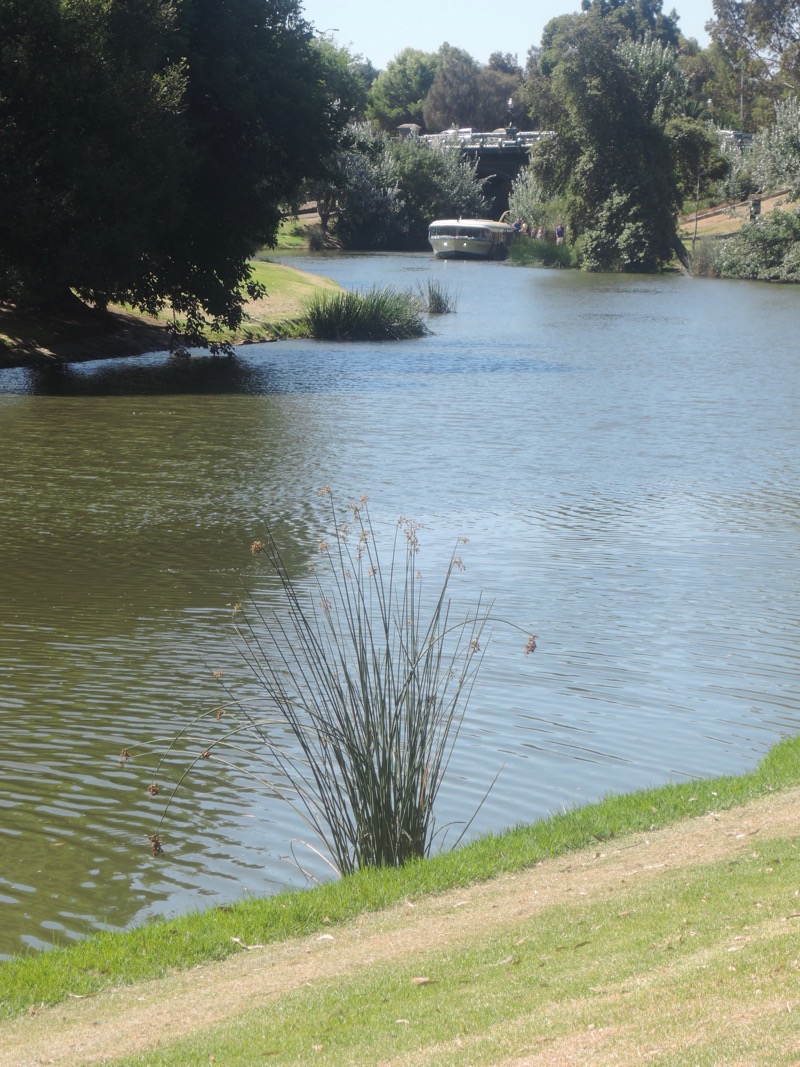
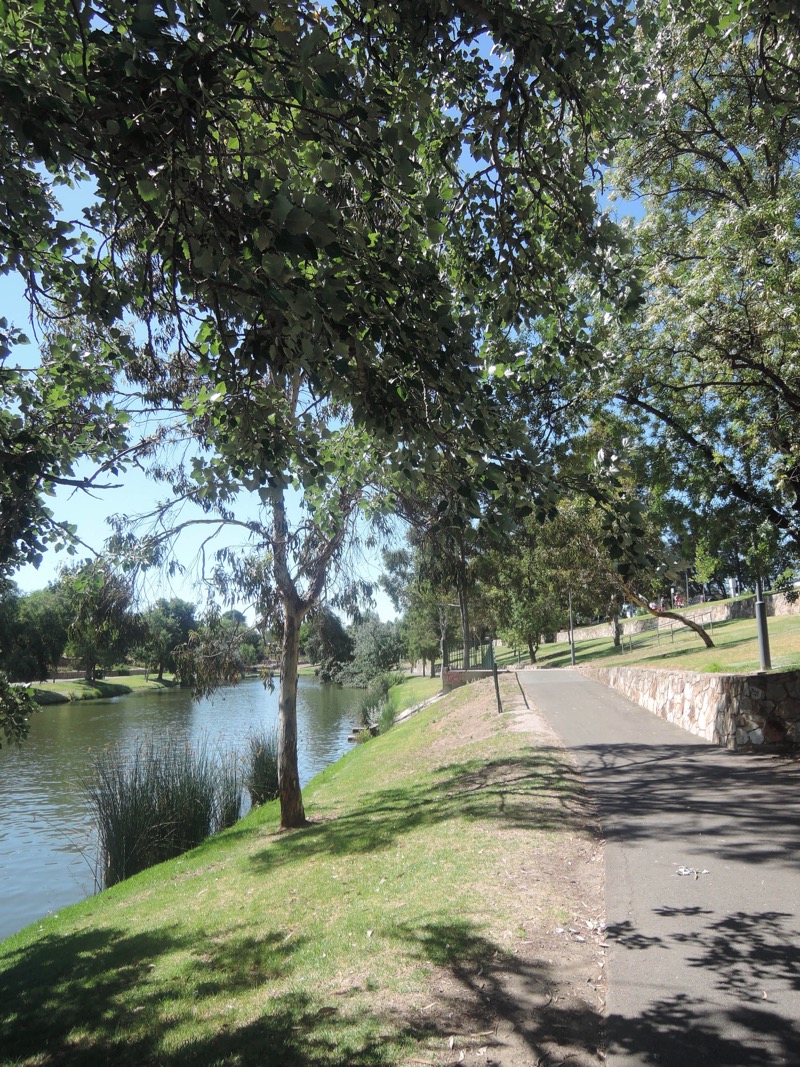
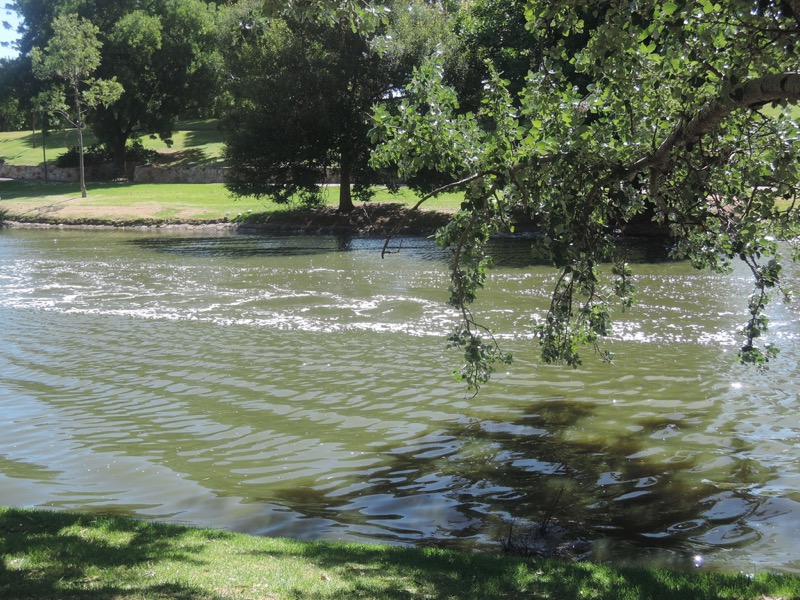
Five minutes north of my office is the River Torrens — the perfect place for a lunchtime stroll.

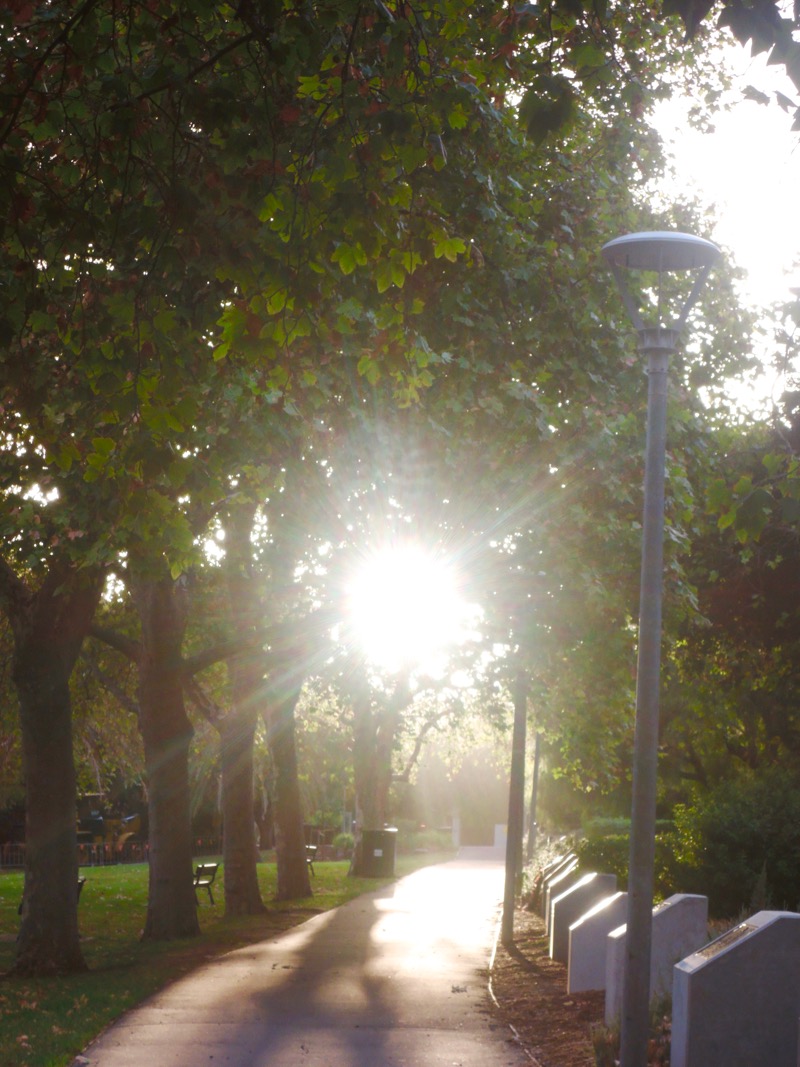
This particular day was one of those lovely January days, as I hope my photos on this post demonstrate: warm and sunny, with soft blue skies and a gentle breeze ruffling the water …

… There were ducks and moorhens paddling about, and the grass, which had been recently mown, smelt dry but sweet.

January is one of my favourite months of the year, as far as the seasons go. It’s usually sunny, and though the days are mostly warm, the temperatures rarely rise to stifling. It’s the ideal month for strolling, walking and wandering.

I plan to come back to the river in my lunch break again soon …