Grasp

Other people’s words about … reading

After most of my long days at work, I would arrive back at the flat, pour myself a glass of wine or vodka and read, mainly short stories and poetry. I wasn’t reading novels because I didn’t want that kind of continuity; I didn’t want to carry over any part of narrative from one day to the next. Sometimes I read poetry in languages I didn’t fully understand — with a sense of the meaning, but reaching for it, grasping after it. One of my other pleasures was smoking, but I didn’t dwell or savour; I narrowed it down to lighting up and the first few drags — after that I lost interest. I read like I smoked: fixating on my new favourite in its entirety to begin with and then honing in on the exact phrase or phrases that gave me the fix, then reading only for those, discarding the rest and when that poem had been emptied out, moving on to the next.

from ‘Signs of Life
by Anna Raverat

I’m not a smoker and I love reading novels far more than I do short stories or poetry, but still, I found myself smiling in recognition when I read the narrator’s description in the passage by Raverat above about her approach to reading. I experience myself, these days, as a greedy reader — greedy for beautiful words, phrases, images, moments, greedy for the fix they give me, while often the plot or theme of a novel remains distant or abstract to me.

Pathway, Sellicks Beach, July 2023.

Reading has been an important part of my life for as long as I can remember, though the reasons for its importance to me has varied over the years. These days, it feels like an escape for me from the world, or perhaps more accurately an escape into someone else’s world — that world they create with their words. And, like anyone addicted to their fix, I’m not about to give it up.

Little green bench (a place to read in when the warmer weather returns?)
Sellicks Beach, July 2023.

Lately I’ve been reading …

Today’s reading list is exclusively about animals and pets — for all the animal-lovers out there! xo


Ravaging

Other people’s words about … growing older as a woman

The things they don’t tell you about menopause are multiple and ever-changing, newly horrifying with every fresh wave.

I know there are positives. Apparently you no longer care what people think about you. Apparently you have come into your power, you are a wise elder, you don’t give a shit about what anyone else might say.

Only you do. The thing no-one tells you about menopause is that you look like you don’t care because your face is set that way, because you get used to trying not to care until you imagine it is true. But you do care. It is ravaging and you do care, you really do.

from ‘Fat Girl Dancing
by Kris Kneen

I can’t think of a time when I didn’t care about what other people think about me. I have always been someone who cares too much about this, who compares myself with others and finds myself wanting in every way I can think of to be found wanting.

This hasn’t changed as I’ve got older. Like Kneen, I’ve heard the truisms around ageing; I’ve listened to and read the interviews in which famous older women tell their interviewer that at fifty/sixty/seventy they feel wiser/calmer/happier/more beautiful than at any previous stage in their life — and I’ve believed them. (Let it be said, I am somewhat suggestible when it comes to what other people say. It comes with the territory.)

Sunset, Taperoo Beach, June 2023.

I was thinking, when I first read Kneen’s words, about writing a post here about how we as women are objectified; about how that’s why, when we reach menopause, we feel the way Kneen describes; about how, though objectification feels odious, being silently discarded feels even worse. But this morning as I sat down to write this post, I found that what I wanted to say was something else.

What I really want to say is that one of the things I have come to realise as I grow older is that the pieces of received wisdom I’ve absorbed over the years rarely work for me when I try to apply them to myself. Over and over again over the years, I’ve had to discard those generalisations — about living, about being a woman, about growing older, about finding some level of happiness or contentment or peace — and find my own truth.

At fifty-two, I certainly don’t feel that I am coming into my power, and I could not feel further from being a wise elder. But I do know that in the years that lie ahead of me, if I am lucky enough to live them, I will continue to need to find my own path through life. I will continue to need to turn away from those truisms and pieces of received wisdom about how my life should appear to me. And I will continue to need to be less suggestible. Because I do care; I really do. I always will.

Black and white, Taperoo Beach, June 2023.

Lately I’ve been reading …

How to write

Other people’s words about … writing (and shame)

The voice I wrote with felt new to me — unrestrained. For years I had been trying to cool down the temperature of my writing, to pull it back, pull it back, pull it back — neutralise it, contain it, make it crisp, clear, and sharp, every word carved out of crystal. This writing was nothing like that — it was drippy, messy, breezy. I was working through a mind frame, not a conceit. I was creating a world, not words on a page.

from ‘Vladimir
by Julia May Jonas

There is a practice called Loving Kindness Meditation that I first encountered some years ago when I was participating in a forty-day meditation challenge that involved raising money for a particular charity by pledging to my sponsors to meditate for ten or more minutes every day for forty days. Although I tried many different kinds of meditation during those forty days, and although ultimately I didn’t keep meditating after the challenge was over, the idea behind Loving Kindness Meditation has stuck with me. Essentially, this kind of meditation is about generating, through your meditation practice, kindness and love to other people — as well as to yourself.

There’s a quote by Femi Kayode about writing that I keep close to me whenever I myself am writing. I don’t remember where I got the quote from, and I’ve tried but failed to trace it back to its source. In it, though, Kayode says:

Most of all, write in love. Love for the characters — good or bad, and the story. Love for the reader, for the craft, for humanity. An unconditional compassion for the human condition is the one true gift I believe a writer can give the world.

I thought about Kayode’s words when I came across the passage I’ve quoted at the start of this post, from Julia May Jonas’s wonderful novel Vladimir. The narrator in Vladimir is, like me, a middle-aged female writer who has had two novels published early on in her writing career but has struggled to bring out a third novel. Now, when I think about the ten years I spent between having my second novel for young adults published and submitting my third manuscript to my agent, a novel for middle-grade readers that remains as yet unpublished, what I remember most is how I wrote and rewrote the same manuscript, then wrote and rewrote it some more, all the while trying to perfect it — all the while not understanding that there is no such thing as perfect, and that the search for perfection can take you a long way away from the place you started, that place of excitement and hope.

Stormy skies over the Port River, Port Adelaide, February 2023.

I mentioned recently that I’ve now begun working on a fourth manuscript, a literary fiction novel. This time around, in an attempt to break free of the tangle of lonely perfectionism that I’d somehow found myself ensnared in during the writing of my third novel, I’ve deliberately sought feedback from readers early on in the process. Predictably, some of the feedback I’ve received has been positive, and some less so. Your writing lacks introspection, one reader said. And: We never really get to know or understand your narrator, so it’s hard to care about what happens to her.

To be honest, I was a little shocked when I got this feedback. I thought I’d been writing with great restraint; I thought I’d been ‘showing, not telling’; I thought I’d been practising the principle of ‘less is more’. All those old writing saws. But I’ve slowly come to see, as I’ve mulled this feedback over, that in writing this way I’d been falling into the same trap as Jonas’s narrator, trying to carve my words out of crystal. To neutralise my writing. To contain it. To pull it back.

And here is where I find myself returning to the idea of loving kindness and compassion that I began this post with. It’s okay to try to improve your writing, to see the flaws in it and work hard to make it better: more interesting, perhaps, or more insightful, or more moving. But trying to improve your writing isn’t the same thing as condemning it. Because what is the act of trying to neutralise your writing other than a reflection of your own self-doubt and self-hatred? What is the act of trying to contain your words and thoughts other than a reflection of the shame you feel about yourself? What is this whole painful process, other than a way of saying to yourself that your writing is not good enough? That your characters are not good enough? That you, by extension, are not good enough?

Calmer waters, the Port River, Port Adelaide, February 2023.

In the end, what I’ve learned from all of this over the last few weeks (or perhaps over the last ten years) — what I’ve learned from Jonas’s words, and from the words of those people who were kind enough to read my manuscript and give me feedback, and from, finally, the words of Kayode — is that writing, any kind of writing, can’t come from a place of shame.

If, as a writer, you ask your readers to care about your characters, then you have to allow yourself to care about your characters, too. You have to write from a place of compassion. You have to write — yes — in love.

Lately I’ve been reading …

Speak

Other people’s words about … despair

She sat across from him. For some reason, he removed his glasses and set them on the gold table. His naked eyes were as dark as the burnished leather they sat on and held a startling amount of despair. The effect struck her as indecent, as if he’d disrobed. ‘Put your glasses back on,’ she wanted to tell him. ‘For God’s sake.’

from ‘Vacuum in the Dark
by Jen Beagin

I’ve been thinking a lot recently about the things people say to each other and the things they don’t. And about subtext, which is not quite the same thing but is part of it all the same.

Over the last couple of years, having written and submitted a middle-grade fiction manuscript to my agent which has as yet to find a home with a publisher, I’ve been writing a literary fiction manuscript. I haven’t mentioned this here till now, in part because my writing in that area is still so new and tentative, and in part because when I say the words, ‘I am writing a literary fiction manuscript’, all I hear is my own internal mocking laughter.

You? says the voice in head, that little internalised voice. How could you possibly presume to have something to say in the literary fiction field? How could you assume that much writing talent of yourself? That much wisdom?

Bracken fern, light and shadow, January 2023.

It’s impossible to say whether what I’m writing will ever be something complete, let alone publishable. That’s the risk any writer takes, whether they have had previous books published, as I have, or not. But what I am writing about in that manuscript is in part what Jen Beagin describes so beautifully in the passage I’ve quoted above: our unwillingness to witness each other’s despair. Our inability to talk about it or bring it to light. Our constant need to reassure each other with upbeat, optimistic conversation and good cheer.

I am not by nature a cheerful person. Nor am I an optimist. Nor am I a skilled conversationalist. At fifty-two, I still find myself getting midway through a conversation with another person, only to realise that I have revealed too much of myself: my fears, my doubts, my sadnesses. (Actually, ‘I still find myself’ is the wrong way to put this; in fact, the right way to put this would be, ‘I increasingly find myself’.) Maybe this isn’t evident to the person I’m talking to, or maybe it is. I’m never sure. But I often feel like the man Beagin describes in the passage above: glasses off, the truth in my eyes revealed. This is not a comfortable place to find myself.

But increasingly I believe in the importance of confronting the secrets we see in other people’s eyes. I believe in meeting those secrets head-on. I believe in talking about them. Perhaps what I am saying here is that secrets don’t have to be the subtext to the conversations we have with other people: they can be the essence of our conversations. They can be where we meet.

Common everlasting flowers, January 2023.

Lately I’ve been reading …

A question

Other people’s words about … therapy

My scores and answers [on the psychology questionnaires] indicated, among other things, [the therapist] had said, a lack of excitement about the future. Sleeping a great deal or sleeping very little. An ongoing melancholy.
My laughter burbled up again, helpless, irrepressible. It was the first time I had been this disrespectful to a grown-up.
If you ‘cured me’ of all of these, I told her, I don’t even know who I would be. It would be like getting lobotomised. I would not recognise myself.
Setting the clipboard down, I thanked her, still chuckling lightly. Walked out.
What the questionnaires had not asked that might have been useful to me:
Do you wake up each day for yourself or for someone else?
Do you believe your life to be your own?

from ‘All This Could Be Different
by Sarah Thankam Mathews

I’ve written before about how, many years ago now, I quit therapy. I’d been seeing a therapist for many years, but I’d come to the conclusion I couldn’t see him anymore. That therapist — I still remember him with great respect and affection, and I still remember my last session with him with great rage. I think my rage had been growing for some time, and I think, if I am honest with myself, that it was as much about what I felt my life might look like post-therapy than it was about the therapist himself, or about any failure I accused him of that day. Nonetheless, I did accuse him.

I told my therapist that day that I left each session with him feeling sadder than I did when I arrived. I told him that I was tired of the words ‘recovery’ and ‘cure’ when they were used in reference to my sadness. I told him, repeatedly, that this language we used in our sessions, which was the language of illness, made no sense in the context of my sadness. I told him that I didn’t want to speak this language anymore. And I left.

In my time I have filled out many questionnaires like the ones that the therapist in All This Could Be Different asks the narrator, Sneha, to fill out. And like Sneha, I’ve been given labels to use about myself as a result of the findings from those questionnaires. Ultimately, though, it’s the stuff I feel that isn’t diagnosable that is the hardest to sort through. To live with.

What would therapy be like if the first questions our therapists asked us — the questions our therapists repeated to us at every session — were Sneha’s two questions? What would life be like if those were the two questions we asked the people we love when we were worried about them? I don’t know. Sometimes I feel as though I’ve been trying to have that kind of therapy, that kind of conversation, all my life.

Tell me, do you wake up each day for yourself or for someone else? Do you believe your life to be your own? And what does it mean if your answer to both of those questions was ‘no’?

Lately I’ve been reading …

Replenish

Other people’s words about … being alone

As the train left the station, I felt a sense of relief. I wanted to walk in the woods and among the trees. I wanted not to speak to anyone, only to see and hear, to feel lonely.

from ‘Cold Enough for Snow
by Jessica Au

I’ve been thinking a lot this year about solitude and loneliness, about participating socially and withdrawing. Though popular scientists and the mainstream media continue to exhort us to maintain our social connections as we age, both for the health of our brain and for our psychological wellbeing, I have come to believe that it’s just as important to be comfortable in your own skin as it is to be comfortable in a social context.

Garden pickings (1), October 2022.

Some years ago a friend said to me that what she admired most in me was that I am a person who has a rich inner life. I have often thought about her words and what they might mean. I tend to think of myself as introverted and shy, a social choker, and I often find myself wanting because of this. But the truth is that when I let go of my expectations of myself as a social creature, I am happy wandering the avenues of my mind.

I think that’s why I find such accord with Jessica Au’s words in the passage I’ve quoted above. What if loneliness wasn’t just a negative version of solitude? Why not embrace it for itself? In fact, why not seek replenishment from it?

Truly: why not?

Garden pickings (2), October 2022.

Lately I’ve been reading …

Roar

Other people’s words about … country and city life

Ramesh was used to the sounds of the suburbs. He never noticed barking dogs or level crossings. On the train to work every morning he turned up the volume of his audiobook so it was louder than other passengers’ mobile phone conversations. But [tonight he was in] the country [and it] roared. He could hear the air move in the trees. He had grown up in Croydon, moved to Glasgow at seventeen, back to London at twenty-three, then Sydney at thirty-six. As a child he’d stood outside his parents’ bedroom listening to his father’s whistling snore. He liked living in places where he could hear others alive. He reached for his phone where it sat charging. For an instant he saw his hands illuminated in the bluish light of its screen. He set his rain sound app to the setting called ‘Harbour Storm’.

‘What are you doing?’ Henry croaked. His face was pressed to the pillow. ‘You don’t need that tonight.’ 

Ramesh opened his mouth to argue, then he heard the rain outside, like gunfire on the corrugated iron roof.

from ‘Pulse Points
by Jennifer Down

I love this passage, not because I’m in accordance with Ramesh, but for the opposite reason. I love the ‘roar’ of the country. I spend most of my time living in a house in the suburbs. It’s close to the beach, which I love, but it’s even closer to the railway line, a line that trains zip up and down every half an hour from five in the morning until midnight.

Sunset, early August 2022.

I don’t mind the sound of trains, actually — as suburban sounds go, I find it vaguely comforting — but when I leave my house to stay outside the city, to visit Aldinga Scrub or to camp in Yorke Peninsula, I feel a knot inside my chest of which I wasn’t even aware releasing itself.

Sounds I love when I am away from the city: the dull roar of the ocean at the end of the road (yes, another roar). The whistle of a hot wind through the trees. A frogmouth letting out its low, persistent, booming call at dusk. A shrike thrush singing. A magpie warbling. Frogs croaking. Insects clicking in the grass. And, yes, like Ramesh, the rain drumming on the roof.

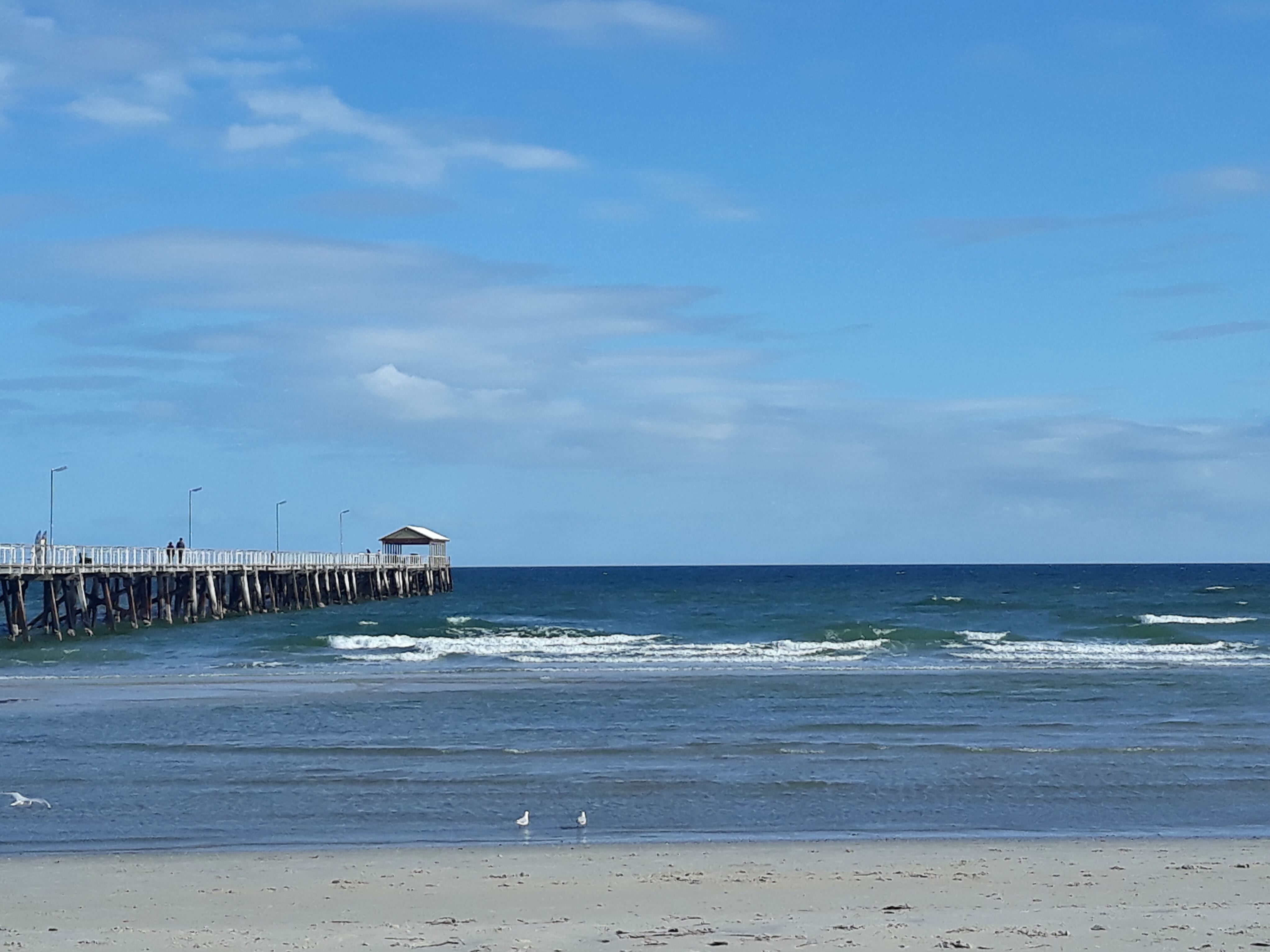
Still, the photo accompanying my post today, like so many of my photos on this blog these days, comes from the suburban beach at the end of the street I live on. The sand is being eroded away and there are car parks dotted along the coast line and on most weekends a food truck selling hot donuts sets up shop during daylight hours.

But it’s still the beach. It’s still wide and beautiful and open and … The sea still roars.

Lately I’ve been reading …

It’s a lengthy list today, because I’ve been reading far more than I’ve been posting. But I hope you find something interesting below.

Mysterious

Other people’s words about … ageing (yes, again, but bear with me …)

I was not a happy or a healthy young person. I had chronic asthma exacerbated by smoking; I was unfit; my diet was ordinary. ‘Orphaned’ by 29, I spent most of my 20s and 30s in grief. I was deeply anxious with little confidence, my fretful neediness causing relationship problems. For many of those years, I cried every week.
The day I turned 50, I felt a mysterious surge of what I could only think of as power. A deep optimism, energy and peacefulness took up space inside me. Give or take a few crises since, it hasn’t really left. In my mid-50s, I’m physically and emotionally stronger, healthier, more calmly loved and loving, more productive, more organised, smarter, wealthier and exponentially happier than I ever was in my youth. In the past four years I’ve really cried about three times, on one occasion because a good friend died.

From ‘The Luminous Solution

by Charlotte Wood

In my last blog post I talked about how a feeling of invisibility is something many women complain of experiencing as they grow older — and about how that feeling of invisibility doesn’t have to be (only) a negative experience. I talked about how feeling invisible can confer a certain grace and dignity to the way we live our lives.

It was my mother who reminded me subsequently of Charlotte Wood’s words about ageing. I have heard other women in their fifties and sixties express similar things and while so far I can’t say I share their feelings or their experiences, I find a certain comfort in their words. In my early fifties, I am, unlike Wood, neither more energetic nor healthier than I was as a younger woman; nor am I more productive or smarter. And I certainly don’t cry any less frequently.

And yet. The words optimism and peacefulness resonate deeply with me. I have fewer expectations of life than I did in my twenties and thirties — less hope, perhaps, but also, strangely, more joy.

Optimism, peacefulness, hope, joy. These are all invisible things. Maybe that’s what makes them feel so profound.

Shining sea, Late May 2022.

Lately I’ve been reading …

Spectrum

Other people’s words about … being invisible

Sandra is the contrail of light left on the back of the eye by the sun. Like so much of Muriel’s life she is invisible. Muriel thinks that there is some dignity in that, yet it leaves a life so immaterial it may be erased in a blink.

From ‘On Swift Horses

by Shannon Pufahl

The older we get, the more invisible we feel, or so the story goes — particularly if you are a woman. I think it’s natural to feel some grief in response to this. For so many of us, it can feel as though we are losing something — our sex appeal, perhaps, or our looks, or our matriarchal role in the family, or our authority in the workforce.

Ragged sky, May 2022.

When I was a younger woman I was proud of how articulate I was. I was fluent with words, both spoken and written, and I felt that people were listening to me, hearing me, because of this. As the years pass, though, I feel this less and less. Moving from early to middle age and beyond feels to me like a process of being muted. That’s not the same thing as feeling invisible, I know, but it’s clearly on the same spectrum.

But I like Shannon Pufahl’s perspective on invisibility, particularly invisibility of the female kind. I like the way she weighs up both the dignity and the immateriality of an invisible life, its grace and its insignificance. It seems to me a metaphor for everything that we think of when we talk of a person’s life: the sorrow of it. The joy.

Ragged sea, May 2022.

Lately I’ve been reading …


Only connect: Reunion

Other people’s words about connection

Maude cranes around to look and Cormac looks too, close enough to see them, all quite young and glacially made up with one man of height and handsomeness towering over the rest and another, a man to the tall one’s left, cocking his head and nodding in Cormac’s direction meaningfully.
It is Senan. Cormac waves …
He hasn’t seen Senan in person for months and yet his vision still telescopes in, urgent and unreconstructed, so that Cormac sees and knows again he loves him with a scratchy passion that returns as reliably as a rash. It is not a nostalgic feeling and casts no shadow, existing always in a self-sustaining now.
How acute it is: immediate deja vu.

From ‘We Were Young

by Niamh Campbell

I love this passage from Niahm Campbell about a man reuniting with someone he loves after the two of them have spent some time apart. Cormack, the character in Campbell’s novel, seems unable to commit to one person, whether man or woman; he moves from one relationship or liaison to another. But as a backdrop to all his attempts to remain unfettered there is his love for Senan, a man who is smart enough, perhaps, to keep himself unavailable and therefore always desirable and lovable.


Sunlight and trees, April 2022.


Who hasn’t at some time in their life loved someone who was unavailable? Or, moving beyond relationships and intimacy, who hasn’t wanted something that was eternally just out of reach?


Grasstree, May 2022.

Lately I’ve been reading …