Passage

Other people’s words about … sorrow

… I tried to keep busy. I haunted bookstores, sat in cafés, drinking coffee and smoking. As the weather got colder, I went often to the Gardner Museum — for the humidity, for the scent of jasmine in the courtyard.

But of course, the truth was that I was depressed, and that waiting for me the moment I stilled was a sorrow that filled my time amply with its emptiness, that kept me very busy even as I lay open-eyed on my bed or sat at my desk staring out at the houses across the street. I tried my hardest never to still.

From ‘While I was Gone’
by Sue Miller

You know the kind of depression Miller is describing here, right? It is not so much a clinical thing, requiring medical consultations and diagnosis and treatment, as it is a thing of sorrow, of emptiness, of lacklustre wakefulness. Of restlessness. Sudden, fleeting moments of despair.

I tried my hardest never to still, Miller says, simply. You’ve done that, too, right? — tried to match the sense of endless mental pacing with an equal sense of physical pacing.

Just as there are no diagnoses or treatments, I don’t think there’s any kind of cure. I find, as with so many difficult things, that it’s mostly a matter of waiting the thing out, giving it passage, allowing yourself to see it through.

And that, for me, is where I find the stillness that Miller’s narrator describes herself trying so hard to flee. The act of waiting, of riding something out, is itself paradoxically an act of stillness. Sometimes, just knowing this can be enough.
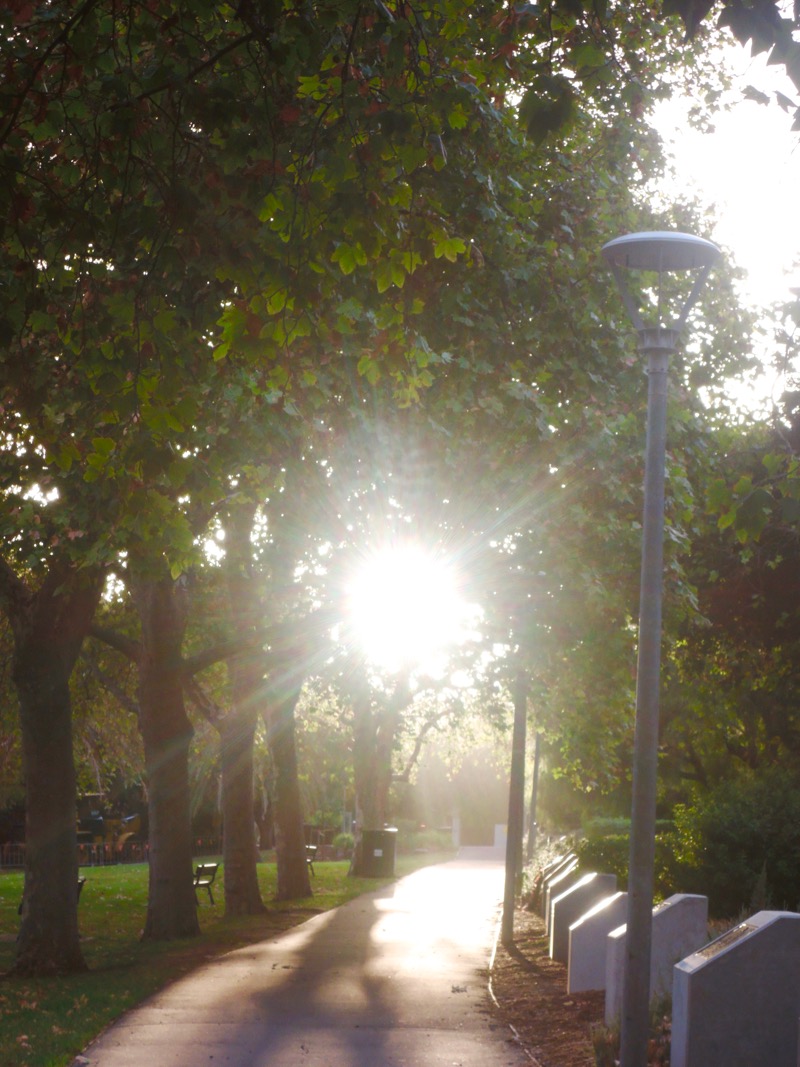
The world out there.

And then there’s always the matter of looking up, every once in a while. Of reminding yourself that there is a world out there, to which you will return. In a moment. In an hour. In a few weeks.

In time.

Miracle

Other people’s words about … running

Soon, he is at the base of the mountains, his heart rate is at least 140, and the peaks tower over him like wild, hungry beasts. It is this moment in which Russ understands himself best. In which he could easily say, my name is Russ Fletcher, I am a man living a certain sort of life, and I am happy.This gasping moment is free of obligation, of expectation and that bruised yellow past. It is only Russ and his beating man’s heart, Russ and the cloud of his breath as it unfurls white in the cold morning, Russ and the burn, burn of his legs. The needle-prick attention of his mind, as it focuses on blazing extremities. Running, Russ is okay. Running, he moves forward.

From ‘Girl in Snow
by Danya Kukafka

I have a chequered history with running, but recently, I’ve taken up the habit on my own terms. Here’s how it goes: every day, either before or after work, I make the effort to stroll down the road to the beach, and then, once I’m on the sand, a few metres from the shore, I break into a run for a few minutes. Often, honestly, I run for only five minutes or so before slowing down, turning around and heading back home. I guess it’s as much about getting fresh air into my lungs, moving my limbs a little before or after sitting at a desk all day, feeling sand crumble beneath the soles of my feet, as it is about anything you might want to call ‘fitness’ or ‘athleticism’.

Occasionally, though — once or twice a week, if I’m lucky — I run for a longer time, for twenty minutes or so, taking my camera with me (so that I can stop along the way to take photos like the ones in this post). No matter how slowly I run, or how heavy my legs seem to become, or how tired I was beforehand, or even, some days, how sub-par I felt before I set off, there is always a moment on these runs when I feel, like Russ in the passage above, that I understand [my]self best, a moment when I feel free of obligation, of expectation, of that bruised yellow past.

A couple of years ago, when I first took up running again after a lapse of twenty years, I hoped to run for much longer times, to run much further distances. That seemed to be what every other runner did, after all. And that’s what I wanted to be: a runner.

But running is like everything else in life: what works for other people isn’t necessarily what works for me. And over the last two or three years, I’ve learned — at first to my bitter (childish?) disappointment, and then, slowly, to my joy — that I can find a way to run on my own terms and still find pleasure in it. Still find release. Still find hope. And reason. And courage. And peace. And, like Russ, who runs when he’s both joyous (as in the first quote) and terribly sad (as in the next quote), freedom.

Russ runs. He takes off down the sterile … streets … All he can do now is push — move his body, sweat it out, keep inching forward. For now, he focuses on his own limbs and the miracle ways in which they serve him. The freedom of the open Colorado sky.

I thought at first, when I couldn’t run the distances I wanted to run, the distances I thought I should run, the way everyone else seemed to, that I was giving up. It took me a while to understand that finding a way to run that worked for me wasn’t so much about giving up as it was about learning to surrender.

Surrendering is not the same as giving up. I didn’t understand this before. I am glad that I am beginning to now.

Big

Other people’s words about … sunsets

The sun was setting. There were plenty of natural phenomena that went unrecognised (snowflakes kissing a windowsill, fingernails dug into the skin of a tangerine), but Cameron could see why people made such a big deal of sunsets. The sunset at Pine Ridge Point always made Cameron feel so disastrously human, caged inside his own susceptible self.

From ‘Girl in Snow
by Danya Kukafka

I found Danya Kukafka’s words in the passage above very poignant — although when I watch the sun set, I feel, unlike her character Cameron, as though I am escaping the cage of my susceptible [human] self to join with the rest of the natural world.

For me, both the sense of bigness, and the sense of being a tiny part of that bigness, make me feel at once grounded and free. Perhaps some of the photos below, which I took on a number of evenings this past January and February, might give you that sense, too?

On labour

Other people’s words about … loneliness

Dad’s dying had been like a long labor, the work mostly his, but the experience for me was as profound, as isolating, as the labor of birth. For weeks after my son was delivered, I remember, I was stunned by it — by what I’d gone through, by how alone with it I’d felt, by how astonished I was by it, and by how isolating that astonishment was. Others held my son, admired him. They saw him simply as a big healthy baby. But when I looked at him, part of what I saw and felt was how he’d come to me, that long solitary labor, the amazing combination of agony and release that I felt I could explain to no one else. And in some nearly parallel way, this is what I felt about my father’s death. It was what I returned to frequently, it was privately where I lived, for a long time after it was over.

From ‘The Story of My Father
by Sue Miller

Let me start by explaining (hastily!) that the affinity I feel with the words in the quote above is not because I’ve ever given birth (I have not). Nor, more importantly, is it because I’ve recently experienced the death of anyone close to me, let alone my father, who is a strong, healthy, happy man whose company I hope to enjoy for many years to come. No, not at all.

I am a big fan of Sue Miller’s writing. What I most like is her attention to detail, her scrupulous examination of people’s inner workings — their thoughts, their feelings, their individual senses and perceptions — and the way she then builds on these ‘small’ things to make ‘big’ stories from them. A writer friend of mine who isn’t a fan of Miller’s books once said to me that she feels ‘dead inside’ when she reads a Miller novel. And I get that, actually. I think, in fact, that what my friend dislikes about Miller’s writing is exactly what I like: the precision, the detail, the refusal to hurry over anything, or to be swayed by sentiment or affection or a need for resolution for her characters.

I’ve explored loneliness and isolation a lot in my posts on this blog, but I thought the theme was worth returning to because of Miller’s words here. I was stunned by it, she says of giving birth, by how astonished I was by it, and by how isolating that astonishment was. This, for me, distils the experience of living itself, the realisation that each experience we have, however great or small, however joyful or devastating, is an experience we feel we [can] explain to no one else.

In the last couple of years, whenever I’ve experienced bouts of unwellness or anxiety (or both, combined) that have left me feeling isolated at home, struggling to go out, struggling to get to work or to catch up with people I love, I have found myself, afterwards, return[ing] to those experiences repeatedly in my mind; I have found that those times of illness were, for a while, privately where I lived.

Miller’s use of the word labor here refers only to giving birth, but the passage applies to other things, too, if you reframe it: to the labour of living, of loneliness — yes, to that astonishing labour.

And yet, still, it is worth labouring on.

Of peonies and perception

Other people’s words about … memory

That was the beginning of that summer, which merged in many of their minds with other summers, but was remembered chiefly as the summer that young William was born, and there was that sad matter of the other baby; but remembered by Polly as the summer that [her cat] Pompey died and his splendid funeral; remembered by old William Cazalet as the summer he clinched the deal over buying the Mill Farm down the road; remembered by Edward as the summer when, offering to stand in for Hugh at the office, he met Diana for the first time; remembered by Louise as the summer she got the Curse; remembered by Teddy as the summer when he shot his first rabbit and his voice started going funny; remembered by Lydia as the summer she got locked in the fruit cage by the boys who forgot her, went off to play bicycle hockey and then to lunch and nobody found her until half-way through lunch (it was Nan’s day off) and she’d worked out that when the gooseberries were over, she’d die of nothing to eat; remembered by Sid as the summer when she finally understood that Rachel would never leave her parents, but that she, Sid, could never leave Rachel; remembered by Neville as the time his loose tooth came out when he was on his fairy cycle which he could only dismount by running into something so he swallowed the tooth and didn’t dare tell anyone, but waited in terror for it to bite him inside; remembered by Rupert as the summer when he realised that in marrying Zoe he had lost the chance of being a serious painter, would have to stick to school-mastering to provide her even with what she thought of as the bare necessities; remembered by [Edwards’s wife] Villy as the summer when she got so bored that she started to teach herself to play the violin and made a scale model of the Cutty Sark which was too large to put into a bottle, something she had done with a smaller ship the previous summer; remembered by Simon as the holidays Dad taught him to drive, up and down the drive in the Buick; remembered by Zoe as the frightful summer when she was three weeks late and thought that she was pregnant; remembered by the Duchy as the summer that the tree paeony first flowered; remembered by Clary as the summer she broke her arm falling off [her horse] Joey when Louise was giving her a riding lesson and when she sleepwalked into the dining room when they were all having dinner and she thought it was a dream and Dad picked her up and carried her to bed; remembered by Rachel as the summer she actually saw a baby being born, but also the summer when her back really started to go wrong, was only intermittently right for the rest of her life. And remembered by Will, whose first summer it was, not at all.

From ‘The Light Years
by Elizabeth Jane Howard

Today’s quote is a long one, so I’ll keep my own words short. Howard in this passage describes, poignantly, two things — first (and most obviously), the way our experiences are filtered by our own perceptions and then, further, by our own memories, so that the way one person remembers something can be entirely different from the way another remembers it; and second, she describes the summer of 1938, which was the year before World War II began, though Howard — deliberately, I think — does not say so in this passage, and does not have her characters remember it that way.

Every time I read this passage I find myself sympathising with a different character, or nodding in recognition at a different character’s thoughts or feelings. And then, in turn, I find myself thinking about my own memories, and re-examining them, and wondering how someone else, going through the same things, would perceive and remember them …

Another world

Other people’s words about … Cairo

Sunlight was streaming through the shutters. I peered down into the street where a cat was sunbathing on a parked car. Friday morning was always the most peaceful time of the week in Istanbul Street. The doorman’s wife sat on the kerb watching her ragged child play in the clouds of pollen and dust. [My weekend away from Cairo] seemed a world away, a movie I watched last year. Cairo is so encompassing that when you are there all other realities seem to fade away. I thought of Hatton Garden and it seemed surreal that at that very moment crowds of London commuters were heading to work in the rain. It felt impossible that the two places could exist at the same time.

From ‘Playing Cards in Cairo: Mint Tea, Tarneeb and Tales of the City
by Hugh Miles

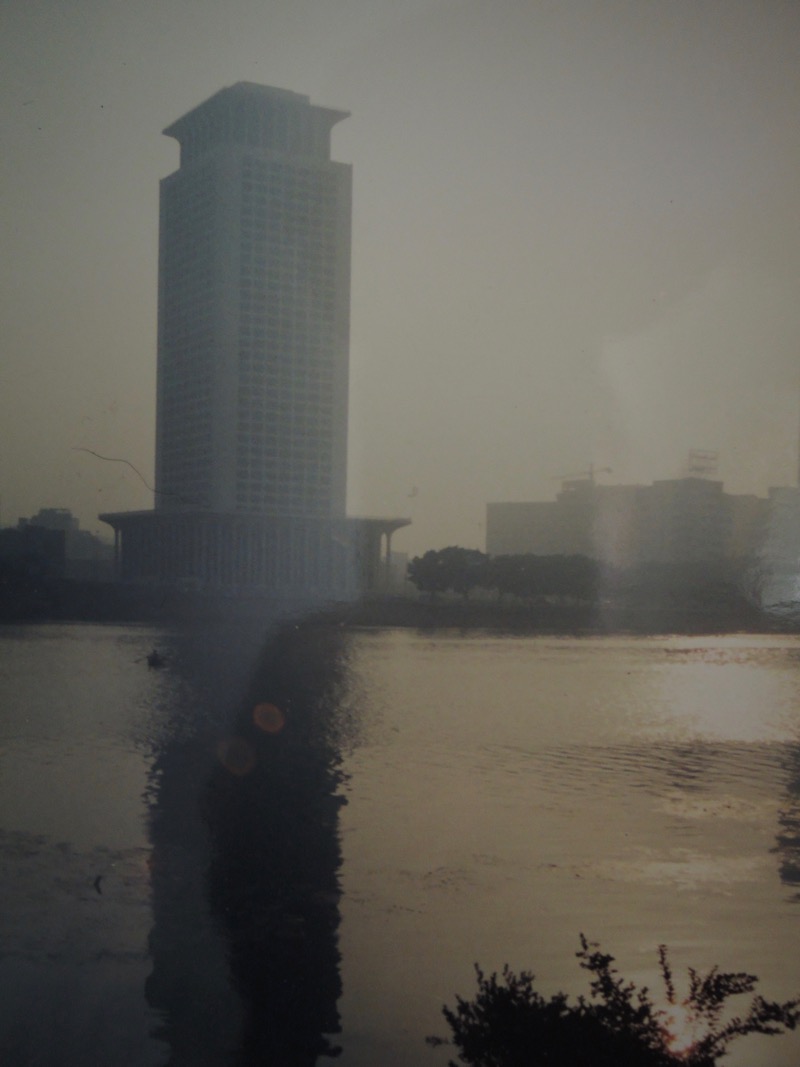
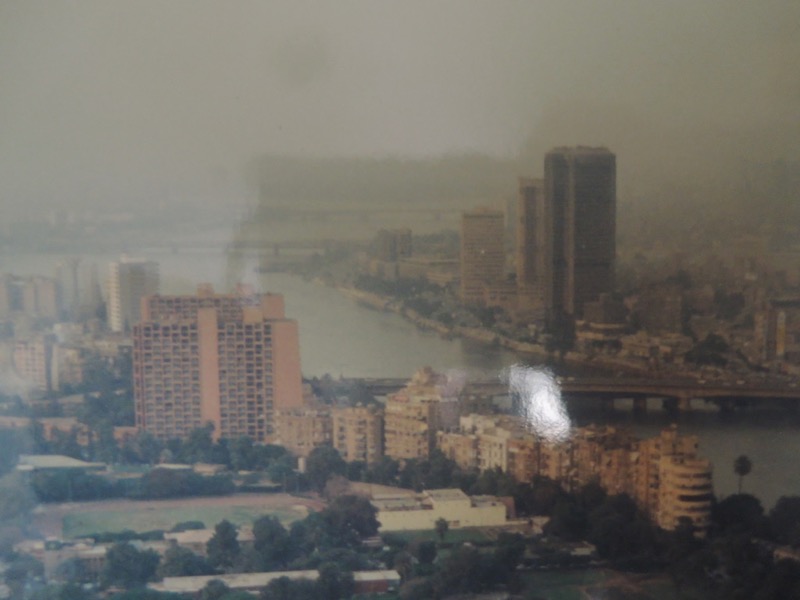
Many years ago, in another life, I spent about six months living in Cairo. I had happened there by chance, at the suggestion of my boyfriend at the time, who spoke a smattering of Arabic. We lived in the centre of the city, away from the ex-pat community, in a dusty fourth-floor apartment with faded red velvet sofas that gave off great puffs of dust whenever one of us sat down on them. At night, when we switched on the lights in the darkened bedroom, there was the sound of a thousand cockroaches scuttling out of view. The view from the rickety balcony was of life on the street below: the storekeeper of the small general store where we bought bottled water, washing down his front doorstep with water and a broom; the ta’ameya man at his food stand, stirring his big metal spoon through a great dented tin bowl of smoking hot oil.

I left Cairo as I came to it — by chance, at someone else’s bidding. I knew even then that I would never go back. For those few months in Cairo, I had not lived as a tourist, as most Westerner visitors do. Not exactly. Not quite. Cairo was in me, and on me, in a very physical, a very literal, sense: its grime lay in thick strips of black beneath my fingernails; its dust coated my skin. The city had, for those few months, as Hugh Miles so succinctly puts it, encompassed me.

And so I left, and I did not go back.

I found some old photos from that time recently, ones I took with an old camera, in those pre-digital years. I don’t have a scanner and so in order to reproduce them here, I actually used my camera to rephotograph those photographs. This accounts for their odd, slightly removed, unreal aspect — for, as well as Cairo in these pictures, you can see the glare from my window right here in Australia, the bend in the photographic paper.

I was going to apologise for this, originally. And then it occurred to me that in fact, this aspect of distance and remove is exactly right. In this context, it is right.

And so, no apologies today — just a glimpse into another world, a very long way away from here and from now.

I see you

Other people’s words about … love

The bright lights had been switched off and the place was lit only by small windows. Then there she was — Stella — the top of her head highlighted as she looked down, reading. It never ceased to amaze him the thrill he got at seeing her. Catching her unawares.

From ‘Midwinter Break
by Bernard MacLaverty

Every time I read these words by Bernard MacLaverty, I feel my breath catch. They describe so perfectly those tiny, stolen glimpses we get of the people we love.

The photo accompanying this post is one I took while I was in Yorke Peninsula recently. It was very early summer: fan flower season. One evening just after sunset, as I wandered along the top of the cliffs, I came to a fork in the path where there were fan flower bushes growing at every corner.

And there, in the dim glow of the early-evening sky, the petals of the fan flowers — which in the warm, bright light of the middle of the day are a strong, cheery blue — seemed to shine for a few moments: pale, spectral, luminescent.

Perhaps my talk of fan flowers seems an odd match for the words I began this post with. But this was another one of those tiny, stolen moments we’re given in life from time to time, and it seems to me a good way to honour Bernard MacLaverty’s lovely words …

PS One other thing: a quick shout-out to my mother, who celebrates her birthday today, and who is a person responsible for many lovely moments in my life .

This quiet unknowing

Other people’s words about … dreams

I am trying to find my dog, which is going to be put down. Not a dog I live with in my waking life, but another, a black Labrador. The dog has already been taken away and is awaiting its death at a pound on the edge of town. This awful knowledge permeates my sleep. When I get there, however, my dog has gone. In its place, lying sick and exhausted on the concrete floor inside a large cage, is a young, very beautiful red setter. As I enter, the creature raises its head towards me and I see with slow shock that its muzzle has been sewn up with fishing line. The red dog pulls itself off the ground and limps towards me. Rising on its hind legs, it puts its forelegs on my shoulders, and rests its head against the left side of my neck. I can sense it begging me to save it. I feel great pity; I embrace and try to comfort it. But there is no sense that I can or will do anything to help it. The burden would be too great. Words come into my head. The dog’s name: Gadget. (Why Gadget? I wonder, even in the dream.) Then the thought — with which I am already justifying my decision to abandon it — that red setters are not very intelligent dogs. I step away. The animal stands there, hopeless. I touch it on the back and I leave.

What to do with a dream like that?

From ‘Anaesthesia
by Kate Cole-Adams

What to do, indeed?

I love the words in this passage: this description of a dream, which is vivid and haunting and bewildering all at once, as dreams so often are. Over time, Cole-Adams goes on to say, various astute readers have suggested to me that this particular dream might not belong in this particular book, that it is a dream that emanates from somewhere else and that ought to be left there …. And yet she includes the dream in her book anyway. In doing so, she allows herself to write intuitively, blindly, instinctively, knowing — knowing — that what she is writing must be written, but not knowing why.

In the quiet after waking I lay curled on my side suffused with the knowledge of irrevocable loss. I had betrayed the red dog. And in doing so I understood that I had disavowed some helpless, voiceless part of me. The dream did not feel like a dream. The house was still and very dark. I did not know what the dog had been trying to say, but I could still feel almost physically the place above my left shoulder where it had nuzzled its head against my neck, and I accepted finally that I could not write this book without it.

Do you sometimes have dreams like Cole-Adams’s dream — a dream that [does] not feel like a dream? Do you feel memories rising in you that feel more alive than memories should ever feel? Do you get a feeling of sickness in your gut that you know — you just know — isn’t a sickness; and yet it is, it is?

I do.

These days, I’m not much one for grand resolutions. I don’t know what path I’ll follow this year (though, hopefully I’ll get to walk one of the sandy paths in Aldinga Scrub, like the one pictured above, every now and then). I don’t know what 2018 holds, for me or for you.

I do hope, though, that there will be some moments like Cole-Adams describes, for you and for me: those quiet moments after waking when you do not disavow the helpless, voiceless part of you; those moments when you accept finally that you cannot otherwise do what it is you need to do.

The best-laid plans

Other people’s words about … waiting

Nick didn’t call me that morning, or that night. He didn’t call me the next day, or the day after that. Nobody did. Gradually the waiting began to feel less like waiting and more like this was simply what life was: the distracting tasks undertaken while the thing you are waiting for continues not to happen. I applied for jobs and turned up for seminars. Things went on.

From ‘Conversations with Friends
by Sally Rooney

I hadn’t planned to write this post. I thought that I would be — I planned to be — too busy to post anything between now and next week. I had family celebrations planned, after all, and a holiday trip away with a dear friend, and even a couple of shifts at work.

But I haven’t been well this Christmas, and so most of my plans for the holiday period so far haven’t eventuated.

Christmas is a tricky time, isn’t it? For some reason, I often get sick around this time of the year (and at other times of celebration). Like Sally Rooney’s narrator, Frances, in the passage above, I keep waiting for this to change, but the thing I am waiting for — not to get sick at Christmas, not to feel sad about getting sick at Christmas — continue[s] not to happen.

So why am I writing a post now, after all? Partly, I’m writing because I have unexpected time on my hands. Mostly, though, I’m writing because I wanted to reach out to other people who might also be feeling sad — whether unexpectedly or otherwise — this Christmas.

I don’t have any advice. I wish I did. The only thing I can find to do at times like this is to wait them out — which is ironic, given Rooney’s words above.

Still, whoever you are, wherever you are, if you are feeling sad right now, know this: you are not alone. Sadness is part and parcel of the deal.

And it passes.

Like the weather, like the tide, like footsteps in the sand, like all those hackneyed things — like Christmas, even — sadness, too, passes.

Walk on

Other people’s words about … things falling apart

When you’ve passed through a difficult period, it can be tempting to yearn for a delivery of good fortune, or for experience that feels redemptive somehow. You want suffering to have purpose, for pain to be justified by wisdom or abundance or growth.

from Weekend Reading
by Gena of The Full Helping blog

I had an odd weekend recently, going through some of my old journals and photos for writing-related reasons. The entries I’d written in my journals back then, during a time in my twenties when I lived overseas — first in Texas, then England, then Germany, Cairo, Jakarta — were vividly descriptive of a life I no longer lead, nor will ever lead again. Those journal entries threw me back to a ‘me’ I hadn’t exactly forgotten but somehow, foolishly, thought I had let go of.

Although I have let go of that me, mostly.

My life, during those years I lived overseas, was filled with extremes — of loneliness, joy, excitement, fear, love, doubt, sorrow, terror, grief. There was one particularly difficult period, living in Jakarta with my then boyfriend, when one thing after another went terribly wrong, and I felt as though I was walking through my days — those days that made up my life as I then knew it — with my head down, just waiting for the next blow.

Like Gena, in the words I’ve quoted above, sometimes in Jakarta I just wanted those most difficult days to have a meaning. A purpose. But they didn’t. Even now, when I look back on those times, I find them hard to make sense of. I think I always will.

Gena quotes the Buddhist Nun Pema Chodron, who says the following in her book When Things Fall Apart:

We think that the point is to pass the test or overcome the problem, but the truth is that things don’t really get solved. They come together and they fall apart. Then they come together again and fall apart again. It’s just like that. The healing comes from letting there be room for all of this to happen: room for grief, for relief, for misery, for joy.

These days, I would quibble with Pema Chodron’s use of the word healing — isn’t that just another way of saying you can solve things? — but then, I’m not a Buddhist. Or a Nun.

Still, I like the notion of things falling apart and then coming together again, only to fall apart once more; I find it immensely comforting. Even more, I like Pema Chodron’s simple statement, neither defeatist not celebratory, that life is just like that.

It is just like that, isn’t it?


The photographs accompanying today’s posts come from a recent trip to Yorke Peninsula. It was mid-November, and the late-spring flowers dappled the dunes. Fan flowers, common sea heath, grasses, sedges, acacias and other flowers I couldn’t identify and don’t usually see at home had sprung up everywhere, in every bare patch of sandy ground, in every sheltered nook, in every little cranny in the rocks. Walking amongst them, I felt things come together again in my heart, for a little while.

And then — well, then I let go. And walked on.