Another world

Other people’s words about … Cairo

Sunlight was streaming through the shutters. I peered down into the street where a cat was sunbathing on a parked car. Friday morning was always the most peaceful time of the week in Istanbul Street. The doorman’s wife sat on the kerb watching her ragged child play in the clouds of pollen and dust. [My weekend away from Cairo] seemed a world away, a movie I watched last year. Cairo is so encompassing that when you are there all other realities seem to fade away. I thought of Hatton Garden and it seemed surreal that at that very moment crowds of London commuters were heading to work in the rain. It felt impossible that the two places could exist at the same time.

From ‘Playing Cards in Cairo: Mint Tea, Tarneeb and Tales of the City
by Hugh Miles

Many years ago, in another life, I spent about six months living in Cairo. I had happened there by chance, at the suggestion of my boyfriend at the time, who spoke a smattering of Arabic. We lived in the centre of the city, away from the ex-pat community, in a dusty fourth-floor apartment with faded red velvet sofas that gave off great puffs of dust whenever one of us sat down on them. At night, when we switched on the lights in the darkened bedroom, there was the sound of a thousand cockroaches scuttling out of view. The view from the rickety balcony was of life on the street below: the storekeeper of the small general store where we bought bottled water, washing down his front doorstep with water and a broom; the ta’ameya man at his food stand, stirring his big metal spoon through a great dented tin bowl of smoking hot oil.
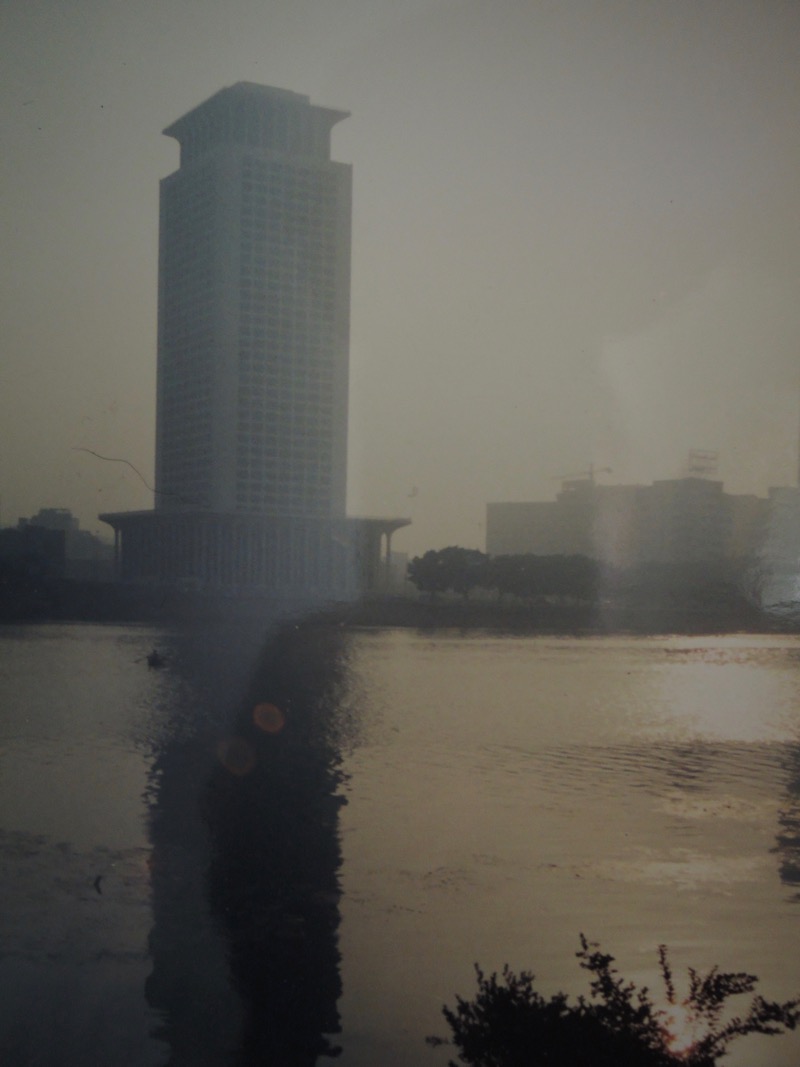
I left Cairo as I came to it — by chance, at someone else’s bidding. I knew even then that I would never go back. For those few months in Cairo, I had not lived as a tourist, as most Westerner visitors do. Not exactly. Not quite. Cairo was in me, and on me, in a very physical, a very literal, sense: its grime lay in thick strips of black beneath my fingernails; its dust coated my skin. The city had, for those few months, as Hugh Miles so succinctly puts it, encompassed me.

And so I left, and I did not go back.
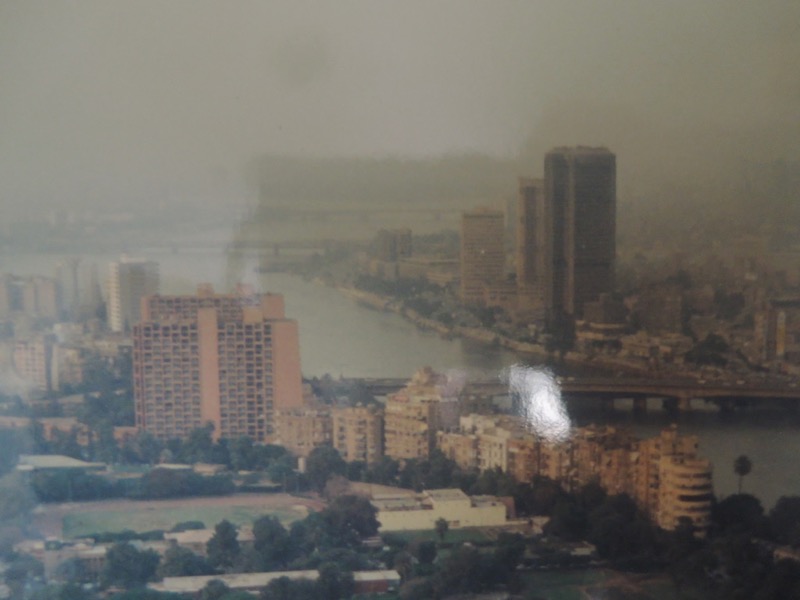
I found some old photos from that time recently, ones I took with an old camera, in those pre-digital years. I don’t have a scanner and so in order to reproduce them here, I actually used my camera to rephotograph those photographs. This accounts for their odd, slightly removed, unreal aspect — for, as well as Cairo in these pictures, you can see the glare from my window right here in Australia, the bend in the photographic paper.

I was going to apologise for this, originally. And then it occurred to me that in fact, this aspect of distance and remove is exactly right. In this context, it is right.

And so, no apologies today — just a glimpse into another world, a very long way away from here and from now.

Hint

Other people’s words about … the world below

For a time I was obsessed with the idea that I could live under the sea. Not … using a great tank of air strapped to my neck. No, I wanted to dive deep down, skimming the sandy bottom of the ocean with my bare skin. I wanted to glide through fingers of pink weed and velvety fronds of green and come face to face with a mullet, or a gummy shark, slide up to the rubbery flank of a great whale and feel her song vibrate through my cheek to the very centre of my brain and understand what she told me.

From ‘Skylarking
by Kate Mildenhall

We’ve all felt like the narrator in Skylarking, at some point in our lives, haven’t we? Living by the ocean, as she does in Kate Mildenhall’s novel, I often think about the world below the surface of the water.

In the summer heat, on days like the one pictured below, I feel like that even more. It was about 5 pm on a day in the middle of January when I took this photo, and it was 42 degrees Celsius. It was too hot, truly, to spend much time with a camera in my hand. Moments after I’d put the camera away, I slipped into that silky, blue expanse and felt the water washing softly over my skin.

Sometimes when I swim on afternoons like this, I see shoals of little white fish darting ahead of me, or a blue swimmer crab scuttling along the bottom of the sand bed. Sometimes I see a sting-ray. Sometimes I feel fronds of seagrass and kelp brushing over my limbs as I swim. They are tiny hints of that underwater world that seems so fascinating and so close, and yet, somehow, so very far from reach …

Out and about: at lunch

‘When you’re walking the view shifts and changes.
Walking’s a form of hope.’

from ‘The World Without Us
by Mireille Juchau


I haven’t done an out and about post for a while, so I thought it was time. I recently quit my job at the call centre in order to concentrate on my work as an editor, where my workplace is in the city centre …

… which means that my lunch-break strolls haven’t stopped, but they have certainly changed.

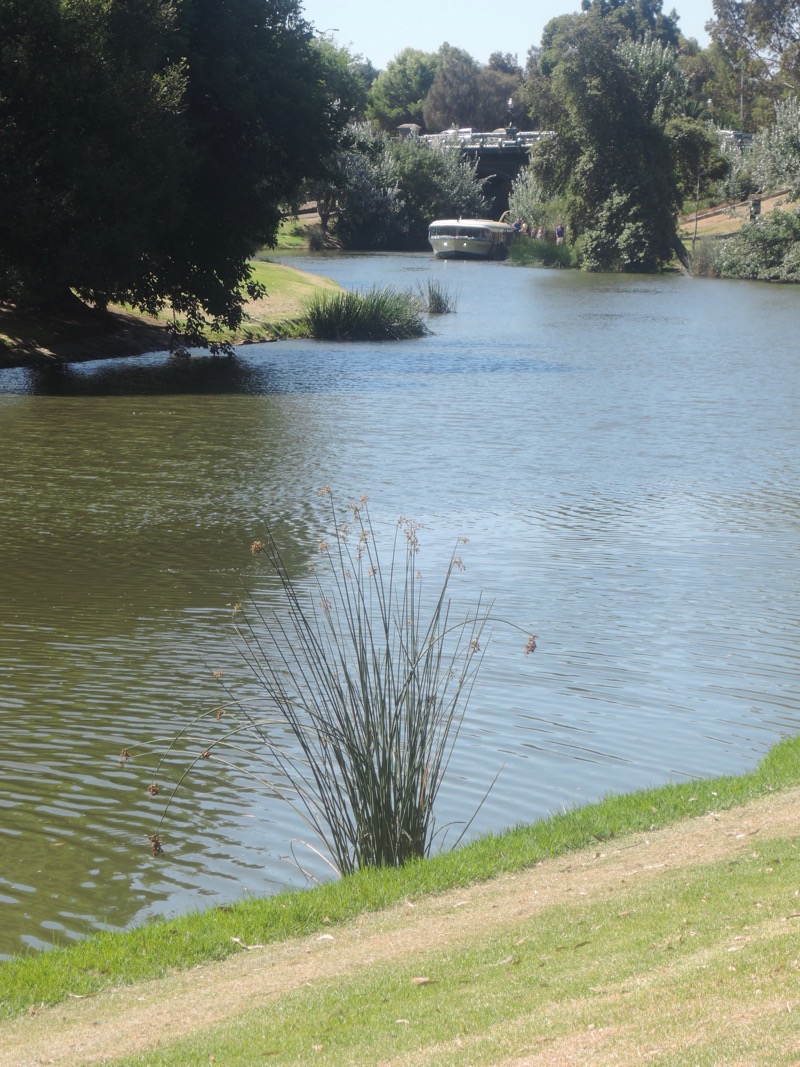
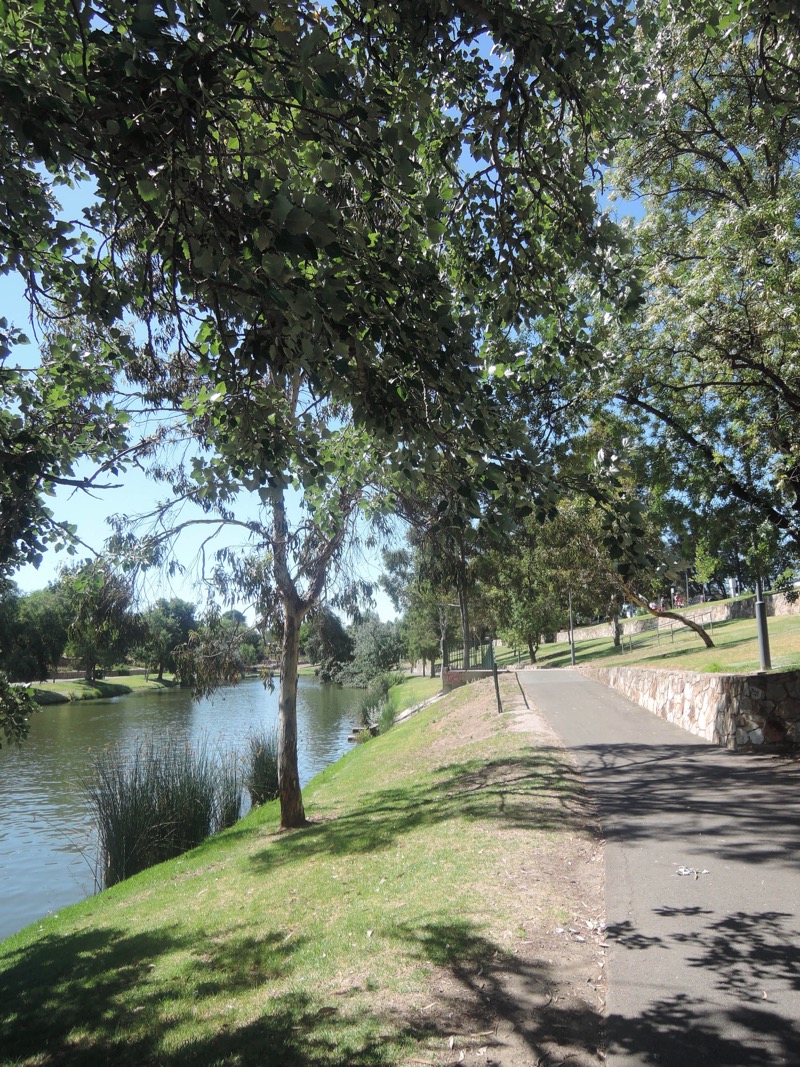
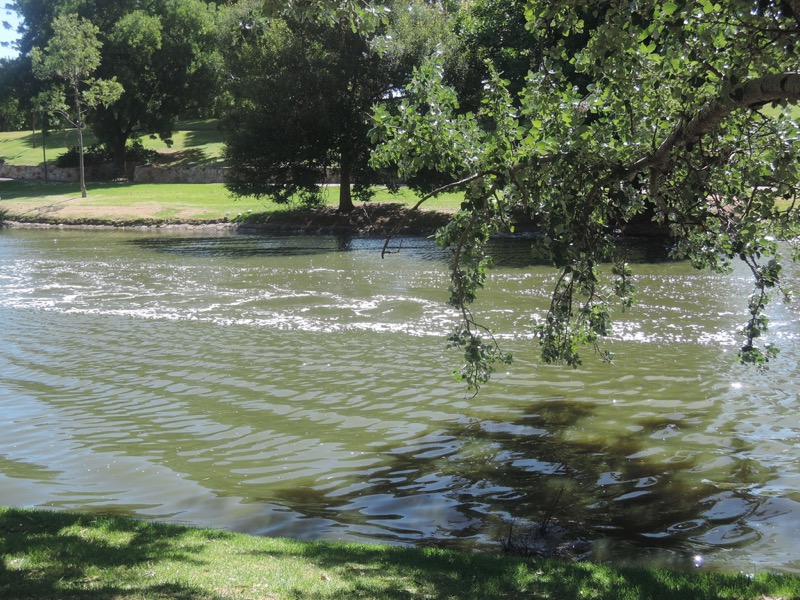
It’s easy to be tempted by shops when you work in town (books! clothes! books!), but the other day, on a late lunch break, I headed north towards the river as I left my office, rather than south towards the shops.

Five minutes north of my office is the River Torrens — the perfect place for a lunchtime stroll.

This particular day was one of those lovely January days, as I hope my photos on this post demonstrate: warm and sunny, with soft blue skies and a gentle breeze ruffling the water …

… There were ducks and moorhens paddling about, and the grass, which had been recently mown, smelt dry but sweet.

January is one of my favourite months of the year, as far as the seasons go. It’s usually sunny, and though the days are mostly warm, the temperatures rarely rise to stifling. It’s the ideal month for strolling, walking and wandering.

I plan to come back to the river in my lunch break again soon …

Snatched phrases: last pages

‘I will love a book forever
if the final pages mark my subconscious.’

From ‘The Museum of Words’
by Georgia Blain

My mother and sister and I (all inveterate readers) were talking the other day about those devastatingly disappointing books you read all the way through, from start to finish, without skipping a paragraph, because you are in the grip of a conviction that you’ll get to the end and suddenly — suddenly — all this time you’ve spent reading it, feeling love and hate for the book and its author in equal measure, will be justified.

You know those books I mean? I say ‘devastatingly disappointing’ because I am describing the kind of book that, when you do finally get to the end, you realise your time wasn’t justified at all. You realise that, on the contrary, the whole time you spent reading it was, in your opinion at least, a waste of time.

You know those kinds of books?

That’s why I love Georgia Blain’s words above.

So I thought I would make a list of books whose last pages have, as Blain so delightfully puts it, marked my [own] subconscious forever. Here they are, in no particular order:

Rebecca, by Daphne du Maurier
Prep, by Cutis Sittenfeld
The Children’s Book, by AS Byatt
A Map of the World, by Jane Hamilton
The Smart One, by Jennifer Close
Me and Mr Booker, by Cory Taylor
Wasted, by Marya Hornbacher
Tell Me I’m Here, by Anne Deveson (Georgia Blain’s mother).

And, yes, the book I’ve quoted today, Museum of Words, by Georgia Blain.

What about you?

I see you

Other people’s words about … love

The bright lights had been switched off and the place was lit only by small windows. Then there she was — Stella — the top of her head highlighted as she looked down, reading. It never ceased to amaze him the thrill he got at seeing her. Catching her unawares.

From ‘Midwinter Break
by Bernard MacLaverty

Every time I read these words by Bernard MacLaverty, I feel my breath catch. They describe so perfectly those tiny, stolen glimpses we get of the people we love.

The photo accompanying this post is one I took while I was in Yorke Peninsula recently. It was very early summer: fan flower season. One evening just after sunset, as I wandered along the top of the cliffs, I came to a fork in the path where there were fan flower bushes growing at every corner.

And there, in the dim glow of the early-evening sky, the petals of the fan flowers — which in the warm, bright light of the middle of the day are a strong, cheery blue — seemed to shine for a few moments: pale, spectral, luminescent.

Perhaps my talk of fan flowers seems an odd match for the words I began this post with. But this was another one of those tiny, stolen moments we’re given in life from time to time, and it seems to me a good way to honour Bernard MacLaverty’s lovely words …

PS One other thing: a quick shout-out to my mother, who celebrates her birthday today, and who is a person responsible for many lovely moments in my life .

This quiet unknowing

Other people’s words about … dreams

I am trying to find my dog, which is going to be put down. Not a dog I live with in my waking life, but another, a black Labrador. The dog has already been taken away and is awaiting its death at a pound on the edge of town. This awful knowledge permeates my sleep. When I get there, however, my dog has gone. In its place, lying sick and exhausted on the concrete floor inside a large cage, is a young, very beautiful red setter. As I enter, the creature raises its head towards me and I see with slow shock that its muzzle has been sewn up with fishing line. The red dog pulls itself off the ground and limps towards me. Rising on its hind legs, it puts its forelegs on my shoulders, and rests its head against the left side of my neck. I can sense it begging me to save it. I feel great pity; I embrace and try to comfort it. But there is no sense that I can or will do anything to help it. The burden would be too great. Words come into my head. The dog’s name: Gadget. (Why Gadget? I wonder, even in the dream.) Then the thought — with which I am already justifying my decision to abandon it — that red setters are not very intelligent dogs. I step away. The animal stands there, hopeless. I touch it on the back and I leave.

What to do with a dream like that?

From ‘Anaesthesia
by Kate Cole-Adams

What to do, indeed?

I love the words in this passage: this description of a dream, which is vivid and haunting and bewildering all at once, as dreams so often are. Over time, Cole-Adams goes on to say, various astute readers have suggested to me that this particular dream might not belong in this particular book, that it is a dream that emanates from somewhere else and that ought to be left there …. And yet she includes the dream in her book anyway. In doing so, she allows herself to write intuitively, blindly, instinctively, knowing — knowing — that what she is writing must be written, but not knowing why.

In the quiet after waking I lay curled on my side suffused with the knowledge of irrevocable loss. I had betrayed the red dog. And in doing so I understood that I had disavowed some helpless, voiceless part of me. The dream did not feel like a dream. The house was still and very dark. I did not know what the dog had been trying to say, but I could still feel almost physically the place above my left shoulder where it had nuzzled its head against my neck, and I accepted finally that I could not write this book without it.

Do you sometimes have dreams like Cole-Adams’s dream — a dream that [does] not feel like a dream? Do you feel memories rising in you that feel more alive than memories should ever feel? Do you get a feeling of sickness in your gut that you know — you just know — isn’t a sickness; and yet it is, it is?

I do.

These days, I’m not much one for grand resolutions. I don’t know what path I’ll follow this year (though, hopefully I’ll get to walk one of the sandy paths in Aldinga Scrub, like the one pictured above, every now and then). I don’t know what 2018 holds, for me or for you.

I do hope, though, that there will be some moments like Cole-Adams describes, for you and for me: those quiet moments after waking when you do not disavow the helpless, voiceless part of you; those moments when you accept finally that you cannot otherwise do what it is you need to do.

The best-laid plans

Other people’s words about … waiting

Nick didn’t call me that morning, or that night. He didn’t call me the next day, or the day after that. Nobody did. Gradually the waiting began to feel less like waiting and more like this was simply what life was: the distracting tasks undertaken while the thing you are waiting for continues not to happen. I applied for jobs and turned up for seminars. Things went on.

From ‘Conversations with Friends
by Sally Rooney

I hadn’t planned to write this post. I thought that I would be — I planned to be — too busy to post anything between now and next week. I had family celebrations planned, after all, and a holiday trip away with a dear friend, and even a couple of shifts at work.

But I haven’t been well this Christmas, and so most of my plans for the holiday period so far haven’t eventuated.

Christmas is a tricky time, isn’t it? For some reason, I often get sick around this time of the year (and at other times of celebration). Like Sally Rooney’s narrator, Frances, in the passage above, I keep waiting for this to change, but the thing I am waiting for — not to get sick at Christmas, not to feel sad about getting sick at Christmas — continue[s] not to happen.

So why am I writing a post now, after all? Partly, I’m writing because I have unexpected time on my hands. Mostly, though, I’m writing because I wanted to reach out to other people who might also be feeling sad — whether unexpectedly or otherwise — this Christmas.

I don’t have any advice. I wish I did. The only thing I can find to do at times like this is to wait them out — which is ironic, given Rooney’s words above.

Still, whoever you are, wherever you are, if you are feeling sad right now, know this: you are not alone. Sadness is part and parcel of the deal.

And it passes.

Like the weather, like the tide, like footsteps in the sand, like all those hackneyed things — like Christmas, even — sadness, too, passes.

Day by day

Other people’s words about … tea

I am the sole tea-abstainer in my family. I think they regard this as a baffling perversion. To me, tea tastes like dried lawn-clippings, diluted leaf mould, watered-down compost mixed with a dash of bovine bodily fluid. I have never been able to stomach it.

From ‘I Am, I Am, I Am
by Maggie O’Farrell

I loved this quote from Maggie O’Farrell. My sister, an inveterate coffee-drinker, feels much the same as O’Farrell, I think: she wrinkles her nose in disgust at any suggestion of tea. She, in contrast to O’Farrell’s family members, is baffled by my love of the stuff.

Each to her own, right? I would find it harder to give up my one or two pots of tea per day than I would to give up chocolate or cake or wine. Tea provides me with what amounts to both a daily treat and a ritual, and it gives me, each day, a small moment (often temporary but still cherished) of sanity and solace.

I would write more, but it’s 9.30 in the morning and the kettle is on the stove waiting for me to make my daily pot of tea …

Snatched phrases on … birds

‘It was eluding her again: the essence of bird.’

From ‘Nest
by Inga Simpson

I love this sentence. Jen, the protagonist of Nest, is an artist, and in this passage she is trying to draw a fairy wren.

I’m not an artist; in fact, I’m spectacularly untalented when it comes to drawing. But I know the feeling of trying to capture — in a photograph, perhaps, or in conversation, or in writing — what you see when you see a bird. To say that a bird flies, or that it sings, or that it is beautiful is true, but those descriptions come nowhere near to capturing what a bird really is, or how it makes you feel.

The essence of bird. Perhaps it will always elude me, as it does Jen. Perhaps that’s part of the fascination.