The sea, breathing

Other people’s words about … the sea at night

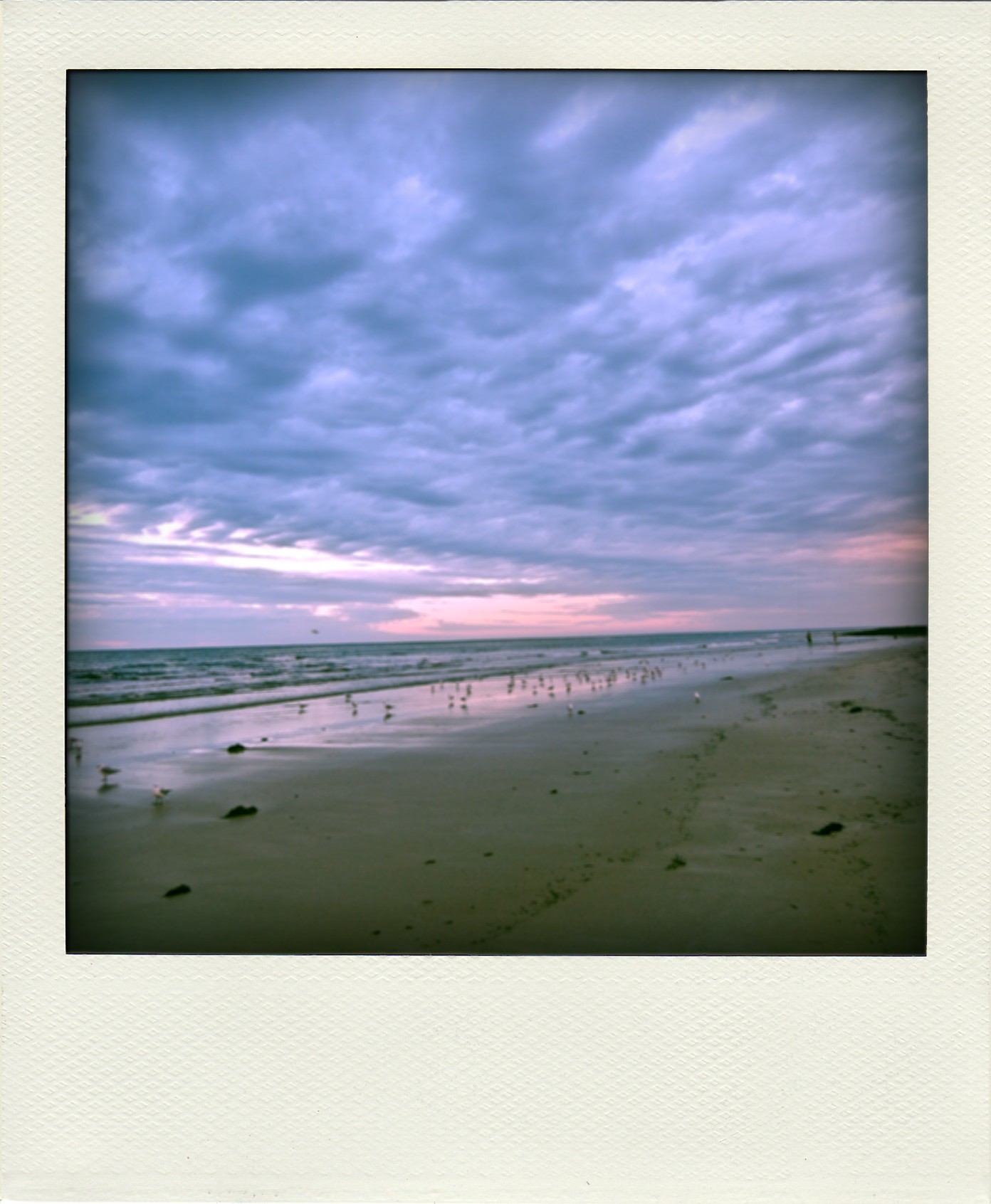
I take many photos of the sea during daylight hours, but my photography skills aren’t good enough to capture the sea at night. Some nights, though, when the wind is westerly, blowing from the ocean onto the land, I can hear the waves, through the open windows of my house, as they roll into the beach and fall back, roll in and fall back.

It’s a dreamy, dreamy sound.

The night garden was thick with dreams. Beneath the earth, beneath the eyelids of birds, in the air that came like an exhalation from the sea. Pearl listened. It always felt closer at night, the slump and hiss of waves like an old man dreaming.

From ‘Shell
by Kristina Olsson

The slump and hiss of waves

.

Raw

Other people’s words about … making art

What is it that makes some artists productive all their lives, while others founder at the slightest hurdle, convinced of their own lack of talent? Are those who continue to produce art more gifted? Or are they simply more certain of themselves?

But perhaps her ambition outweighed her abilities, or else her perfectionist’s unappeasable eye scuttled what talent she had, for at art college she soon discovered she was no longer the best student — and indeed could not even capture the attention of her teachers … She was full of self-doubt, forced to recognise that a modicum of talent got you so far and no further, and that while she had imagined she was climbing the mountain, in truth she was only ever at the bottom.

From ‘The Landing
by Susan Johnson

A long time ago, just after I had had my second novel for young adults published, I talked with a woman who had just had her own first novel published. She told me that the thing she worried about most, as a writer, was that she would run out of time. She had so many more novels inside of her, she told me: so many ideas. What if she didn’t live long enough to write them all down?

I wonder now: was it an awareness of her own talent that enabled my writer friend to ask this question, or was it simply self-confidence? I don’t know. What I do know is that this was ten years ago, and she has written and published several more novels since then, and time does not appear to be running out for her. Not at all.

She made one last, honourable effort to become a full-time artist, but nothing she made satisfied her, nothing seemed original or bold or magnificent enough, everything was only half good. She strove for an aesthetic perfection she could never reach, and every day she did not reach it was a misery, the febrile pressure she placed on herself impossible to bear. She could not transfer to the canvas the perfect illuminated world inside her head; she was her own harshest critic and could not accept work she knew was not first rate. In the end, art had to be wonderful or nothing; there was no in between.

Perhaps an artist’s talent will wither away and die unless she nourishes it with a certain, requisite amount of self-confidence. Or perhaps her productivity has more to do with her courage and fortitude — with her dogged determination to carry on, free of caring — as Penny, the character about whom Susan Johnson is writing in the passages I’ve quoted in today’s post, finally discovers.

And Penny will pick up her paintbrush in an ecstasy of release … [S]he will try to make whatever she is making, imperfectly and full of mistakes. She will take long-service leave; not certain what she is going to do with what remains of her life, but certain she is making something manifest, exploiting to the best of her abilities — or the worst! — her raw materials. She is herself, no-one finer. She might travel, or she might not; her project might come to something, or it might not, but, suddenly, she will be free of caring. She will see how far she can take a line for a walk.

Perfect illuminated world

A year of words

Other people’s words about … other people’s words

I’ve been thinking about reading again recently — what it means to me, what it gives to me, why, even though it’s a solitary activity, it makes me feel connected to the world. I like Sarah Clarkson’s use of the word journey, in the passage below, to describe the act of reading. Reading, like life, is a journey. You never know where it might take you.

Reading, rather, is a journey. Reading is the road you walk to discover yourself and your world, to see with renewed vision as you encounter the vision of another … Reading is a way to live.

From ‘Book Girl
by Sarah Clarkson

Reading is a journey

PS It’s good to be back in the blogging world. I’m changing the format of my posts slightly this year, but it’s still all about celebrating other people’s words. So … here’s to another year! xo

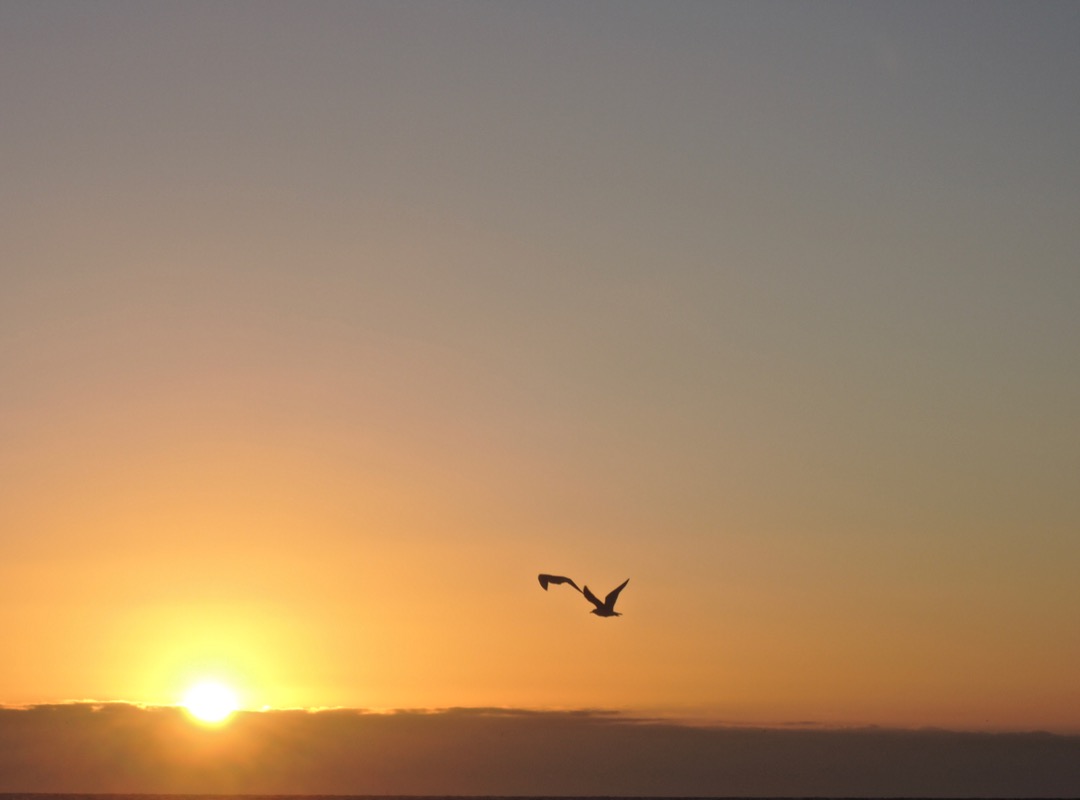
Tip your head back and look up at the sky

Other people’s words about … the sky

Axel … breathed out, trying for calm. He tipped his head back, looked at the sky, wide and empty of trouble. His heart slowed. The moment passed.

From ‘Shell
by Kristina Olsson

Oh, that beautiful sky …

No time like now

Other people’s words about … cages

At not yet thirty, she can feel her life shrinking into the gentle sameness of her days and she knows she is pacing back and forth in a comfortable cage of her own construction. She needs someone to bump against, to disrupt things. she can’t go on like this, she knows. She must resolve the tension between longing and fear.

From ‘The Fragments
by Toni Jordan

I’m back! I’ve missed blogging. I’ve missed you all, too.

And I’ve gone on collecting other people’s words, gone on taking photographs of the world around me, gone on wanting to have a place to keep the words I’ve collected and the pictures I’ve taken. So I’ve decided, rather than ending this blog completely, as I first planned to do, to pop in every now and then with a quote I love or a photograph I’ve taken. I’d like to keep the practice up, and I hope that some of you will continue to enjoy reading the words I’ve found, or seeing the photographs I’ve taken, as you might have done in the past.

Last year, as some of you may remember, I lost my job. In the end, instead of looking for a new job straight away, I decided I would take a few weeks or months off first. And so that’s what I’ve been doing in the weeks since I last wrote: living on my savings and trying out, meantime, new habits, new practices. I’m trying to disrupt some of my old ways, like Caddie in the passage I’ve quoted above; I’m trying to stop pacing back and forth in a comfortable cage of [my] own construction; I’m trying to let my life expand, rather than to shrink. There’s no time like now!

Because there is always a way through … always

Thank you for accompanying me so far on my blogging journey. Thank you, too, to the readers who wrote to me and encouraged me to keep posting, if only sporadically: who told me I was missed. I hope you all find pleasure in the posts that are still to come.

Rebecca xo

Fleeting

Other people’s words about … happiness

Happiness doesn’t come in the way I expected; not a massing of good things over time, but a succession of small, strange and unowned moments — the sun makes a hot oblong on the bedroom floor and I stand in it with my eyes closed. The coriander germinates in the window box and up comes the seedling. The bled radiators stop knocking at night.

From ‘Dear Thief
by Samantha Harvey

I thought it was apt to write a post on happiness today, to accompany my previous post on sadness — though perhaps both posts are, after all, about the same thing, simply taken from opposing perspectives.

But also it seemed apt to me to write a post about happiness because today’s post, I think, will be my last post, at least on this blog, twenty-one words.

Over the years, I’ve written about many things on this blog — the sea, the sky, vomiting, writing, books, therapy, running, walking, travel, birds, flowers, hope, to name a few. But in many ways, I see, looking back, that I’ve been exploring, post by post, what it means to live a small life in the happiest, or at least the most meaningful and most humble, way I know.

Happiness, as Harvey says, isn’t something you can accumulate or amass; it most surely isn’t something you can own. It flits into our lives and out again. Writing this blog has been, for me, both a meaningful and a humbling experience — and in that sense it has been a happy experience for me, too. I don’t know if my posts have brought you, my readers, any moments of happiness, but I hope so: I do.

I spent over half my life waiting for the accumulation of happiness and then I realised that it doesn’t accumulate at all, it just occurs here and there, like snow that falls and never settles. Not the drifts that you and I imagined we would plough ourselves into, but instead gently, opportunistically, holding one’s tongue out to catch the flakes.

I’m not sure yet whether I’ll leave this blog up for posterity (i.e. for a little while!) or whether I’ll take it down altogether, or whether, perhaps, I’ll change its privacy settings so that you can only access it by contacting me first. (Please feel free to do that, if it’s what I do.)

In the meantime, I’ll go on running and walking and hoping and reading and looking, looking, looking.
Fleeting


Thank you to everyone who’s read this blog. Take care of yourselves. Keep reading and looking. Keep savouring those fleeting moments of happiness, whenever they come your way.

Observation

Other people’s words about … sadness

Why was she so sad? The unspoken question had dangled over the [therapist’s] beige couch and the framed degrees and the economy of Kleenex. He commanded a cache of Ohs and I sees in varying grades of volume and texture, knew when to prod and when to sink with her. Why was she so sad?

Ada was sad because she was sad because she was sad. She experienced extreme difficulty in reaching past the tautological.

From ‘Infinite Home
by Kathleen Alcott

Some time ago, for much the same reason as Ada in the passage above, I quit therapy. I had come to my therapist feeling sad; but years of therapy later, I still felt sad. It seemed to me at last that, whether my sadness was unique or universal or — like Ada’s — purely tautological, the time for exploring it was over.

In the years that have passed since then, I’ve learned that I feel better when I try to make peace with sadness than I do when I try to overcome it. There is much to be said for acceptance and for patience. And for seeing things through.

I took the pictures in today’s post on a day when I had just heard that I will be losing my job at the end of this year. I felt, that day, as though I had been cheated of something — of an income, yes, but also of something less tangible, some essential part of me that I couldn’t actually name. I felt anxious and old and vulnerable and as though I had failed. Most of all, I just felt sad.

What I saw

I couldn’t sit still with my sadness that day; I couldn’t see it through. So I did the only thing that seemed manageable to me in the moment: I took myself off for a run by the beach. I ran what seemed to me a long way, the furthest I’d ever run, in fact — although the distance didn’t matter, really. What mattered was that I was outside: moving, breathing deeply, looking around. Seeing. Sadness, I’ve found, stops me from seeing. But stepping outside returns my vision to me, at least for a while.

Losing a job — especially a job that you love, especially when you are nearing fifty — entails a specific kind of sadness, one that is wrapped up in grief and fear. Still, I’m curious. What do you do when you are sad?

This day, and the next, and the next

Other people’s words about … the vastness of the ocean

For every day went ahead like a ferry on its cables, from one shore to the other, passing on its route those same red buoys tasked with breaking up the water’s monopoly on vastness, making it measurable, and in so doing giving a false impression of control.

From ‘Flights
by Olga Tokarczuk
(translated by Jennifer Croft)

A false impression of control:
breakwater in the foreground and a line of buoys on the horizon …

Why do you write?

Other people’s words about … writing and joy

Still, Connell went home that night and read over some notes he had been making for a new story [that he was writing], and he felt the old beat of pleasure inside his body, like watching a perfect goal, like the rustling movement of light through leaves, a phrase of music from the window of a passing car. Life offers up these moments of joy despite everything.

From ‘Normal People
by Sally Rooney

I have a friend, whom I very much respect, who has been writing fiction for as long as I’ve known her, without any desire to seek either publication or readership. It seems to me that she writes purely for the pleasure of the process itself, and for what that process brings her; it seems to me that writing, for her, is an entirely internal process of discovery and exploration, requiring no further justification, either to herself or to others.

Light through leaves (1)

Since my own decision to stop writing a while back, I’ve gone on thinking about writing and the role that it plays, or has played, in my life. And I’ve come to find my friend’s concept — whereby writing is a private act, an act for no-one other than herself, with no thought to the future or to the past — consoling and inspiring in equal measures. I like the honesty of her act. I like the wonder in it. I like the courage. Sometimes, it takes courage to do things just because.

Light through leaves (2)

So I hope that my friend experiences, when she writes, those brief, flickering, sun-dappled moments of joy Rooney describes so beautifully in the passage above. I hope she feels the old beat of pleasure inside [her] body.

And I’m sure that she does.

Chasing clouds

It was the week of daffodils, and they were everywhere — outside everyone’s fences and shrubs, jubilant. It was that perfect running weather: cool and damp, still a little cloudy over the water.

From ‘Alternative Remedies for Loss’
by Joanna Cantor

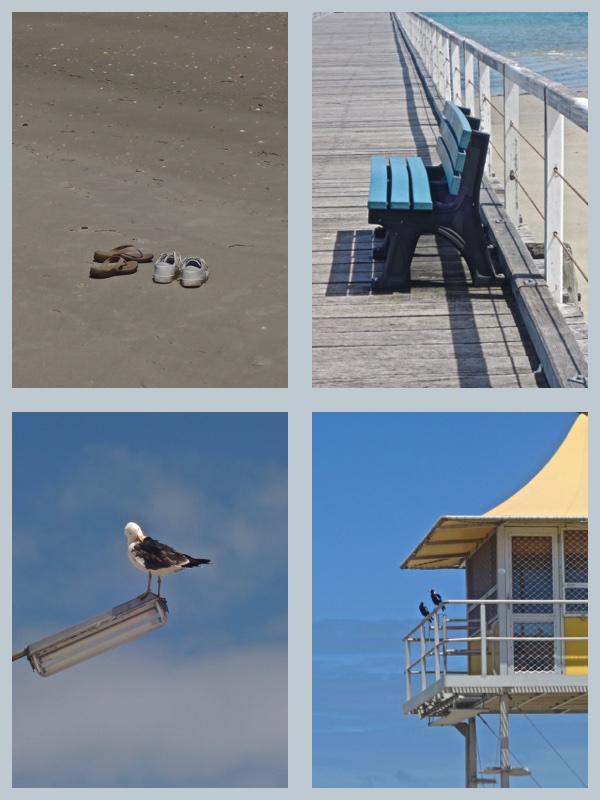
The photos in today’s post come from a run I went on in early October, a muggy, warm, cloudy spring day, perfect for running, though different from the conditions Cantor describes above.

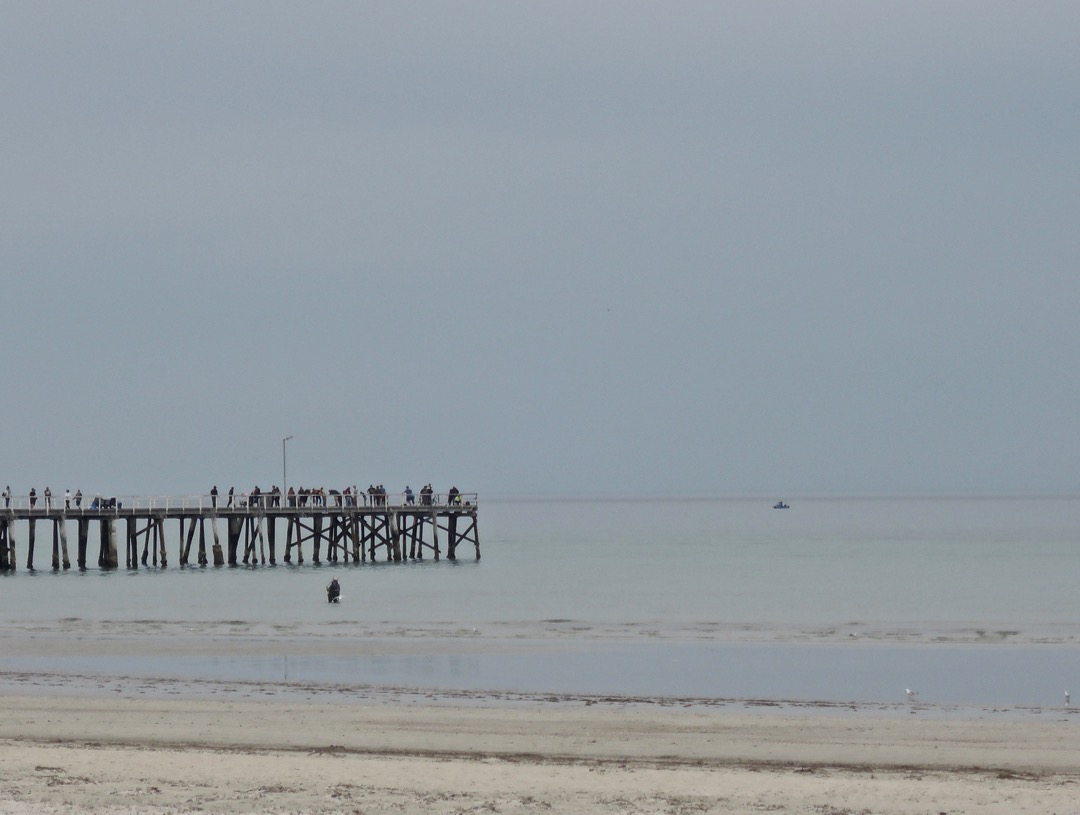
It was also the Monday of the October long weekend, as well as the first weekend of the school holidays, so the jetties at Semaphore and Largs Bay were jostling with people, and kids paddled and squealed in the water. Dogs dashed about on the shore, chasing balls.

This year, oddly, the usual swathes of variable groundsel flowers didn’t appear on the dunes around Taperoo and Largs Bay. But the pigface plants blossomed as usual, their astonishing purple brightness undimmed by the cloudy sky above.

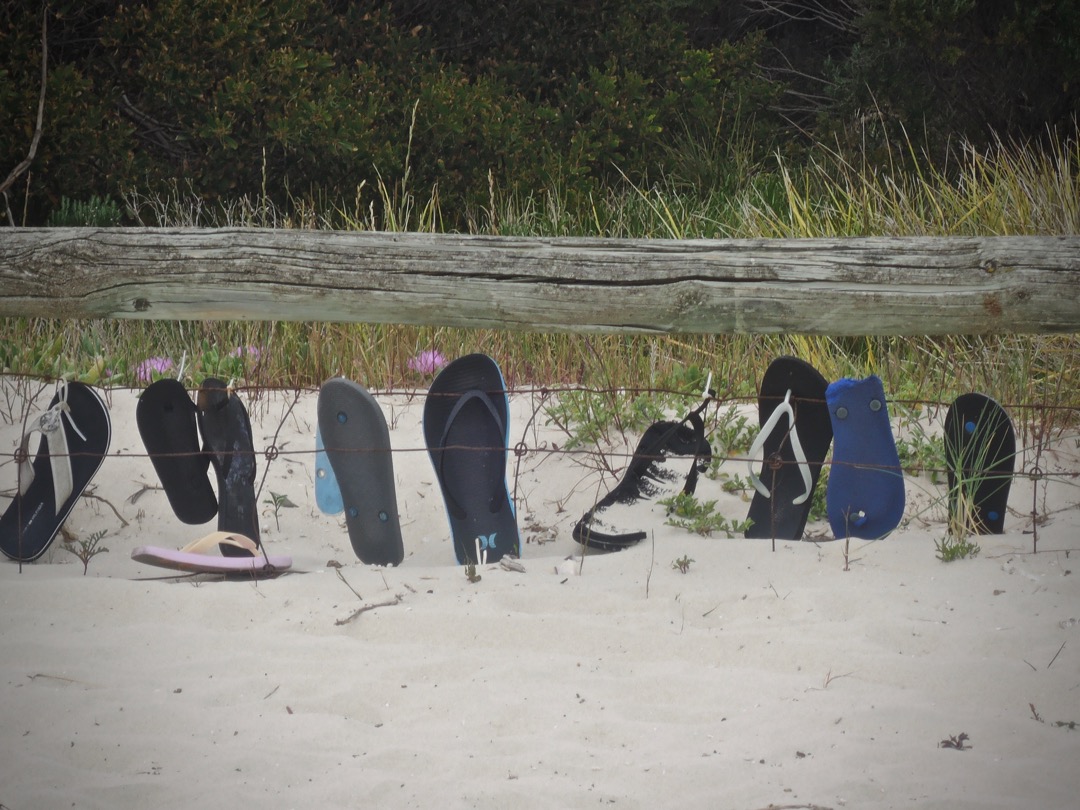
On the way home, I left the beach by a path I don’t usually take, and found this array of beach-thongs dotting the fence post, which brought a smile to my face:

Whatever your definition of perfect running weather, I’m pretty certain that any day on which you finish up your run with a smile comes close to perfect, regardless!