Snatched phrases: stolen

‘[I] saw a squawking flash of cockatoos
go reeling and wheeling into the sky.
The soft secret underside of their wings,
so close, so tender.’

From ‘Skylarking’
by Kate Mildenhall
 

I was standing at the bus-stop the other day on my way to work when an odd commotion across the road caught my eye. A car had driven past, fast, and something had got caught up in the passage of its passing: something grey and small and warm and moving, something that gave the impression of flight, of flurrying. I wasn’t sure what it was at first, although subconsciously I registered feathers, but after the car had sped past, I saw that it was a small bird. In my memory I replayed what had just happened and this time, in my mind, I saw it: the bird had swooped down from the branch of a tree overlooking the street, but somehow it had mistimed its dive, and so it had got caught up in the passage of the car. Got hit, is what I mean.

The dove — that’s what it was, I saw: one of those spotted turtle doves with the iridescent sheen on their neck and the rash of white spots over a patch of purest black — had landed, after its collision with the car, on the ground in the middle of the far lane. Now the wind was playing with its feathers a little, and I saw the dove try get up on its legs but then fall back down again. It was young, not quite fully grown. I glanced around me, at my fellow commuters waiting at the bus-stop, but though I saw people looking, though I saw them seeing what I was seeing, no-one moved.

And so I ran out onto the road before the next car came past and crouched down beside the dove. I looked down at it, hesitating, and then I whispered to it, because I felt I should, I’m just going to pick you up and get you out of the way of all these cars; and then I reached for it and clasped it between my hands. I could feel its heart beating inside my two hands, and the warmth beneath its feathers, and I could feel it trying to gather itself and flap its wings to free itself from me; it didn’t want me to hold it, not at all. But it was too small or injured to shrug itself free and so I held it gently and lifted it and crossed to the far side of the road, opposite the bus-stop, and then I set it down on the footpath, there out of reach of the traffic.

Once I had put the dove down I crouched down beside it a moment on the footpath, watching it. I said to the bird, You’re safe now, and then it blinked — only it wasn’t a blink, not really. Its eyelid came down far too slowly, like a shutter, in a kind of world-weary exhaustion; and then its eyelid opened again, also too slowly. I could swear it had let out a little sigh as it blinked, although birds don’t sigh, do they? After that, it went utterly still. When I glanced across the road at the bus-stop, no-one was looking my way anymore; everyone was busy with their phones and their handbags and their earbuds. After a moment I stood up and walked back across the road and waited with them at the bus-stop. Five minutes later the bus arrived, and still no-one had spoken, and still the bird hadn’t moved from the place where I had set it to rest on the footpath.

I thought as I sat on the bus that the dove had died: that perhaps the shock of me lifting it up had added a final trauma to its day and its heart had stopped right then, as I crouched by it on the footpath and whispered to it, trying to comfort it. I thought about that all the way to work, and then I tried not to think about it anymore.

Doves are a dime a dozen, and there was nothing more I could have done, I guess, but still I felt sad. It was the intimacy of that moment, I think: feeling the secret beat of the dove’s heart between my hands, the warmth of its soft chest against my palm. I felt, perhaps, the way the narrator does in the passage above, as she observes the cockatoos in the sky, seeing the soft secret underside of their wings. It was the stolen, fleeting nature of the moment between the dove and me, tinged further with the thought that I hadn’t helped, and maybe — just maybe — I had made the dove’s last moments worse, not better.

When I got off at the bus-stop that evening, on my way home from work, I saw to my surprise and my slow delight that the body of the bird wasn’t there as I had expected it to be, cold and long dead. There were no feathers there, either, no signs of blood or injury or scuffle.

And I think now — I truly think — that when I set down the bird on the footpath and it let out that terrible not-sigh, it was in shock, but it was essentially uninjured; and so afterwards — after it had recovered from its shock — it got up and it flew away to safety.

That’s what I think.

Out and about: dragons & damsels

‘When you’re walking the view shifts and changes.
Walking’s a form of hope.’

from ‘The World Without Us‘
by Mireille Juchau


I wasn’t expecting anything special on my most recent walk in the Scrub. It was mid-February, a warm Sunday at the end of a warm week, after a very warm January. I figured everything in the Scrub — bushes, birds, animals — would be going through what I always think of as mid-summer somnolence.

But things in the Scrub were thriving. Passing sea box bushes resplendent with red berries (above) and sheoak trees whose branches were clustered with woody fruit (below), I walked south, towards the little lagoon just behind the boundary fence that runs along Acacia Terrace.

Damselflies skimmed the (somewhat scummy) surface of the water, and a pair of ducks paddled amongst the reeds in the lagoon. As I followed the curve of the bank around to the other side of the pond, I saw a family of kangaroos lazing in the shade of the nearby bushes, one of them poised upright, ears pricked, standing sentry.

There was a bush in flower that I’d never seen before, too — I think it was a hakea, though I’m not entirely sure. Its white flowers reflected the bright summer sun so that the petals seemed to glow.

And just outside the Scrub, perched on an upright stump by the side of the road, a little dragon caught my eye.

He (or she, I’m not sure) was very still, so still that I thought at first he was an oddly shaped twig sticking out at the top of the stump. We regarded each other silently for quite some time — I, fascinated, he, less so — before I turned to go.

I swear I could feel that dragon’s eyes on me all the way home …

Snatched phrases: on cake

‘This is bread in the way that banana bread is bread.
It’s not really. It’s cake.’

From ‘The Little Library Cookbook’
by Kate Young


I loved the recipe notes I’ve quoted above, which accompany a recipe for a ‘fruity nutbread’, in Kate Young‘s literature-inspired cookbook. That’s my kind of bread! (Cake?)

(So of course I had to make the recipe … )

Out and about: at lunch

‘When you’re walking the view shifts and changes.
Walking’s a form of hope.’

from ‘The World Without Us‘
by Mireille Juchau


I haven’t done an out and about post for a while, so I thought it was time. I recently quit my job at the call centre in order to concentrate on my work as an editor, where my workplace is in the city centre …

… which means that my lunch-break strolls haven’t stopped, but they have certainly changed.

It’s easy to be tempted by shops when you work in town (books! clothes! books!), but the other day, on a late lunch break, I headed north towards the river as I left my office, rather than south towards the shops.

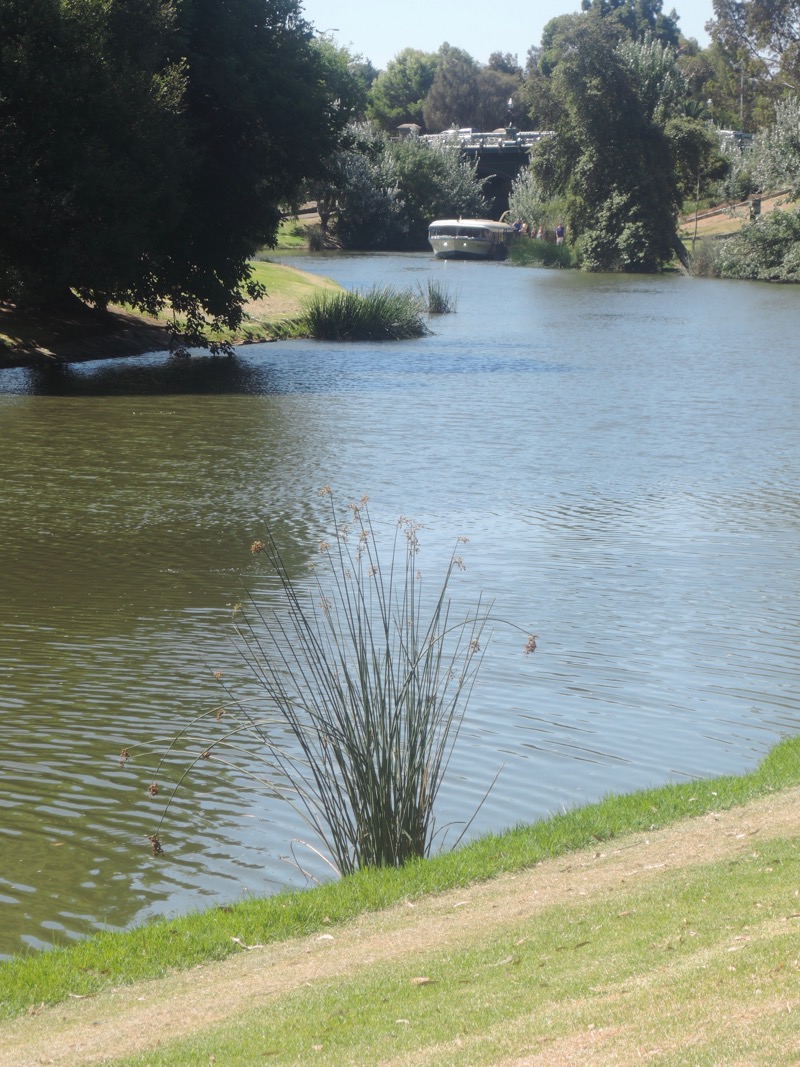
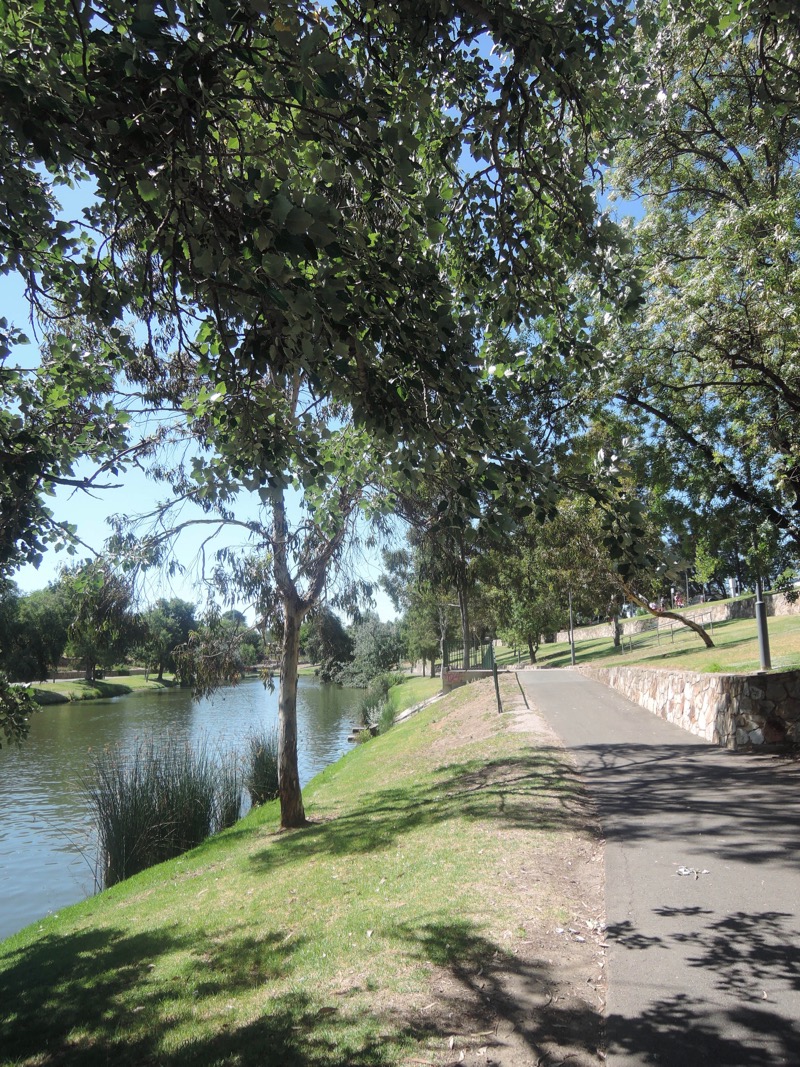
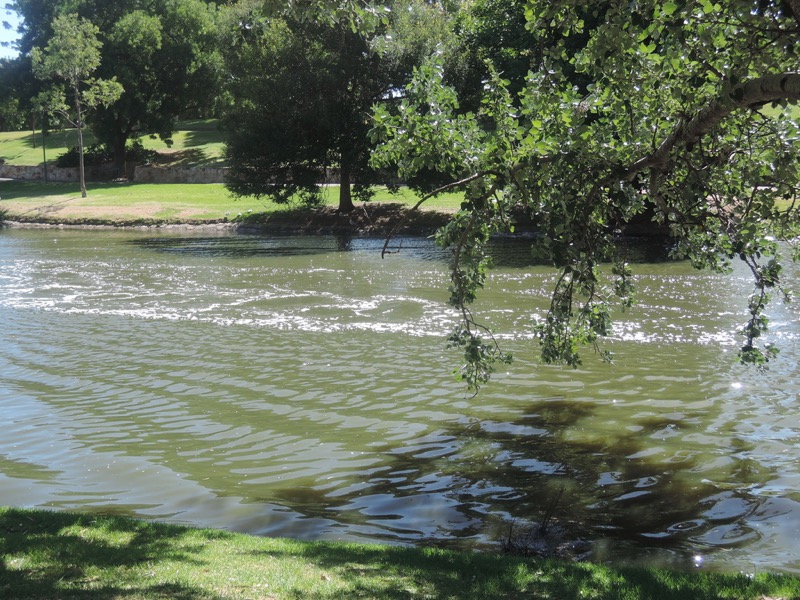
Five minutes north of my office is the River Torrens — the perfect place for a lunchtime stroll.

This particular day was one of those lovely January days, as I hope my photos on this post demonstrate: warm and sunny, with soft blue skies and a gentle breeze ruffling the water …

… There were ducks and moorhens paddling about, and the grass, which had been recently mown, smelt dry but sweet.

January is one of my favourite months of the year, as far as the seasons go. It’s usually sunny, and though the days are mostly warm, the temperatures rarely rise to stifling. It’s the ideal month for strolling, walking and wandering.

I plan to come back to the river in my lunch break again soon …

Snatched phrases: last pages

‘I will love a book forever
if the final pages mark my subconscious.’

From ‘The Museum of Words’
by Georgia Blain

My mother and sister and I (all inveterate readers) were talking the other day about those devastatingly disappointing books you read all the way through, from start to finish, without skipping a paragraph, because you are in the grip of a conviction that you’ll get to the end and suddenly — suddenly — all this time you’ve spent reading it, feeling love and hate for the book and its author in equal measure, will be justified.

You know those books I mean? I say ‘devastatingly disappointing’ because I am describing the kind of book that, when you do finally get to the end, you realise your time wasn’t justified at all. You realise that, on the contrary, the whole time you spent reading it was, in your opinion at least, a waste of time.

You know those kinds of books?

That’s why I love Georgia Blain’s words above.

So I thought I would make a list of books whose last pages have, as Blain so delightfully puts it, marked my [own] subconscious forever. Here they are, in no particular order:

Rebecca, by Daphne du Maurier
Prep, by Cutis Sittenfeld
The Children’s Book, by AS Byatt
A Map of the World, by Jane Hamilton
The Smart One, by Jennifer Close
Me and Mr Booker, by Cory Taylor
Wasted, by Marya Hornbacher
Tell Me I’m Here, by Anne Deveson (Georgia Blain’s mother).

And, yes, the book I’ve quoted today, Museum of Words, by Georgia Blain.

What about you?

I see you

Other people’s words about … love

The bright lights had been switched off and the place was lit only by small windows. Then there she was — Stella — the top of her head highlighted as she looked down, reading. It never ceased to amaze him the thrill he got at seeing her. Catching her unawares.

From ‘Midwinter Break‘
by Bernard MacLaverty

Every time I read these words by Bernard MacLaverty, I feel my breath catch. They describe so perfectly those tiny, stolen glimpses we get of the people we love.

The photo accompanying this post is one I took while I was in Yorke Peninsula recently. It was very early summer: fan flower season. One evening just after sunset, as I wandered along the top of the cliffs, I came to a fork in the path where there were fan flower bushes growing at every corner.

And there, in the dim glow of the early-evening sky, the petals of the fan flowers — which in the warm, bright light of the middle of the day are a strong, cheery blue — seemed to shine for a few moments: pale, spectral, luminescent.

Perhaps my talk of fan flowers seems an odd match for the words I began this post with. But this was another one of those tiny, stolen moments we’re given in life from time to time, and it seems to me a good way to honour Bernard MacLaverty’s lovely words …

PS One other thing: a quick shout-out to my mother, who celebrates her birthday today, and who is a person responsible for many lovely moments in my life ♥.

This quiet unknowing

Other people’s words about … dreams

I am trying to find my dog, which is going to be put down. Not a dog I live with in my waking life, but another, a black Labrador. The dog has already been taken away and is awaiting its death at a pound on the edge of town. This awful knowledge permeates my sleep. When I get there, however, my dog has gone. In its place, lying sick and exhausted on the concrete floor inside a large cage, is a young, very beautiful red setter. As I enter, the creature raises its head towards me and I see with slow shock that its muzzle has been sewn up with fishing line. The red dog pulls itself off the ground and limps towards me. Rising on its hind legs, it puts its forelegs on my shoulders, and rests its head against the left side of my neck. I can sense it begging me to save it. I feel great pity; I embrace and try to comfort it. But there is no sense that I can or will do anything to help it. The burden would be too great. Words come into my head. The dog’s name: Gadget. (Why Gadget? I wonder, even in the dream.) Then the thought — with which I am already justifying my decision to abandon it — that red setters are not very intelligent dogs. I step away. The animal stands there, hopeless. I touch it on the back and I leave.

What to do with a dream like that?

From ‘Anaesthesia‘
by Kate Cole-Adams

What to do, indeed?

I love the words in this passage: this description of a dream, which is vivid and haunting and bewildering all at once, as dreams so often are. Over time, Cole-Adams goes on to say, various astute readers have suggested to me that this particular dream might not belong in this particular book, that it is a dream that emanates from somewhere else and that ought to be left there …. And yet she includes the dream in her book anyway. In doing so, she allows herself to write intuitively, blindly, instinctively, knowing — knowing — that what she is writing must be written, but not knowing why.

In the quiet after waking I lay curled on my side suffused with the knowledge of irrevocable loss. I had betrayed the red dog. And in doing so I understood that I had disavowed some helpless, voiceless part of me. The dream did not feel like a dream. The house was still and very dark. I did not know what the dog had been trying to say, but I could still feel almost physically the place above my left shoulder where it had nuzzled its head against my neck, and I accepted finally that I could not write this book without it.

Do you sometimes have dreams like Cole-Adams’s dream — a dream that [does] not feel like a dream? Do you feel memories rising in you that feel more alive than memories should ever feel? Do you get a feeling of sickness in your gut that you know — you just know — isn’t a sickness; and yet it is, it is?

I do.

These days, I’m not much one for grand resolutions. I don’t know what path I’ll follow this year (though, hopefully I’ll get to walk one of the sandy paths in Aldinga Scrub, like the one pictured above, every now and then). I don’t know what 2018 holds, for me or for you.

I do hope, though, that there will be some moments like Cole-Adams describes, for you and for me: those quiet moments after waking when you do not disavow the helpless, voiceless part of you; those moments when you accept finally that you cannot otherwise do what it is you need to do.

Snatched phrases on … (Christmas and) the sea

‘The sea is flat silver under a lapis sky.’

From ‘I am, I am, I am’
by Maggie O’Farrell

Christmas in my neck of the woods is all about summer, so what better way to celebrate it than by the sea?

That’s how I’ll be spending my Christmas season, anyway — how about you?

Meanwhile, I just wanted to wish a quick merry Christmas to everyone who reads this blog.

Thank you for your companionship once again this year … and here’s to more reading next year, as well as walking, wandering and (of course) time spent by the sea!

Rebecca xo

Day by day

Other people’s words about … tea

I am the sole tea-abstainer in my family. I think they regard this as a baffling perversion. To me, tea tastes like dried lawn-clippings, diluted leaf mould, watered-down compost mixed with a dash of bovine bodily fluid. I have never been able to stomach it.

From ‘I Am, I Am, I Am‘
by Maggie O’Farrell

I loved this quote from Maggie O’Farrell. My sister, an inveterate coffee-drinker, feels much the same as O’Farrell, I think: she wrinkles her nose in disgust at any suggestion of tea. She, in contrast to O’Farrell’s family members, is baffled by my love of the stuff.

Each to her own, right? I would find it harder to give up my one or two pots of tea per day than I would to give up chocolate or cake or wine. Tea provides me with what amounts to both a daily treat and a ritual, and it gives me, each day, a small moment (often temporary but still cherished) of sanity and solace.

I would write more, but it’s 9.30 in the morning and the kettle is on the stove waiting for me to make my daily pot of tea …

Walk on

Other people’s words about … things falling apart

When you’ve passed through a difficult period, it can be tempting to yearn for a delivery of good fortune, or for experience that feels redemptive somehow. You want suffering to have purpose, for pain to be justified by wisdom or abundance or growth.

from Weekend Reading
by Gena of The Full Helping blog

I had an odd weekend recently, going through some of my old journals and photos for writing-related reasons. The entries I’d written in my journals back then, during a time in my twenties when I lived overseas — first in Texas, then England, then Germany, Cairo, Jakarta — were vividly descriptive of a life I no longer lead, nor will ever lead again. Those journal entries threw me back to a ‘me’ I hadn’t exactly forgotten but somehow, foolishly, thought I had let go of.

Although I have let go of that me, mostly.

My life, during those years I lived overseas, was filled with extremes — of loneliness, joy, excitement, fear, love, doubt, sorrow, terror, grief. There was one particularly difficult period, living in Jakarta with my then boyfriend, when one thing after another went terribly wrong, and I felt as though I was walking through my days — those days that made up my life as I then knew it — with my head down, just waiting for the next blow.

Like Gena, in the words I’ve quoted above, sometimes in Jakarta I just wanted those most difficult days to have a meaning. A purpose. But they didn’t. Even now, when I look back on those times, I find them hard to make sense of. I think I always will.

Gena quotes the Buddhist Nun Pema Chodron, who says the following in her book When Things Fall Apart:

We think that the point is to pass the test or overcome the problem, but the truth is that things don’t really get solved. They come together and they fall apart. Then they come together again and fall apart again. It’s just like that. The healing comes from letting there be room for all of this to happen: room for grief, for relief, for misery, for joy.

These days, I would quibble with Pema Chodron’s use of the word healing — isn’t that just another way of saying you can solve things? — but then, I’m not a Buddhist. Or a Nun.

Still, I like the notion of things falling apart and then coming together again, only to fall apart once more; I find it immensely comforting. Even more, I like Pema Chodron’s simple statement, neither defeatist not celebratory, that life is just like that.

It is just like that, isn’t it?


The photographs accompanying today’s posts come from a recent trip to Yorke Peninsula. It was mid-November, and the late-spring flowers dappled the dunes. Fan flowers, common sea heath, grasses, sedges, acacias and other flowers I couldn’t identify and don’t usually see at home had sprung up everywhere, in every bare patch of sandy ground, in every sheltered nook, in every little cranny in the rocks. Walking amongst them, I felt things come together again in my heart, for a little while.

And then — well, then I let go. And walked on.