When the water runs dry

Other people’s words about … drought

Many years ago, when I was in my twenties and travelling overseas, my American boyfriend took me back home to meet his family and friends in Michigan. We had been living for the previous few months in Cairo, that famous desert city, and to begin with we had, like all Westerners, drunk bottled water, fearing that the local water might make us sick. But we didn’t have much money and we had read that the municipal water in Cairo was safe to drink, even for Westerners, and so after a few weeks we had transitioned to drinking tap water. Neither of us had become sick as a result, but the Cairo water was so heavily chlorinated (presumably to make it safe to drink) that even I, hailing from Adelaide, found it hard to stomach.

In my home town, the tap water was similarly heavily chlorinated — so heavily, in fact, that it was said that aeroplanes, landing in Adelaide to refuel, didn’t refill with local water. How apocryphal this story is, I am not sure, but in any case, back in Cairo my boyfriend and I had taken to adding Tang to our water to take the taste of chlorine away. When I think of Cairo now, I still think of the taste of the water we drank in our last few weeks there, tangy with artificial orange flavour. How it sat in your belly afterwards like a stone. It was in Cairo, not Adelaide, that I came to understand the meaning of the term hard water.

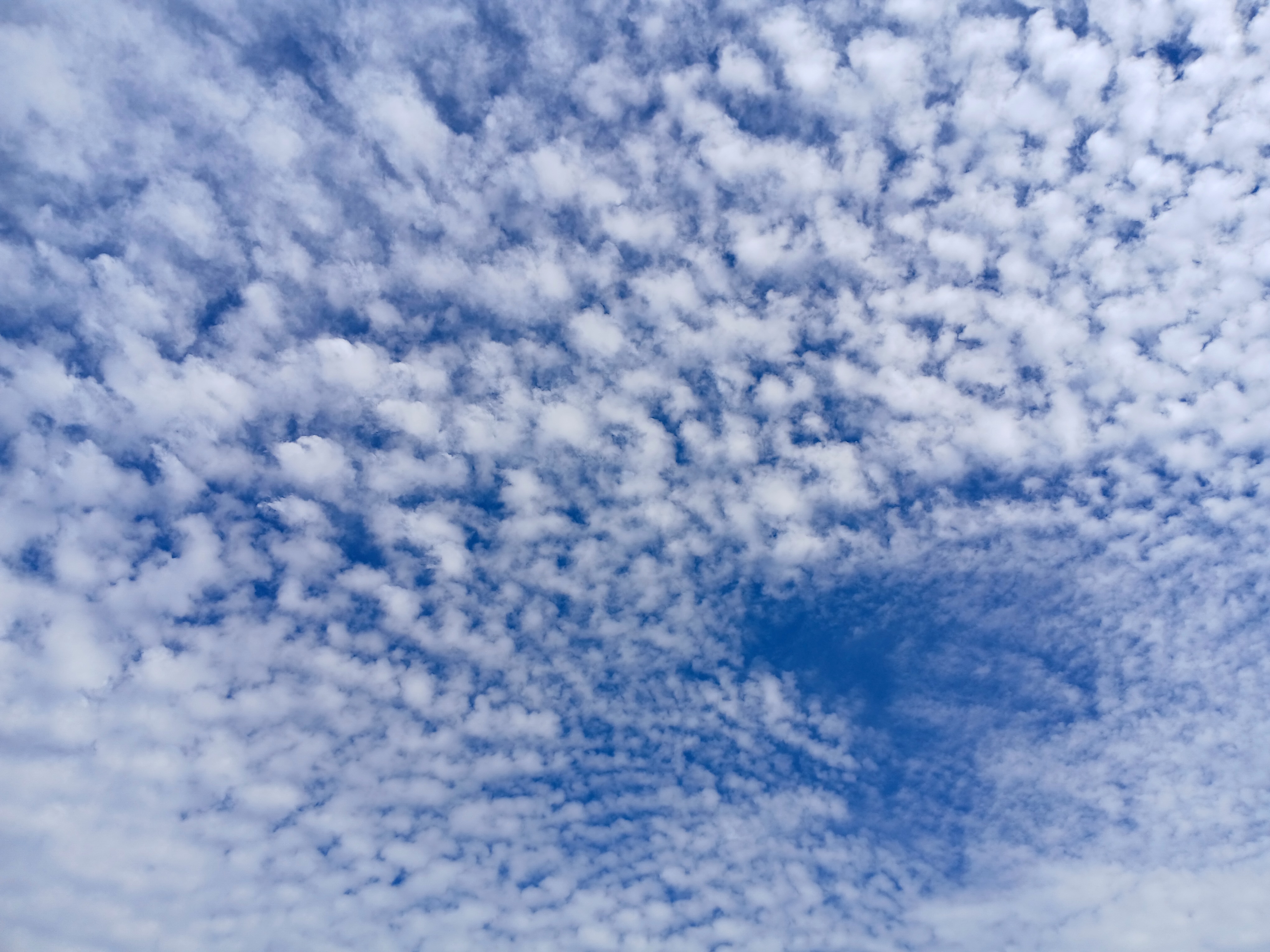
Clouds but no rain, Aldinga Beach, May 2025.

The narrator in Madeleine Watt’s quietly devastating novel Elegy, Southwest, Eloise, is a young Australian woman, twenty-nine years old in the present day, which makes her, I guess, a Millennial. And yet when I read the passage I’ve quoted above I thought of myself, most decidedly a Gen X-er, and my own reactions to water scarcity when I was travelling in the nineties. In Michigan, when my boyfriend left the tap running as he brushed his teeth, when his mother washed the dishes under a running tap, I struggled to swallow back my protests.

‘We’re surrounded by the Great Lakes,’ my boyfriend said, teasing me. ‘We’re hardly experiencing water scarcity.’

But my response to the sight of running water was instinctive, fundamental. Water was a precious resource. You didn’t waste it. You just didn’t.

This year in South Australia we’re experiencing record low rainfall. After the driest summer in thirty-three years, we’ve moved into an equally dry autumn, and we’ve been saved from water restrictions only through the existence of the desalination plant that opened in 2012 in response to the Millennium Drought. Meanwhile, the native local flora and fauna are visibly, heart-breakingly struggling to stay alive. Those beautiful wide blue skies of South Australia? I’ve come almost to dread them.

Like Eloise, I grew up watching Hollywood movies where teenagers hung out in malls with fountains in them. Like Eloise, I don’t remember seeing a fountain in our local malls (though in the much-loved TV comedy from the noughties Kath and Kim, the local shopping mall is aptly — prophetically? — named Fountain Lakes). And like Eloise, all these years later, in these years of drought after drought, I, too, want to ask: Who is in charge? Why isn’t somebody doing something?

Lately I’ve been reading …

Like breath

Other people’s words about … places that reside within our hearts

During our visit to the jungle, while we slept on the verandah at 3 AM, night would be suddenly alive with disturbed peacocks. A casual movement from one of them roosting in the trees would waken them all and, so fussing, sounding like branches full of cats, they would weep weep loud into the night.

One evening I kept the tape recorder beside my bed and wakened by them once more out of a deep sleep automatically pressed the machine on to record them. Now, and here, Canadian February, I write this in the kitchen and play that section of cassette to hear not just peacocks but all the noises of the night behind them — inaudible then because they were always there like breath. In this silent room (with its own unheard hum of fridge fluorescent light) there are these frogs as loud as river, grunting, the whistle of other birds brash and sleepy, but in that night so modest behind the peacocks they were unfocused by the brain — nothing more than darkness, all those sweet loud younger brothers of the night.

from ‘Running in the Family
by Michael Ondaatje

I have just spent a week away in Deep Creek, having been chosen as this year’s lucky winner of the Deep Creek Residency for writers. I spent that week away writing, reading, bushwalking, running, writing again, then writing some more. It was a joyous time, the rarest privilege, to be given time away simply to write.

Daytime, Deep Creek, October 2024.

In our lives, I think that there are some places, connected to some times, that are somehow magic, that come to us through luck or stealth or a great deal of planning and then reside with us forever. These places become a part of the fabric of who we are, though we may not always understand why, and what we feel, when we think of them or remember them or revisit them, is a sense of awe — a sense of connection to something deeper than we can articulate.

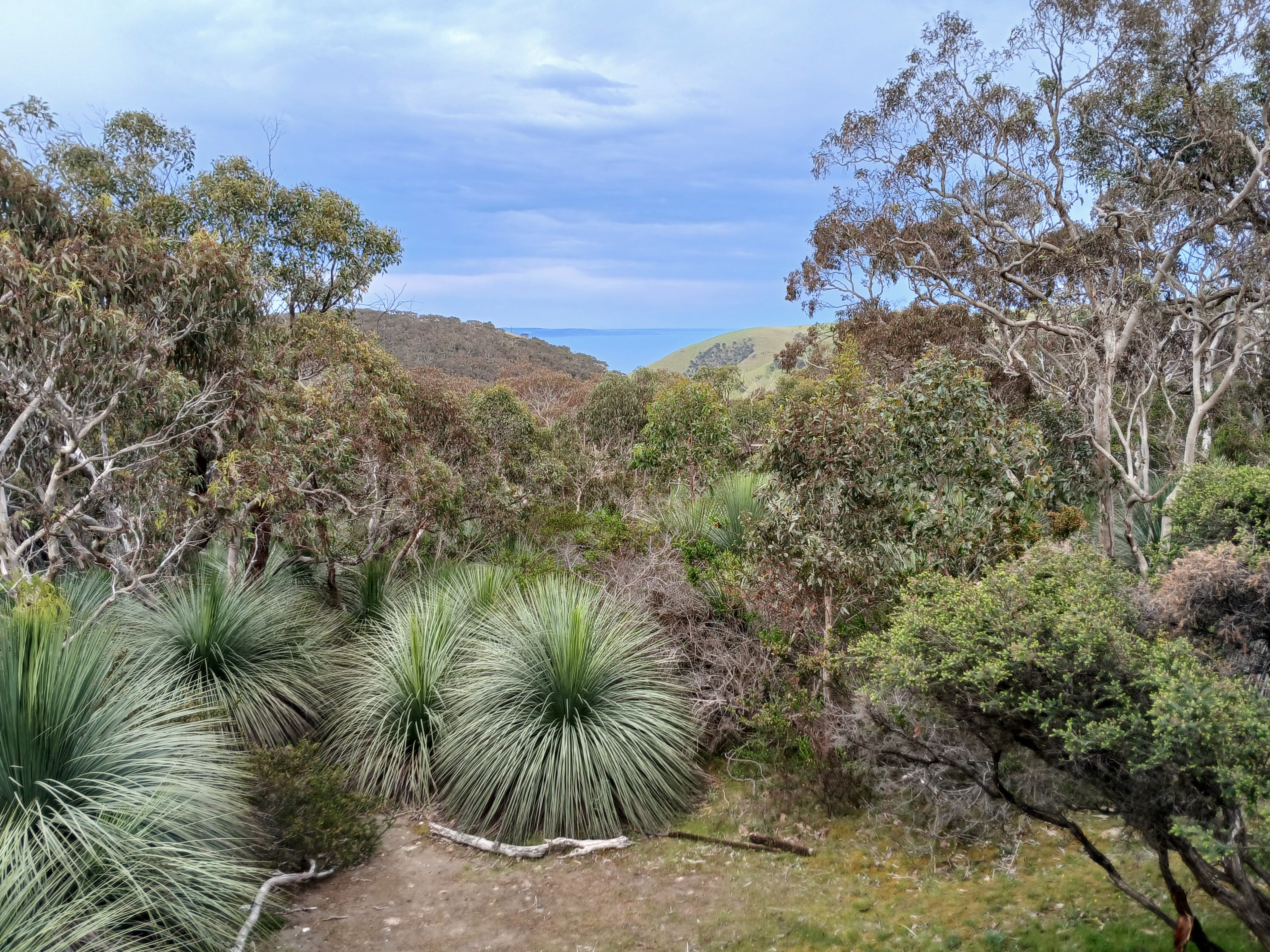
Gully of grass trees, Deep Creek, October 2024.

Deep Creek, place of grass trees and rolling hills and shrike thrushes calling in the trees, place of kangaroos and echidnas and sheep and shingleback lizards, place of tawny frogmouths and fogs and sunshine and rain and big, big skies — Deep Creek is, anyway, one of those places for me, a place close to my heart. I have left Deep Creek now, and the hopes and dreams I went there with — that I would write copiously and productively, that the story I’m writing is worth telling, that the manuscript I’m working on might one day get published — may or may not come true, but Deep Creek is still with me and always will be. I don’t know how else to put it.

Resting place, Deep Creek, October 2024.

And this is what I love about the passage I’ve quoted above by Michael Ondaatje, the way he captures the mystery of a place, its essence; the way it has become a part of him. I have never been to the jungle that he writes of, never heard peacocks who weep weep loud into the night. But in Deep Creek I have felt what Ondaatje describes. In Deep Creek I have felt that I have found a place that will, like breath, always be with me.

First light, Deep Creek, October 2024.

Lately I’ve been reading …

We cannot know

Other people’s words about … writing about life

‘We cannot know.’ If used sparingly, this is one of the strongest phrases in the biographer’s language. It reminds us that the suave study-of-a-life we are reading, for all its detail, length and footnotes, for all its factual certainties and confident hypotheses, can only be a public version of a public life, and a partial version of a private life. Biography is a collection of holes tied together with string, and nowhere more so than with the sexual and amatory life. For some there is nothing easier than understanding the sex life of someone you’ve never met, and easier still when they’re conveniently dead; or in posthumously adding another conquest to the dance card of a known Don Juan. Others simplify things by maintaining that human sexual habits have always been more or less the same, the only variables being the degree of hypocrisy and cover-up.
But sex is a world in which self-deception can so easily present itself as objective fact, and ‘brutal honesty’ is no more likely to be true than shy evasiveness or sentimental melodrama as an explanation of what really took place. Oscar Wilde may have been a ‘posing sodomite’, but such evidence as we have suggests he preferred intercrural sex, and if so was not technically a ‘sodomite’ at all. We cannot know. Sara Bernhardt was a nymphomaniac. Oh, but she was also incapable of orgasm. Until she had the problem fixed by means of an ingenious surgical implant — which is reliably attested by that ‘hysterical duplicitous gossip’ Jean Lorrain, and then recorded in the [j]ournal of Edmond de Goncourt, whose views on women were old-fashioned to say the least. We cannot know. Robert de Montesquiou was a flamboyant homosexual, except that his biographer thinks he was too coldly fastidious to indulge his Hellenic urges, while [Samuel] Pozzi’s biographer thinks he may have been impotent from around 1884, and remained so. We cannot know. Pozzi had a reputation as ‘an incorrigible seducer’, a doctor who slept with his patients, who may even have used his consultations as foreplay. He also kept all the letters he had received from women over a sexual career of half a century or more. Yet after his death, Mme Pozzi instructed her son Jean to burn them all. So we cannot know a large amount … We may speculate as long as we also admit that our speculations are novelistic, and that the novel has almost as many forms as there are forms of love and sex.

from ‘The Man in the Red Coat
by Julian Barnes

Many years ago, my mother and I embarked together on a reading project for a year, our own little book club before book clubs were a thing. Our reading theme was American novels, and we took it in turns to pick a novel, one by one over the course of the year, which we each then assiduously read; afterwards, we caught up over coffee to talk about it. I remember this year with great fondness as a time of shared reading and conversations, conversations that began with reading and literature but moved on, as all good conversations do, to other things. Art. Love. Life.

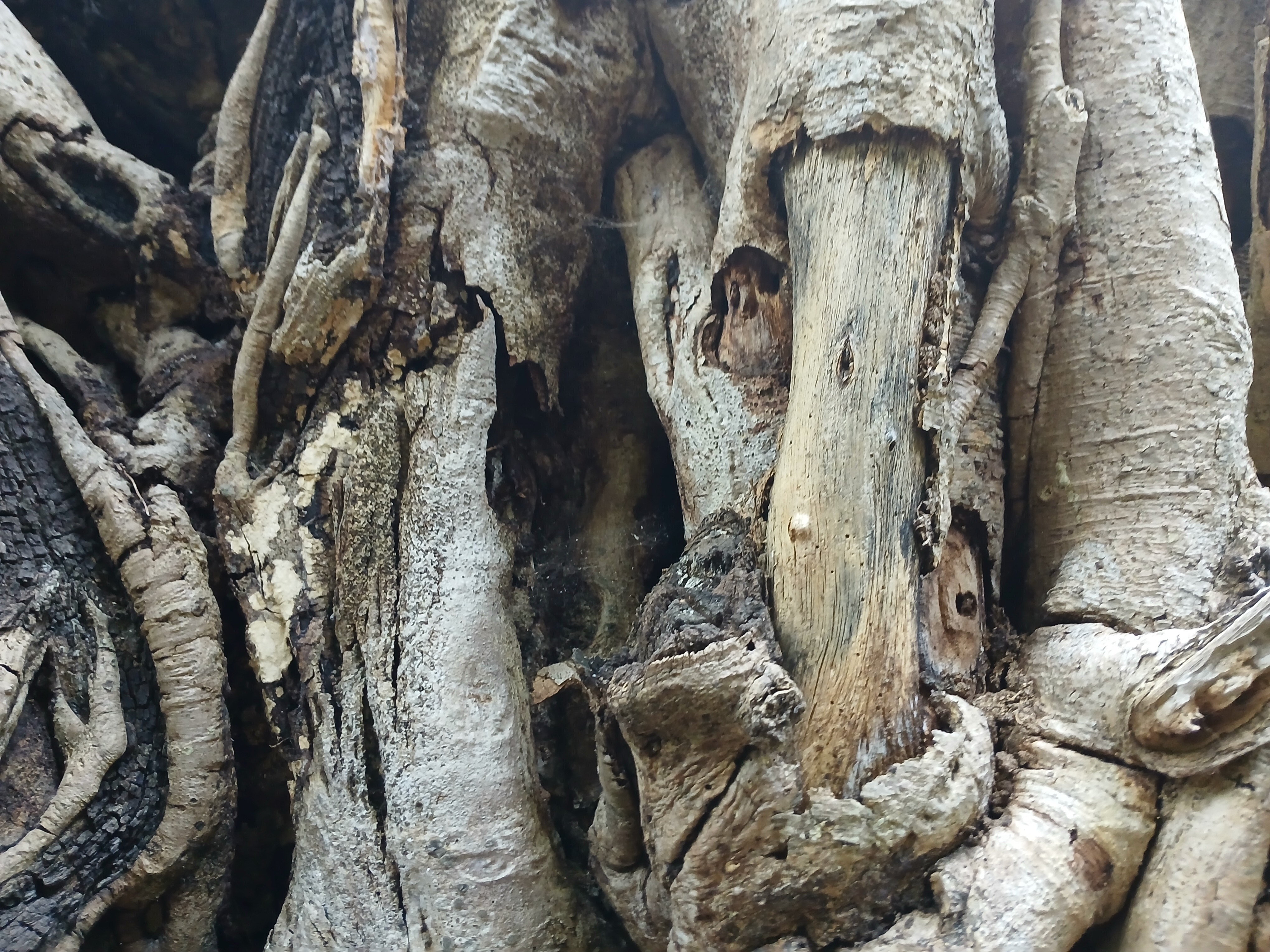
Knotted trunk, Lameroo Beach, Darwin, August 2024.

Recently we’ve begun another reading project together, one that we hope will involve some writing further down the track. As a result, my reading choices, which usually tend to fiction only, and generally to contemporary literary fiction at that, have widened. I’m reading fiction and non-fiction, works by contemporary writers and works by long-dead ones, works by women and works by men. Hence The Man in the Red Coat, which I might not otherwise have come across.

We cannot know. I’ve quoted Barnes at length here (which I hope he will forgive me for) because I love the virtuosity of this passage, the way he begins with a simple assertion, a certain truth, and then moves on in the space of a couple of paragraphs to cover themes at once intimate and specific to the period he is writing about (the Belle Epoque) but also meta-textual, concerning the art of biography itself, that collection of holes tied together with string. (What a lovely image that is.) And then, somehow, we arrive at the end of this flight of thought with another assertion, equally simple but bold, about the essence of novels and fiction.

We cannot know. Indeed.

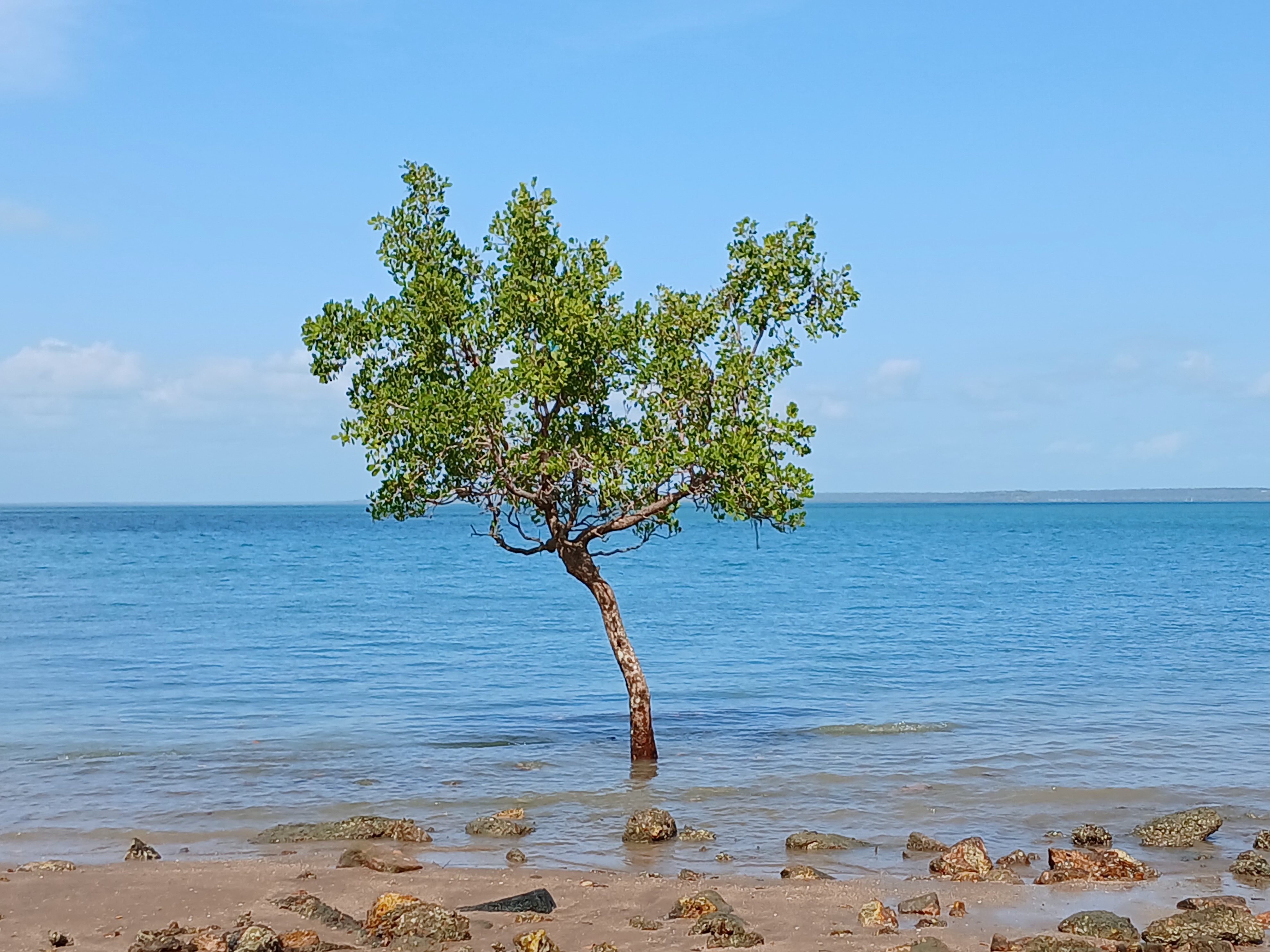
Mangrove tree at Lameroo Beach, Darwin, August 2024.

The photographs in this post, like the ones in my previous post, come from a recent trip I took to Darwin. I’d never been to Darwin before and was only there fleetingly on this occasion, but I fell in love with it, all of it. Darwin in the dry season: place of sunny days, rainforest-lined beaches, mangroves and vines and bush-stone curlews. When you visit somewhere new, you see things through a stranger’s eyes, which is to say that you don’t see its inner workings, its inner truth. Does that mean that you see its truth or something else, your own hypothesis of the place? We cannot know. But oh, the privilege of having the opportunity to see it anyway.

Lately I’ve been reading …

Unrequited

Other people’s words about … a woman’s desire

The meat was ready, steaming, when I lifted the lid of the pot. As I sliced it up I pictured meeting the ambassador in the hotel room. First, he will open the door and clasp me in his arms, I decided, putting a plate in front of my husband. He will kiss the hollow of my throat very softly, and then he will gaze upon me, I decided, like he did today, but with much more tenderness. I cut my potatoes up into tiny pieces. My husband chewed and chewed, with the mouth that never kissed me. He will lay me down on the soft white bed and undo the buttons slowly, I decided. He will kiss my eyelids. I will place my hands on his smooth back, I decided as I chewed. I will clutch him to me but not too hard, not like a drowning person. The light will be dim. The bedding will be spotless. He will tell me that he has seen what nobody else has ever noticed. He will say, ‘It’s you I’ve wanted all along, Elodie. I see you, Elodie. You. You.’

from ‘Cursed Bread
by Sophie Mackintosh

I came back to Elodie’s story again today, having quoted from it once before. Elodie’s story continues to compel me — her longing for her husband to desire her, to see her, oh, to want her. Though Elodie is young and has her life ahead of her, I wonder whether the feelings and desires she expresses in her narrative, those feelings and desires that in her tiny village community are so forbidden, are a little like those an older woman might feel, a woman my age, on realising that the desires she once thought might be realised are now out of reach.

I wonder.

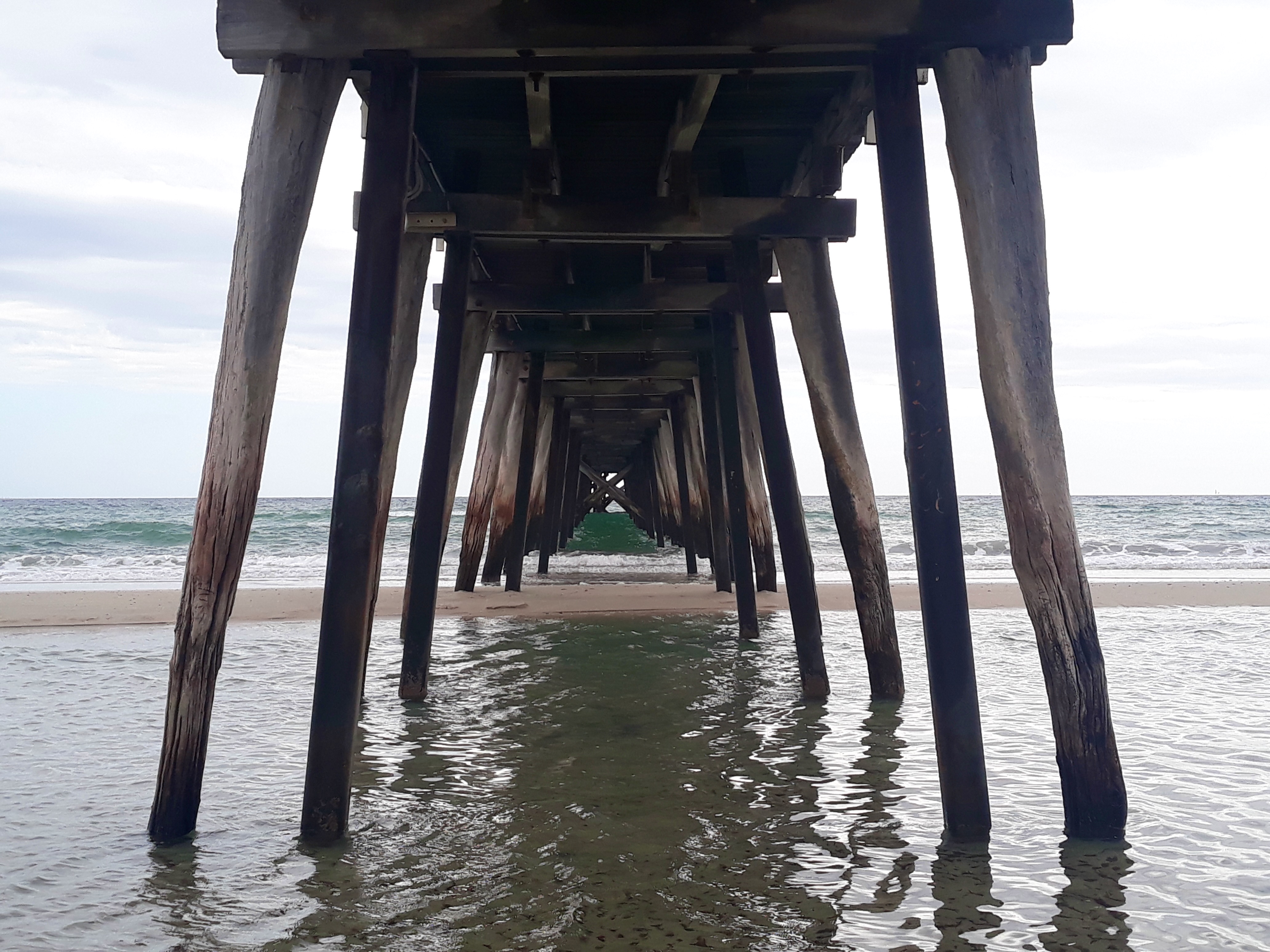
Largs Bay Jetty, May 2024.

I’ve spent the last few weeks quietly. Post-Covid, I still feel tired. It’s a funny kind of tiredness, not so much a feeling of lethargy as a feeling of being tissue-thin, emotionally and physically. I don’t know how else to describe it. Still, I’ve been walking and reading and even writing (a little), and I had a quiet moment of celebration a couple of weeks ago when I saw ten hooded plovers at Aldinga Beach.

Yes, ten. I have never seen so many before, and I walked home feeling quietly jubilant.

Bracken fern, May 2024.

Lately I’ve been reading …

All that food

Other people’s words about … not eating

Mae doesn’t look convinced, but she hands me another bowl, which I pass to TJ. He holds it in the space between us, locking eyes.
You didn’t take any, he says.
I took plenty, I say. I’m stuffed.
No. I watched you.
You must’ve blinked.
Then try some more.
I just told you–
Don’t be a dick, says TJ.
Boys, says Mae.
Her voice is terse enough to shut us up.
Mae holds our gaze until we’ve settled. Then she pours more wine into her coffee mug, twirling her food with a fork.
It’s been too long since we’ve been together, says Mae. Let’s make it a nice evening.
So TJ shoves the bowl of tomatoes my way. I scoop more onto my plate. Then I take bites from the spaghetti and the chicken, and it’s all delicious, and the three of us eat silently, until there’s something like a hum between us.
Is the bathroom still in the same place, I ask.
Mae points down the hallway. I don’t look at TJ when I stand. But once I’ve locked the door behind me, I turn on the faucet, and it’s maybe another five seconds before all that food leaves me.

from ‘Family Meal
by Bryan Washington

When I was a teenager receiving treatment for an eating disorder, people had certain fixed ideas about what kind of person was likely to experience anorexia. By ‘people’, I mean not just family and friends but doctors, psychiatrists, medical researchers. Anorexics, people thought then (because that was what we called people with anorexia in those years, anorexics, a label that many people would now object to), were generally white, middle-class, well-educated, high-achieving, likeable young women with a tendency towards perfectionism.

Perhaps, back then, this was true. Or perhaps, more likely, if you were anorexic but you happened to be male, poor, uneducated, older than twenty-five, queer, or a person of colour — or any combination of these things — then your anorexia went unrecognised. Undiagnosed. Untreated.

We know better than this now, I am thankful to say.

Fringe Lily, December 2023.

In the passage I’ve quoted above, Cam, one of the narrators of Bryan Washington’s second novel, Family Meal, is grieving the loss of his boyfriend, Kai, who died in unexpected, violent circumstances. Cam is Black and queer; he is also addicted to many things, including drugs, sex and, yes, starving himself. He is surrounded by friends who see what he is doing to himself and try to talk to him about it, try to show him that they see, and that they care, and that he doesn’t need to be alone. It takes him a long time to see this for himself, though.

Cam’s experience of struggling with food is different from mine, and that’s partly because of who each of us is — precisely because I did, after all, fit most of the anorexic stereotypes I’ve listed above — although it’s also partly because everyone’s struggle with food is, simply, different. But I am so glad, so glad, that contemporary literature that includes stories about anorexia and disordered eating has broadened to include other stories than ones like mine.

And it’s funny how, no matter what your background, no matter what your life experience, the feelings don’t change. I’m fucking suffocating from the weight of myself, Cam writes.

I remember feeling exactly the same.

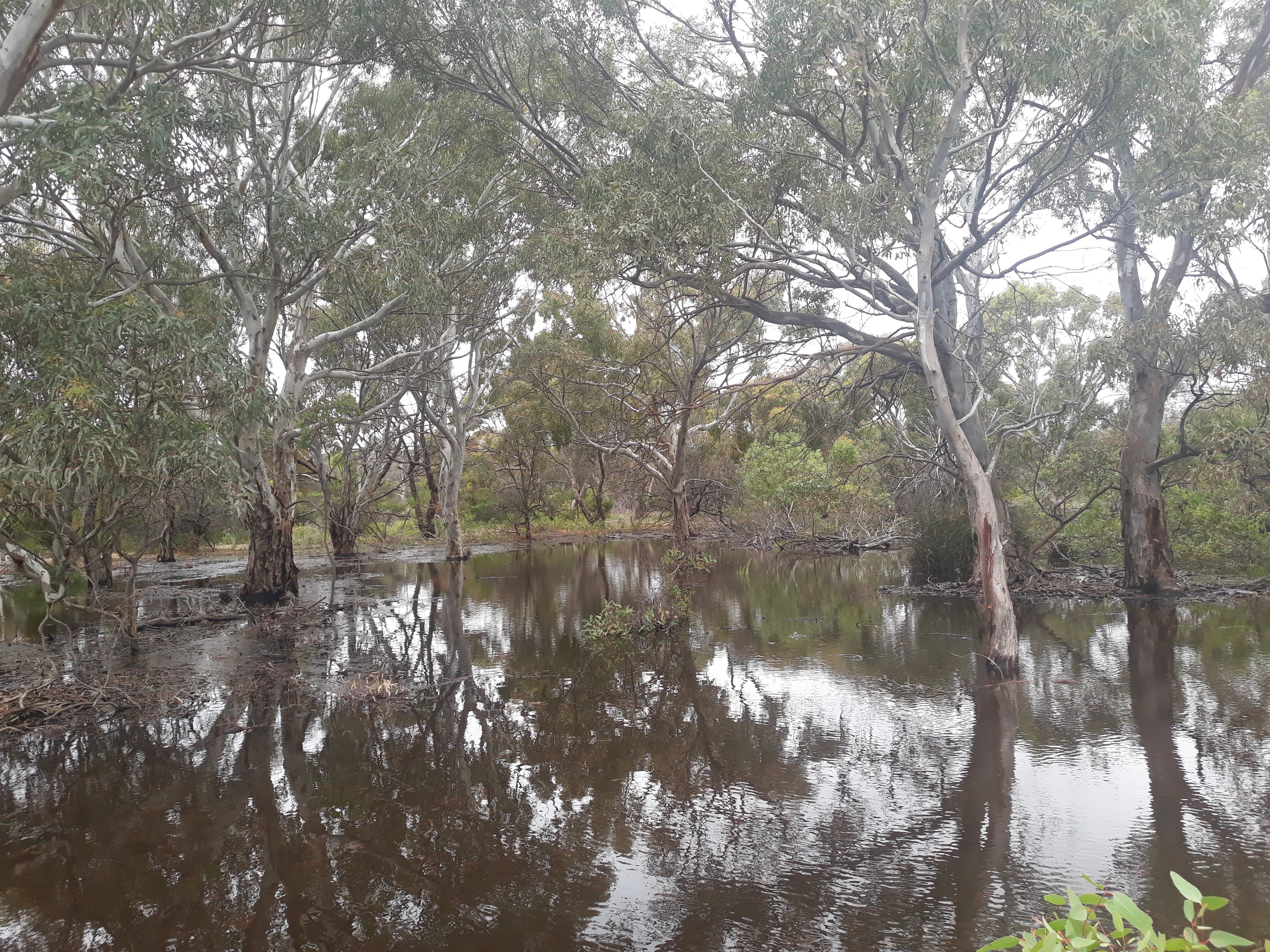
After the rain, Flooded scrub, November 2023.

Lately I’ve been reading …

Please

Other people’s words about … chronic pain

I told [my parents] how that afternoon I had actually gone and seen another psychologist [for help with my chronic migraine]. I was just feeling so low and so down, and a friend had recommended her, and she could squeeze me in. I told her the pain would come and the pain would go, and that I couldn’t control it, that some days I would be fine, more than fine, ecstatic, but that other days the pain would return and I would slide into a depression so deep I could not see my way out. I told her I felt like a rat in an experiment, a rat made to drink water — sometimes the water was normal but other times the water shocked with an electricity so violent that I would swear never to drink it again, but then I would see everyone else drinks water and I would wonder why I couldn’t do that too. I told her I just wanted to drink the water. Sometimes I could, but mostly I couldn’t and I never knew when. I told her I just wanted to know why. It had been years since I’d had the initial migraine, but even now, right then, the pain had returned and I couldn’t read or write or — I told her I was sick of being an experiment, that I just wanted answers, someone to help. Then I asked her if she could help. I asked if she’d ever heard of anything like this before and then I told her please. I said, Please, I would just really appreciate it if you could help, and she just smiled and told me she’d seen it all before. Then she got out a piece of paper and a pen and told me to rewrite negative self-thoughts as positive self-thoughts. I asked her what she meant. She said, Well, you could rewrite ‘I am worthless’ as ‘I am special’; ‘I am alone’ as ‘I am loved’; ‘I am useless’ as ‘I am capable’. And then she sat back and pushed the pen and paper towards me and told me to try. I told Mum and Dad I just got up and left, then — because I knew she was just the same as everyone else — full of bullshit just like the whole world was full of bullshit. I told them it was like I was eight years old, and everyone was playing pretend.

from ‘Train Lord
by Oliver Mol

There was a period in my life some years ago when a headache settled over me which, despite all the cures and treatments I tried in response to it (both conventional and alternative) would not fade away. Unlike the chronic headache that Oliver Mol describes seeking treatment for in the passage above, my headache wasn’t a migraine: the pain I experienced was of a milder kind, what doctors call a tension headache. This meant that, unlike Mol, I could still function. That is to say, I could still present to the world an image of myself functioning. Unlike him, I could still read and write; I could still watch television and use computers; I could still get myself to work.

Still, the pain during that period was omnipresent. It varied in intensity: sometimes it was faint, just a light tingling sensation at the edge of my eyelids or (oddly) inside my nose; sometimes it was strong and persistent, as though someone had lodged a heavy, blunt object (a hammer? a mallet?) into the top of my head and was pressing this object — pressing and pressing it — down into my skull. Sometimes the headache made me feel dizzy and sick, and this, because of my phobia about vomiting, triggered bouts of anxiety that weakened my ability to cope with the pain. On days like that, I felt desperate. I made a mask of my face in social contexts; I disappeared from my desk at work to cry behind the closed door of a toilet cubicle; I made excuses and went home early from gatherings (or didn’t go to them at all). I felt myself, or the person I thought of as myself, slowly disintegrating.

I hadn’t known until then how much my sense of myself as a social creature, and as a socially worthy creature, was predicated on an assumption of my good health. I’ve since learned that this is an experience common to people experiencing chronic pain or illness, but I didn’t know that then.

Aldinga Scrub, summer flooding, January 2023.

Mol’s migraine lasted ten months initially (although later it returned for another few months). My headache faded away around the two-year mark. I still don’t know why, really — whether the cure was due to something I did, or to one of the treatments I tried, or simply to plain luck. Sometimes it returns, settling over me for a day, or a few days, or a week, or a few weeks — but eventually it leaves again. And because of this, because the pattern has changed, because I know now, or at least allow myself to assume, that the pain is only temporary, I have learned simply to wait it out when it visits. To let it run its course.

And yet. That word: temporary. And then I told her please, Mol writes, and that’s what it feels like, even now, when I’m in the midst of a long headache: a prayer to someone, anyone, to make sure that the pain is only temporary, that it won’t take over again the way it did for those two years. Because once you’ve felt it, you never forget it: the way pain changes you, the way it writes itself on you, the way it renders you powerless. The way it robs you of yourself.

This, I think, is what Mol’s psychologist failed to see. Perhaps the worst thing, when you are experiencing chronic pain or illness, is the sense of betrayal that accompanies your pain. You feel, first, as though your body has betrayed you, this body you have been lucky enough never really to have thought about before, which until now has performed for you mostly without pain or grievance; and then, second, as though the people around you — the ‘experts’ you have consulted — have betrayed you, too, with their so-called treatments and cures, with the promises they make you, with the money they take from you, all to no end; and then, third, as though the world itself has betrayed you, in its refusal to operate in a way that is manageable or meaningful for you in your pain.

If, in the end, you are lucky enough to get relief from your pain, what you never quite forget is that when you were in pain, you changed. You no longer knew yourself. You became a person who said, Please.

Lately I’ve been reading …

Speak

Other people’s words about … despair

She sat across from him. For some reason, he removed his glasses and set them on the gold table. His naked eyes were as dark as the burnished leather they sat on and held a startling amount of despair. The effect struck her as indecent, as if he’d disrobed. ‘Put your glasses back on,’ she wanted to tell him. ‘For God’s sake.’

from ‘Vacuum in the Dark
by Jen Beagin

I’ve been thinking a lot recently about the things people say to each other and the things they don’t. And about subtext, which is not quite the same thing but is part of it all the same.

Over the last couple of years, having written and submitted a middle-grade fiction manuscript to my agent which has as yet to find a home with a publisher, I’ve been writing a literary fiction manuscript. I haven’t mentioned this here till now, in part because my writing in that area is still so new and tentative, and in part because when I say the words, ‘I am writing a literary fiction manuscript’, all I hear is my own internal mocking laughter.

You? says the voice in head, that little internalised voice. How could you possibly presume to have something to say in the literary fiction field? How could you assume that much writing talent of yourself? That much wisdom?

Bracken fern, light and shadow, January 2023.

It’s impossible to say whether what I’m writing will ever be something complete, let alone publishable. That’s the risk any writer takes, whether they have had previous books published, as I have, or not. But what I am writing about in that manuscript is in part what Jen Beagin describes so beautifully in the passage I’ve quoted above: our unwillingness to witness each other’s despair. Our inability to talk about it or bring it to light. Our constant need to reassure each other with upbeat, optimistic conversation and good cheer.

I am not by nature a cheerful person. Nor am I an optimist. Nor am I a skilled conversationalist. At fifty-two, I still find myself getting midway through a conversation with another person, only to realise that I have revealed too much of myself: my fears, my doubts, my sadnesses. (Actually, ‘I still find myself’ is the wrong way to put this; in fact, the right way to put this would be, ‘I increasingly find myself’.) Maybe this isn’t evident to the person I’m talking to, or maybe it is. I’m never sure. But I often feel like the man Beagin describes in the passage above: glasses off, the truth in my eyes revealed. This is not a comfortable place to find myself.

But increasingly I believe in the importance of confronting the secrets we see in other people’s eyes. I believe in meeting those secrets head-on. I believe in talking about them. Perhaps what I am saying here is that secrets don’t have to be the subtext to the conversations we have with other people: they can be the essence of our conversations. They can be where we meet.

Common everlasting flowers, January 2023.

Lately I’ve been reading …

Roar

Other people’s words about … country and city life

Ramesh was used to the sounds of the suburbs. He never noticed barking dogs or level crossings. On the train to work every morning he turned up the volume of his audiobook so it was louder than other passengers’ mobile phone conversations. But [tonight he was in] the country [and it] roared. He could hear the air move in the trees. He had grown up in Croydon, moved to Glasgow at seventeen, back to London at twenty-three, then Sydney at thirty-six. As a child he’d stood outside his parents’ bedroom listening to his father’s whistling snore. He liked living in places where he could hear others alive. He reached for his phone where it sat charging. For an instant he saw his hands illuminated in the bluish light of its screen. He set his rain sound app to the setting called ‘Harbour Storm’.

‘What are you doing?’ Henry croaked. His face was pressed to the pillow. ‘You don’t need that tonight.’ 

Ramesh opened his mouth to argue, then he heard the rain outside, like gunfire on the corrugated iron roof.

from ‘Pulse Points
by Jennifer Down

I love this passage, not because I’m in accordance with Ramesh, but for the opposite reason. I love the ‘roar’ of the country. I spend most of my time living in a house in the suburbs. It’s close to the beach, which I love, but it’s even closer to the railway line, a line that trains zip up and down every half an hour from five in the morning until midnight.

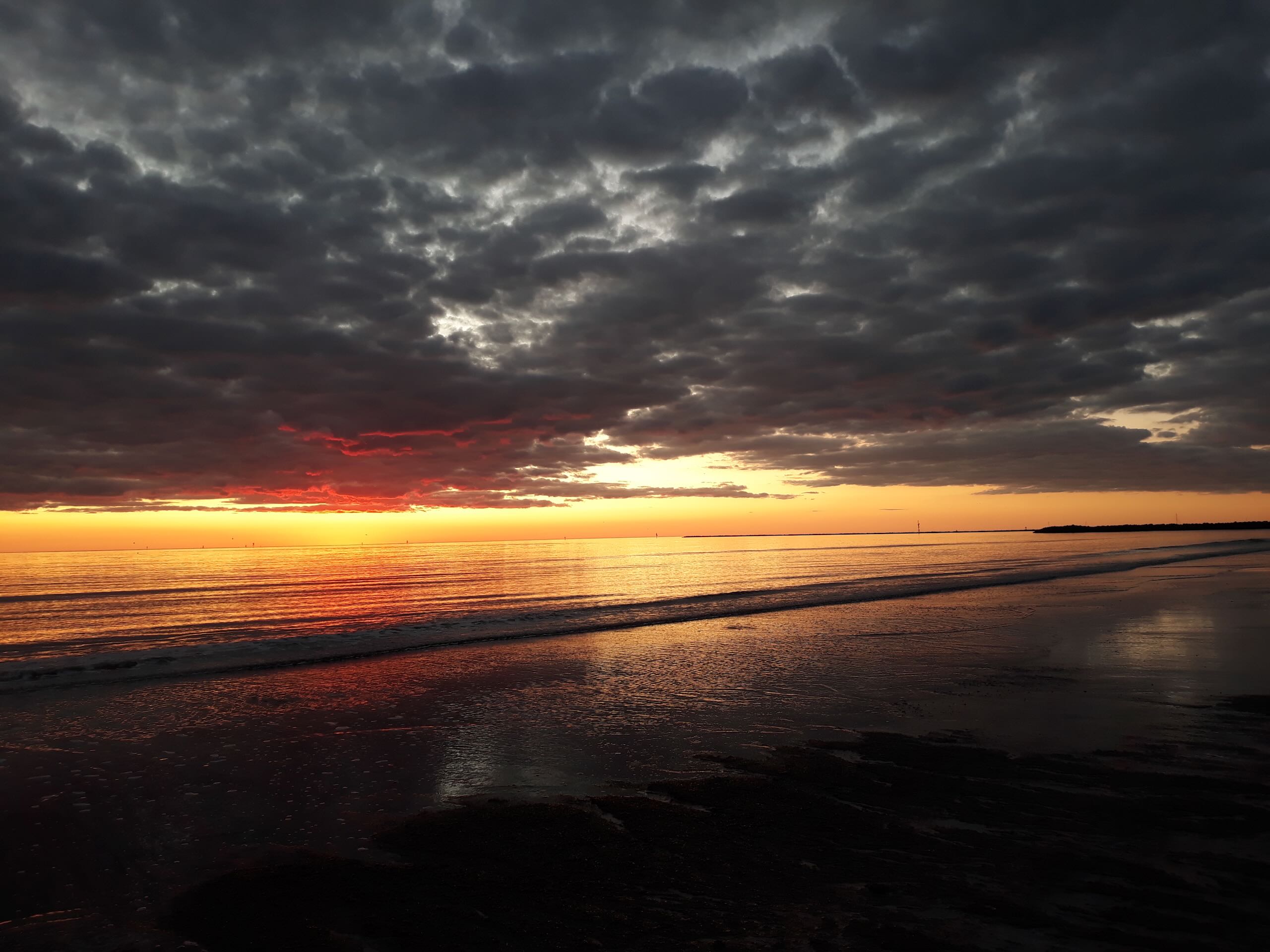
Sunset, early August 2022.

I don’t mind the sound of trains, actually — as suburban sounds go, I find it vaguely comforting — but when I leave my house to stay outside the city, to visit Aldinga Scrub or to camp in Yorke Peninsula, I feel a knot inside my chest of which I wasn’t even aware releasing itself.

Sounds I love when I am away from the city: the dull roar of the ocean at the end of the road (yes, another roar). The whistle of a hot wind through the trees. A frogmouth letting out its low, persistent, booming call at dusk. A shrike thrush singing. A magpie warbling. Frogs croaking. Insects clicking in the grass. And, yes, like Ramesh, the rain drumming on the roof.

Still, the photo accompanying my post today, like so many of my photos on this blog these days, comes from the suburban beach at the end of the street I live on. The sand is being eroded away and there are car parks dotted along the coast line and on most weekends a food truck selling hot donuts sets up shop during daylight hours.

But it’s still the beach. It’s still wide and beautiful and open and … The sea still roars.

Lately I’ve been reading …

It’s a lengthy list today, because I’ve been reading far more than I’ve been posting. But I hope you find something interesting below.

Revelation

Other people’s words about … secrets

‘Philip,’ [his mother Rose] said. ‘There are things I could tell you.’
‘Tell them,’ Philip said.
‘No.’
‘Why not? I’m prepared.’
She turned, looked at [Philip’s father Owen] slumped on the sofa. ‘Because I don’t believe that just because something’s a secret it therefore by definition has to be revealed,’ Rose said. ‘Keeping certain secrets secret is important to — the general balance of life, the common utility.’

From ‘The Lost Language of Cranes

by David Leavitt

I have always been fascinated by people like Philip’s mother Rose in the passage above: people who keep their own counsel. I have a tendency to do the opposite — to over-share, to talk to people for advice, to feel guilty if the life I lead isn’t entirely transparent. I’m not sure why. I may just be wired that way, but I suspect that years of therapy during adolescence and early adulthood ingrained this way of being in me. When you are used to talking things through with someone on a weekly basis, it can feel odd — unsafe, even — once you stop.

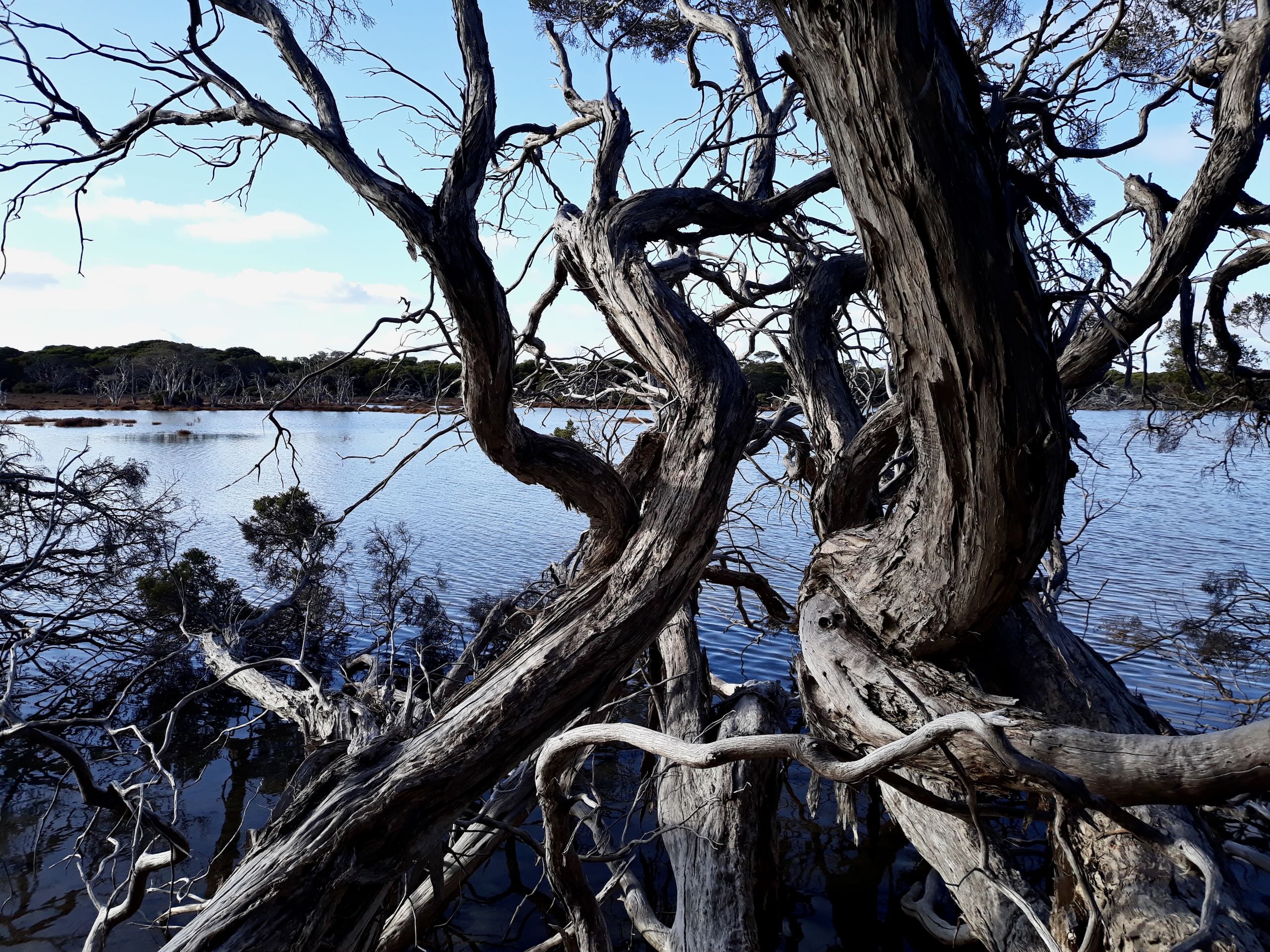
Gnarled trunk, early July 2022.

I like Rose’s matter-of-fact statement that secrets don’t have to be revealed. Sometimes, when I am uncertain about a course of action or a decision I have to make, I think of the oath that I’m told doctors must take: ‘First, do no harm.’ I find this oath, applied to life in general, one of the most useful creeds I know.

And so I find myself thinking that Rose may be right. If keeping a secret doesn’t harm anyone, then why feel compelled to reveal it? Why not learn to live in silence with one’s own truths?

Waterways, early July 2022.

Lately I’ve been reading …

Only connect: Reunion

Other people’s words about connection

Maude cranes around to look and Cormac looks too, close enough to see them, all quite young and glacially made up with one man of height and handsomeness towering over the rest and another, a man to the tall one’s left, cocking his head and nodding in Cormac’s direction meaningfully.
It is Senan. Cormac waves …
He hasn’t seen Senan in person for months and yet his vision still telescopes in, urgent and unreconstructed, so that Cormac sees and knows again he loves him with a scratchy passion that returns as reliably as a rash. It is not a nostalgic feeling and casts no shadow, existing always in a self-sustaining now.
How acute it is: immediate deja vu.

From ‘We Were Young

by Niamh Campbell

I love this passage from Niahm Campbell about a man reuniting with someone he loves after the two of them have spent some time apart. Cormack, the character in Campbell’s novel, seems unable to commit to one person, whether man or woman; he moves from one relationship or liaison to another. But as a backdrop to all his attempts to remain unfettered there is his love for Senan, a man who is smart enough, perhaps, to keep himself unavailable and therefore always desirable and lovable.


Sunlight and trees, April 2022.


Who hasn’t at some time in their life loved someone who was unavailable? Or, moving beyond relationships and intimacy, who hasn’t wanted something that was eternally just out of reach?


Grasstree, May 2022.

Lately I’ve been reading …