Freeze

Other people’s words about … how to write

I’ve read a few how-to write-a-book guides, and in doing so I’ve found some useful tips along the way, although I’ve never found anything that really sustained me in them. When I read Alexander Chee’s essay, ‘On Becoming an American Writer’, I realised why.

What I was looking for when I picked up those books, what I’ve been looking for all along, is advice not on how to write, but on how to keep writing. By which I mean, how to sustain yourself, how to live with yourself — as a writer, yes, but also as a human. Because if you are a writer, or if you see yourself as someone who could be a writer, or if you see yourself as someone who has written something and wants to write something else (and these are not the same things, though they are on a continuum) — if you are any or all of these things, anyway, then the two things are wrapped up in each other, impossible to disentangle, writing and being human. Writing and living. Writing and keeping going.

Front garden tree, Christmas Day, 2024

I am not particularly good at sustaining myself, either as a writer or as a human. I tend to be plagued by self-doubt and self-loathing — to such a degree, in fact, that I would call this tendency both instinctive and self-destructive. It certainly doesn’t make me very productive. I find myself often frozen in place, as Chee puts it, in that private theatre of pain that seats one.

What sustains me when nothing else does is that writing, the very process itself, feels meaningful to me. Maybe this wouldn’t be enough to keep another writer going, but for me at least, it is what I always return to in times of doubt and frozenness.

I don’t know why writing feels meaningful to me; if pressed, I couldn’t even articulate what its meaning is to me. But still — beyond the search for happiness or wealth, neither of which things I have ever lastingly found through writing — there is this: writing feels meaningful to me. That is what sustains me.

Lately I’ve been reading …

Begin again

From the annals of The Great First Chapter Project

About a year ago my husband handed me a brochure for a retreat in a nearby mountain village. We were standing in our Beijing kitchen while the girls played make-believe dog at our feet. The brochure was more like a handmade pamphlet – four pieces of white computer paper folded in the middle and stapled three times along the crease. There was a grainy photo of a cement terrace on the cover, and a more alarming photo of people sitting in a room with their eyes closed, and text under the photos that explained something called a ‘day of silence’ and yoga and the chance for participants to reinvent themselves. My husband, Lukas, told me these things would make a good week’s vacation for me, and he smiled while I looked at the photos, but it was a distant smile.

from ‘Elsey Come Home
by Susan Conley

I’ve been thinking, as you do at this time of the year, about endings and beginnings. About the things I hoped for at the start of the year, and the things that happened, and the things that I wanted to happen but didn’t (or haven’t yet). And about next year too, of course — the same kind of things, what I hope for, what I dread, what I can plan for, what I can’t. What I might just have to take on the chin.

One of the things that happened for me this year was that, as part of winning the Deep Creek Residency, I got to have a conversation with a publisher after he’d read the first 20 pages of the manuscript I’m currently working on. I’m the kind of writer who works from project to project — that is to say, uncontracted — and I also spend years between publications, years working alone, writing and rewriting and doubting myself all the while, so this was an incredible opportunity, one I’ll be forever grateful for.

Over the course of one hour, the publisher and I talked about many things, one of which was how important it is to get the first few pages of your manuscript right. We talked about prologues. We talked about hooks. We talked about grabbing the reader within the first five pages. We talked. We talked. Oh, we talked.

And I’ve been thinking about beginnings ever since.

Abandoned writer’s cabin, Deep Creek, October 2024.

So much has changed for me in the last two years when it comes to writing. I’ve had my first piece of literary fiction published, my novella Ravenous Girls. I’ve begun work on my second piece. I’ve won a residency. So many beginnings! Somehow, it seems fitting to end my year of writing on this note, thinking about beginnings.

On this note, I’ve started collecting quotations from books whose first chapter, or first few paragraphs, or even — rarely — first sentences, grab me. I’m calling this The Great First Chapter project, and I can’t think of a better way to start than with the first paragraph I’ve quoted in this post, which comes from a novel I love, Susan Conley’s Elsey Come Home.

My husband, Lukas, told me these things would make a good week’s vacation for me, writes Conley, and he smiled while I looked at the photos, but it was a distant smile. There it is, the story lying ahead of us in a nutshell: the story of a husband and wife who love each other but are estranged, the story of a marriage that needs healing. I knew the moment I read this line for the first time that I would love this book, and I did.

View from the cabin, Deep Creek, October 2024.

Before I go, I wanted to mention some good news I’ve had recently. My story ‘A Farewell’ was shortlisted for the MIKI Prize and included in the MIKI Prize 2024 Anthology, which was launched last week, and just this week my story ‘City of Lights’ was highly commended in the Marj Wilke Short Story Award 2024. I’ve never really focused on writing shorter pieces before, but this year, while I was working on a longer manuscript, the one that the publisher and I were discussing, I also started writing and submitting stories here and there, where and when I can. I have a lot to learn, but when it comes to beginnings — this feels like another one.

The cabin from afar, Deep Creek, October 2024.

Lately I’ve been reading (and listening) …

How do you see the world?

Other people’s words about … the deeper truth

At dinner, my mother had asked about my own life. I had said that Laurie and I were wondering about whether or not to have children. My mother said that we should, that children were a good thing. At the time, I had agreed. But what I really wanted to say was that we talked about it often, while cooking dinner or walking to the shops or making coffee. We talked about every aspect over and over, each of us adding tiny life-like details, or going over hundreds of different possibilities, like physicists in endless conjecture. How hurtful would we be when we were both exhausted and sleep-deprived? How would we go for money? How would we stay fulfilled while at the same time caring so completely for another? We asked our friends, all of whom were frank and honest. Some of them said that it was possible to find a way through, especially as their children got older. Others said that all the weakest points of our relationship would be laid bare. Others still said that it was a euphoric experience, if only you surrendered yourself to it. And yet really, these thoughtful offerings meant nothing, because it was impossible, ultimately, to compare one life to another, and we always ended up essentially in the same place where we had begun. I wondered if my mother had ever asked these questions, if she’d ever had the luxury of them. I had never particularly wanted children, but somehow I felt the possibility of it now, as lovely and elusive as a poem. Another part of me wondered if it was okay either way, not to know, not be sure. That I could let life happen to me in a sense, and that perhaps this was the deeper truth all along, that we control nothing and no-one, though really I didn’t know that either.

from ‘Cold Enough For Snow
by Jessica Au

If you are someone who loves books, who loves reading — if you are someone to whom reading is fundamental to your life — you will know what I mean when I say that there are certain books, a handful of books, that, when you read them, change your life. Jessica Au’s Cold Enough For Snow is one of those books for me. It made me feel, when I reached the end of it, that I was seeing the world differently: its textures, its colours, the way I breathed the world in. There is a quality to Au’s writing, to the story she is telling, that is as lovely and elusive as a poem — and this is the kind of writing that changes the world for me.

Other books that have had the same effect on me? As I say, there are just a handful. Garth Greenwell’s What Belongs To You is one: Greenwell, with his layered sentences built of clause piled upon clause, writes about shame in a way that, for me, no other writer comes close to. Also: Sally Rooney’s Conversations With Friends, Katherine Brabon’s The Shut Ins, Bryan Washington’s Memorial, Alexander Chee’s Edinburgh.

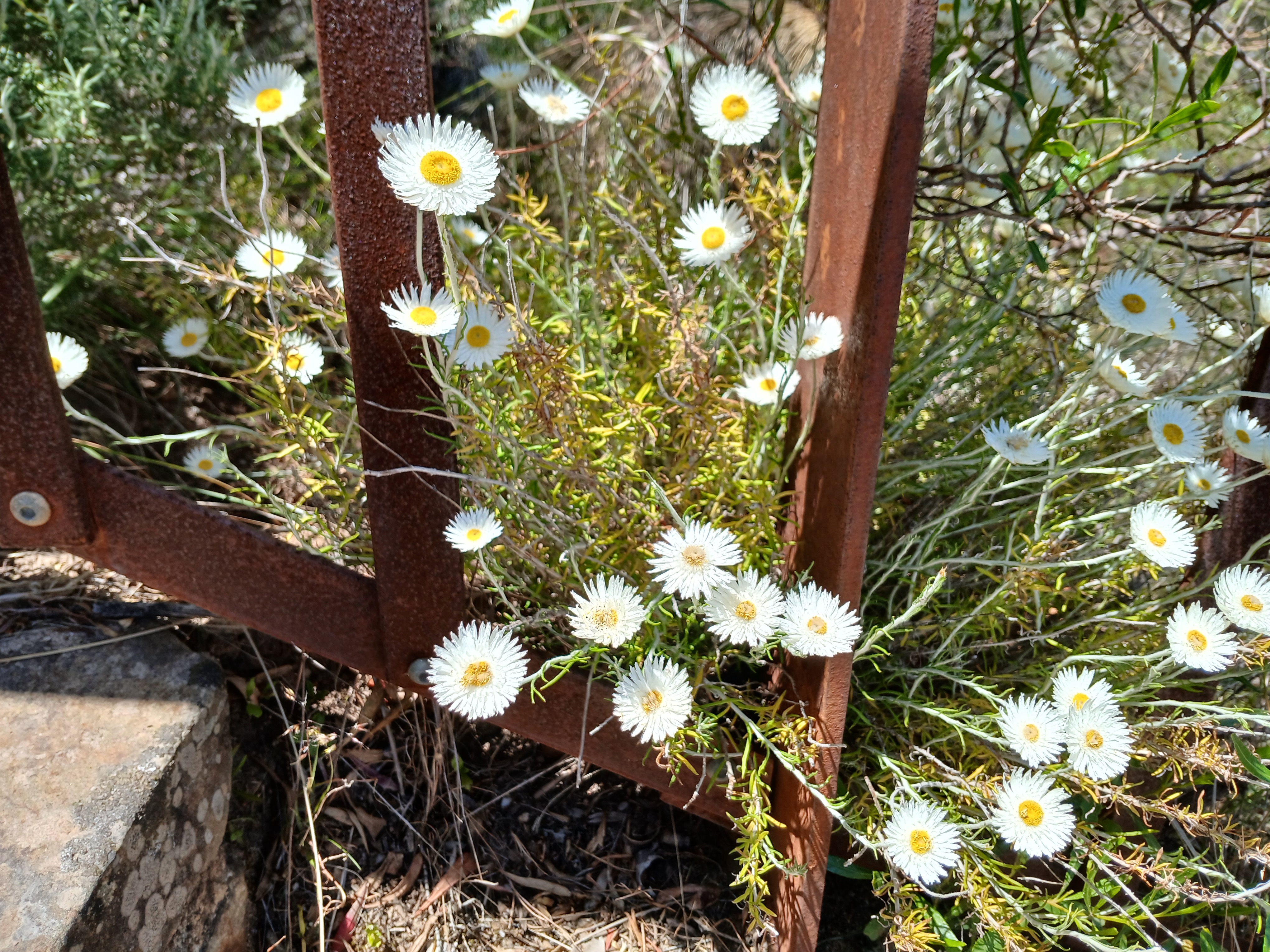
Everlasting Daisies, Morialta Falls, November 2024.

Each of the books I’ve named above is different from the others, but what they all share, I think, is a certain interiority. Whether through Rooney’s flat, prosaic narrative and dialogue or Washington’s choppy, plain sentences, we see the world through the eyes of their characters — and in doing so, we see the world anew.

I can think of no higher praise for a writer than to say of their writing: This has changed my world. So, I’m curious. What are the books that have changed your world? Drop a comment below — I’d love to know.

Lately I’ve been reading …

I’ve gone back through some of my oldest bookmarks for some of the pieces listed below. Even now, years after bookmarking them, these pieces still resonate with me in some way. I hope they do for you, too.

Like breath

Other people’s words about … places that reside within our hearts

During our visit to the jungle, while we slept on the verandah at 3 AM, night would be suddenly alive with disturbed peacocks. A casual movement from one of them roosting in the trees would waken them all and, so fussing, sounding like branches full of cats, they would weep weep loud into the night.

One evening I kept the tape recorder beside my bed and wakened by them once more out of a deep sleep automatically pressed the machine on to record them. Now, and here, Canadian February, I write this in the kitchen and play that section of cassette to hear not just peacocks but all the noises of the night behind them — inaudible then because they were always there like breath. In this silent room (with its own unheard hum of fridge fluorescent light) there are these frogs as loud as river, grunting, the whistle of other birds brash and sleepy, but in that night so modest behind the peacocks they were unfocused by the brain — nothing more than darkness, all those sweet loud younger brothers of the night.

from ‘Running in the Family
by Michael Ondaatje

I have just spent a week away in Deep Creek, having been chosen as this year’s lucky winner of the Deep Creek Residency for writers. I spent that week away writing, reading, bushwalking, running, writing again, then writing some more. It was a joyous time, the rarest privilege, to be given time away simply to write.

Daytime, Deep Creek, October 2024.

In our lives, I think that there are some places, connected to some times, that are somehow magic, that come to us through luck or stealth or a great deal of planning and then reside with us forever. These places become a part of the fabric of who we are, though we may not always understand why, and what we feel, when we think of them or remember them or revisit them, is a sense of awe — a sense of connection to something deeper than we can articulate.

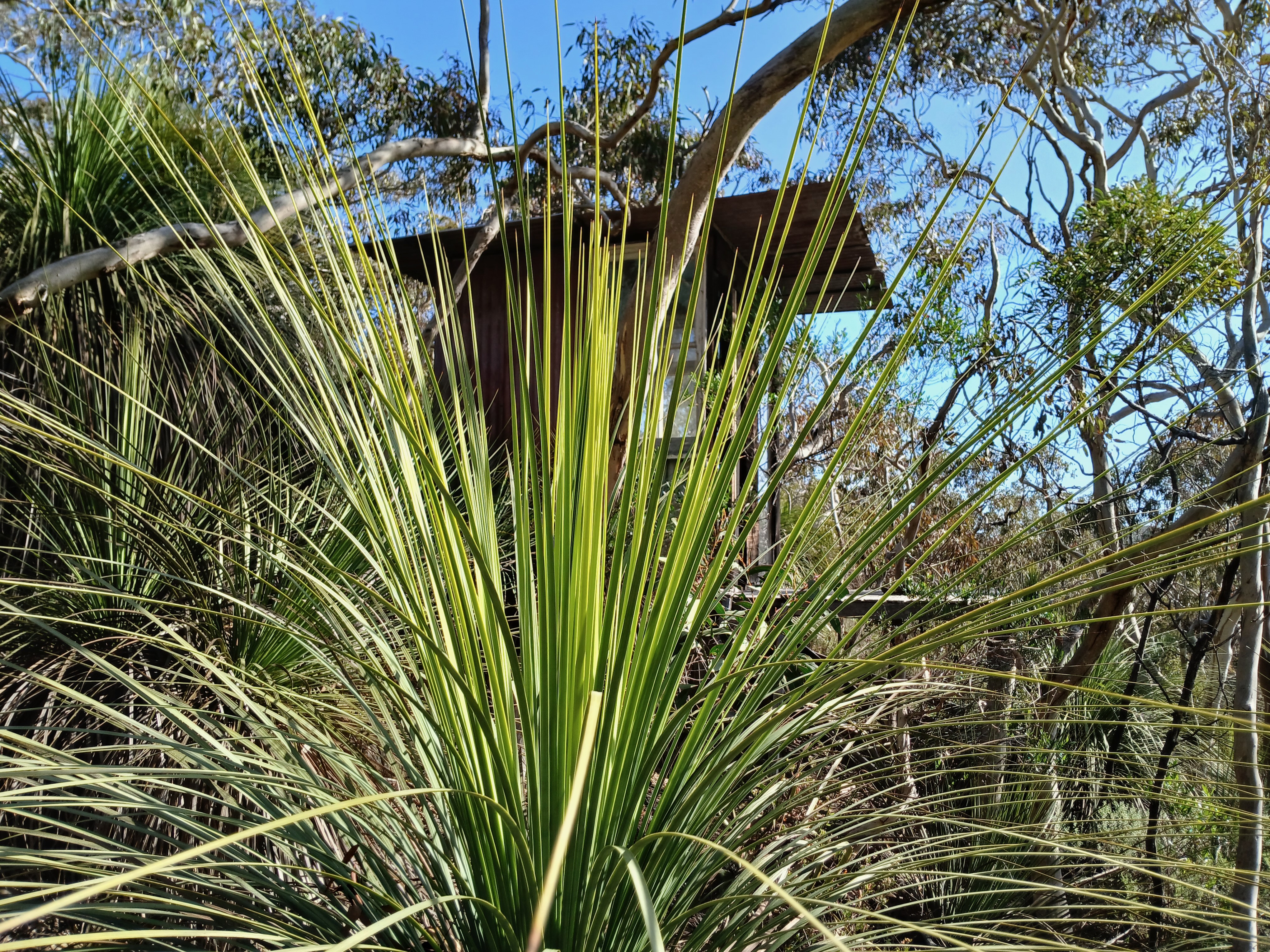
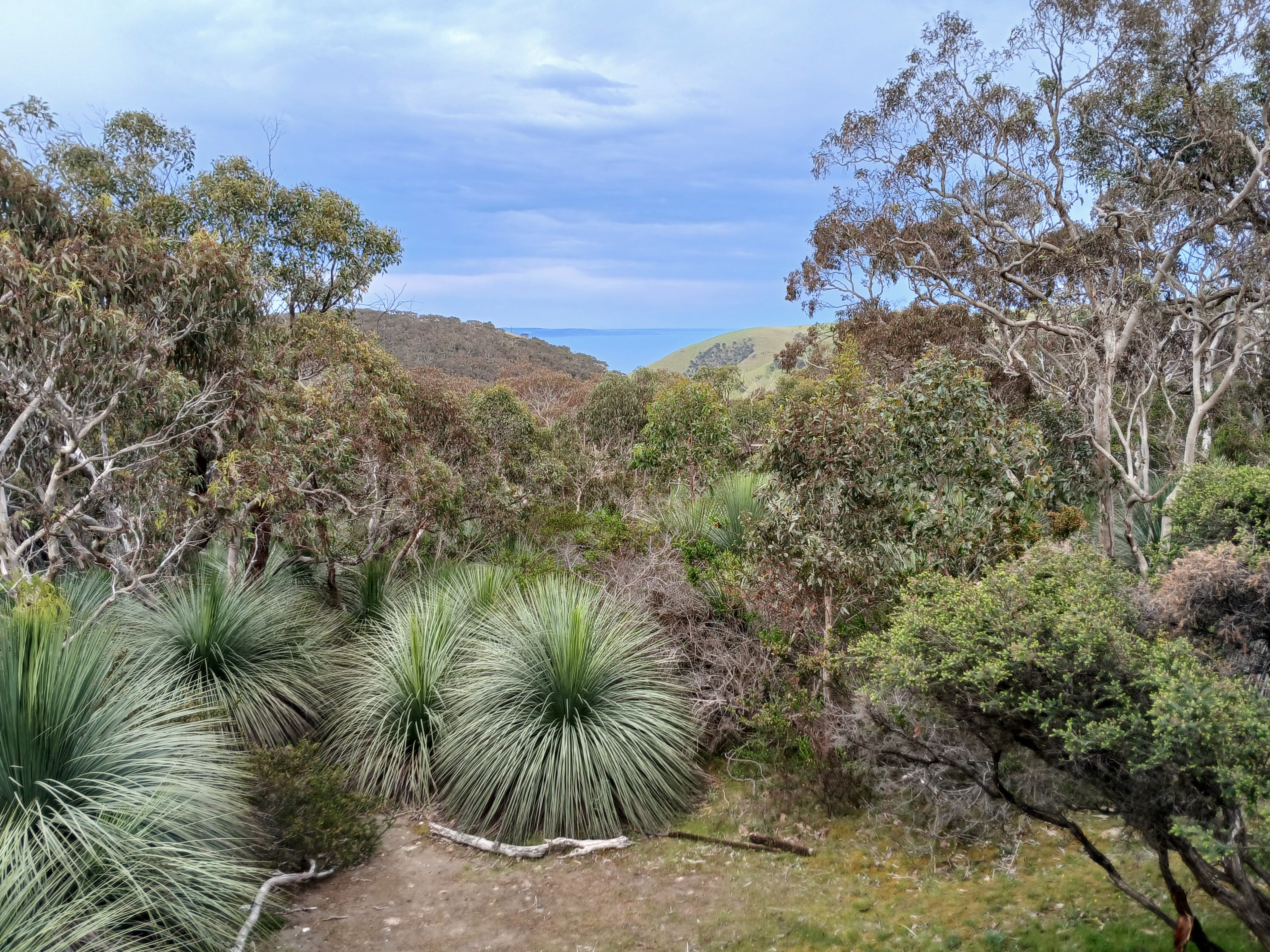
Gully of grass trees, Deep Creek, October 2024.

Deep Creek, place of grass trees and rolling hills and shrike thrushes calling in the trees, place of kangaroos and echidnas and sheep and shingleback lizards, place of tawny frogmouths and fogs and sunshine and rain and big, big skies — Deep Creek is, anyway, one of those places for me, a place close to my heart. I have left Deep Creek now, and the hopes and dreams I went there with — that I would write copiously and productively, that the story I’m writing is worth telling, that the manuscript I’m working on might one day get published — may or may not come true, but Deep Creek is still with me and always will be. I don’t know how else to put it.

Resting place, Deep Creek, October 2024.

And this is what I love about the passage I’ve quoted above by Michael Ondaatje, the way he captures the mystery of a place, its essence; the way it has become a part of him. I have never been to the jungle that he writes of, never heard peacocks who weep weep loud into the night. But in Deep Creek I have felt what Ondaatje describes. In Deep Creek I have felt that I have found a place that will, like breath, always be with me.

First light, Deep Creek, October 2024.

Lately I’ve been reading …

We cannot know

Other people’s words about … writing about life

‘We cannot know.’ If used sparingly, this is one of the strongest phrases in the biographer’s language. It reminds us that the suave study-of-a-life we are reading, for all its detail, length and footnotes, for all its factual certainties and confident hypotheses, can only be a public version of a public life, and a partial version of a private life. Biography is a collection of holes tied together with string, and nowhere more so than with the sexual and amatory life. For some there is nothing easier than understanding the sex life of someone you’ve never met, and easier still when they’re conveniently dead; or in posthumously adding another conquest to the dance card of a known Don Juan. Others simplify things by maintaining that human sexual habits have always been more or less the same, the only variables being the degree of hypocrisy and cover-up.
But sex is a world in which self-deception can so easily present itself as objective fact, and ‘brutal honesty’ is no more likely to be true than shy evasiveness or sentimental melodrama as an explanation of what really took place. Oscar Wilde may have been a ‘posing sodomite’, but such evidence as we have suggests he preferred intercrural sex, and if so was not technically a ‘sodomite’ at all. We cannot know. Sara Bernhardt was a nymphomaniac. Oh, but she was also incapable of orgasm. Until she had the problem fixed by means of an ingenious surgical implant — which is reliably attested by that ‘hysterical duplicitous gossip’ Jean Lorrain, and then recorded in the [j]ournal of Edmond de Goncourt, whose views on women were old-fashioned to say the least. We cannot know. Robert de Montesquiou was a flamboyant homosexual, except that his biographer thinks he was too coldly fastidious to indulge his Hellenic urges, while [Samuel] Pozzi’s biographer thinks he may have been impotent from around 1884, and remained so. We cannot know. Pozzi had a reputation as ‘an incorrigible seducer’, a doctor who slept with his patients, who may even have used his consultations as foreplay. He also kept all the letters he had received from women over a sexual career of half a century or more. Yet after his death, Mme Pozzi instructed her son Jean to burn them all. So we cannot know a large amount … We may speculate as long as we also admit that our speculations are novelistic, and that the novel has almost as many forms as there are forms of love and sex.

from ‘The Man in the Red Coat
by Julian Barnes

Many years ago, my mother and I embarked together on a reading project for a year, our own little book club before book clubs were a thing. Our reading theme was American novels, and we took it in turns to pick a novel, one by one over the course of the year, which we each then assiduously read; afterwards, we caught up over coffee to talk about it. I remember this year with great fondness as a time of shared reading and conversations, conversations that began with reading and literature but moved on, as all good conversations do, to other things. Art. Love. Life.

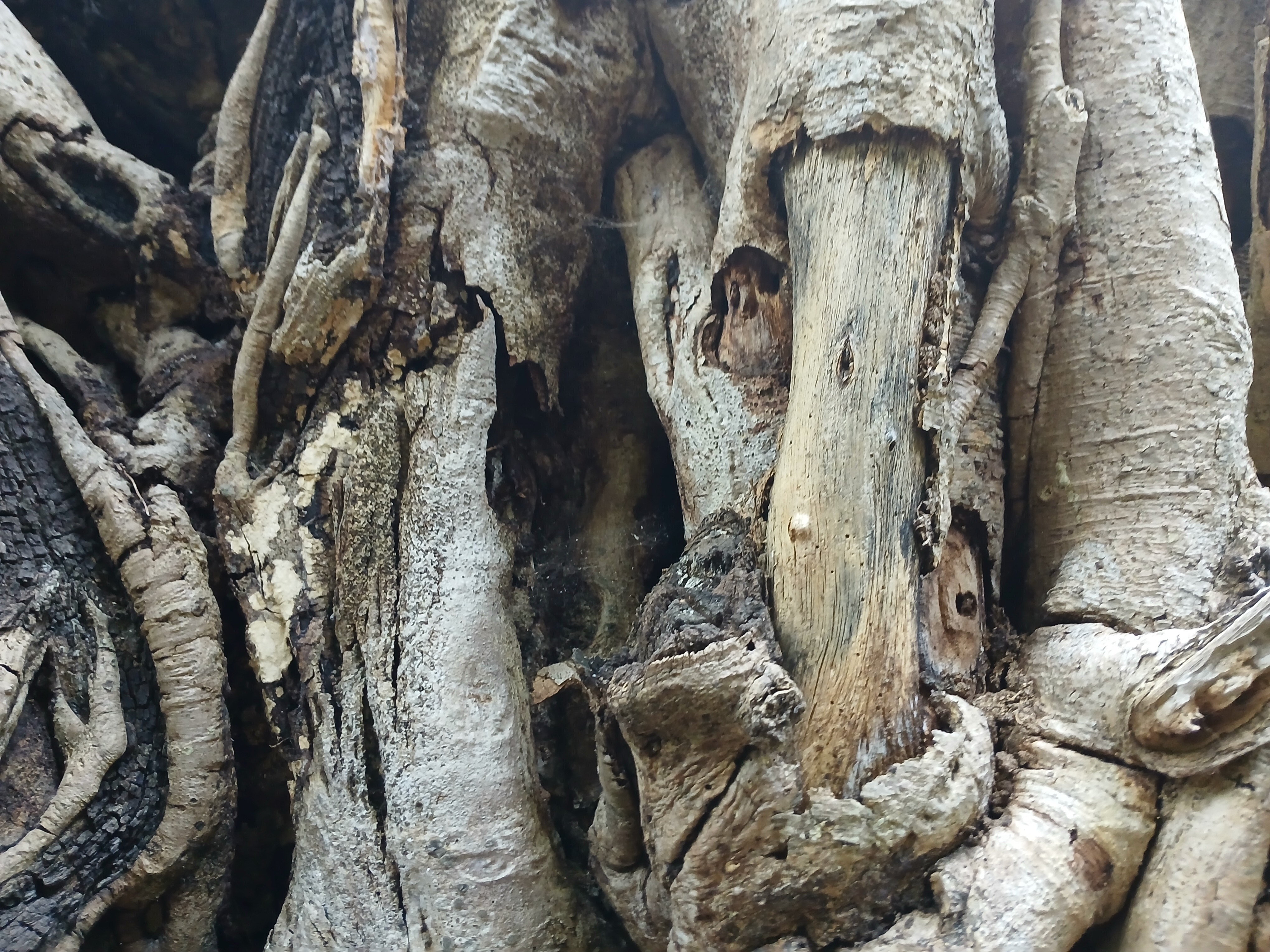
Knotted trunk, Lameroo Beach, Darwin, August 2024.

Recently we’ve begun another reading project together, one that we hope will involve some writing further down the track. As a result, my reading choices, which usually tend to fiction only, and generally to contemporary literary fiction at that, have widened. I’m reading fiction and non-fiction, works by contemporary writers and works by long-dead ones, works by women and works by men. Hence The Man in the Red Coat, which I might not otherwise have come across.

We cannot know. I’ve quoted Barnes at length here (which I hope he will forgive me for) because I love the virtuosity of this passage, the way he begins with a simple assertion, a certain truth, and then moves on in the space of a couple of paragraphs to cover themes at once intimate and specific to the period he is writing about (the Belle Epoque) but also meta-textual, concerning the art of biography itself, that collection of holes tied together with string. (What a lovely image that is.) And then, somehow, we arrive at the end of this flight of thought with another assertion, equally simple but bold, about the essence of novels and fiction.

We cannot know. Indeed.

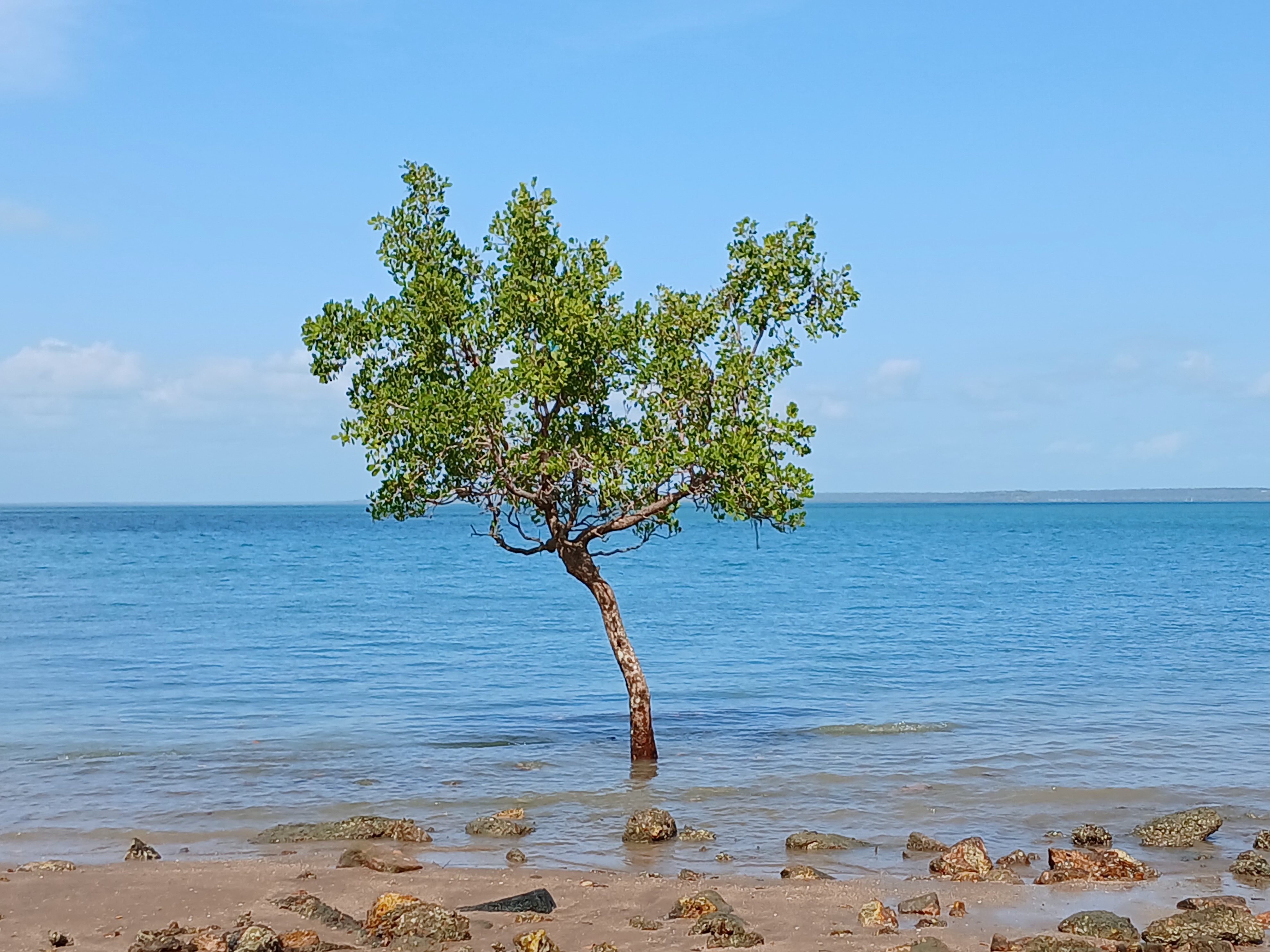
Mangrove tree at Lameroo Beach, Darwin, August 2024.

The photographs in this post, like the ones in my previous post, come from a recent trip I took to Darwin. I’d never been to Darwin before and was only there fleetingly on this occasion, but I fell in love with it, all of it. Darwin in the dry season: place of sunny days, rainforest-lined beaches, mangroves and vines and bush-stone curlews. When you visit somewhere new, you see things through a stranger’s eyes, which is to say that you don’t see its inner workings, its inner truth. Does that mean that you see its truth or something else, your own hypothesis of the place? We cannot know. But oh, the privilege of having the opportunity to see it anyway.

Lately I’ve been reading …

End-times

Other people’s words about … the end of the world

It has been so many years — a decade of this, another decade before that of almost this. People take supplements, for vitamin D, for energy, complain the damp has reached their bones. It rains constantly and the fact of the rain, of the rain’s whole great impending somethingness, runs parallel to the day-to-day of work and sleep and lottery tickets, of yoga challenges, of buying fruit and paying taxes, of mopping floors and taking drugs on weekends and reading books and wondering what to do on dates. It’s exhausting, as it always was, to live with such a breadth of things to take up one’s attention — exhausting, the way there can be too much world, even in its final stages. Exhausting, to be so busy and so bored with no time left for either.

from ‘Private Rites
by Julia Armfield

In Private Rites, three sisters, Isla, Irene and Agnes, are living in the end-times of the world. Their world, their day-to-day, is one of endless rain, of land flooding, buildings subsiding, people drowning. It’s not the world we live in, not quite — and yet it is. When I read the passage above, I thought of the days of the Covid lockdowns, of 2020 and 2021 when on the one hand everything stopped — when no-one went out, when people lost their jobs and their lives — and yet on the other hand, people went on. They bought food; they spoke to their loved ones; they slept and ate and bickered and loved each other and tried to stay healthy and tried to stay apart from each other while also trying not to let go of each other. Armfield’s rainy, drowning world is a lot like that.

Pathway to Lameroo Beach, Darwin, August 2024.

The pandemic is over now, at least officially, and no-one speaks about it anymore, except in passing, but it has changed our lives forever. Meanwhile, in the background, there is the climate crisis, which was possibly what made it possible for a pandemic like Covid to happen in the first place, and which continues apace while we look away and go about our lives.

Vines at Lameroo Beach, Darwin, August 2024.

For me, Armfield’s words in the passage above capture all of this, the worry and the refusal to worry, the going on and the not quite going on. It is exhausting, and it is boring. Writing about it, I think, is important.

Lately I’ve been reading …

Calculus

Other people’s words about … counting calories

In 2008, I downloaded a new app to my iPod. The icon featured a silhouetted figure in the middle of a balletic jump, lithe and limber like I wanted to be, and when I clicked open the app I was welcomed and asked to input my height, current weight, age, gender, and goal weight. MyFitnessPal, which debuted on the app store in 2005, is to this day one of the most popular calorie counting apps worldwide. Its icon is also regular featured in eating disorder starter pack memes and discussed on pro-ED websites. ‘Does anyone else have MyFitnessPal app trauma???’ someone posted, while another joked darkly about ‘the myfitnesspal to eating disorder pipeline’, and another mocked ‘myfitnesspal’s yassification of orthorexia’. The app is focused on calories in and out, calculating your personalised daily allotment based on your biometrics and the date by which you’d like to hit your weight goal. During the era I spent addicted to the app, every time I considered putting something in my mouth, I searched it in the apps’s expansive database, and often decided against eating it after seeing its caloric content. What I did eat, I entered, and the app updated my remaining calories for the day accordingly. The app quickly became a ritual and a rulebook, and scrolling my daily record in bed at night a practice as yearnful and penitent as running my fingers through rosary beads.

from ‘Dead Weight
by Emmeline Clein

I have written two novels now that feature characters with eating disorders in them, a YA novel and my recent novella, Ravenous Girls. Both the characters in my books, like myself, experienced the onset of their anorexia in the late 1980s or early 1990s, before the existence of the internet, let alone of iPods and the app store. And yet when I read the passage I’ve quoted above by Emmeline Clein, I thought how familiar it sounded and how, despite the passage of time and the onslaught of digital technology, the experience of anorexia has remained in its essence the same across generations, at least in certain parts of the world and among people of a certain class.

Whether you count calories by consulting a book of charts that is updated and republished annually (as my characters and I did in the 1980s) or whether you download an app and then ‘chat’ about it online with your pro-ana friends, you are still counting calories. You are still measuring yourself by your food intake and the effect it has on your physical appearance. You are still, in other words, measuring your worth by what you eat and how you look.

Taperoo Beach, July 2024.

There are people who say that when we write about the experience of anorexia we trigger others to seek the experience out. I am not one of those people. The subtitle of Clein’s book is On Hunger, Harm and Disordered Eating, and I think it’s the first two words of that subtitle that grab me most strongly. Hunger is the primary experience of anorexia, whatever your age or sex or class or gender, and harm is the result — in some cases, terrible harm.

Perhaps we can’t prevent that harm when we write about it, but perhaps, too, we can try to make sense of it. And that, I believe, is important.

Lately I’ve been reading …

Each week I bookmark pieces I’ve read online that I might list on my blog, and each week my list grows and grows, since I read far more than I blog. For this post, I’ve dived into my archive of bookmarks for some pieces I’ve loved over the last two or three years.

Sad place

Other people’s words about … funfairs

Deep down, the funfair was a sad place. You couldn’t hear yourself think. Everything was too bright and too big. The floor was covered in sawdust and underneath it, dirt. On the other side of the Round Up there was a wire fence around a patch of muddy grass with a few bits of hay, and inside the fence was the saddest horse you ever saw. Chestnut brown with white socks, covered in flies, its nose more or less touching the ground because its own head was too much for its neck to bear. It wasn’t just sad: there was something mean in it that wasn’t its fault. When I whispered to it, ‘hello, horse’, it slowly turned its whole body away.

from ‘Western Lane
by Chetna Mario

In my memory, the Cairo Zoo is a little like the funfair that Chetna Maroo’s narrator describes in the passage I’ve quoted above.

I visited the Cairo Zoo thirty-two years ago, just once. I didn’t take any photographs or record it in my diary at the time, and the man I visited it with, the man I was living with in Cairo, an American man, is no longer in regular touch with me, so I don’t know how accurately I’m recalling it. But in my memory the zoo was a place where the animal enclosures were small and narrow with bare ground and no grass, a place where the animals were thin with their ribs showing through their mangy fur. It was also a place where families wandered down the paths with an air of celebration and festivity, where children carried balloons and mothers pushed prams and vendors walked past, selling roses and snacks. It was a sad place. That’s how I remember it.

Largs Bay, June 2024.

In the camel enclosure, a camel stood before us, a camel whose toenails had grown so long that they curved down towards the ground. The American man and I stared silently back at the camel.

‘That’s cruel,’ I said at last, my voice wobbling. ‘They should cut its toes.’

‘I know,’ the American man said back.

He laughed helplessly and then he looked as though he might start to cry instead.

‘Let’s go,’ he said. ‘Oh God, Rebecca, let’s get out of here.’

And we fled.

How did we get to the zoo that day — by bus or train? I don’t know. Where did we go afterwards — back to our apartment in downtown Cairo or to the fiteer place that we loved for lunch? I don’t know. Is any of this memory true? I don’t know.

And if it’s not true, this memory, this story that I’ve just told you — even though I remember it that way — do I have the right to tell it to you?

I don’t know.

Lately I’ve been reading …

Unrequited

Other people’s words about … a woman’s desire

The meat was ready, steaming, when I lifted the lid of the pot. As I sliced it up I pictured meeting the ambassador in the hotel room. First, he will open the door and clasp me in his arms, I decided, putting a plate in front of my husband. He will kiss the hollow of my throat very softly, and then he will gaze upon me, I decided, like he did today, but with much more tenderness. I cut my potatoes up into tiny pieces. My husband chewed and chewed, with the mouth that never kissed me. He will lay me down on the soft white bed and undo the buttons slowly, I decided. He will kiss my eyelids. I will place my hands on his smooth back, I decided as I chewed. I will clutch him to me but not too hard, not like a drowning person. The light will be dim. The bedding will be spotless. He will tell me that he has seen what nobody else has ever noticed. He will say, ‘It’s you I’ve wanted all along, Elodie. I see you, Elodie. You. You.’

from ‘Cursed Bread
by Sophie Mackintosh

I came back to Elodie’s story again today, having quoted from it once before. Elodie’s story continues to compel me — her longing for her husband to desire her, to see her, oh, to want her. Though Elodie is young and has her life ahead of her, I wonder whether the feelings and desires she expresses in her narrative, those feelings and desires that in her tiny village community are so forbidden, are a little like those an older woman might feel, a woman my age, on realising that the desires she once thought might be realised are now out of reach.

I wonder.

Largs Bay Jetty, May 2024.

I’ve spent the last few weeks quietly. Post-Covid, I still feel tired. It’s a funny kind of tiredness, not so much a feeling of lethargy as a feeling of being tissue-thin, emotionally and physically. I don’t know how else to describe it. Still, I’ve been walking and reading and even writing (a little), and I had a quiet moment of celebration a couple of weeks ago when I saw ten hooded plovers at Aldinga Beach.

Yes, ten. I have never seen so many before, and I walked home feeling quietly jubilant.

Bracken fern, May 2024.

Lately I’ve been reading …

Disjunction

Other people’s words about … getting divorced

I went to a gymnasium most afternoons between half past five and dinner time, because exercise kept me clearheaded writing copy in the daytime, and fresher-looking through the evening. The gymnasium had a running track on the roof. Going round and round it, regarding the view of upper Broadway electric light signs, or thinking that the person who invented the sweat shirt had no sense of design, or just counting off twenty laps to the mile, and debating detachedly whether to be energetic and run three miles, or lazy and stop at two, I felt very contented. Thump, thump, thump, around a board track. It was a simple occupation, but an absorbing one.
That feeling of running, of having been running endlessly, so that I was breathless, yet must go on running forever, seemed to sum up my life. Running through days of posing as an efficient young business woman, through nights of posing as a sophisticated young woman about town. Running from the memory of Peter, toward something or nothing, it did not matter which.

from ‘Ex-Wife
by Ursula Parrott

You could think, reading the passage above, that you were reading something from a book by a contemporary female author, a Millennial or a Gen Z writer, that you were reading a modern sad-girl novel. But you would be mistaken. Ursula Parrott published her wonderful novel, The Ex-Wife, in 1929. I am astonished at how true Patricia’s story, and Patricia’s voice, still rings now.

I read The Ex-Wife just before I came down with my first bout of Covid, and now, picking the novel up again and reading the words from it that I’ve quoted above, which so struck a chord with me at the time I read it, I wonder if I’ll ever run again the way Patricia describes, which is the way I remember running. Thump, thump, thump. I know that everyone feels like this after Covid, and I assume that it will pass. Still, the feeling of disjunction between the me who read Parrott’s novel a few weeks ago and the me writing this post is jarring.

Norfolk pine trees and autumn sunshine post-Covid, April 2024.

In The Ex-Wife Patricia’s husband has just broken up with her and she is trying to make sense of being, yes, an ex-wife. Though divorce is now far commoner than it was when Parrott wrote her novel; and though we accept the idea of wives committing adultery as much as we do the idea of husbands doing so; and though many women no longer feel the need to marry at all — still, it seems to me that Patricia’s feelings reflect what a young, heartbroken woman might feel now in a similar situation. Patricia feels betrayed by her ex-husband Peter, who leaves her after she confesses to him that she has slept with another man (even though he has, all along, been sleeping with another woman); she loves him, still, as much as she hates him; she wants to move on but can’t; and meanwhile she tries to make her way as a young, single, independent woman through the world. How familiar does all of that sound?

I am grateful to live in a world post-third wave feminism. I am grateful to live in a world that has allowed the #MeToo movement to happen finally. And yet. And yet. There is still so much that needs to change in this space. So very much.

Cuddly Covid companion, April 2024.

Lately I’ve been reading …