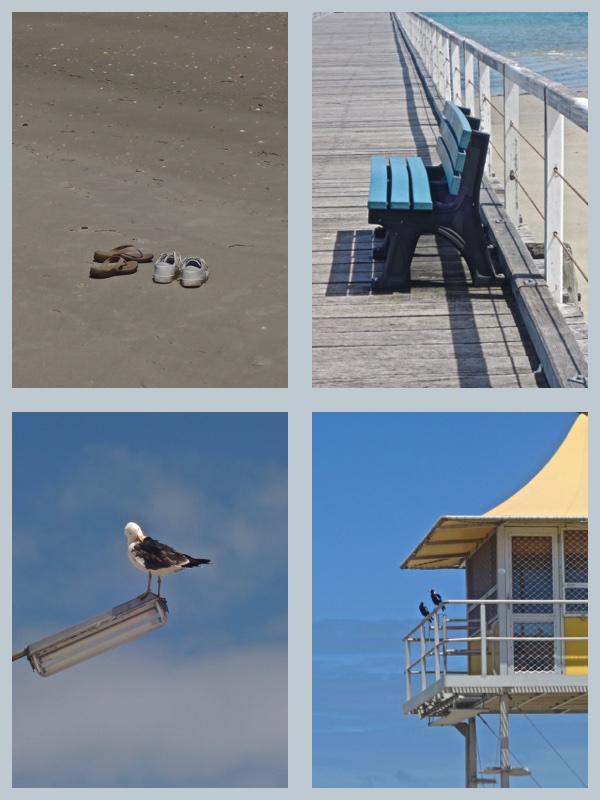
Astonished

Other people’s words about … ageing

When I was thirty, I felt sure that a paradoxical reward awaited me at sixty, if I made it that far. Having never had any beauty to lose, I reasoned, I’d be exempted from mourning its loss. But as I’ve grown older, this proposition has turned inside out. I see now that I did have at least some beauty — not much, but some — and exactly because I had so little, I could hardly afford to lose it. Now, at this inconvenient moment, I realise that I do care about my looks. I find myself spending more energy compensating for my inadequacies than I used to. I search for becoming clothes. I color my hair. I experiment, in a gingerly [sic] way, with makeup. I suspect these efforts don’t do a lot for me, though they do make some difference, if only in letting people know I’m trying.

From ‘At Sixty-Five’
by Emily Fox Gordon

I am closer to fifty years old than I am to sixty-five: my fiftieth birthday is next year, 2020. And yet, already I understand that inconvenient moment Emily Fox Gordon describes in the passage above.

When I was a young woman — that is to say, when I was in my twenties and thirties — I went makeup-free. I washed my (uncoloured) hair and let it drip dry; I applied nothing other than sunblock to my skin (not even moisturiser). And, oh, I bought all my clothes from op-shops: jeans, shirts, trousers for work, jackets. I still remember the pretty, floral-patterned strappy dress I once bought from my local St Vincent’s op-shop to wear to a relative’s wedding, which cost $3. I happened to be very thin at that time, because of a digestive illness, and within six months of the wedding, I was well again, which meant that I could no longer fit into it. But I kept that dress for years afterwards. Every now and then, I would pull it out of my wooden chest to look at it: to run my fingers over the soft, thin, flowered fabric.

$3! To prepare for the wedding, I’d pulled the dress over my head twenty minutes beforehand, brushed my hair and tied it back in an elastic band, slipped on a pair of sandals (the only pair I owned), and then spent a couple of minutes debating over whether I’d need a (secondhand) jacket or not, because it was an outdoor wedding, and there was a cool breeze blowing through my window. And then I left for the wedding.

Yorke Peninsula: View from the cliffs

If you had asked me during those years what guided my fashion style, I would have said — very proudly, very innocently — that I went for a ‘natural’ look. What I wouldn’t have said, because I didn’t yet realise it, was that I went for a young, natural look. I didn’t yet understand that the word ‘natural’, when it comes to a woman’s beauty, her appearance, is synonymous with the word ‘young’. I couldn’t have understood it back then. I was too young.

*

I found Fox Gordon’s essay in The Best American Essays 2014, a copy of which I borrowed from my local library to take with me on my latest trip to Yorke Peninsula. (Yes, I’m still enjoying reading essays.) It is a short essay, as essays go, but it is wise and witty and forthright, and almost every word in it rings true for me. (You can read it in its entirety here.)

Thirty years ago I assumed I would take the eccentric route as I aged, become one of those bluff, outspoken, truth-telling old women people claim to admire, even as they avoid them. That would have been in keeping with my strong contrarian impulse. But instead of growing bolder and more heedless, I seem to be growing more circumspect, more nervously observant of the proprieties, more conscious of other people’s feelings.

Now that I’m (almost) fifty, I, too, find myself becoming more circumspect, both in the way I dress and in the way I speak and act. I feel [my age] in my invisibility to strangers, Fox Gordon writes. And it fascinates me — no, let me be honest here: it astonishes me — that as women like Fox Gordon, women like me, grow more invisible, we grow in tandem more worried about how other people perceive us. This is a contrarian impulse that we could, perhaps, never have predicted when we were younger — again, precisely because we were younger.
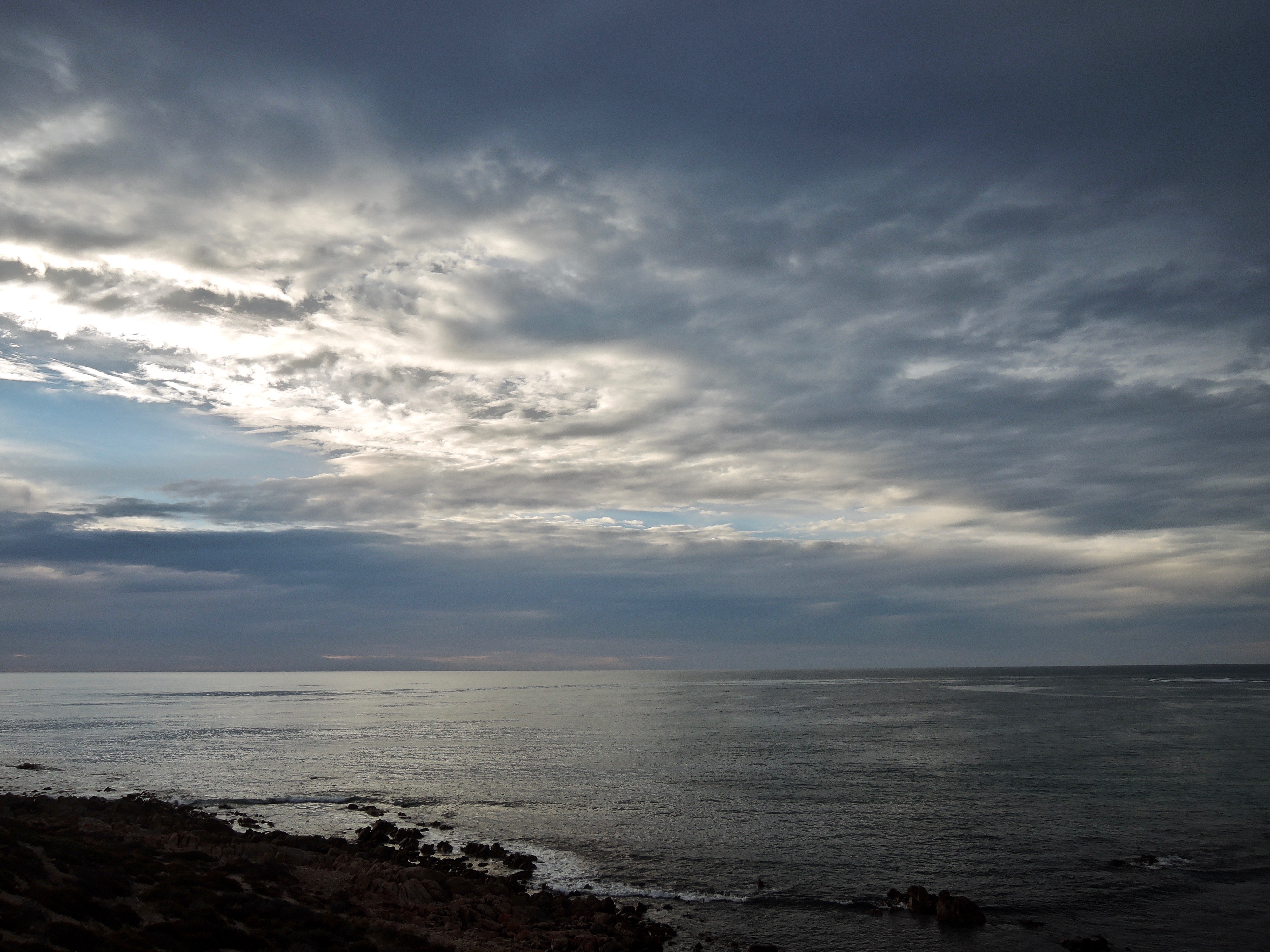
Yorke Peninsula again: Clouds, reflected

*

The day after I got back from Yorke Peninsula, I rode my bike to Semaphore, where I often go to buy my groceries and to borrow my library books. I parked and locked my bike outside the sushi shop, bought a sushi roll, and then wandered down the main street towards the library. There was a woman at the ATM as I walked by, her back to me as she withdrew her cash. She was around my age, or perhaps a little older: tall, lean, wearing easy, worn clothes, her hair tied back in a long, straight, grey ponytail. She had a slender face but a strong profile: short eyelashes, pointy nose. No makeup, as far as I could tell. I glanced at her as I walked by — once, and then again. Then again.

I thought of Fox Gordon. I thought of the old(er) woman I hope I will one day become. It came to me, then, that I was looking right at her, my role model, standing at the ATM in all her natural, worn, grey beauty.

There is room, I believe, for all of us. We can be contrarian, if we dare.

Yorke Peninsula again: Three clouds


Lately I’ve been reading about …

Meanwhile, here’s what I’ve been reading online lately:

Betrayed

Other people’s words about … anxiety

It took me years to work out that what the experts tell you isn’t always right, no matter how expert they may be, nor how much you may have paid them to tell you what they’ve told you. Fiona Wright explores this theme in the passage below, in relation to her own experience of searching for a cure for her anxiety — a cure that the experts she has consulted have not, despite their expertise, as yet been able to help her find.

This was not supposed to be the lesson that I learnt, she writes. And that, right there, is the power that those so-called experts can hold over us: that they can make us feel that way; that we can come to believe, from them, that there is a lesson — one particular lesson and no other — that we are supposed to learn.

It’s enough, I think, to struggle with poor health, mental or physical or both, without also coming to feel a failure for not responding to the treatment or advice that the experts offer us. Betrayal is the word Wright uses — a strong word, but it is apt.

This feeling, I was right to be nervous, is to me the worst of all the things I think and feel out of anxiety, at least in part because it feels like a cruel joke. Clinical psychologists insist that the problem with anxiety is that the anxiousness — that tension in the gut and shoulders, the clamped jaw and cramping rib cage, the wildly circulating thinking and breathless panic — is always disproportionate, always misplaced; that the fear itself, that is, is always worse than the thing that makes us afraid. And so the treatment focuses on exposure, on deliberately coming into contact with the things we fear and then coming out the other side unscathed in order to learn the hollowness of the focus (and locus) of our fear. So when I get this feeling — I was right to be nervous — it always feels like a betrayal: this was not supposed to be the lesson that I learnt.

From ‘A Regular Choreography
in ‘The World was Whole’
by Fiona Wright

Wildly circulating

Note:
Fiona Wright is an Australian poet and writer. In her essays, she writes with candid, almost forensic insight into her experience of living with chronic physical and mental illness. You can read more of her work here.

This is my work

Other people’s words about … the sea

Vale, Mary Oliver. I’m not a fan of all of her work — not by a long shot — but I do love the way she observed and wrote about nature: intimately, intricately, affectionately, quietly, humbly.

I go down to the shore in the morning
and depending on the hour the waves
are rolling in or moving out,
and I say, oh, I am miserable,
what shall—
what should I do? And the sea says
in its lovely voice:
Excuse me, I have work to do.

I Go Down to the Shore
by Mary Oliver

That lovely voice

A year of words

Other people’s words about … other people’s words

I’ve been thinking about reading again recently — what it means to me, what it gives to me, why, even though it’s a solitary activity, it makes me feel connected to the world. I like Sarah Clarkson’s use of the word journey, in the passage below, to describe the act of reading. Reading, like life, is a journey. You never know where it might take you.

Reading, rather, is a journey. Reading is the road you walk to discover yourself and your world, to see with renewed vision as you encounter the vision of another … Reading is a way to live.

From ‘Book Girl
by Sarah Clarkson

Reading is a journey

PS It’s good to be back in the blogging world. I’m changing the format of my posts slightly this year, but it’s still all about celebrating other people’s words. So … here’s to another year! xo

Tip your head back and look up at the sky

Other people’s words about … the sky

Axel … breathed out, trying for calm. He tipped his head back, looked at the sky, wide and empty of trouble. His heart slowed. The moment passed.

From ‘Shell
by Kristina Olsson

Oh, that beautiful sky …

No time like now

Other people’s words about … cages

At not yet thirty, she can feel her life shrinking into the gentle sameness of her days and she knows she is pacing back and forth in a comfortable cage of her own construction. She needs someone to bump against, to disrupt things. she can’t go on like this, she knows. She must resolve the tension between longing and fear.

From ‘The Fragments
by Toni Jordan

I’m back! I’ve missed blogging. I’ve missed you all, too.

And I’ve gone on collecting other people’s words, gone on taking photographs of the world around me, gone on wanting to have a place to keep the words I’ve collected and the pictures I’ve taken. So I’ve decided, rather than ending this blog completely, as I first planned to do, to pop in every now and then with a quote I love or a photograph I’ve taken. I’d like to keep the practice up, and I hope that some of you will continue to enjoy reading the words I’ve found, or seeing the photographs I’ve taken, as you might have done in the past.

Last year, as some of you may remember, I lost my job. In the end, instead of looking for a new job straight away, I decided I would take a few weeks or months off first. And so that’s what I’ve been doing in the weeks since I last wrote: living on my savings and trying out, meantime, new habits, new practices. I’m trying to disrupt some of my old ways, like Caddie in the passage I’ve quoted above; I’m trying to stop pacing back and forth in a comfortable cage of [my] own construction; I’m trying to let my life expand, rather than to shrink. There’s no time like now!

Because there is always a way through … always

Thank you for accompanying me so far on my blogging journey. Thank you, too, to the readers who wrote to me and encouraged me to keep posting, if only sporadically: who told me I was missed. I hope you all find pleasure in the posts that are still to come.

Rebecca xo

Fleeting

Other people’s words about … happiness

Happiness doesn’t come in the way I expected; not a massing of good things over time, but a succession of small, strange and unowned moments — the sun makes a hot oblong on the bedroom floor and I stand in it with my eyes closed. The coriander germinates in the window box and up comes the seedling. The bled radiators stop knocking at night.

From ‘Dear Thief
by Samantha Harvey

I thought it was apt to write a post on happiness today, to accompany my previous post on sadness — though perhaps both posts are, after all, about the same thing, simply taken from opposing perspectives.

But also it seemed apt to me to write a post about happiness because today’s post, I think, will be my last post, at least on this blog, twenty-one words.

Over the years, I’ve written about many things on this blog — the sea, the sky, vomiting, writing, books, therapy, running, walking, travel, birds, flowers, hope, to name a few. But in many ways, I see, looking back, that I’ve been exploring, post by post, what it means to live a small life in the happiest, or at least the most meaningful and most humble, way I know.

Happiness, as Harvey says, isn’t something you can accumulate or amass; it most surely isn’t something you can own. It flits into our lives and out again. Writing this blog has been, for me, both a meaningful and a humbling experience — and in that sense it has been a happy experience for me, too. I don’t know if my posts have brought you, my readers, any moments of happiness, but I hope so: I do.

I spent over half my life waiting for the accumulation of happiness and then I realised that it doesn’t accumulate at all, it just occurs here and there, like snow that falls and never settles. Not the drifts that you and I imagined we would plough ourselves into, but instead gently, opportunistically, holding one’s tongue out to catch the flakes.

I’m not sure yet whether I’ll leave this blog up for posterity (i.e. for a little while!) or whether I’ll take it down altogether, or whether, perhaps, I’ll change its privacy settings so that you can only access it by contacting me first. (Please feel free to do that, if it’s what I do.)

In the meantime, I’ll go on running and walking and hoping and reading and looking, looking, looking.

Fleeting


Thank you to everyone who’s read this blog. Take care of yourselves. Keep reading and looking. Keep savouring those fleeting moments of happiness, whenever they come your way.

Observation

Other people’s words about … sadness

Why was she so sad? The unspoken question had dangled over the [therapist’s] beige couch and the framed degrees and the economy of Kleenex. He commanded a cache of Ohs and I sees in varying grades of volume and texture, knew when to prod and when to sink with her. Why was she so sad?

Ada was sad because she was sad because she was sad. She experienced extreme difficulty in reaching past the tautological.

From ‘Infinite Home
by Kathleen Alcott

Some time ago, for much the same reason as Ada in the passage above, I quit therapy. I had come to my therapist feeling sad; but years of therapy later, I still felt sad. It seemed to me at last that, whether my sadness was unique or universal or — like Ada’s — purely tautological, the time for exploring it was over.

In the years that have passed since then, I’ve learned that I feel better when I try to make peace with sadness than I do when I try to overcome it. There is much to be said for acceptance and for patience. And for seeing things through.

I took the pictures in today’s post on a day when I had just heard that I will be losing my job at the end of this year. I felt, that day, as though I had been cheated of something — of an income, yes, but also of something less tangible, some essential part of me that I couldn’t actually name. I felt anxious and old and vulnerable and as though I had failed. Most of all, I just felt sad.

What I saw

I couldn’t sit still with my sadness that day; I couldn’t see it through. So I did the only thing that seemed manageable to me in the moment: I took myself off for a run by the beach. I ran what seemed to me a long way, the furthest I’d ever run, in fact — although the distance didn’t matter, really. What mattered was that I was outside: moving, breathing deeply, looking around. Seeing. Sadness, I’ve found, stops me from seeing. But stepping outside returns my vision to me, at least for a while.

Losing a job — especially a job that you love, especially when you are nearing fifty — entails a specific kind of sadness, one that is wrapped up in grief and fear. Still, I’m curious. What do you do when you are sad?

Snatched phrases: the sky

Look at the sky. (It’s amazing. It’s always amazing.)

From ‘Notes on a Nervous Planet’
by Matt Haig

Matt Haig is right. The sky is amazing.

It is always amazing.

It is a story that is forever unfolding …

PS Shout-out to my father, whose birthday it is today! 

Snatched phrases: on translation

But a certain dullness of mind seems an almost necessary qualification, if not for every public man, at least for everyone seriously engaged in making money.

From ‘The Idiot’
by Fyodor Dostoevsky

Hmmm … read and weep. Dostoevsky’s observation about people is as relevant now as it was when he wrote it in the late nineteenth century. If only our public figures, our business people, our politicians would take heed!

But onto other things — no more weeping for now. One of the overarching reasons I’ve had for writing this blog in the last few years has been to give myself (and hopefully you, my readers) the chance to explore the joys of reading: to revel in other people’s words, to find meaning in their thoughts and the way they express them, to learn from them, to find communion and kinship with them. As I’ve remarked before, without books and reading, I would be a far lonelier person.

Recently, I’ve found a different kind of companionship in my reading. On Mother’s Day earlier this year, my mother and I started a reading ‘project’ together, our own little two-woman book club. At her suggestion, we have decided to read works of translation. We take it in turns to pick a title and read it, and then we exchange titles, and, having read them, meet up for coffee or for a walk to talk about them. The Idiot was one of her choices.

My mother is an inveterate reader. She reads widely, hungrily, curiously. Her joy in reading is contagious and almost palpable. I’m glad — and privileged — to have ‘caught’ that joy from her. And I’m extra glad to be exploring new books with her, to be having my world opened by her and by the writers she chooses.

Meanwhile, while we’re on the subject of translation, here’s the thing about reading, and the happiness you can find in it: it translates into life.

And that happiness is only amplified when it is shared.