Snatched phrases on … pretty days

‘The grass had been cut and gave off a warm, allergenic smell.
The sky was soft like cloth
and birds ran over it in long threads.’

from ‘Conversations with friends’
by Sally Rooney

The image in today’s post doesn’t quite match the words, I’m afraid:

Still, it’s a pretty image, and perhaps it captures a little of the essence of Rooney’s soft spring day …

Yellow

Other people’s words about … spring


After Matthew left I lost the knack of sleeping. Brighton seemed unsettled and at night it was very bright … At periodic intervals throughout the day I felt that I was drowning, and it was all I could do not to fling myself to the ground and wail like a child. These feelings of panic, which in more sober moments I knew were temporary and would soon pass, were somehow intensified by the loveliness of that April. The trees were flaring into life: first the chestnut with its upraised candles and then the elm and beech. Amid this wash of green the cherry began to flower and within days the streets were filled with a flush of blossom that clogged the drains and papered the windscreens of parked cars.

from ‘To the River
by Olivia Laing


I continue to be fascinated with the notion of seasons, and how the idea of a season is as much a cultural and traditional one as it is a quantifiable or temporal one. Here in my part of South Australia, if you were to measure the year out using temperature and climate as your basic season markers, you might say that we begin the year in January and February with dry, glaring, windy heat. In March and April the weather is often warm and dry but the wind drops off; in May and June the days grow cold, though they remain frequently sunny and still. Somewhere around July and August, the serious clouds and rain begin; in September and October there may be both storms and patchy sun; in November and December the weather is dry and warm but variable.

That, at least, would be one way to mark out the seasons where I live.

But temperature and weather are only half the picture. Plant life and animal life have their own seasons, too. In the northern hemisphere, spring is often celebrated as a season of growth and birth, much as Laing describes it so vividly in the passage above, but here in South Australia, that season of growth is far more staggered and gradual. In late July, when the temperatures are still winter-cold, the native plants begin to flower, and the birds begin to build their nests. By November, that cycle of birth and growth has already begun to slow and drop off.

And then there are the different seasonal colours. Myself, I tend to think of July and August, in my own world, as the yellow months. So many of the native plants that flower at this time of the year have yellow blossoms: acacias, guinea flowers, groundsel flowers, punty bushes, bush peas, goodenias.

Many of the plants I’ve just named were in flower on one of my latest bushwalks, as you can see in the pictures accompanying this post. Everywhere I looked, from the tops of the trees right down to the ground, there were sprinklings of yellow.

So it was a yellow walk through a yellow world. Perhaps we should call this time of year the yellow season?

Out and about: after the rain

‘When you’re walking the view shifts and changes.
Walking’s a form of hope.’

from ‘The World Without Us
by Mireille Juchau


This year, July was exceptionally dry in South Australia. Then August blew in and it has been bitterly cold, windy and rainy ever since.

There is a manic wind whipping through the treetops today … the sort of wind that’s somewhat unsettling and leaves me feeling a bit scratchy, Belinda Jeffery writes in her August 5 entry in her wonderful cookbook-cum-nature diary The Country Coobook. And I know what she means. In the middle week of August, I spent a week on holiday near the coast down south, and much of the time the squalls of rain were so frequent and unpredictable, there wasn’t much of a chance for me to get out.

Rain in the vineyards

Still, one morning mid-week the sun shone between showers and I risked a walk. I headed down a path that skirted wetlands and vineyards (on one side) and bush (on the other side) and then turned south to follow the path back into the bush.

Flooded bush

The low-lying parts of the land along the trail had flooded. Beyond the reeds that bordered the flooded land, I saw trees with their trunks submerged, and waterbirds diving and swooping from branch to branch.

Submerged trunks

There was even a family of ducks.

If I crouched down to peek through the reeds, I could just see the green grassy banks rising above the flooded land, further within, beyond the path.

Is the grass always greener on the other side?

Once I’d walked far enough south, I turned west, deep into the bush, where there were no more floods, and where yellow blossom dotted the landscape (more about which in an upcoming post). But even as I walked, the sky darkened and the temperature dropped.

I made it home just before the next burst of rain …

Snatched phrases on … the sea

‘They’d ended up sitting on the beach,
the sea a great black heaving beast,
sighing and rolling under the white light of the moon.’

From ‘Between a Wolf and a Dog
by Georgia Blain

I don’t have any photographs to accompany this post because I still haven’t yet managed to get the hang of the craft of night-time photography. But isn’t that a wonderful image of the sea at night? — that great black heaving beast, sighing and rolling. It makes me want to go for a night-time walk on the beach right now …

Out and about: a new series

‘When you’re walking the view shifts and changes.
Walking’s a form of hope.’

from ‘The World Without Us
by Mireille Juchau


As I’ve mentioned before, I have two part-time jobs, which I move between each week. One of my jobs involves editing manuscripts for an academic press, while the other involves call centre work.

The job at the call centre doesn’t involve sales work; I work for a not-for-profit community health organisation. My calls are mostly from clients wondering what time their nurse is coming or needing an unscheduled visit from a nurse due to an unexpected health crisis, or from members of the public wanting to find out how to go about becoming a client. Around me, as I take call after call, my colleagues do the same. We work in a bubble of chatter and noise: phones ringing; people laughing or raising their voices for a client who’s hard of hearing; people taking complaints; the lunch lady ringing her bell as she pushes her trolley between desks to sell food to anyone who didn’t bring their own lunch with them.

During each shift, I am allotted a thirty-minute lunch break at a stipulated time (which varies depending on what time my shift starts). There is a lunch room at the end of the corridor, with a toaster and a microwave and a dishwasher, but I rarely eat my lunch there. Though I’m proud to work for the organisation — though I enjoy the work and value what we all do there — I think of those thirty minutes as my chance to escape.

And so I wander outside the office with my lunch. Our office is on the fringes of the city, and just down the road from our building is a stretch of park land that runs between the main road and the railway track. I walk there each day, and despite the hum of traffic and the rattle of trains passing, it’s a peaceful time. Swallows dive in front of me; parrots chirp; magpies sing; mynah birds chortle.

You can’t go far in thirty minutes, and I walk briskly along the path on a designated route. Still, despite my hurry, there are moments enough in which I have the chance to notice the passing of the seasons. In the cold months of the year, the grass is long and wet and the trees sway in wild, wet winds, their branches silhouetted against the grey sky. In the hot months, the grass dies off and the sun beats down between the branches, and the birds murmur amongst themselves.

Today’s pictures come from one of those lunch breaks a couple of weeks ago: late July, early August. Officially, these months are still classified as winter, at least according to the Western calendar. I’ve heard, though, that Indigenous Australians traditionally mark the time differently, recognising more than four seasons each year — and on this walk I saw why. Despite the cold, blustery wind, and the wet grass, and the leaden clouds above me threatening squalls of rain, the native bushes along the path had begun to flower. Acacia trees were heavy with musty yellow blossom (as pictured in the top photo), and I came upon a couple of hardenbergia vines in full bloom, their vines resplendent with purple flowers (as pictured in the remaining photos).

Perhaps you recognise the words I’ve quoted at the top of this passage: I’ve quoted them before. I think the words bear repeating, here and elsewhere, which is why this is the first post in a new series on my blog — a series I’m entitling ‘Out and About’. In these posts, you’ll find pictures and thoughts that I’ve collected together after one of my frequent wanders. It’s not a new topic for my blog, really — just a new way of gathering these kinds of post together: a recognition of how much this part of my life means to me.

Walking is a form of hope. It’s also a form of joy. That’s how those lunchtime walks seem to me.

Snatched phrases on … the bush

‘The bush flex[ed] its great, porous hide as we moved,
tiny and blissfully unimportant,
between its bristles.’

From ‘Hope Farm
by Peggy Frew

I’ve been out and about a lot again recently, on foot and on my bike. The photos in today’s post are from a stroll down south a few weeks ago, on one of the last days of June, before the winter rains began — finally, belatedly — to fall.

On this particular walk, I passed through an area where the bushland borders some new housing developments. Before those houses were built, the land had already been denuded of its natural vegetation: it was farmland for years, and then, when the land was sold off, it grew into bare, grassy paddocks.

And yet.

Despite the impact that humans have had on that land, still, as I walked over it, I swear I got a hint of Peggy Frew’s great, porous hide beneath my feet …

Snatched phrases on … the weather

‘Someone once told me it was bad blogging and boring writing
to wax lyrical about the weather but I can’t help it.
And I am not sorry.’

from Ruby and Cake blog,
this
post

Well, as you may have guessed by now, I’m with Ruby on this. I love waxing lyrical about the weather, and have been doing so, on and off, ever since I began writing this blog, back in April 2014.

And when I’m not waxing lyrical about the weather, I’m taking photographs in celebration of it instead. So, to continue the weather celebrations, here are some photos from one of my latest saunters out and about.

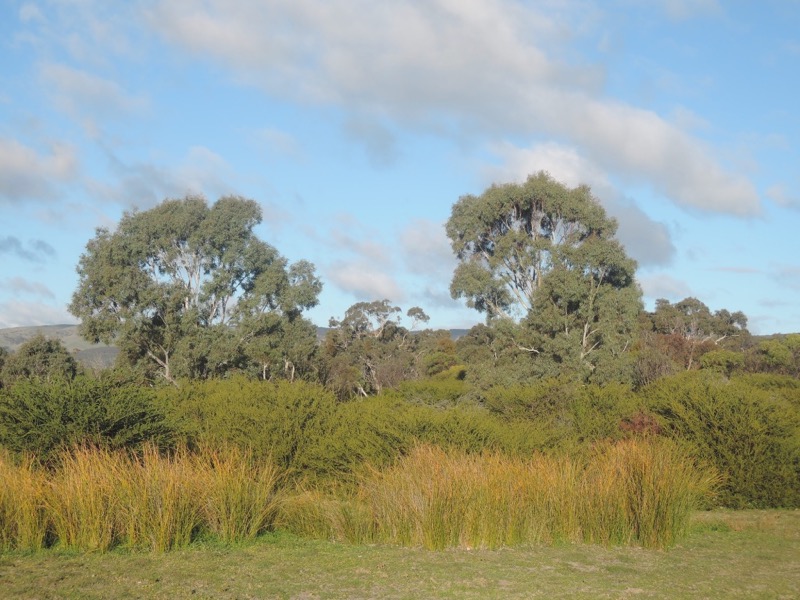
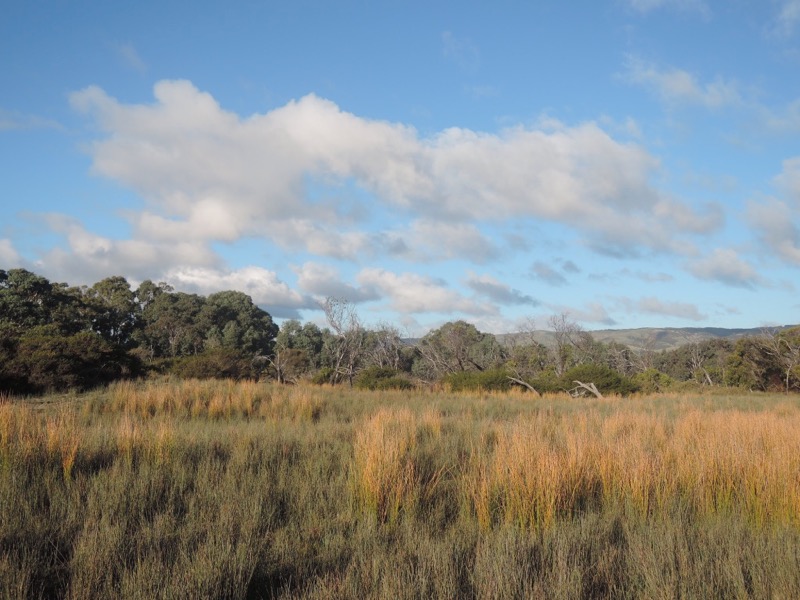
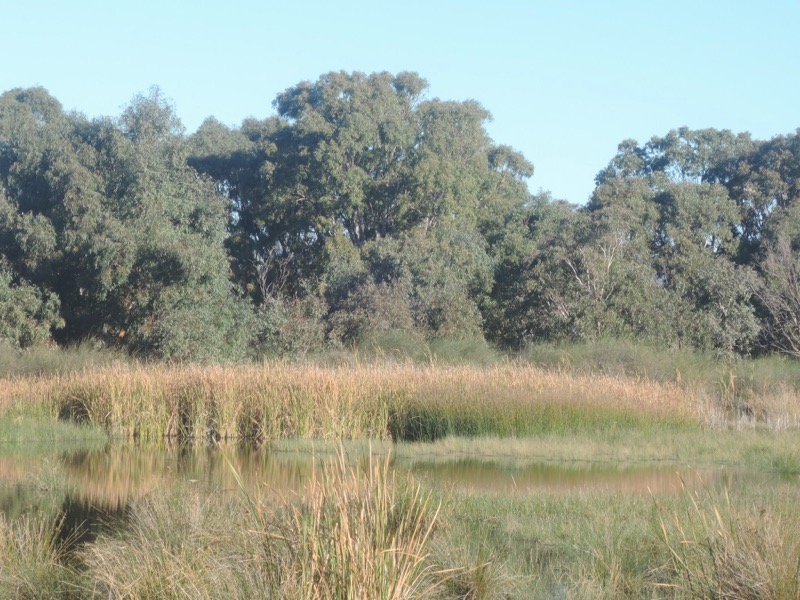
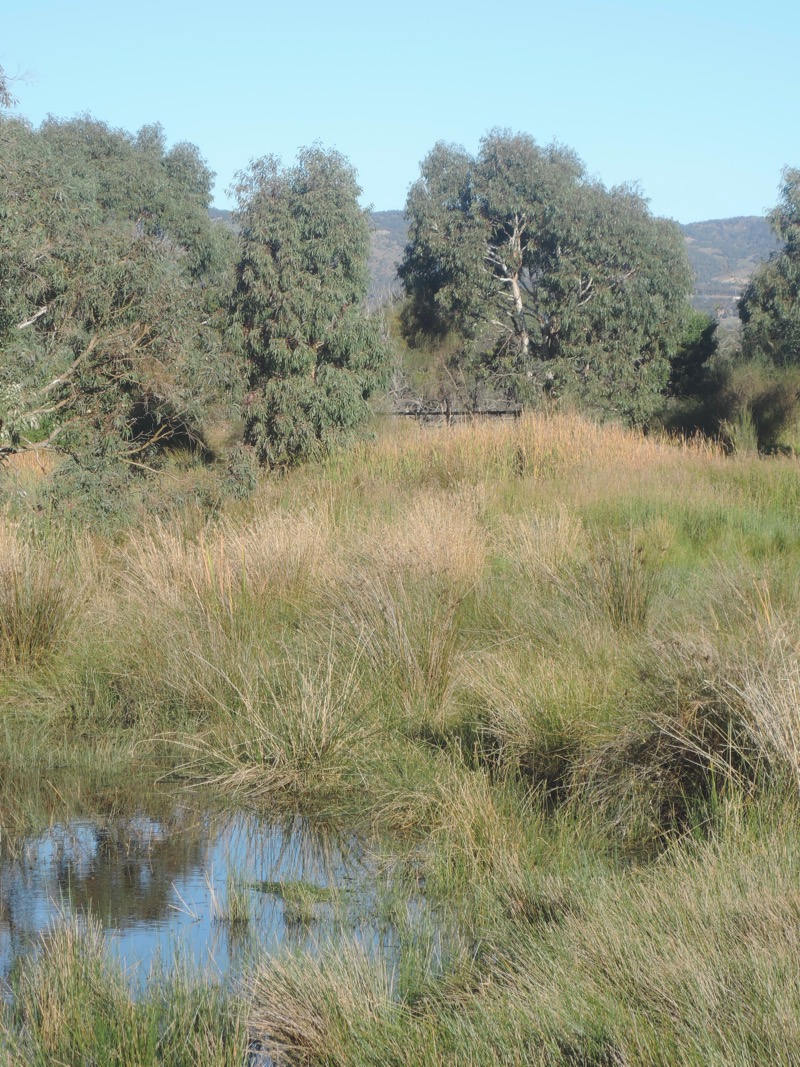
This particular jaunt took place in early June, a time of year when we expect rain and clouds and wind here in South Australia. But, as I’ve mentioned several times before recently, in my usual waxing-lyrical-about-the-weather mode, that’s not the weather we’ve had at all this June. This day was just one of a number lately that began cold, crisp and clear, and progressed into soft, still sunniness.

If I were to say anything more here about how clear and true the sun shone as I wandered through the wetlands that day, or about how the sunshine filled me with joy, I’d be venturing into waxing-purple territory. (That, I believe, is the stage that follows the waxing-lyrical stage.) So I’ll leave you to enjoy these photos without further ado.

Although PS Like Ruby, as far as talking about the weather goes, I’m. Just. Not. Sorry.

Differentiation

Other people’s words about … wild animals

As Paul and I were cresting the last hill, as I was squinting into the darkening woods to make out the path, a couple of deer lifted their heads at once and differentiated themselves from the trees.

We stared at them, and they at us, for a full thirty seconds without moving. They multiplied as we looked at them. There were three at first, then there were four, then there were five. They were the exact color of the bark and leaves –- gray brown –- but the skin around their eyes was red. I felt the breeze on their backs lift the braid from my chest and set it down over my shoulder.

‘They’re going to get us,’ Paul whispered. He reached for my hand.

‘They’re a herd,’ I reminded him. ‘They’re afraid of us.’

Two more appeared. Paul shivered.

From ‘History of Wolves
by Emily Fridlund

There are many places I like to go bushwalking in, but one of my favourites is the Aldinga Scrub. When I walk there, particularly at certain times of the day, I am always conscious that I might encounter a roo or too. There are traces of them throughout the Scrub.

Sometimes a kangaroo appears before me in plain sight — in a clearing in a patch of sunlight, enjoying the last rays of the sun, joey in pouch.

But sometimes there are roos in front of me all the time, without my even realising it. I don’t know what alerts me to them then. It might be the faintest rustle in the leaves around me, or a slight movement — an ear-twitch, perhaps. Sometimes a sense comes over me, simply: a dawning awareness that I am not alone any more, that I am being watched, and regarded, and assessed.

Kangaroos are not naturally aggressive towards humans, as far as I know, or not during encounters like this. But still, like all wild animals, they are protective of each other and of their young. And so, when I come across a roo or two (or more) in this way — when they differentiate themselves from the bushes around them, as Linda, the narrator in the passage above, beautifully puts it — I make sure to stop and take one or two steps back. I let the kangaroos know I’m not a threat. We regard each other a while, creature to creature, acknowledging each other. It’s not fear I feel then, like Paul, the little boy in the quote above: it’s respect.

And then I move on, leaving them to their world, re-entering my own.

Darkness encroaching

Other people’s words about … winter

Minutes after that the sun came out: brilliant, stunning us all. Still, it was no surprise when we were let out of school a half hour early due to the windchill. I made my way home from the bus stop at a rigid trot. I crunched along the snow-packed trail, felt the wind come off the lake in blasts, heard the pines groan and creak overhead. Halfway up the hill, my lungs started to feel raggedy. My face changed into something other than face, got rubbed out. When I finally got to the top of the hill, when I slowed down to brush ice from my nose, I turned and saw a puff of exhaust across our lake. I had to squint against all that white to make it out.

From ‘History of Wolves
by Emily Fridlund

Many years ago, I spent a winter in Michigan in the USA. For a whole month, the temperature did not lift above zero degrees Celsius. Having lived in South Australia most of my life, I had never seen a lake freeze over before. I walked across the surface of the frozen water, and grasped for the first time the meaning of the term ‘windchill’, a term I realised I had never understood before. A little way further out, a fisherman sat in a folding camp chair with his line cast down into a carved-out pool at his feet. I thought of taking a photograph, but my hands grew numb in the few seconds it took me to take off my gloves and fiddle with the lens on my camera. How can you grow so cold so quickly? It didn’t seem possible.

My American friends, knowing my love of ice cream, suggested taking me to the ice cream parlour in their local town, but it was shut down for the winter. We did a quick march up and down each side of the main street to look at the ice sculptures standing outside the shops. I kept expecting them to melt. I am Australian: I expect ice to melt. That’s just what it does.

For me, Emily Fridlund’s words, which I’ve threaded above and below throughout this post, capture the essence of that winter I spent in the northern hemisphere.

Overhead each afternoon we could hear the Canada geese coming back. We could hear them giving directions, labouring through wind currents, setting down their Vs. When the sun had just about set, we turned around, Paul lagging, getting farther and farther behind, so as the day grew truly cold –- miniature winter setting in, the way it does at night in April –- I put the backpack on … and we headed back toward his house on the lake.

What a lovely phrase, don’t you think?: Miniature winter.

Here in South Australia, where our climate is temperate, we don’t have four distinct seasons. Autumn is the beginning of what I always think of as the grey months. Our native trees are mostly evergreen, so they don’t shed their leaves; the weather simply grows windy, rainy and cold. As winter approaches, the days grow greyer still, and the hours of daylight shorten. The sky seems to sink lower over the earth, closing everything in. The world grows monochrome.

But then, in the middle of March, the temperature shot up to fifty and miraculously stayed there. Within a couple of weeks, the south slope drifts had eroded to stalagmite pillars. A wet sheen appeared across the surface of the ice, and in the late afternoons you could hear the whole lake pop and zing. Cracks appeared. It was warm enough to gather wood from the pile without mittens, to unfreeze the latches on the dogs’ chains with the heat of your fingers.

This time of the year — the first days of March, the very beginning of autumn — I always grow nostalgic for summer. Down the road at the beach, the sea is still warm enough to swim in, and the sand crumbles soft and dry and warm beneath my bare feet. A sense of urgency comes over me as I look up at the upside-down bowl of blue sky above me. I murmur spells at it, trying to make it stay.

The grey months are coming but not yet, not yet.

Note:
The pictures accompanying today’s posts are photos I’ve taken over the last few years during the South Australian winter. It may look as though I used black-and-white film, but I didn’t. That’s just the way it is.

Inhabitant

Other people’s words about … noticing

Over the last year I have discovered a passion for birds and wildflowers in particular, along with the ever-present kangaroos. I love the texture of bark, the colour of leaves and mosses, I’m utterly fascinated with the fact that I can walk around our small patch of natural bushland each day and find something I’ve never noticed before. Or find something I have noticed before, but it catches my eye for a different reason.

from ‘Fifteen Acres: A Small Slice of Paradise‘ blog
by Lisa from Central Victoria, Australia

I came across Lisa’s blog only recently and instantly realised she is a kindred blogger. Her blog documents her growing understanding of, knowledge about, and love for all the species of native flora and fauna that live on her block of land in rural Central Victoria. I get the feeling that Lisa has learned about her patch of land simply by walking through it and observing.

One of my favourite parts of the world in my state is Aldinga Scrub. I didn’t even know about the scrub’s existence until I was well into adulthood: it was the beach nearby — with its beautiful cliffs, its blue waters, its fish-inhabited and bird-dotted reef, its wide sands — which initially attracted me.

The first time I walked through the Aldinga Scrub, I was just curious. I had heard that it was the last remnant of original coastal bushland in South Australia, and so I wanted to see what it was like. A year later, going through another phase of feeling inexplicably agitated and uncomfortable in my own skin, I decided to try walking there more often. I thought that, if I made the effort to look outwards at the world around me instead of looking inwards into my own seething internal landscape, I might find solace.

And I did.

A small kind of miracle happened as I revisited the Scrub again and again. As I wandered, I began to wonder. As I wondered, I stopped. As I stopped, I observed. As I observed, I noticed, as Lisa puts it. And then, at last, I started to see and to learn.

Something else happened, too. I began to inhabit the world around me during those walks. Inhabitation — it’s a powerful word. Maybe it’s pretentious. Maybe it’s corny? And yet that’s how it feels.

It never stops, this seeing, learning, wondering, inhabiting. That’s another kind of miracle.

The pictures in this post are photographs I’ve taken over the years on my many visits to, and walks through, the Aldinga Scrub. Here you can see it in its many moods, its many seasons, its many tempers. I don’t know if my photographs can convey the wonder I felt as I took them, or the remembered sense of discovery I feel now when I return to them, but I hope that they convey, at least, the deep joy that my wandering has brought me.

That’s the thing, you see — noticing is both a humble and a joyful process. It’s a privilege to inhabit this kind of joy.