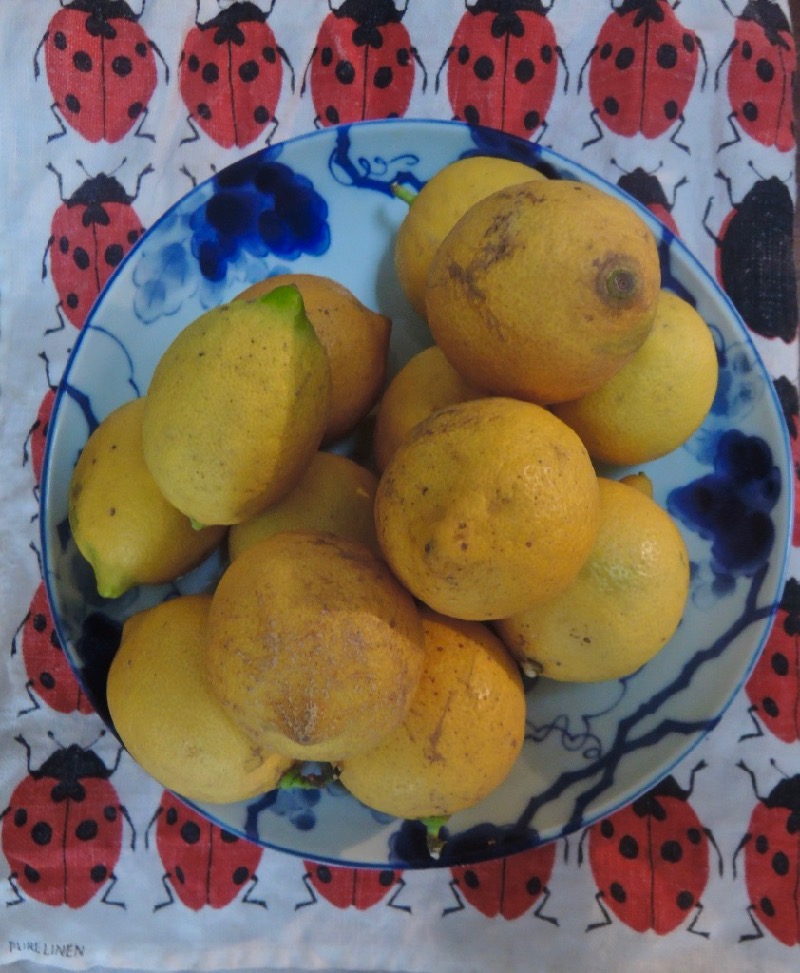
Tipping point

Otherwise

I got out of bed
on two strong legs.
It might have been
otherwise. I ate
cereal, sweet
milk, ripe, flawless
peach. It might
have been otherwise.
I took the dog uphill
to the birch wood.
All morning I did
the work I love.

At noon I lay down
with my mate. It might
have been otherwise.
We ate dinner together
at a table with silver
candlesticks. It might
have been otherwise.
I slept in a bed
in a room with paintings
on the walls, and
planned another day
just like this day.
But one day, I know,
it will be otherwise.

by Jane Kenyon

I have never known whether this poem, which I love, is about gratitude or fear, joy or sorrow. Is Kenyon, who experienced terrible bouts of depression throughout her life, describing her gratitude for, and joy in, the small moments of beauty and happiness she has experienced on the day she describes in her poem — the peach, the walk with her dog, the work she loves, the time with her mate?

Or is she describing her fear of losing these moments — of tipping away from happiness, back down into sorrow and depression?

A small thing, this, of beauty.
It might have been otherwise.

It’s a see-saw, this poem, I think. The poet hangs in a kind of precarious balance between one life and the other, without knowing when the hinge will tip her down again, away from the things she loves. It might have been otherwise, she writes at the start, and then, later, sadder and more afraid: it will be otherwise (my emphasis).

Gratitude. Joy. Fear. Sorrow. Grief. Yearning. They’re all there in this one, short poem.

What I see now

Other people’s words about … tears

I can’t help it, the valve between my thoughts and tears is so worn down that I don’t think I have any control over them anymore. Fat tears drop onto my cheeks. I feel them before I even know what’s happening and I just let them fall. I pull my hand [away from Gideon’s, and he] rolls over to face me.

from ‘Beautiful Mess
by Claire Christian

When I first started reading young adult novels I was already in my mid-twenties, several years older than their teenage target audience. That was partly because when I myself was a teenager, young adult novels had only just begun to become a ‘thing’, especially Australian young adult novels. And it was partly because something drew me to those novels in my mid-twenties, despite my age: something about their coming-of-age themes — and then, too, something about the way they handled those coming-of-age themes. Most of all, I liked the raw, direct voice in which many of their narratives were written, a voice that was both bleak and hopeful.

After I’d written my own two young adult novels, my love for the genre started to fade. This was partly, in turn, because I had in the meantime grown older again: my life now had nothing in common with either the novels’ protagonists or the novels’ intended readers. But it was also partly because it seemed to me that there were, suddenly, too many young adult novels being published every year. That raw, direct, bleak/hopeful voice seemed to me suddenly overused. Over-familiar. Hackneyed, even.

I don’t know what made me pick up Claire Christian’s young adult novel Beautiful Mess the other day. At any rate, it is the first young adult novel I have read in a long, long time, and the reading of it felt like one, long, jagged, indrawn breath that I couldn’t release until I had got to the end. There it was again, that raw, direct, bleak/hopeful voice — familiar, yes, but not overused this time. Not hackneyed. It was a poignant voice. Intimate.

The view ahead: not a bleak prospect

That’s what I love most about good novels, whatever genre they happen to fall into. Their protagonists, and the writer behind them, reach out and speak to you: they say things you know you’ll never forget, things you yourself have been wanting to say, but haven’t figured out how to. I see now that this is something I haven’t managed to do in my own writing for quite some time, though I didn’t realise it until I stopped. Perhaps that’s why I stopped: though the decision felt instinctual and unplanned, perhaps my instinctual knowledge simply kicked in before my conscious knowledge did.

In the meantime, even though I’m not writing fiction, I know I’ll find more good books to read (whatever their genre), and more narrative voices to hear, and more tears to shed. There’s nothing bleak about that prospect: in fact, the view ahead of me seems filled with hope.

The end of the story

Other people’s words about … writing

April has never really known loneliness until now; she has had all tastes of its dregs, like cold milky coffee curdled at the bottom of the cup, but she has always had faith in the fact that it would pass. Now, she is not so sure. And this loneliness is entangled with her failure as a musician, another certainty in her life that seems to have gone.

Most days, she tries to write.

She sits by the window with her guitar and picks idly at notes, strumming chords underneath, humming to herself as she does so. But nothing ever sticks, and she feels as if she is just pretending, playing alone outside a room she can no longer enter.

from ‘Between a Wolf and a Dog
by Georgia Blain

I did something I had never expected to do this week: I stopped working on the book I’ve been writing, on and off, ever since my last novel was published in 2010. Actually, I stopped writing fiction altogether, at least for now.

The novel I’ve been writing all these years has gone through many, many permutations: I’ve written it as a ghost story for young adults; as a reworked ghost story for middle-grade readers; as a love story for ‘new’ adults’; as a coming-of-age story for women my own age. I’ve written it in the first person and in the third person, and in past tense and in present tense. I’ve written it using pen and paper, and Microsoft Word, and Scrivener.

I’ve written it. And written it. And written it.

All the time I’ve been writing this novel, I’ve been telling myself that the doubt I feel in myself, and in my ability to write a third novel — this third novel, anyway — would pass. But it hasn’t. Sometimes it’s quietened down for a period, but then it’s flared up again. And over the years, like April, the sense of inner loneliness I carry with me — which is in part an aspect of being me, Rebecca Burton, and in part an aspect of being me, a human being — has slowly become ensnared with the doubt I feel about my writing. [N]othing ever sticks, and she feels as if she is just pretending, playing alone outside a room she can no longer enter. Yup. Yup. Yup.

Ever since I wrote my first novel and it was accepted for publication, I’ve believed, with all of my heart, that writing books was something I would do for the rest of my life, because that’s what writers do, right? It’s what they want to do. It’s their privilege, and their gift. Or so the story goes.

But I just don’t think I believe that particular story anymore. That’s what I finally realised this week, after all this time. I don’t think — as April thinks, in this passage which I have loved so much for so long — that I am a failure as a writer, or as a person, if I stop writing, for a while, or forever. I think the world is bigger than that.

I don’t know what the future holds for me if I’m not a writer anymore — for now, or for a while, or forever. But you know what? Unlike April, I want to find out.

It’s a big, big world.

On labour

Other people’s words about … loneliness

Dad’s dying had been like a long labor, the work mostly his, but the experience for me was as profound, as isolating, as the labor of birth. For weeks after my son was delivered, I remember, I was stunned by it — by what I’d gone through, by how alone with it I’d felt, by how astonished I was by it, and by how isolating that astonishment was. Others held my son, admired him. They saw him simply as a big healthy baby. But when I looked at him, part of what I saw and felt was how he’d come to me, that long solitary labor, the amazing combination of agony and release that I felt I could explain to no one else. And in some nearly parallel way, this is what I felt about my father’s death. It was what I returned to frequently, it was privately where I lived, for a long time after it was over.

From ‘The Story of My Father
by Sue Miller

Let me start by explaining (hastily!) that the affinity I feel with the words in the quote above is not because I’ve ever given birth (I have not). Nor, more importantly, is it because I’ve recently experienced the death of anyone close to me, let alone my father, who is a strong, healthy, happy man whose company I hope to enjoy for many years to come. No, not at all.

I am a big fan of Sue Miller’s writing. What I most like is her attention to detail, her scrupulous examination of people’s inner workings — their thoughts, their feelings, their individual senses and perceptions — and the way she then builds on these ‘small’ things to make ‘big’ stories from them. A writer friend of mine who isn’t a fan of Miller’s books once said to me that she feels ‘dead inside’ when she reads a Miller novel. And I get that, actually. I think, in fact, that what my friend dislikes about Miller’s writing is exactly what I like: the precision, the detail, the refusal to hurry over anything, or to be swayed by sentiment or affection or a need for resolution for her characters.

I’ve explored loneliness and isolation a lot in my posts on this blog, but I thought the theme was worth returning to because of Miller’s words here. I was stunned by it, she says of giving birth, by how astonished I was by it, and by how isolating that astonishment was. This, for me, distils the experience of living itself, the realisation that each experience we have, however great or small, however joyful or devastating, is an experience we feel we [can] explain to no one else.

In the last couple of years, whenever I’ve experienced bouts of unwellness or anxiety (or both, combined) that have left me feeling isolated at home, struggling to go out, struggling to get to work or to catch up with people I love, I have found myself, afterwards, return[ing] to those experiences repeatedly in my mind; I have found that those times of illness were, for a while, privately where I lived.

Miller’s use of the word labor here refers only to giving birth, but the passage applies to other things, too, if you reframe it: to the labour of living, of loneliness — yes, to that astonishing labour.

And yet, still, it is worth labouring on.

Snatched phrases: last pages

‘I will love a book forever
if the final pages mark my subconscious.’

From ‘The Museum of Words’
by Georgia Blain

My mother and sister and I (all inveterate readers) were talking the other day about those devastatingly disappointing books you read all the way through, from start to finish, without skipping a paragraph, because you are in the grip of a conviction that you’ll get to the end and suddenly — suddenly — all this time you’ve spent reading it, feeling love and hate for the book and its author in equal measure, will be justified.

You know those books I mean? I say ‘devastatingly disappointing’ because I am describing the kind of book that, when you do finally get to the end, you realise your time wasn’t justified at all. You realise that, on the contrary, the whole time you spent reading it was, in your opinion at least, a waste of time.

You know those kinds of books?

That’s why I love Georgia Blain’s words above.

So I thought I would make a list of books whose last pages have, as Blain so delightfully puts it, marked my [own] subconscious forever. Here they are, in no particular order:

Rebecca, by Daphne du Maurier
Prep, by Cutis Sittenfeld
The Children’s Book, by AS Byatt
A Map of the World, by Jane Hamilton
The Smart One, by Jennifer Close
Me and Mr Booker, by Cory Taylor
Wasted, by Marya Hornbacher
Tell Me I’m Here, by Anne Deveson (Georgia Blain’s mother).

And, yes, the book I’ve quoted today, Museum of Words, by Georgia Blain.

What about you?

This quiet unknowing

Other people’s words about … dreams

I am trying to find my dog, which is going to be put down. Not a dog I live with in my waking life, but another, a black Labrador. The dog has already been taken away and is awaiting its death at a pound on the edge of town. This awful knowledge permeates my sleep. When I get there, however, my dog has gone. In its place, lying sick and exhausted on the concrete floor inside a large cage, is a young, very beautiful red setter. As I enter, the creature raises its head towards me and I see with slow shock that its muzzle has been sewn up with fishing line. The red dog pulls itself off the ground and limps towards me. Rising on its hind legs, it puts its forelegs on my shoulders, and rests its head against the left side of my neck. I can sense it begging me to save it. I feel great pity; I embrace and try to comfort it. But there is no sense that I can or will do anything to help it. The burden would be too great. Words come into my head. The dog’s name: Gadget. (Why Gadget? I wonder, even in the dream.) Then the thought — with which I am already justifying my decision to abandon it — that red setters are not very intelligent dogs. I step away. The animal stands there, hopeless. I touch it on the back and I leave.

What to do with a dream like that?

From ‘Anaesthesia
by Kate Cole-Adams

What to do, indeed?

I love the words in this passage: this description of a dream, which is vivid and haunting and bewildering all at once, as dreams so often are. Over time, Cole-Adams goes on to say, various astute readers have suggested to me that this particular dream might not belong in this particular book, that it is a dream that emanates from somewhere else and that ought to be left there …. And yet she includes the dream in her book anyway. In doing so, she allows herself to write intuitively, blindly, instinctively, knowing — knowing — that what she is writing must be written, but not knowing why.

In the quiet after waking I lay curled on my side suffused with the knowledge of irrevocable loss. I had betrayed the red dog. And in doing so I understood that I had disavowed some helpless, voiceless part of me. The dream did not feel like a dream. The house was still and very dark. I did not know what the dog had been trying to say, but I could still feel almost physically the place above my left shoulder where it had nuzzled its head against my neck, and I accepted finally that I could not write this book without it.

Do you sometimes have dreams like Cole-Adams’s dream — a dream that [does] not feel like a dream? Do you feel memories rising in you that feel more alive than memories should ever feel? Do you get a feeling of sickness in your gut that you know — you just know — isn’t a sickness; and yet it is, it is?

I do.

These days, I’m not much one for grand resolutions. I don’t know what path I’ll follow this year (though, hopefully I’ll get to walk one of the sandy paths in Aldinga Scrub, like the one pictured above, every now and then). I don’t know what 2018 holds, for me or for you.

I do hope, though, that there will be some moments like Cole-Adams describes, for you and for me: those quiet moments after waking when you do not disavow the helpless, voiceless part of you; those moments when you accept finally that you cannot otherwise do what it is you need to do.

Snatched phrases on … birds

‘It was eluding her again: the essence of bird.’

From ‘Nest
by Inga Simpson

I love this sentence. Jen, the protagonist of Nest, is an artist, and in this passage she is trying to draw a fairy wren.

I’m not an artist; in fact, I’m spectacularly untalented when it comes to drawing. But I know the feeling of trying to capture — in a photograph, perhaps, or in conversation, or in writing — what you see when you see a bird. To say that a bird flies, or that it sings, or that it is beautiful is true, but those descriptions come nowhere near to capturing what a bird really is, or how it makes you feel.

The essence of bird. Perhaps it will always elude me, as it does Jen. Perhaps that’s part of the fascination.

From my world to yours … and beyond

Other people’s words about … the blogosphere

I don’t know if I’ll make it to eight years of blogging. Probably not, to be honest. And that’s OK. Because the time I’ve spent in this corner of the internet has changed my life in the most unexpected and powerful way. That has nothing to do with me and everything to do with you, so THANK YOU.

From ‘ Reflections on 7 years of blogging
by Ali Feller of
Ali on the Run blog

It’s becoming quite a trend, isn’t it? Quitting blog writing. Decrying the blogosphere and what it has become. I’m saddened to find that some of my favourite bloggers, quoted in the passages dotted throughout this post, are pulling the plug on their blogging.

But I’m not about to do the same.

But it’s time friends. It’s time to pull the plug on my blog. I’ve been putting off this decision and this post for a very long time.

From ‘ So long, farewell
by Christine of
Love Life Surf blog

I’ve talked before about why I love blogging and the blogosphere. Many of the bloggers now leaving the blogosphere complain about how disingenuous bloggers are becoming: how curated so many blogs are; how inauthentic the bloggers’ voices have become; how blogs now function, simply, as the latest tool for a person who wants to build a portfolio in order to make a living through social media.

Honestly? In some ways, I agree. I wince when I realise I am wading through yet another post on a cooking blog filled with not one, not two, not five, but ten (or more) shots of the same dish, artfully presented amongst scrunched-up tea towels, autumnal leaves and battered enamel saucepans. And I wince even more when I find myself reading yet another post by a blogger announcing breathily, Guess what? Exciting news! I got a publishing contract!

I’m almost nostalgic for the early days of blogging (except I don’t really do nostalgia). It was enormous fun, but also an enormous consumer of time. I loved it at the beginning but foresaw early on many of the problems now associated with the internet, and now I’m happier doing it all in private. I always had faith that the appeal of printed books, face-to-face conversations, trips to the cinema, walking, swimming and camera-less experiences would never fade for me and now I am back where I was before I started blogging in 2005 … I’m writing a new book. I’ve moved on from writing about domesticity. I just live and breathe it, like I always did.

From ‘ As I live and breathe
by Jane Brocket of
yarnstorm press blog

But there’s still room in the blogosphere for sincerity. For vitality. For authenticity. There is. You just have to look a little harder to find it.

Some bloggers find joy in the blogging community; recently, for example, I read a lovely post by children’s author and fellow blogger Cynthia Reyes about bloggers helping bloggers. Her post would make any blogger think twice about stopping blogging.

Me? I blog for many reasons. I see blogging as a way of improving my writing: of learning to express myself better, learning to reach out to people, somehow, with my words. I see blogging as a form of connection to the rest of the world — if I show you my world, perhaps you will show me yours. I see it as a substitute for journal writing: a substitute that is better than the original because, due to the public nature of the domain in which my blog appears, there is discipline involved in the writing of each post, and discretion. And I see blogging, as I’ve said before, as a way of reaching towards beauty, wherever I can find it.

All of those are selfish reasons for blogging, I guess. But the corollary of writing a blog is spending time reading other people’s blogs: listening to what other bloggers have to say, seeing what they see, understanding what they believe (even if I don’t agree with them). Reading of any kind, no matter how enjoyable an activity it is, is inherently an unselfish act. It forces you to listen to other people. It can, if you let it, open your mind.

I think blogging offers a richer, more thoughtful, more all-compassing vehicle for expression than other forms of social media like, for example, Twitter (where pithiness is valued over thoughtfulness) and Instagram (where aesthetics are valued over normality). And for that reason alone, I will continue to participate in, and love, the blogosphere.

What about you? What do you think about the state of blogging today?

This moment, now

Other people’s words about … the everyday

The sunlit room is silent and there rises a kind of aural transparency through which a deeper background of sound emerges, intricately embroidered like an ocean bed seen through clear water: the sound of passing cars outside, of dogs barking and the distant keening of gulls, of fragments of conversation from the pavements below and music playing somewhere, of phones ringing, pots and pans clattering in a faraway restaurant kitchen, babies crying, workmen faintly hammering, of footsteps, of people breathing, and beneath it all a kind of pulse, the very heartbeat and hydraulics of the day.

From ‘Aftermath’
by Rachel Cusk

I’ve been saving this quote for a while. My copy of Aftermath came from the library, and so I can’t look the quote up again and remind myself of the context; but from memory, Cusk, who was at the time living and working in the British seaside town of Brighton, is in this passage writing of a visit to the dentist.

It’s easy to focus our attention on the beautiful things we see and hear around us. (I do it in my posts on this blog all the time.) But I love the way that Cusk does the opposite here: she takes an everyday moment — not a remarkable one, not even a particularly pleasant one — and describes it so vividly that the moment shines; it sings.

Sometimes, as I go about my own day — at moments when I am particularly busy, or grumpy, or stressed, or anxious — I make myself stop. I glance around; I tilt my head to one side to listen; I sniff the air. I make myself take everything in, just for that moment. It’s a way of stepping back, I suppose: of absorbing rather than participating. However unremarkable my surrounds at that moment, the act of stepping back from them and observing them creates a stillness inside of me.

That stillness is useful. It reminds me that I’m alive.

Look up from your work
every now and then.
Take a step back.

I suppose you could call this a form of anxiety management. I suppose you could say that I am teaching myself to be present, or trying to practise mindfulness. But I’m not consciously striving to do any of these things: the act feels more instinctive than that. It feels, simply, as though it is an important — no, an essential — thing to do, every now and then.

And that’s what Cusk does in this passage, I think: she grabs a very ordinary moment, she witnesses it and she breathes life (a heartbeat, a kind of pulse) into it.

And somehow, along the way, with the words she uses, she breathes magic into her day.