Chasing clouds

‘It took me years to see that path and to find my pace.
When I finally got moving, I hoped I might be able to run forever.’

From ‘The Long Run’
by Catriona Menzies-Pike

We’ve had an unusually dry, cold winter in South Australia this year — the driest, I heard recently, since the mid-1960s — and so the days in the last few weeks have been mostly clear and crisp. Global warming and environmental concerns aside, I love this weather.

And here’s a first — I have even grown to love the short days this year!

Sunrise, bird, tree.

Some mornings, I get up around 6 am, and go for a run before work, as the sun rises. Running before breakfast, I’ve discovered, is a completely different beast from running later in the day: sleepy and not yet well-fed, I run more slowly (which may not seem possible, but apparently is) but also somehow more smoothly. It is as though the calm of the night, the deep, rhythmic breathing of sleep, still hang over me. I feel light, buoyant, in my body and in my mind, as though I’m still moving through my dreams. My joints are loose and easy, and the exertion of the run seems somehow separate from me, not part of the dream I’m in.

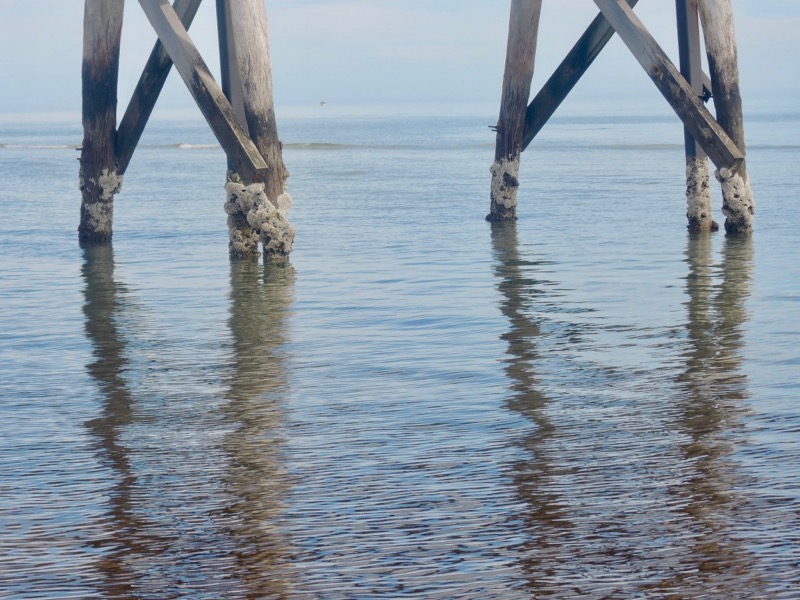
Meanwhile, as I run along the esplanade path or by the shore, the sky grows rosy to the landward east; and the sea turns from silver, to grey, to blue, to the west; and the scent of the sand drifts up to me, filled with chill and damp; and sometimes a sliver of moon hangs above the tops of the pine trees lining the coast.

And I know that I’m awake. Alive. Grateful to be here.

The end of the story

Other people’s words about … writing

April has never really known loneliness until now; she has had all tastes of its dregs, like cold milky coffee curdled at the bottom of the cup, but she has always had faith in the fact that it would pass. Now, she is not so sure. And this loneliness is entangled with her failure as a musician, another certainty in her life that seems to have gone.

Most days, she tries to write.

She sits by the window with her guitar and picks idly at notes, strumming chords underneath, humming to herself as she does so. But nothing ever sticks, and she feels as if she is just pretending, playing alone outside a room she can no longer enter.

from ‘Between a Wolf and a Dog
by Georgia Blain

I did something I had never expected to do this week: I stopped working on the book I’ve been writing, on and off, ever since my last novel was published in 2010. Actually, I stopped writing fiction altogether, at least for now.

The novel I’ve been writing all these years has gone through many, many permutations: I’ve written it as a ghost story for young adults; as a reworked ghost story for middle-grade readers; as a love story for ‘new’ adults’; as a coming-of-age story for women my own age. I’ve written it in the first person and in the third person, and in past tense and in present tense. I’ve written it using pen and paper, and Microsoft Word, and Scrivener.

I’ve written it. And written it. And written it.

All the time I’ve been writing this novel, I’ve been telling myself that the doubt I feel in myself, and in my ability to write a third novel — this third novel, anyway — would pass. But it hasn’t. Sometimes it’s quietened down for a period, but then it’s flared up again. And over the years, like April, the sense of inner loneliness I carry with me — which is in part an aspect of being me, Rebecca Burton, and in part an aspect of being me, a human being — has slowly become ensnared with the doubt I feel about my writing. [N]othing ever sticks, and she feels as if she is just pretending, playing alone outside a room she can no longer enter. Yup. Yup. Yup.

Ever since I wrote my first novel and it was accepted for publication, I’ve believed, with all of my heart, that writing books was something I would do for the rest of my life, because that’s what writers do, right? It’s what they want to do. It’s their privilege, and their gift. Or so the story goes.

But I just don’t think I believe that particular story anymore. That’s what I finally realised this week, after all this time. I don’t think — as April thinks, in this passage which I have loved so much for so long — that I am a failure as a writer, or as a person, if I stop writing, for a while, or forever. I think the world is bigger than that.

I don’t know what the future holds for me if I’m not a writer anymore — for now, or for a while, or forever. But you know what? Unlike April, I want to find out.

It’s a big, big world.

Chasing clouds

‘It took me years to see that path and to find my pace.
When I finally got moving, I hoped I might be able to run forever.’

From ‘The Long Run’
by Catriona Menzies-Pike

I recently spent a week holidaying in one of my favourite spots, near a clifftop in the Yorke Peninsula region. It was mid-Autumn, and the weather, like the view, changed every day, sometimes every minute.

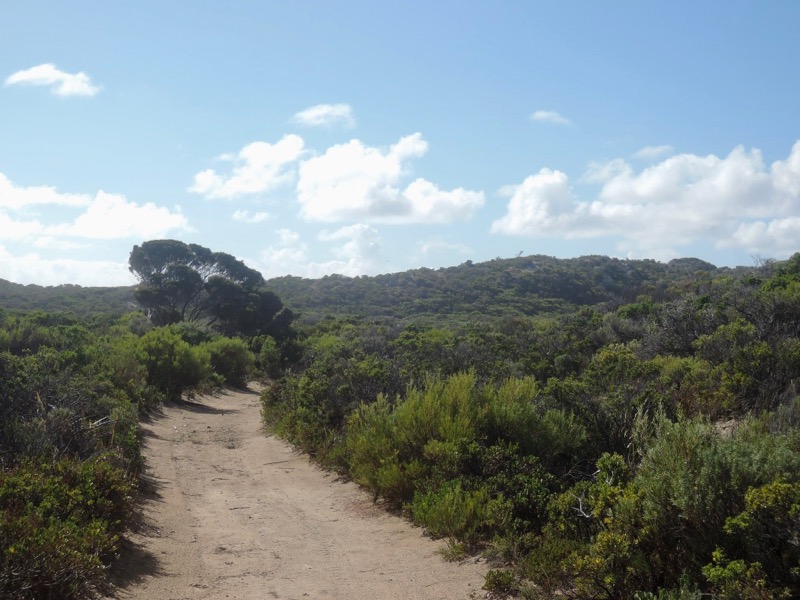
During one of the sunnier hours, I went for a run in the bushland that lies behind the dunes and cliffs. I took off my running shoes and ran barefoot along the winding sandy track that rises and dips through the scrubland. Despite the lack of rain in the previous months, the bushland here seemed to me quite lush (at least by South Australian standards).

I finished my run at the base of the highest dune, and then I trundled up to the top of the dune to look down on the beach and shoreline below.

It was a moment of silver seas and blue skies — a moment worth celebrating.

Prayer

Other people’s words about … books

After Bunty died, days slid into one another like the colours in a sunset. Whole afternoons passed as Christabel drank tea in the kitchen … If there was a book in front of her, she would look away frequently and forget to turn its pages — she no longer read in the old, urgent way. The taste for reading had started to withdraw from her; she felt it pulling gently away, like a tide. Books contained hard truths, waiting like splinters in their pages. Over the years, many had lodged in her unnoticed. Little anticipations of life’s awfulness, they might have served as a defence against it but pierced instead with knowledge of damage, error, waste.

From ‘The Life to Come’
by Michelle de Kretser

CS Lewis once wrote that we read fiction and literature to seek an enlargement of our being; we read because [w]e want to see with other eyes, to imagine with other imaginations, to feel with other hearts, as well as with our own. I don’t subscribe to Lewis’s Christian practices and beliefs, but I do — oh, I do — subscribe to his views on reading.

And so Michelle de Kretser’s words in the passage above affected me deeply. I cannot imagine a life in which [t]he taste for reading had started to withdraw from me; the thought that the truths I treasure finding within a book’s pages might begin to feel like splinters horrifies me.

Reading for me is an activity that provides solace. The solace comes most strongly from finding kinship within the pages of the books I read: kinship with the book’s characters, and, vicariously, with the book’s writer, who created the characters. That’s not quite what Lewis is saying, but it’s part of it, I think: it’s hidden in his words. When de Kretser’s character Christabel finds herself losing the taste for reading, losing the urgency that was inherent for her in the act, what she is really experiencing is loss. Loneliness. Desolation.

If I was a praying person, as Lewis certainly was, I would offer up a prayer here, in response to de Kretser’s words. I would pray: Please don’t let me ever experience this particular form of loss.

I would pray: Please don’t let me lose the companionship of books.

I would pray: Please don’t let the tide go out.

Please.

Prayer

Chasing clouds

‘Some athletes love to talk about what a simple sport running is.
They say that all you need is a pair of sneakers.
That’s not true.
What you need is some freedom of movement
and the ability to see a clear path ahead of you.
It took me years to see that path and to find my pace.
When I finally got moving, I hoped I might be able to run forever.’

From ‘The Long Run’
by Catriona Menzies-Pike

Around about a year ago, I wrote a post on this blog in response to lawyer-turned-long-distance-runner Robyn Arzón’s book Shut Up and Run. In that post, I wrote, in angry contradiction to Arzón, about the virtues of taking things slowly, of living humbly, of letting things unfold gently, whether or not your life is unfolding as you wish it would, or as you think it should. (You can read the post — which, by the way, I still stand by — in its entirety here.)

Here’s the thing about running, though, as an activity, as a practice: it lends itself to metaphors. That’s why so many runners, like Arzón and Menzies-Pike, write about it. Speed, distance, endurance, cadence, rhythm, pace — all of those things can be metaphors for something else: for life. It took me years to see that path and to find my pace, Menzies-Pike writes, of her running. And: When I finally got moving, I hoped I might be able to run forever.

Don’t tell me she’s not talking in metaphors.

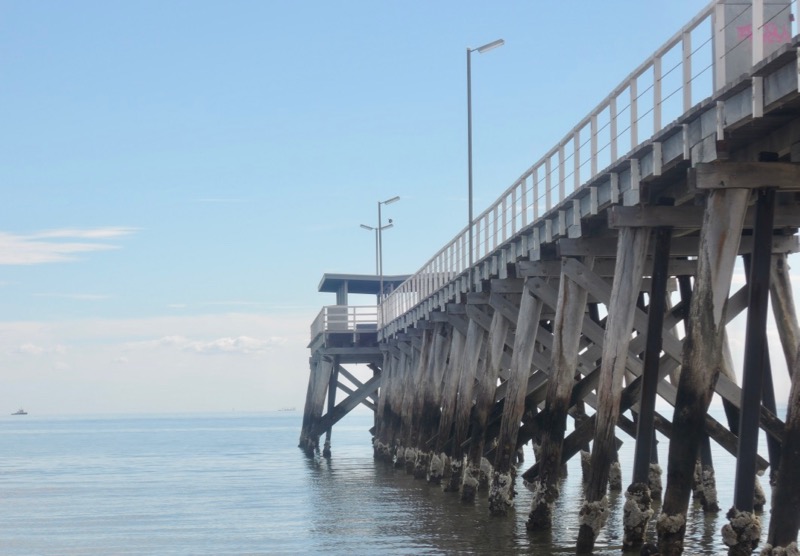
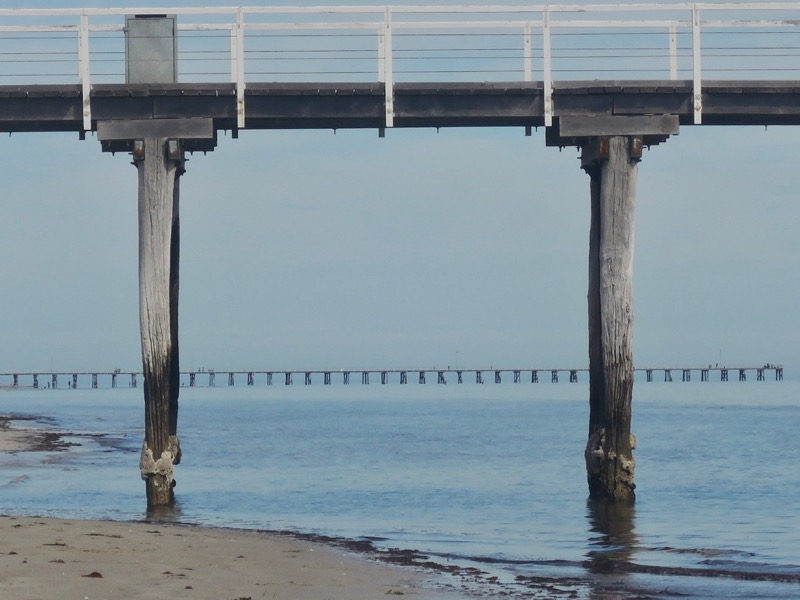
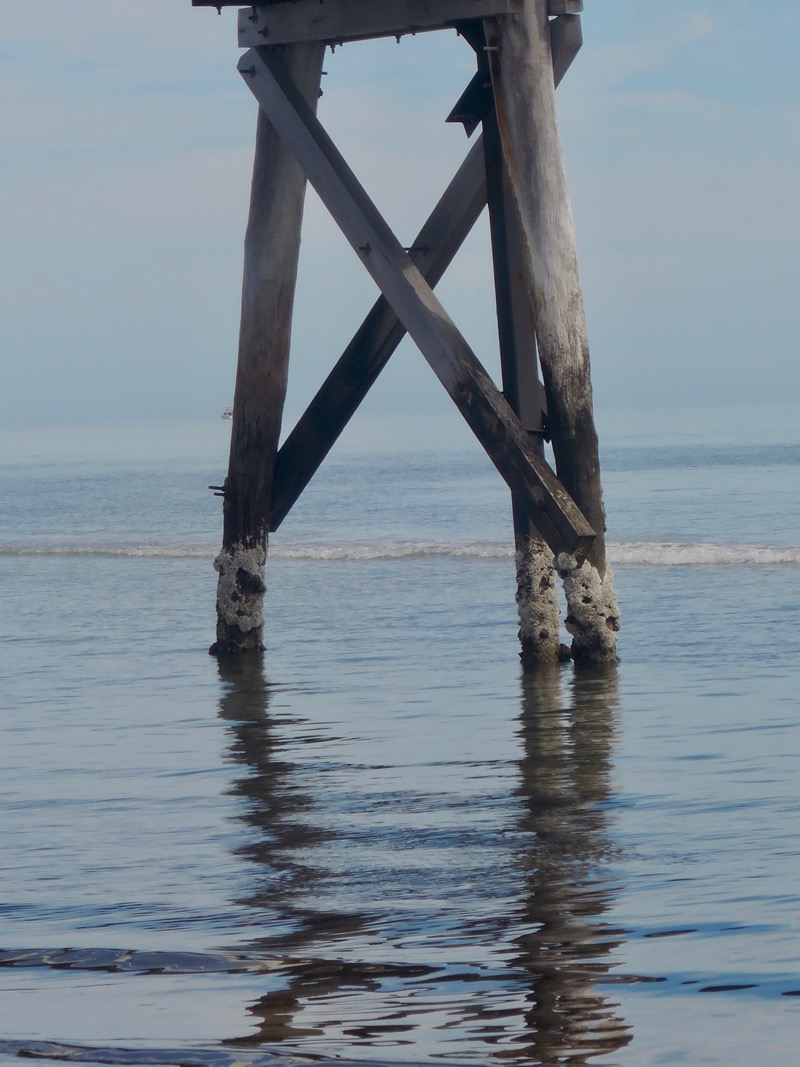
As for me, I stopped mid-run — on a gorgeous, warm, still day last week; a day when all of coastal Adelaide seemed to be bathed in soft sunshine — to take the photos you see in today’s post. Afterwards, I put my camera away and lingered at the shore a while, before wandering back from the beach to the foreshore path and setting off again, back home.

Days like that — days of running beneath a soft blue sky, beside a silken blue sea — are days, simply, to be grateful for, days that feel as though they are unfolding as they should, or at least as you wish they would.

And so this post is the first in a new series on my blog entitled Chasing clouds. It is a companion series to my Out and about series, in essence. The theme in that series is walking; the theme in this one is running. Running, for me — like walking — is about wandering, about wondering. It is about chasing clouds.

Of course I’m using metaphors. Running, for me, is about hope.

Miracle

Other people’s words about … running

Soon, he is at the base of the mountains, his heart rate is at least 140, and the peaks tower over him like wild, hungry beasts. It is this moment in which Russ understands himself best. In which he could easily say, my name is Russ Fletcher, I am a man living a certain sort of life, and I am happy.This gasping moment is free of obligation, of expectation and that bruised yellow past. It is only Russ and his beating man’s heart, Russ and the cloud of his breath as it unfurls white in the cold morning, Russ and the burn, burn of his legs. The needle-prick attention of his mind, as it focuses on blazing extremities. Running, Russ is okay. Running, he moves forward.

From ‘Girl in Snow
by Danya Kukafka

I have a chequered history with running, but recently, I’ve taken up the habit on my own terms. Here’s how it goes: every day, either before or after work, I make the effort to stroll down the road to the beach, and then, once I’m on the sand, a few metres from the shore, I break into a run for a few minutes. Often, honestly, I run for only five minutes or so before slowing down, turning around and heading back home. I guess it’s as much about getting fresh air into my lungs, moving my limbs a little before or after sitting at a desk all day, feeling sand crumble beneath the soles of my feet, as it is about anything you might want to call ‘fitness’ or ‘athleticism’.

Occasionally, though — once or twice a week, if I’m lucky — I run for a longer time, for twenty minutes or so, taking my camera with me (so that I can stop along the way to take photos like the ones in this post). No matter how slowly I run, or how heavy my legs seem to become, or how tired I was beforehand, or even, some days, how sub-par I felt before I set off, there is always a moment on these runs when I feel, like Russ in the passage above, that I understand [my]self best, a moment when I feel free of obligation, of expectation, of that bruised yellow past.

A couple of years ago, when I first took up running again after a lapse of twenty years, I hoped to run for much longer times, to run much further distances. That seemed to be what every other runner did, after all. And that’s what I wanted to be: a runner.

But running is like everything else in life: what works for other people isn’t necessarily what works for me. And over the last two or three years, I’ve learned — at first to my bitter (childish?) disappointment, and then, slowly, to my joy — that I can find a way to run on my own terms and still find pleasure in it. Still find release. Still find hope. And reason. And courage. And peace. And, like Russ, who runs when he’s both joyous (as in the first quote) and terribly sad (as in the next quote), freedom.

Russ runs. He takes off down the sterile … streets … All he can do now is push — move his body, sweat it out, keep inching forward. For now, he focuses on his own limbs and the miracle ways in which they serve him. The freedom of the open Colorado sky.

I thought at first, when I couldn’t run the distances I wanted to run, the distances I thought I should run, the way everyone else seemed to, that I was giving up. It took me a while to understand that finding a way to run that worked for me wasn’t so much about giving up as it was about learning to surrender.

Surrendering is not the same as giving up. I didn’t understand this before. I am glad that I am beginning to now.

Out and about: the last summer days

‘When you’re walking the view shifts and changes.
Walking’s a form of hope.’

from ‘The World Without Us
by Mireille Juchau


Here’s the thing I always forget as summer draws to a close and the annual grey-weather dread steals over me: there are moments, at this time of year, when the wind drops, and the sea becomes shining and silken and blue.

I took the photos in today’s post as I wandered the beach at Largs Bay one afternoon a few days ago, in the week before Easter. The day was so still, and the tide so low, that the pine trees along the Esplanade were reflected in small pools of seawater that had formed between the sandbar and the main ocean …

… and out on the water, ships hung suspended in blueness, somewhere between sea and sky:

It was an afternoon that reminded me that there’s joy and beauty in every season — yes, even in the seasons you’d rather not be heading into …

Snatched phrases: on cake

‘This is bread in the way that banana bread is bread.
It’s not really. It’s cake.’

From ‘The Little Library Cookbook’
by Kate Young


I loved the recipe notes I’ve quoted above, which accompany a recipe for a ‘fruity nutbread’, in Kate Young‘s literature-inspired cookbook. That’s my kind of bread! (Cake?)

(So of course I had to make the recipe … )

Day by day

Other people’s words about … tea

I am the sole tea-abstainer in my family. I think they regard this as a baffling perversion. To me, tea tastes like dried lawn-clippings, diluted leaf mould, watered-down compost mixed with a dash of bovine bodily fluid. I have never been able to stomach it.

From ‘I Am, I Am, I Am
by Maggie O’Farrell

I loved this quote from Maggie O’Farrell. My sister, an inveterate coffee-drinker, feels much the same as O’Farrell, I think: she wrinkles her nose in disgust at any suggestion of tea. She, in contrast to O’Farrell’s family members, is baffled by my love of the stuff.

Each to her own, right? I would find it harder to give up my one or two pots of tea per day than I would to give up chocolate or cake or wine. Tea provides me with what amounts to both a daily treat and a ritual, and it gives me, each day, a small moment (often temporary but still cherished) of sanity and solace.

I would write more, but it’s 9.30 in the morning and the kettle is on the stove waiting for me to make my daily pot of tea …

The tea shop of heaven

Other people’s words about … coffee shops

Gerry sat down in an empty seat by the window and Stella went to the counter. Coffee places were so noisy. This one sounded like they were making the ‘Titanic’ rather than cups of coffee — the grinder going at maximum volume, screaming on and on — making enough coffee grounds for the whole of Europe while another guy was shooting steam through milk with supersonic hissing. A girl unpacked a dishwasher, clacking plates and saucers into piles. A third barista was banging the metal coffee-holder against the rim of the stainless steel bar to empty it — but doing it with such venom and volume that Gerry jumped at every strike. Talking was impossible. It was so bad he couldn’t even hear if there was muzak or not. And still the grinder went on and on trying to reduce a vessel of brown-black beans to dust. Stella had to yell her order.

Gerry looked out on to the square. Pigeons pecked and waddled after crumbs in between the green café tables and chairs. Stella eventually came to the table.

‘In the coffee shops of heaven they will not grind coffee beans,’ she said. ‘But coffee will be available.’

from ‘Midwinter Break’
by Bernard MacLaverty

Do you know the kind of coffee shop Bernard MacLaverty describes in the passage above? I do. I had to smile when I read his words. And then I found myself thinking that in the coffee shops of my heaven …

No, wait.

In my heaven, there will be tea shops, not coffee shops. They will sell loaves of sourdough, and slices of homemade everyday cake, and pots of tea made with malty assam tea leaves, left to brew so long that the tea turns toffee-brown.

And the baristas will pour the milk into my cup before they pour in the tea.

And fresh pots of tea will always be available.

And I’ll be able to drink cup after endless cup, because caffeine won’t have any effect on me …