Snatched phrases on … the sea

‘They’d ended up sitting on the beach,
the sea a great black heaving beast,
sighing and rolling under the white light of the moon.’

From ‘Between a Wolf and a Dog
by Georgia Blain

I don’t have any photographs to accompany this post because I still haven’t yet managed to get the hang of the craft of night-time photography. But isn’t that a wonderful image of the sea at night? — that great black heaving beast, sighing and rolling. It makes me want to go for a night-time walk on the beach right now …

Out and about: a new series

‘When you’re walking the view shifts and changes.
Walking’s a form of hope.’

from ‘The World Without Us
by Mireille Juchau


As I’ve mentioned before, I have two part-time jobs, which I move between each week. One of my jobs involves editing manuscripts for an academic press, while the other involves call centre work.

The job at the call centre doesn’t involve sales work; I work for a not-for-profit community health organisation. My calls are mostly from clients wondering what time their nurse is coming or needing an unscheduled visit from a nurse due to an unexpected health crisis, or from members of the public wanting to find out how to go about becoming a client. Around me, as I take call after call, my colleagues do the same. We work in a bubble of chatter and noise: phones ringing; people laughing or raising their voices for a client who’s hard of hearing; people taking complaints; the lunch lady ringing her bell as she pushes her trolley between desks to sell food to anyone who didn’t bring their own lunch with them.

During each shift, I am allotted a thirty-minute lunch break at a stipulated time (which varies depending on what time my shift starts). There is a lunch room at the end of the corridor, with a toaster and a microwave and a dishwasher, but I rarely eat my lunch there. Though I’m proud to work for the organisation — though I enjoy the work and value what we all do there — I think of those thirty minutes as my chance to escape.

And so I wander outside the office with my lunch. Our office is on the fringes of the city, and just down the road from our building is a stretch of park land that runs between the main road and the railway track. I walk there each day, and despite the hum of traffic and the rattle of trains passing, it’s a peaceful time. Swallows dive in front of me; parrots chirp; magpies sing; mynah birds chortle.

You can’t go far in thirty minutes, and I walk briskly along the path on a designated route. Still, despite my hurry, there are moments enough in which I have the chance to notice the passing of the seasons. In the cold months of the year, the grass is long and wet and the trees sway in wild, wet winds, their branches silhouetted against the grey sky. In the hot months, the grass dies off and the sun beats down between the branches, and the birds murmur amongst themselves.

Today’s pictures come from one of those lunch breaks a couple of weeks ago: late July, early August. Officially, these months are still classified as winter, at least according to the Western calendar. I’ve heard, though, that Indigenous Australians traditionally mark the time differently, recognising more than four seasons each year — and on this walk I saw why. Despite the cold, blustery wind, and the wet grass, and the leaden clouds above me threatening squalls of rain, the native bushes along the path had begun to flower. Acacia trees were heavy with musty yellow blossom (as pictured in the top photo), and I came upon a couple of hardenbergia vines in full bloom, their vines resplendent with purple flowers (as pictured in the remaining photos).

Perhaps you recognise the words I’ve quoted at the top of this passage: I’ve quoted them before. I think the words bear repeating, here and elsewhere, which is why this is the first post in a new series on my blog — a series I’m entitling ‘Out and About’. In these posts, you’ll find pictures and thoughts that I’ve collected together after one of my frequent wanders. It’s not a new topic for my blog, really — just a new way of gathering these kinds of post together: a recognition of how much this part of my life means to me.

Walking is a form of hope. It’s also a form of joy. That’s how those lunchtime walks seem to me.

Snatched phrases on … the bush

‘The bush flex[ed] its great, porous hide as we moved,
tiny and blissfully unimportant,
between its bristles.’

From ‘Hope Farm
by Peggy Frew

I’ve been out and about a lot again recently, on foot and on my bike. The photos in today’s post are from a stroll down south a few weeks ago, on one of the last days of June, before the winter rains began — finally, belatedly — to fall.

On this particular walk, I passed through an area where the bushland borders some new housing developments. Before those houses were built, the land had already been denuded of its natural vegetation: it was farmland for years, and then, when the land was sold off, it grew into bare, grassy paddocks.

And yet.

Despite the impact that humans have had on that land, still, as I walked over it, I swear I got a hint of Peggy Frew’s great, porous hide beneath my feet …

Snatched phrases on … the weather

‘Someone once told me it was bad blogging and boring writing
to wax lyrical about the weather but I can’t help it.
And I am not sorry.’

from Ruby and Cake blog,
this
post

Well, as you may have guessed by now, I’m with Ruby on this. I love waxing lyrical about the weather, and have been doing so, on and off, ever since I began writing this blog, back in April 2014.

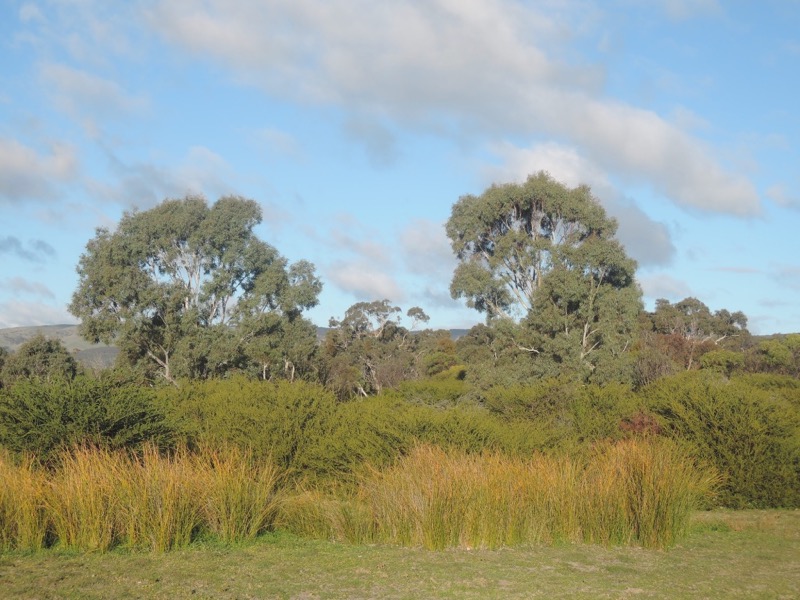
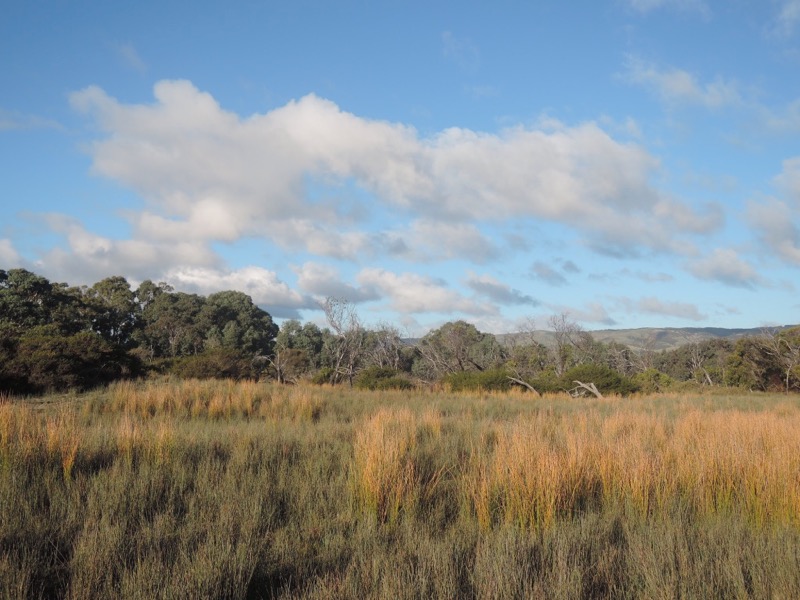
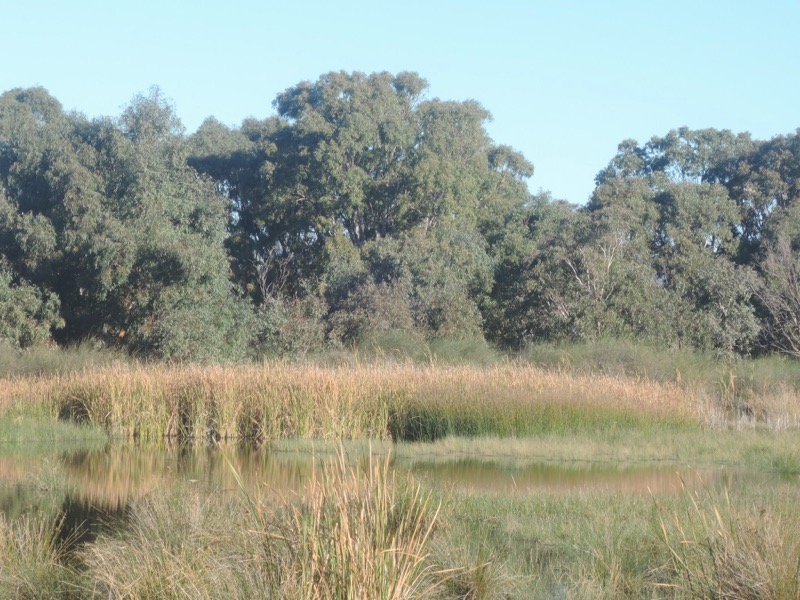
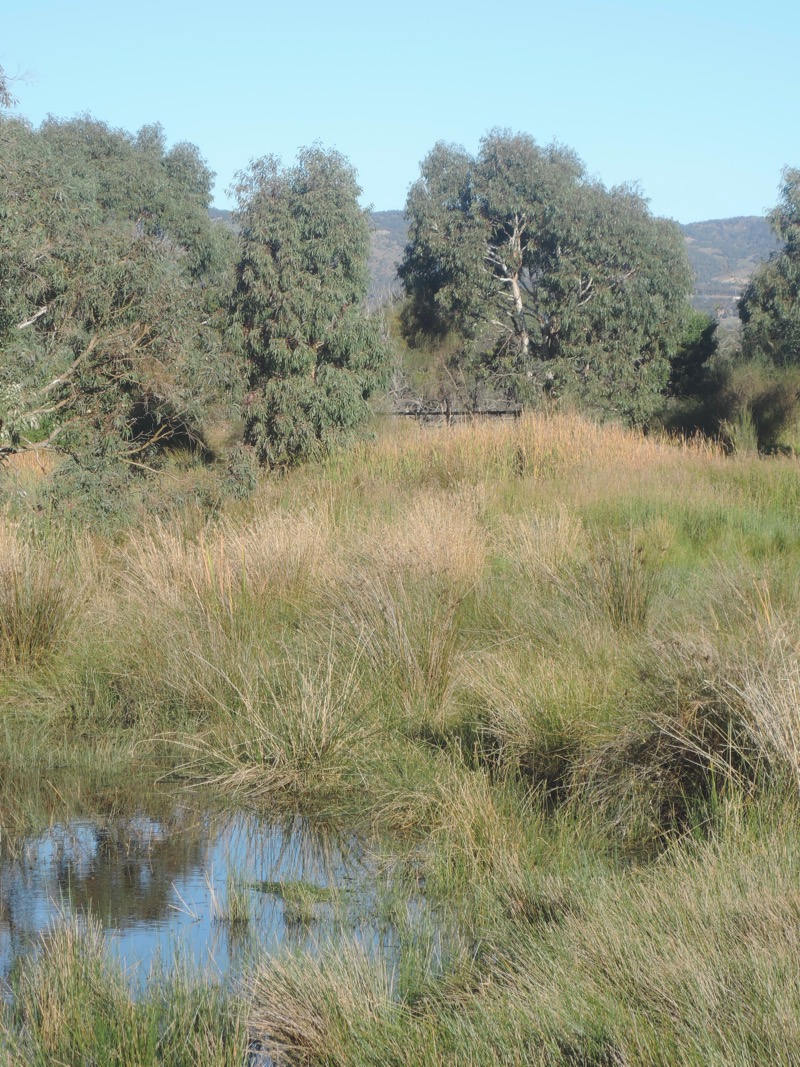
And when I’m not waxing lyrical about the weather, I’m taking photographs in celebration of it instead. So, to continue the weather celebrations, here are some photos from one of my latest saunters out and about.

This particular jaunt took place in early June, a time of year when we expect rain and clouds and wind here in South Australia. But, as I’ve mentioned several times before recently, in my usual waxing-lyrical-about-the-weather mode, that’s not the weather we’ve had at all this June. This day was just one of a number lately that began cold, crisp and clear, and progressed into soft, still sunniness.

If I were to say anything more here about how clear and true the sun shone as I wandered through the wetlands that day, or about how the sunshine filled me with joy, I’d be venturing into waxing-purple territory. (That, I believe, is the stage that follows the waxing-lyrical stage.) So I’ll leave you to enjoy these photos without further ado.

Although PS Like Ruby, as far as talking about the weather goes, I’m. Just. Not. Sorry.

Snatched phrases (on terror)

In the actual moment, you do not have a choice.
Grace finds you.
Acceptance hunts you down.

From ‘The Violet Hour: Great Writers at the End
by Katie Roiphe

Forgive me, but I’ve pulled Roiphe’s words out of context here. She is talking, specifically, about death: her fear of it, and her admiration of the way others face it. I don’t have the same preoccupation with death — or not yet, anyway: not in my mid-forties. I like to hope I have some way to go before it crosses my path.

Still, sometimes I think that fear is the great equaliser. Maybe you get through the terror because you have to get through the terror, Roiphe writes. It’s the same with all great fears, isn’t it?

Grace, acceptance, resilience, surrender — these are all things I’ve touched on before on this blog (here, for example, and here). May they come to you, too, in your moments of greatest fear: may they be your companions along the way.

The beast

Snatched phrases (on being present)

Do the anxiety. Then leave it there. This is our challenge.

from ‘First, We Make the Beast Beautiful: A New Story about Anxiety
by Sarah Wilson

Simple words, huh? They apply to all manner of ills, I think — not just anxiety. They are about staying in the present: doing the hard stuff when it comes up, not questioning it or agonising over it … and then leaving it behind and moving on.

There are no solutions to anxiety out there, Wilson argues further on: no cures or fixes. So you just do it …

… and then you leave it.

This makes great sense to me.

Today’s photos? They’re from one of my latest bushwalks, a couple of weeks ago: mid-March. It was a still, grey afternoon, and when I first began to walk, the colours seemed drab, and the birdsong was muted, and the air felt unkind and cold.

But as I wandered on, I began to see a few flowers despite the greyness, and I came upon a kangaroo, which stiffened at my bumbling approach and then bounded away. I heard the sea murmur somewhere through and beyond the thicket of trees, and a magpie began to carol, low and soft.

I had done my day, and I had left it there, and things were fine. Just fine.

On asides

Other people’s words about … other people

Some writers describe nature beautifully; some express their characters’ inner lives with great insight and pathos; some describe people pithily. I came across two writers of the latter kind recently.

How’s the following for a description of someone, for example?

He had the countenance of someone who’d weathered a thousand tiny insults; they were etched into the lines of his forehead and cheeks. He had the drawn, inelastic face of either a serious smoker (with no time for the inconvenience of food) or a fastidious vegan whose pursuit of a healthy lifestyle had left him on the verge of sickness.

from ‘A Smell of Burning: The Story of Epilepsy
by Colin Grant
(p. 2)

Colin Grant’s book is a memoir about life with a brother who lived with, and ultimately died from, epilepsy. It’s also a history of epilepsy’s treatment (both cultural and medical) over the last two millennia. But it was Grant’s descriptions of people which really held me.

He held disgust in his nose, a magnificent diaphanous beak with thread-like blue veins and tobacco stains on the nostril hair and dividing septum, usually slightly cocked and in a permanent sneer.
(p. 16)

After I’d finished reading A Smell of Burning, I moved on (in a completely non-sequitur fashion) to Angela Carter. I’d never read any of her novels before, though people had told me over and over that I should. I’m still only partway through The Magic Toyshop, but already, I’m relishing Carter’s descriptions of the characters who populate her story.

Here she is on five-year-old Victoria:

Victoria had no sense of guilt. She had no sense at all. She was a round, golden pigeon who cooed. She rolled in the sun and tore butterflies into little pieces when she could catch them.
(p. 6)

And here’s her description of twelve-year-old Jonathan:

Jonathon ate like a blind force of nature, clearing through mounds of food like a tank through the side of a house. He ate until there was no more to eat; then stopped, put knife and fork or spoon and fork together neatly, wiped his mouth with his handkerchief and went away to make model boats.
(p. 4)

Meanwhile, when Melanie, the fifteen-year-old protagonist of Carter’s story, first meets Finn, she watches him from afar before he notices her. When she does capture his attention, he fixes his gaze upon her before speaking:

His eyes were a curious grey green. His Atlantic-coloured regard went over Melanie like a wave; she submerged in it. She would have been soaked if it had been water.
(p. 38)

These are snatched phrases, I guess, more than anything. But that’s the thing about the experience of reading: it’s not just about plot, or emotion, or catharsis. It’s about the little things, too: the words and the phrases; the asides and the diversions. The sentences I’ve quoted above aptly capture the essence of the people they’re depicting: they made me smile in recognition (and wry admiration) and then re-read them, just in case I didn’t miss anything. And, like the characters they’re describing, they stayed in my mind long after I’d put the books aside to get on with the business of my day.

They stayed in my mind. I can think of no greater praise for someone’s ability to write — and no greater reason to keep on reading — than that.