Leak

Other people’s words about … young boys singing

When I was a boy and I sang, my voice felt to me like a leak sprung from a small and secret star hidden somewhere in my chest and whatever there was about me that was fragile disappeared when my mouth opened and I let the voice out. We learned, we were prisons for our voices.

From ‘Edinburgh
by Alexander Chee

I love this image of singing, of the purity of young boys’ voices before they break, and of their song.

And there is no photograph in my collection, really, that I can illustrate this post with adequately, so instead I leave you with a link to a piece of music I love — not a song at all, but a sonata by Beethoven, one that never fails to move me. Despite its overtones, these days, of hackneyed and saccharine overuse, the Moonlight Sonata in its essence is a gorgeous piece.

I think Beethoven would have understood and known that leak that springs from a small and secret star hidden somewhere in [your] chest, whether you are a boy singing or a woman listening to a beautiful piece of music. Don’t you?

Chasing clouds

Running affords the freedom of distance, coupled with the literary appeal of solitude. There’s a meditative cadence to the union of measured breaths and metered strides. Writers and runners both operate on linear planes,
and the running writer soon realises [that] the relationship between art and sport is a mutually beneficial one.’

From ‘Why Writers Run’
by Nick Ripatrazone
in The Atlantic

I’d heard about the connection between writing and running before — or at least about certain writers, like Joyce Carol Oates and Haruki Murakami, who run as well as write, and who believe that their running helps their writing. And I’d always understood the connection instinctively, though I don’t think I could have put it into words as Ripatrazone does (fairly baldly and glibly in some spots, it must be said) in his piece for The Atlantic, which I’ve quoted throughout this post.
Running, the argument goes, clears the mind. Writers stuck on a sentence should lace their sneakers and go for a jog, knowing that when they return, they will be a bit sweatier, more tired, but often more charged to run with their words. This is Ripatrazone’s advice, at any rate.

While I would quibble with any shoulds when it comes to either running or writing — what works for some people won’t work for others; and one person’s meditative jog is another person’s sweaty, heart-pounding, back-spasming nightmare — Ripatrazone also has this to say, which I love:

Writing exists in that odd mental space between imagination and intellect, between the organic and the planned. Runners must learn to accept the same paradoxes, to realise that each individual run has its own narrative,
with twists and turns and strains.’
I’ve been struggling for some time to articulate why writing became such a tortured process for me over the last couple of years, and, equally, why I turned to running around this time with such joy. I knew that when I ran I felt a sense of clarity that I don’t otherwise feel; but still, I didn’t think the two things were connected — especially since, not long after I began to run again regularly, I made the decision to stop writing altogether, at least for now.

Now, though, reading Ripatrazone’s words, I wonder if it was that odd mental space … between the organic and the planned that running creates in me that allowed me to stop writing.

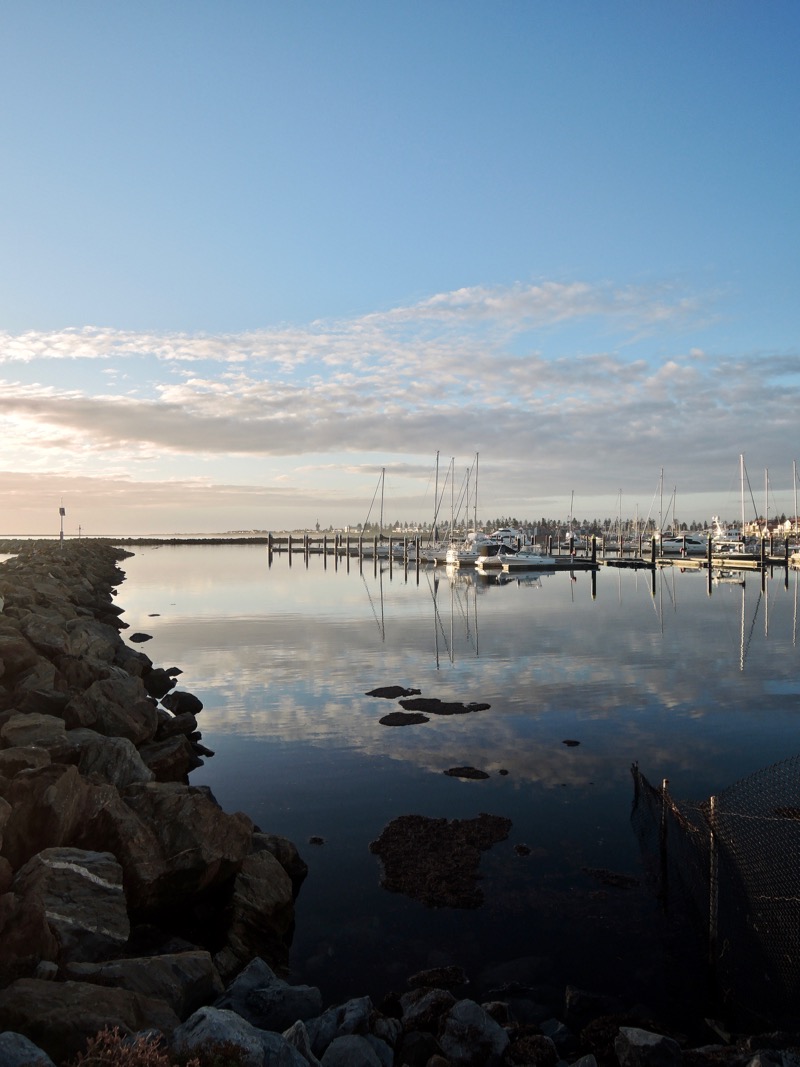
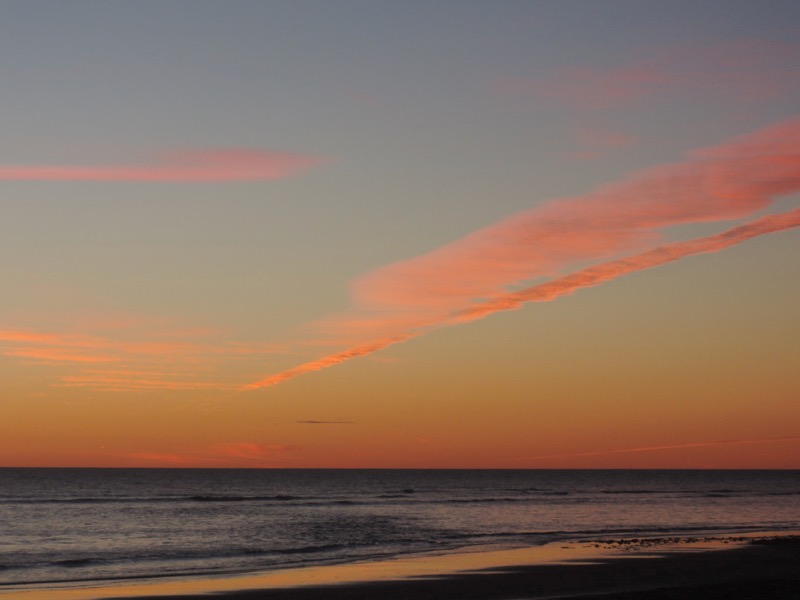
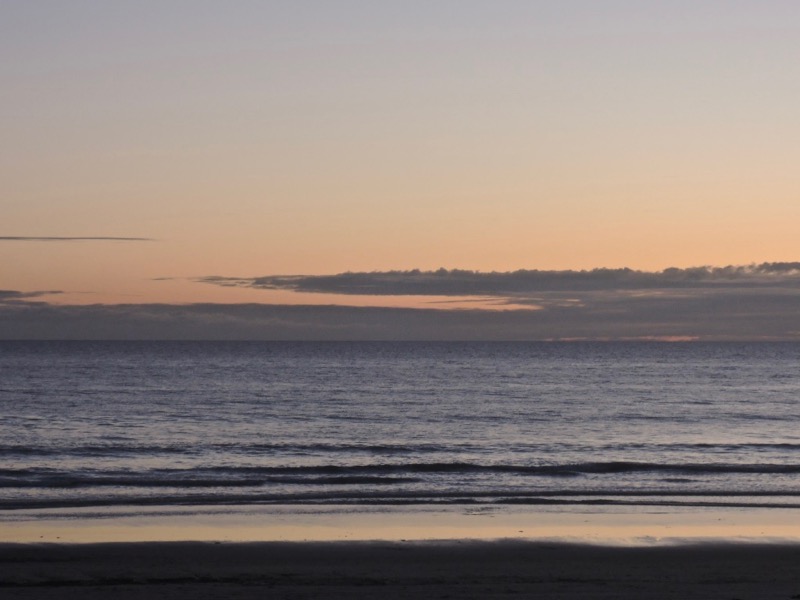
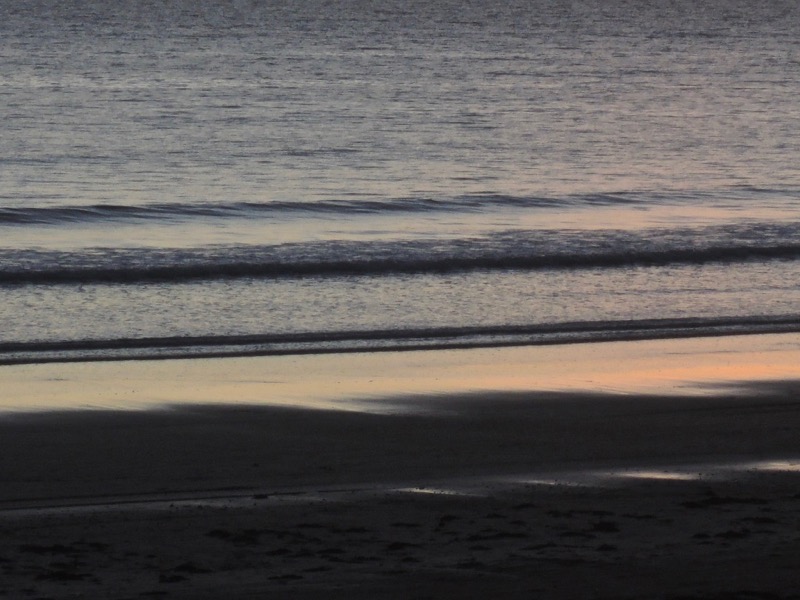
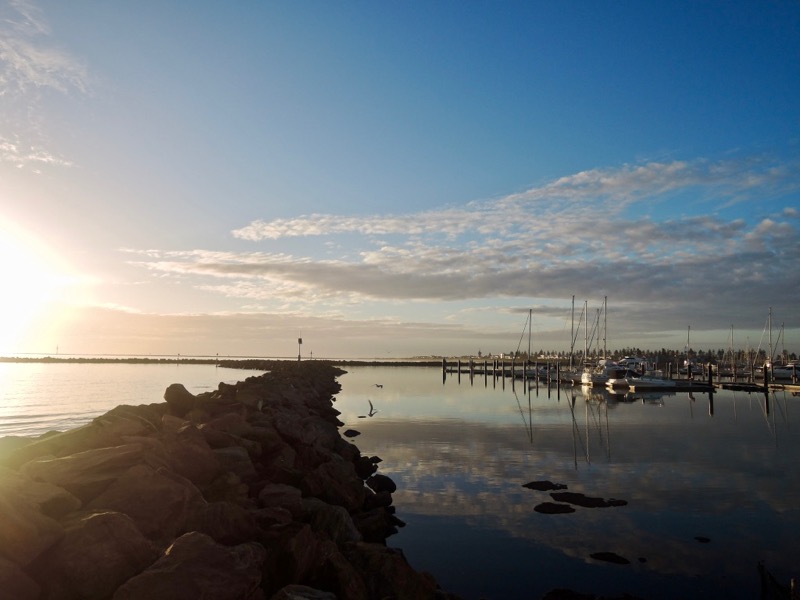
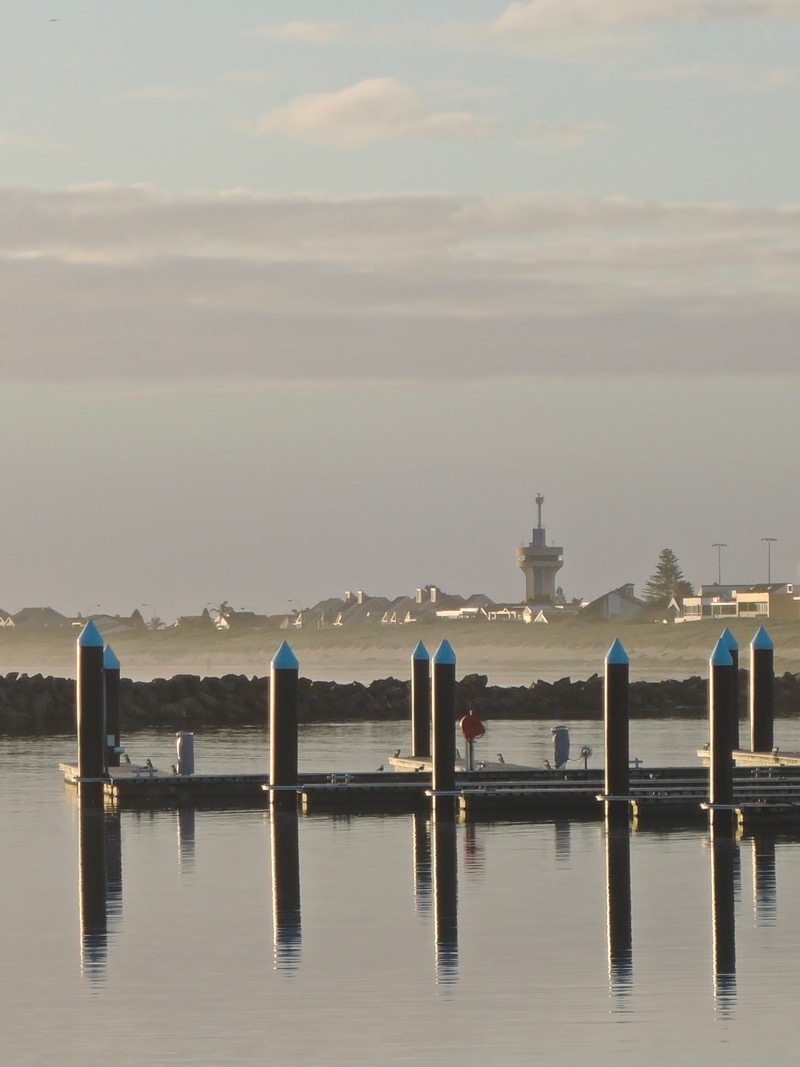
The only way I can explain this is to tell the story behind the pictures in today’s post, which I took on a short, gentle run in late July, after a particularly torrid day at work. I made it onto the beach before the sun set. Once there, I ran with the sun ahead of me rather than at my back. And at the halfway point, at the breakwater, I stopped.

I stopped.

I stopped.

I took these photos, and I breathed in, and I felt the lowering sun on my skin, and I felt everything inside of me, finally, stop.
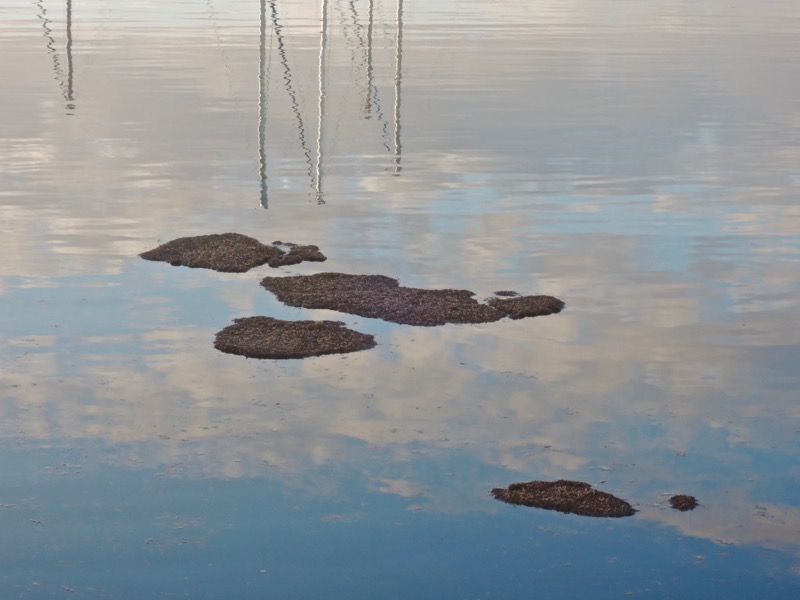
This, I think, is what running does for me: it allows me to stop. It brings me into a kind of stillness I don’t feel at any other time. Running, stopping, finding stillness: to say that these things are intimately connected with each other seems a contradiction in terms. But perhaps it’s not, because something shifted inside of me when I took up running again last year: I felt it almost immediately. That shift was what allowed me to stop writing, which was something — I see now — I had to do, in order to move forward in my life: and to move forward, also, in my writing (again, that contradiction in terms).

Perhaps, in the end, Ripatrazone puts it better than me — not in his clichéd injunction to writers to run in order to improve their writing, but in his description of the paradoxes that both writers and runners must face.

In any case, on the day that I’m speaking of, the day that I took these photos, once I had stopped for a while to breathe in, and to look about, and to rest, I knew that I was ready to move again. And so I turned and ran homewards, with the sun sinking into the sea behind me and the air gradually chilling, and a sense of stillness all about me, and also inside of me.

Deep, deep inside.

Out & about: messages

‘When you’re walking the view shifts and changes.
Walking’s a form of hope.’

from ‘The World Without Us
by Mireille Juchau


I often wax eloquent about the value of stopping and taking the time to look up, but the other day, on a bushwalk, I happened to look down at the ground I was walking on, and this is what I saw:

My friend Anne tells me that these words are quotes from the movie The Best Exotic Marigold Hotel, a movie I’ve never seen because it’s never appealed to me.

I do like these words, though.

I went back to the same spot a few days later, retracing my steps, but the pebbles had gone, or someone had moved them, or (at least, this is what I thought, till I remembered I had photographed them) they had never been there in the first place, except in my imagination.

But I kind of like the fact that they disappeared. Though I’d hate to be accused of solipsism, or indeed of fatalism, somehow it feels as though I was meant to see those words that day.

And as though, perhaps, I was meant to pass them on to you.

Chasing clouds

‘It took me years to see that path and to find my pace.
When I finally got moving, I hoped I might be able to run forever.’

From ‘The Long Run’
by Catriona Menzies-Pike

We’ve had an unusually dry, cold winter in South Australia this year — the driest, I heard recently, since the mid-1960s — and so the days in the last few weeks have been mostly clear and crisp. Global warming and environmental concerns aside, I love this weather.

And here’s a first — I have even grown to love the short days this year!

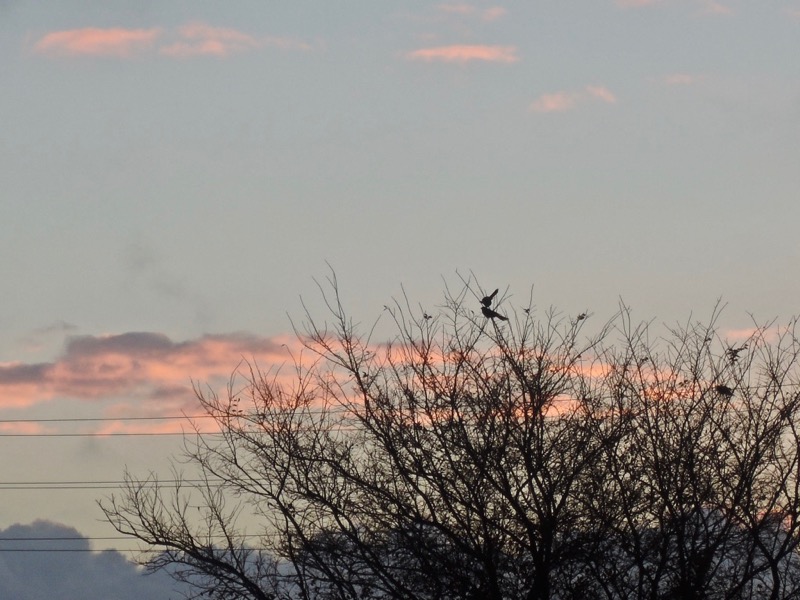
Sunrise, bird, tree.

Some mornings, I get up around 6 am, and go for a run before work, as the sun rises. Running before breakfast, I’ve discovered, is a completely different beast from running later in the day: sleepy and not yet well-fed, I run more slowly (which may not seem possible, but apparently is) but also somehow more smoothly. It is as though the calm of the night, the deep, rhythmic breathing of sleep, still hang over me. I feel light, buoyant, in my body and in my mind, as though I’m still moving through my dreams. My joints are loose and easy, and the exertion of the run seems somehow separate from me, not part of the dream I’m in.

Meanwhile, as I run along the esplanade path or by the shore, the sky grows rosy to the landward east; and the sea turns from silver, to grey, to blue, to the west; and the scent of the sand drifts up to me, filled with chill and damp; and sometimes a sliver of moon hangs above the tops of the pine trees lining the coast.

And I know that I’m awake. Alive. Grateful to be here.

Snatched phrases (sleeping alone)

‘That night I felt so lonely that I couldn’t sleep.
I soothed myself by imagining I was a child again,
at a time in one’s life when sleeping alone is not yet lonely.’

From ‘Somehow’
by Danielle Dutton
(in the Paris Review, #224)

Only a short comment here: unlike the narrator in the quote above, Mr Field, I cannot think of a more luxurious habit than sleeping alone. No matter whether you’re in a committed relationship or not, I can’t recommend it highly enough.

There is nothing — nothing — like a good night’s sleep!

(Oh, and gorgeous quilt covers, like the ones pictured, also never go astray … )

Snatched words: beginning

‘It is terrible to desire the end of something,
the absence of something;
desire should belong to life, to presence and not absence.’

From ‘Aftermath’
by Rachel Cusk

We’re supposed to think about the pot of gold when we look at rainbows, right? But when I stepped outdoors after waking the other morning, the sun had just risen and a storm was about to hit, and in that moment between — in that moment as I stood there — the light in the sky grew lurid, and a rainbow appeared.

It is terrible, as Cusk says, to desire the end of something, the absence of something. The rainbow seemed to me, in that moment before fat raindrops began to fall, a symbol of the opposite of that kind of desire. It seemed to me to be the start of everything: of the rain, yes, of course. Of my day. Of the rest of my life.

Beginning.

Out & about: winter solstice

‘When you’re walking the view shifts and changes.
Walking’s a form of hope.’

from ‘The World Without Us
by Mireille Juchau


I spent the week of the winter solstice on holiday. I had planned to go camping to Yorke Peninsula, but various things conspired against these plans. In the end, it didn’t matter. I live by the beach. That’s holiday enough in itself.

Winter solstice sunset (1)

The weather that week was unusually dry, cold and sunny for June in Adelaide, with overnight temperatures getting down to as low as 2 degrees Celsius. That made for beautiful weather in which to go walking.

Winter solstice sunset (2): dying light

The sunset on the evening of the winter solstice was cold, clear and beautiful. Though the time of the year when the days are at their shortest often leaves me feeling light-starved and sunshine-deprived, that evening was still worth celebrating.

Winter solstice sunset (3): last glow of light

An additional note: I took these photos between about 5.15 pm and 5.30 pm. The sunsets from hereonin will be later every day … and that’s another thing worth celebrating!

Small

Other people’s words about … the passage of time

‘ … We can be like sisters,’ she says. And then she freezes.

I smooth my hair behind my ear. I look at the snow.

‘I didn’t … ‘ She leans forward, cradles her head in her hands.

And I think of how time passes so differently for different people. Mabel and Jacob, their months in Los Angeles, months full of doing and seeing and going. Road trips, the ocean. So much living crammed into every day. And then me in my room. Watering my plant. Making ramen. Cleaning my yellow bowls night after night after night.

‘It’s okay,’ I say. But it isn’t.

from ‘We are Not Alone
by Nina La Cour

Some people in the Western world — most people, perhaps, if you take at face value the world we see portrayed on social media, and on TV, and in the ads — live big, busy, crammed lives, like Mabel and Jacob in the passage above. They go overseas on holiday. Borrow money to buy houses and cars. Renovate and redecorate. Eat out at restaurants. Drink lattes with their friends. Bungee jump. Skydive. Buy new clothes each season, colour their hair so it doesn’t go grey, replace their smartphones with the latest model. The words vibrant and noisy come to mind. They are not the same things, and yet it can be hard to tell the difference, sometimes.

Me, I live a quiet life. A small life.

Partly, this is of my choosing, and partly it isn’t. Partly, it’s because a small life, a simple life, has always appealed to me; partly, it’s because that small life found its way to me a long while ago, and foisted itself upon me. And partly, too, the simple truth is that it’s difficult, when you’ve started down a small, narrow track, to turn around and retrace your steps. To find yourself out in the open. To start again.

Most of the time, I’m okay with this. But sometimes, like Marin, the eighteen-year-old narrator in the passage above, there are moments when it isn’t okay, after all.

Those moments pass. They do. But I think they’re worth acknowledging, every now and then.

Correa flower in blossom in Aldinga Scrub
May 2018
Small but beautiful, after all.

Out and about: autumn

‘When you’re walking the view shifts and changes.
Walking’s a form of hope.’

from ‘The World Without Us
by Mireille Juchau


Autumn arrived in the vineyards in mid-May. One weekend in the last week of May or so, I spent some time walking near the Aldinga Scrub, on a track that skirts the wetlands, the Scrub, the vineyards and the farms.

It was one of those autumn days when the sky changes every moment that you look up at it, and with it the light. One moment the sky was blue and the grass shone bright and green; the next, the sun disappeared behind clouds, and the sky darkened, and the grass turned a pale, sombre green.

As I took the photos you see in this post, I became aware of stinging sensations at my ankles and wrists. There had been had rain overnight, and the ground was damp, though the temperature was mild. Mosquitoes were everywhere, biting, biting. I kept stopping to scratch: my ankles, my wrists, my hands. Still, it was peaceful and green.

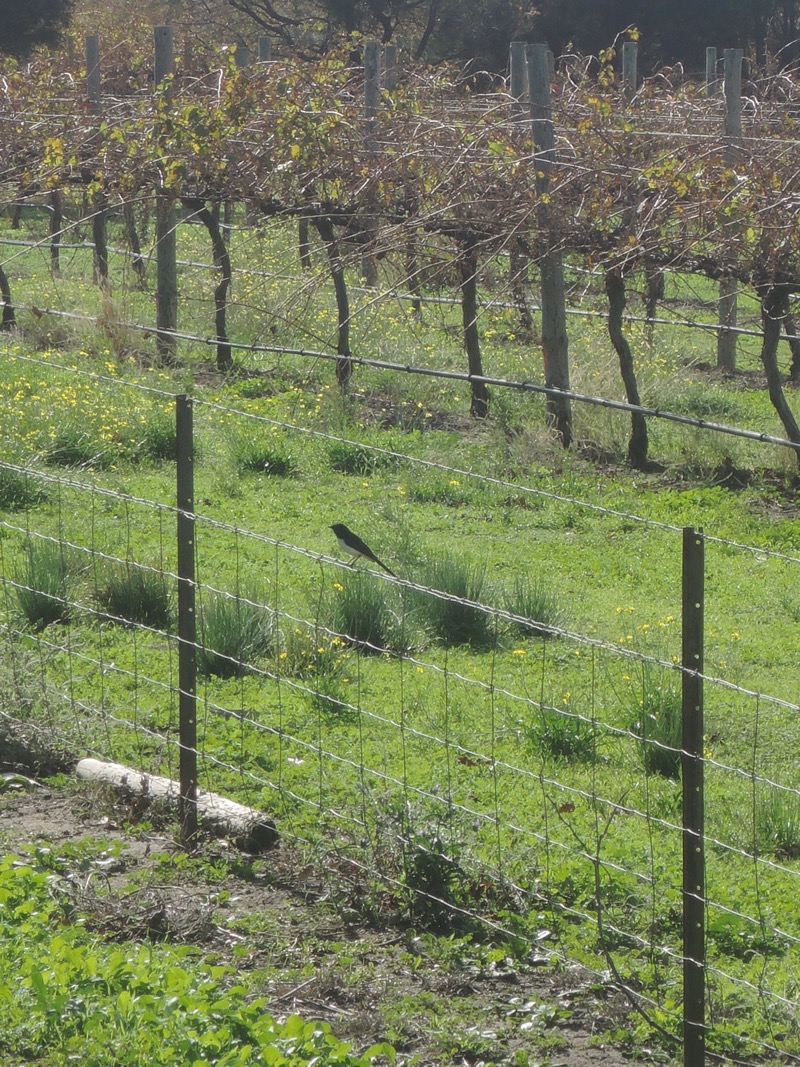
Can you see the willy wagtail perched on the wire fencing in the photograph above? It darted about as I wandered the track, zigzagging and dipping and feinting, the way willy wagtails do. There were fairy wrens on the path, too, but I didn’t manage to capture them.

Next time, maybe … ?