Out and about: the last summer days

‘When you’re walking the view shifts and changes.
Walking’s a form of hope.’

from ‘The World Without Us
by Mireille Juchau


Here’s the thing I always forget as summer draws to a close and the annual grey-weather dread steals over me: there are moments, at this time of year, when the wind drops, and the sea becomes shining and silken and blue.

I took the photos in today’s post as I wandered the beach at Largs Bay one afternoon a few days ago, in the week before Easter. The day was so still, and the tide so low, that the pine trees along the Esplanade were reflected in small pools of seawater that had formed between the sandbar and the main ocean …

… and out on the water, ships hung suspended in blueness, somewhere between sea and sky:

It was an afternoon that reminded me that there’s joy and beauty in every season — yes, even in the seasons you’d rather not be heading into …

On labour

Other people’s words about … loneliness

Dad’s dying had been like a long labor, the work mostly his, but the experience for me was as profound, as isolating, as the labor of birth. For weeks after my son was delivered, I remember, I was stunned by it — by what I’d gone through, by how alone with it I’d felt, by how astonished I was by it, and by how isolating that astonishment was. Others held my son, admired him. They saw him simply as a big healthy baby. But when I looked at him, part of what I saw and felt was how he’d come to me, that long solitary labor, the amazing combination of agony and release that I felt I could explain to no one else. And in some nearly parallel way, this is what I felt about my father’s death. It was what I returned to frequently, it was privately where I lived, for a long time after it was over.

From ‘The Story of My Father
by Sue Miller

Let me start by explaining (hastily!) that the affinity I feel with the words in the quote above is not because I’ve ever given birth (I have not). Nor, more importantly, is it because I’ve recently experienced the death of anyone close to me, let alone my father, who is a strong, healthy, happy man whose company I hope to enjoy for many years to come. No, not at all.

I am a big fan of Sue Miller’s writing. What I most like is her attention to detail, her scrupulous examination of people’s inner workings — their thoughts, their feelings, their individual senses and perceptions — and the way she then builds on these ‘small’ things to make ‘big’ stories from them. A writer friend of mine who isn’t a fan of Miller’s books once said to me that she feels ‘dead inside’ when she reads a Miller novel. And I get that, actually. I think, in fact, that what my friend dislikes about Miller’s writing is exactly what I like: the precision, the detail, the refusal to hurry over anything, or to be swayed by sentiment or affection or a need for resolution for her characters.

I’ve explored loneliness and isolation a lot in my posts on this blog, but I thought the theme was worth returning to because of Miller’s words here. I was stunned by it, she says of giving birth, by how astonished I was by it, and by how isolating that astonishment was. This, for me, distils the experience of living itself, the realisation that each experience we have, however great or small, however joyful or devastating, is an experience we feel we [can] explain to no one else.

In the last couple of years, whenever I’ve experienced bouts of unwellness or anxiety (or both, combined) that have left me feeling isolated at home, struggling to go out, struggling to get to work or to catch up with people I love, I have found myself, afterwards, return[ing] to those experiences repeatedly in my mind; I have found that those times of illness were, for a while, privately where I lived.

Miller’s use of the word labor here refers only to giving birth, but the passage applies to other things, too, if you reframe it: to the labour of living, of loneliness — yes, to that astonishing labour.

And yet, still, it is worth labouring on.

Out and about: dragons & damsels

‘When you’re walking the view shifts and changes.
Walking’s a form of hope.’

from ‘The World Without Us
by Mireille Juchau


I wasn’t expecting anything special on my most recent walk in the Scrub. It was mid-February, a warm Sunday at the end of a warm week, after a very warm January. I figured everything in the Scrub — bushes, birds, animals — would be going through what I always think of as mid-summer somnolence.

But things in the Scrub were thriving. Passing sea box bushes resplendent with red berries (above) and sheoak trees whose branches were clustered with woody fruit (below), I walked south, towards the little lagoon just behind the boundary fence that runs along Acacia Terrace.

Damselflies skimmed the (somewhat scummy) surface of the water, and a pair of ducks paddled amongst the reeds in the lagoon. As I followed the curve of the bank around to the other side of the pond, I saw a family of kangaroos lazing in the shade of the nearby bushes, one of them poised upright, ears pricked, standing sentry.

There was a bush in flower that I’d never seen before, too — I think it was a hakea, though I’m not entirely sure. Its white flowers reflected the bright summer sun so that the petals seemed to glow.

And just outside the Scrub, perched on an upright stump by the side of the road, a little dragon caught my eye.

He (or she, I’m not sure) was very still, so still that I thought at first he was an oddly shaped twig sticking out at the top of the stump. We regarded each other silently for quite some time — I, fascinated, he, less so — before I turned to go.

I swear I could feel that dragon’s eyes on me all the way home …

Hint

Other people’s words about … the world below

For a time I was obsessed with the idea that I could live under the sea. Not … using a great tank of air strapped to my neck. No, I wanted to dive deep down, skimming the sandy bottom of the ocean with my bare skin. I wanted to glide through fingers of pink weed and velvety fronds of green and come face to face with a mullet, or a gummy shark, slide up to the rubbery flank of a great whale and feel her song vibrate through my cheek to the very centre of my brain and understand what she told me.

From ‘Skylarking
by Kate Mildenhall

We’ve all felt like the narrator in Skylarking, at some point in our lives, haven’t we? Living by the ocean, as she does in Kate Mildenhall’s novel, I often think about the world below the surface of the water.

In the summer heat, on days like the one pictured below, I feel like that even more. It was about 5 pm on a day in the middle of January when I took this photo, and it was 42 degrees Celsius. It was too hot, truly, to spend much time with a camera in my hand. Moments after I’d put the camera away, I slipped into that silky, blue expanse and felt the water washing softly over my skin.

Sometimes when I swim on afternoons like this, I see shoals of little white fish darting ahead of me, or a blue swimmer crab scuttling along the bottom of the sand bed. Sometimes I see a sting-ray. Sometimes I feel fronds of seagrass and kelp brushing over my limbs as I swim. They are tiny hints of that underwater world that seems so fascinating and so close, and yet, somehow, so very far from reach …

Out and about: at lunch

‘When you’re walking the view shifts and changes.
Walking’s a form of hope.’

from ‘The World Without Us
by Mireille Juchau


I haven’t done an out and about post for a while, so I thought it was time. I recently quit my job at the call centre in order to concentrate on my work as an editor, where my workplace is in the city centre …

… which means that my lunch-break strolls haven’t stopped, but they have certainly changed.

It’s easy to be tempted by shops when you work in town (books! clothes! books!), but the other day, on a late lunch break, I headed north towards the river as I left my office, rather than south towards the shops.

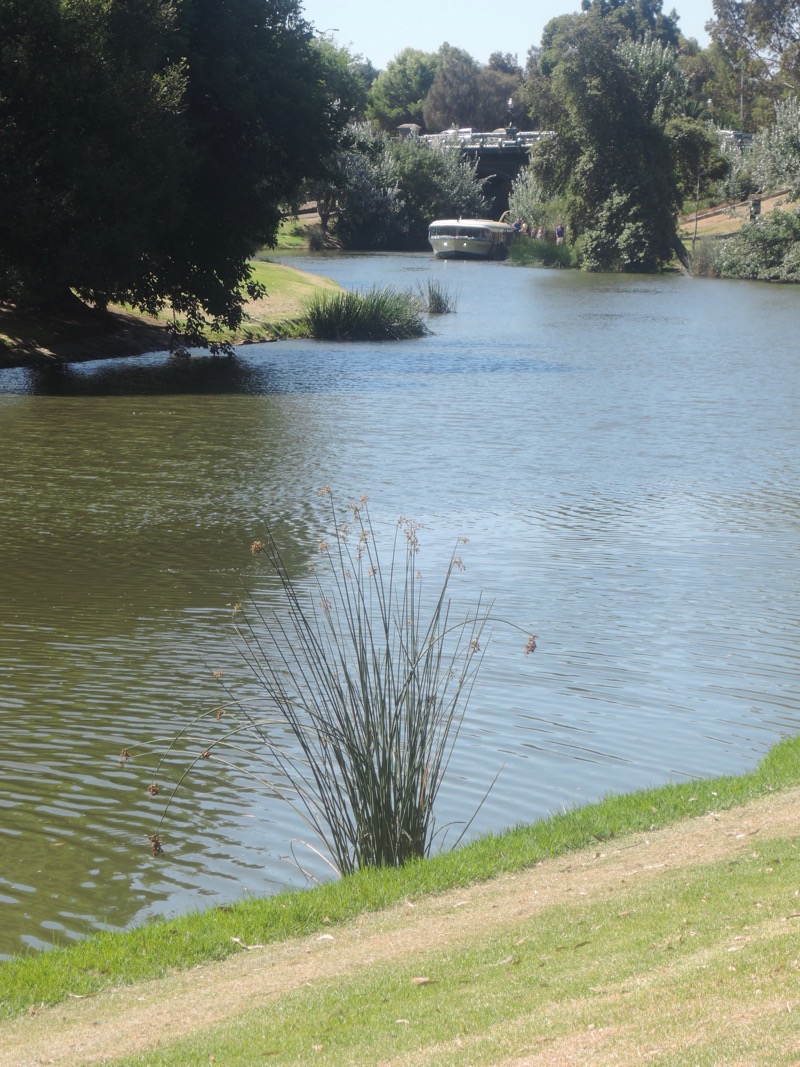
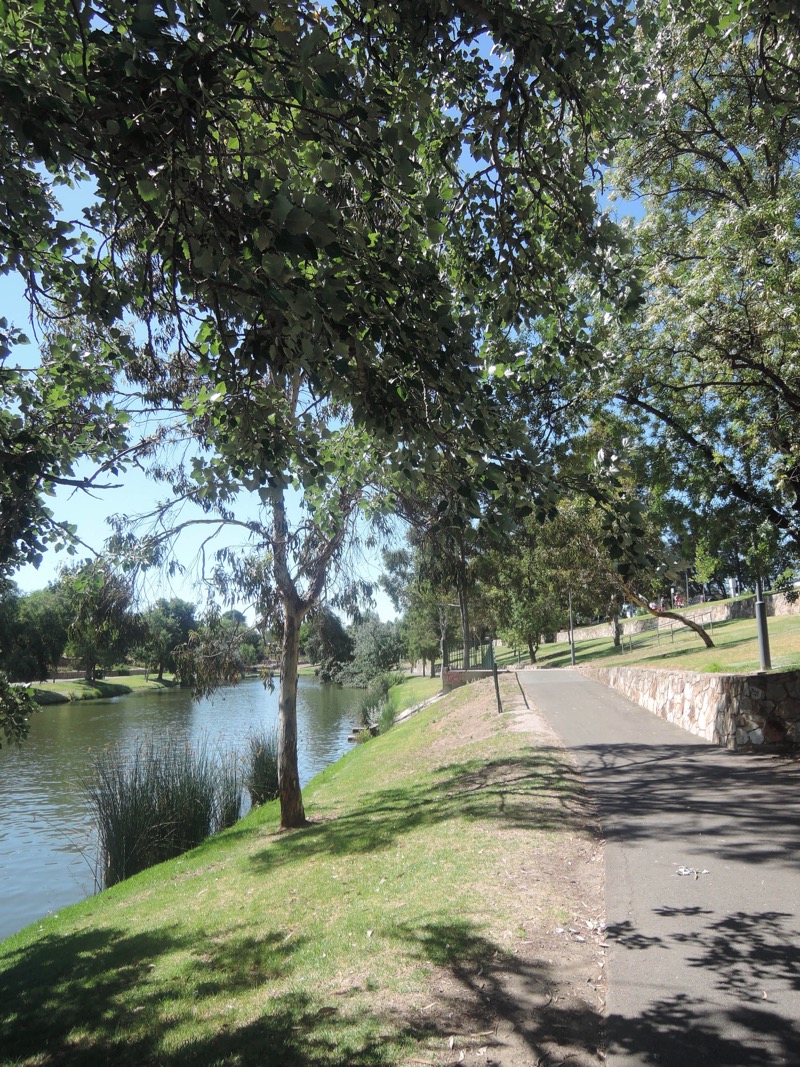
Five minutes north of my office is the River Torrens — the perfect place for a lunchtime stroll.

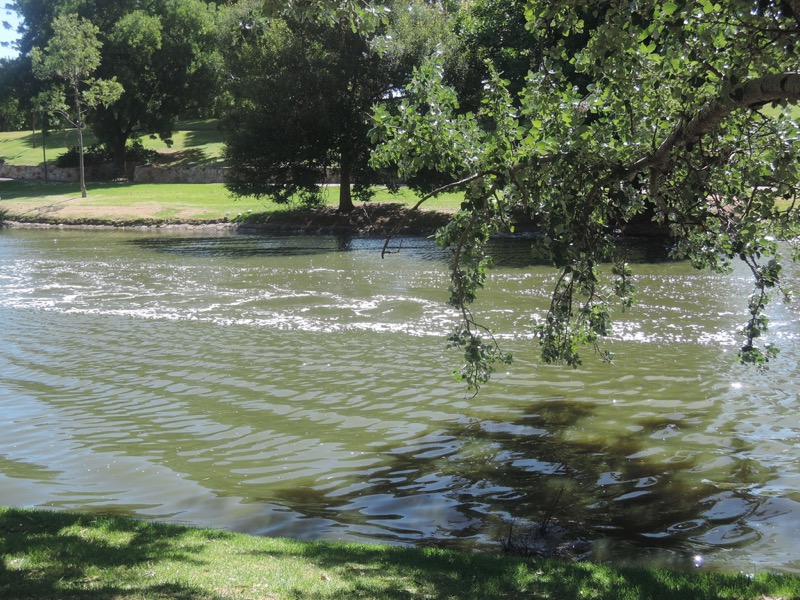
This particular day was one of those lovely January days, as I hope my photos on this post demonstrate: warm and sunny, with soft blue skies and a gentle breeze ruffling the water …

… There were ducks and moorhens paddling about, and the grass, which had been recently mown, smelt dry but sweet.

January is one of my favourite months of the year, as far as the seasons go. It’s usually sunny, and though the days are mostly warm, the temperatures rarely rise to stifling. It’s the ideal month for strolling, walking and wandering.

I plan to come back to the river in my lunch break again soon …

I see you

Other people’s words about … love

The bright lights had been switched off and the place was lit only by small windows. Then there she was — Stella — the top of her head highlighted as she looked down, reading. It never ceased to amaze him the thrill he got at seeing her. Catching her unawares.

From ‘Midwinter Break
by Bernard MacLaverty

Every time I read these words by Bernard MacLaverty, I feel my breath catch. They describe so perfectly those tiny, stolen glimpses we get of the people we love.

The photo accompanying this post is one I took while I was in Yorke Peninsula recently. It was very early summer: fan flower season. One evening just after sunset, as I wandered along the top of the cliffs, I came to a fork in the path where there were fan flower bushes growing at every corner.

And there, in the dim glow of the early-evening sky, the petals of the fan flowers — which in the warm, bright light of the middle of the day are a strong, cheery blue — seemed to shine for a few moments: pale, spectral, luminescent.

Perhaps my talk of fan flowers seems an odd match for the words I began this post with. But this was another one of those tiny, stolen moments we’re given in life from time to time, and it seems to me a good way to honour Bernard MacLaverty’s lovely words …

PS One other thing: a quick shout-out to my mother, who celebrates her birthday today, and who is a person responsible for many lovely moments in my life .

This quiet unknowing

Other people’s words about … dreams

I am trying to find my dog, which is going to be put down. Not a dog I live with in my waking life, but another, a black Labrador. The dog has already been taken away and is awaiting its death at a pound on the edge of town. This awful knowledge permeates my sleep. When I get there, however, my dog has gone. In its place, lying sick and exhausted on the concrete floor inside a large cage, is a young, very beautiful red setter. As I enter, the creature raises its head towards me and I see with slow shock that its muzzle has been sewn up with fishing line. The red dog pulls itself off the ground and limps towards me. Rising on its hind legs, it puts its forelegs on my shoulders, and rests its head against the left side of my neck. I can sense it begging me to save it. I feel great pity; I embrace and try to comfort it. But there is no sense that I can or will do anything to help it. The burden would be too great. Words come into my head. The dog’s name: Gadget. (Why Gadget? I wonder, even in the dream.) Then the thought — with which I am already justifying my decision to abandon it — that red setters are not very intelligent dogs. I step away. The animal stands there, hopeless. I touch it on the back and I leave.

What to do with a dream like that?

From ‘Anaesthesia
by Kate Cole-Adams

What to do, indeed?

I love the words in this passage: this description of a dream, which is vivid and haunting and bewildering all at once, as dreams so often are. Over time, Cole-Adams goes on to say, various astute readers have suggested to me that this particular dream might not belong in this particular book, that it is a dream that emanates from somewhere else and that ought to be left there …. And yet she includes the dream in her book anyway. In doing so, she allows herself to write intuitively, blindly, instinctively, knowing — knowing — that what she is writing must be written, but not knowing why.

In the quiet after waking I lay curled on my side suffused with the knowledge of irrevocable loss. I had betrayed the red dog. And in doing so I understood that I had disavowed some helpless, voiceless part of me. The dream did not feel like a dream. The house was still and very dark. I did not know what the dog had been trying to say, but I could still feel almost physically the place above my left shoulder where it had nuzzled its head against my neck, and I accepted finally that I could not write this book without it.

Do you sometimes have dreams like Cole-Adams’s dream — a dream that [does] not feel like a dream? Do you feel memories rising in you that feel more alive than memories should ever feel? Do you get a feeling of sickness in your gut that you know — you just know — isn’t a sickness; and yet it is, it is?

I do.

These days, I’m not much one for grand resolutions. I don’t know what path I’ll follow this year (though, hopefully I’ll get to walk one of the sandy paths in Aldinga Scrub, like the one pictured above, every now and then). I don’t know what 2018 holds, for me or for you.

I do hope, though, that there will be some moments like Cole-Adams describes, for you and for me: those quiet moments after waking when you do not disavow the helpless, voiceless part of you; those moments when you accept finally that you cannot otherwise do what it is you need to do.

When the wall comes down

Other people’s words about … the view

When I was about fourteen or so, I studied a poem in school by David Campbell, called ‘On the Birth of a Son‘. It was a sonnet, and I didn’t know much about sonnets, except that Shakespeare wrote a lot of them. It never occurred to me that a contemporary poet might write one.

This sonnet by David Campbell has stayed in my mind ever since. It remains one of my favourite poems. Here it is, in its entirety:

The day the boy was born, the wall fell down
That flanks our garden. There’s an espaliered pear,
And then the wall I laboured with such care,
Such sweat and foresight, locking stone with stone,
To build. Well, it’s just a wall, but it’s my own,
I built it. Sitting in a garden chair
With flowers against the wall, it’s good to stare
Inwards. But now some freak of wind has blown
and tumbled it across the lawn — a sign
Perhaps. Indeed, when first I saw the boy,
I thought, he’s humble now, but wait a few
Years and we’ll see! — out following a line
Not of our choice at all. And then with joy
I looked beyond the stones and saw the view.

On the face of it, this poem is about becoming a parent — the fears new parents have; the limitations parenthood imposes on their lives; the unexpected, unsettling joys it rewards them with. So it might seem strange that Campbell’s words have always resonated with me, though I have chosen, deliberately, never to become a parent.

But that’s the thing about great poems: they are universal. They manage to strike a chord in different people at different times for different reasons.
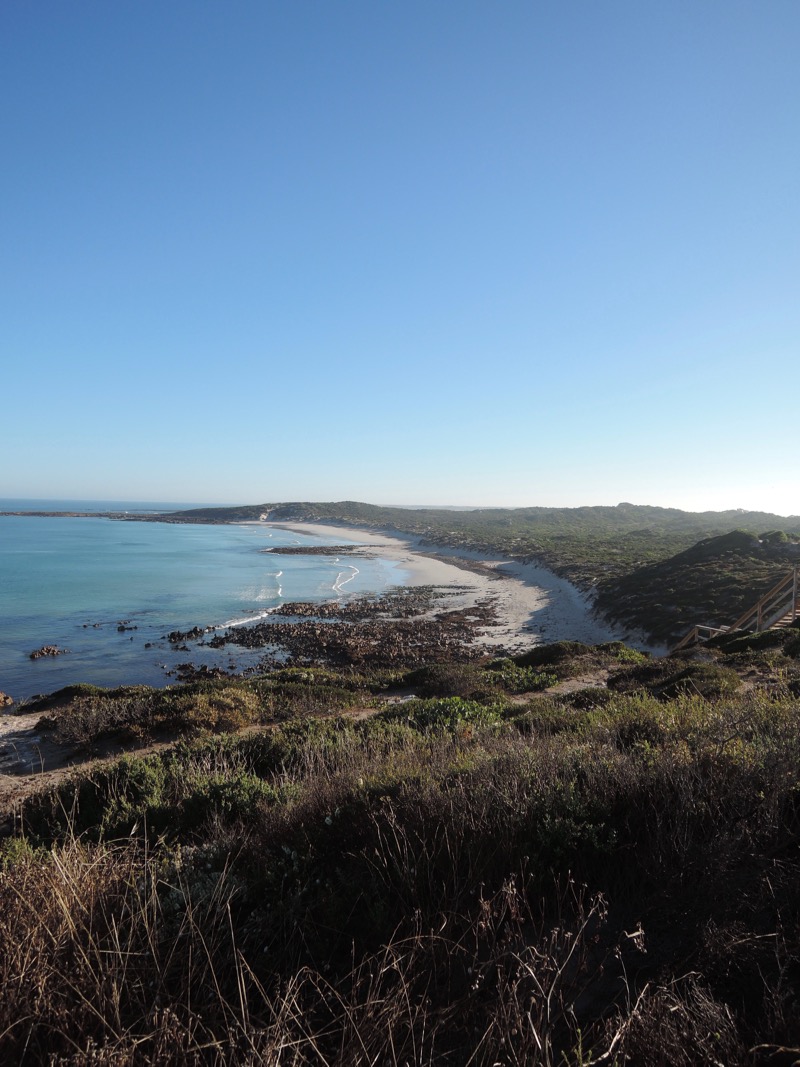
For myself, every time I read this poem I am moved by the contrast the poet makes between the act of looking inward — at his safe, pretty, cosy life — and the act of looking up, out, to glimpse a view of the world, and his life, beyond.

The view beyond. Recently, I went on a holiday in Yorke Peninsula. I returned to one of my favourite spots, following a long, undulating, unpaved road to get there — one that is corrugated and dotted with puddle-holes, dusty with sand stirred up by other passing vehicles, and lined with dense thickets of bush where brown snakes lie coiled, sleeping.

Each day I passed my time the way I always pass my time there. Each day I woke to the same view.
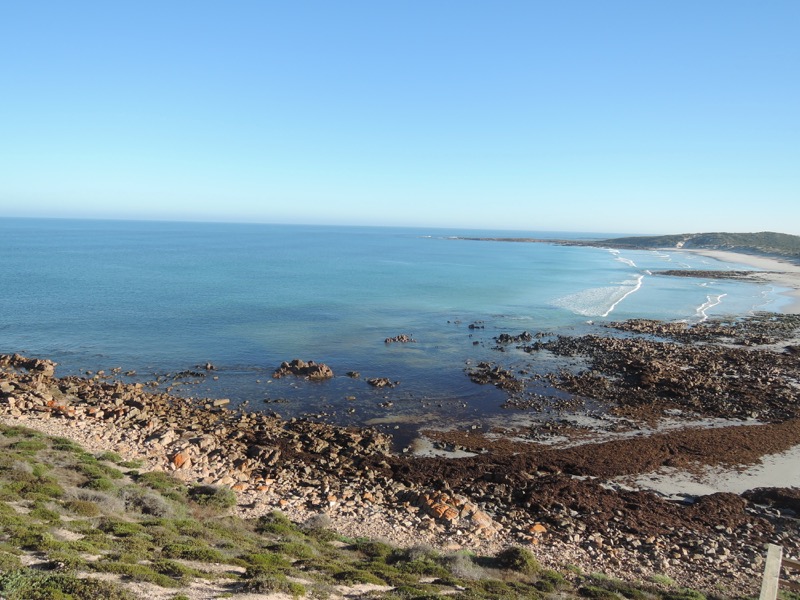
But it is a spectacular view: of open skies, of wide seas, of sprawling cliffs and rolling sand dunes. It is a view of a life beyond the life I normally lead. It is a view that sets me free.

I live a small life: small things give me pleasure. I consider myself, mostly, lucky to be able to live this way. And yet it’s good to escape from time to time: to look up and out and beyond.

And to see, again, the beautiful view.

Notes

You can find a link to this poem here and here.

Of love and tomatoes

Other people’s words about … tomato sandwiches

I’d asked [my disabled friend] Jessie when a doctor had last looked at her. She couldn’t remember, so [while Jessie was staying with me] I went to my doctor, still Jock Ledingham’s wife, Una, at her practice, which was in their home in Ladbroke Square.

Una listened to me kindly, and then asked if anyone was nursing her. ‘Only me.’ There was an awkward pause, and then I added, hardly audible, ‘And I’m afraid I’m very bad at it.’ Lack of food and sleep made me start crying again.

‘I’m going to make you a tomato sandwich,’ she said. ‘All my family can manage a tomato sandwich whatever they are feeling like.’ She did, and I ate it, and felt much better.

from ‘Slipstream: A Memoir
by Elizabeth Jane Howard (p. 147)

When I was a child, my mother would sometimes make my sister and me tomato rolls for dinner instead of our usual cooked meal. This was a summertime-only ritual — she saved it for those evenings when the air was thick and heavy with heat. My sister and I would have spent the day dipping in and out of the swimming pool, so that our skin and hair reeked of chlorine. We’d come inside and stretch out on the carpet in the living-room at the front of our house, next to an electric fan. We’d read, or watch the cricket on television, or play Lego, or colour in, while the fan blew warm air over us and our hair dripped down our backs, forming great wet circles on our t-shirts. And then, at last, it was dinnertime.

dscn3129

My mother made her tomato rolls with white bread — the kind that is crusty on the outside and fluffy on the inside. She cut the rolls lengthwise in thirds rather than in halves, and then spread each layer thickly with butter. Over the butter she laid slices of tomato. Then, as a last touch, she seasoned the tomato with salt. (Never pepper. Children hate pepper.)

These were the days before Australians of Anglosaxon heritage knew about things like basil or coriander, ricotta or feta. We had never eaten avocado or garlic or extra virgin olive oil. We didn’t know of the existence of focaccia bread or ciabatta or sourdough. Most people ate margarine in preference to butter, thinking it was a healthier option. And we ate salt with everything — we lived in a hot climate, after all; we needed to replace the salt we’d sweated out during the day. So a tomato roll was just what it sounded like: a tomato roll. Nothing more, nothing less.

dscn3131

dscn3135

It’s almost forty years since I ate one of my mother’s tomato rolls, and yet when I read Elizabeth Jane Howard’s words above about the curative powers of a tomato sandwich, I was instantly transported back to those simple summer meals my mother made us.

Bread. Butter. Tomatoes. Salt. I still think of this particular combination of food as the ultimate luxury, the greatest treat.

And as a symbol of my mother’s love.

dscn3132


When summer came

Other people’s words about … summer

Summer came, clanging days of glaring sunshine in the seaside town where I live, the gulls screaming in the early dawn, a glittering agitation everywhere, the water a vista of smashed light.

From ‘Aftermath
by Rachel Cusk

I live in a seaside suburb like Rachel Cusk. Gulls scream outside my window most mornings, flapping over the roof, perching on the top of the stobie poles. I find great solace in their shrieks. Like the call of a wattlebird, there is nothing elegant or beautiful in a gull’s cry. It is gloriously unapologetic, and harsh, and guttural, and wild.

There is a particular kind of summer day at the beach: the sand is so hot along the path from the road across the dunes that if you are making your way barefoot — or if you are a dog — you have to run over it towards the shore to prevent the soles of your feet (or paws!) from burning. The sky throbs; the air is windless, hot, salt-scented; and gulls stand in the shallows, waggling their legs as they stare down into the clear water, searching (I think) for fish. It’s so quiet in the hot stillness that you can hear the little lapping, bubbling noises the water makes as the gulls’ legs move about in it.

A vista of smashed light.
A vista of smashed light

I haven’t swum in the sea much this summer. Due to the storms in December and early January, the water is muddied and polluted. But I love the beach at this time of the year, regardless. I feel no glittering agitation, as Cusk does: only joy.

It’s the heat. And the light. And the gull-shriek-rent air.