Snatched phrases (sleeping alone)

‘That night I felt so lonely that I couldn’t sleep.
I soothed myself by imagining I was a child again,
at a time in one’s life when sleeping alone is not yet lonely.’

From ‘Somehow’
by Danielle Dutton
(in the Paris Review, #224)

Only a short comment here: unlike the narrator in the quote above, Mr Field, I cannot think of a more luxurious habit than sleeping alone. No matter whether you’re in a committed relationship or not, I can’t recommend it highly enough.

There is nothing — nothing — like a good night’s sleep!

(Oh, and gorgeous quilt covers, like the ones pictured, also never go astray … )

The silent sea

Other people’s words about … the sea

I thought about the kind of people who come to the sea to look at it: how they put themselves down on whatever rock or bench is around and gaze for hours into the distance as though something out there makes life seem meaningful, or at least less incomprehensible. What are they looking at? I asked myself. What do they see when they see the sea? Most people seemed to find the sea deeply interesting but it held no particular depth or virtue for me. The most profound effect the sea had on me was that sometimes, from the living-room window, it quite literally made me want to throw up. I’d always thought that people who liked the sea were people who didn’t like society, that it was people who’d failed in their relationships who turned to the sea. There was something in their glazed faces — leaning on harbour railings, walking along the crumbling promenade, staring over the tops of their newspapers — which disturbed me. It seemed they wanted to be immersed in it, that as they looked out at the sea they entered into a special relationship with it which, to a certain extent, entitled them to speak to it. Because people who spent too much time looking at the sea did start to commune with it, as if nature held the answer to all of life’s important questions, their expressions suggesting that they were not so much watching the sea as conversing with it. I could tell from the way they sat, dead still, that the sea spoke to them and that they, for their part, were receptive to its communication. But what was the sea saying to them? The sea didn’t speak to me. What do you say to them that you won’t say to me? I asked the sea, but the sea was silent and had no communication to make.

from ‘Somehow
by Danielle Dutton (in the Paris Review, #224)

This passage made me laugh (which I think — although I’m not entirely sure — was the writer’s mischievous intention). So I had to include it in my collection of passages about the sea, didn’t I?

Anyone who even glances at my blog will know that I fall into that category of people to whom the narrator in the passage above, Mr Field, refers as people who spen[d] too much time looking at the sea

And I suspect I always will!

Something out there …

What I see now

Other people’s words about … tears

I can’t help it, the valve between my thoughts and tears is so worn down that I don’t think I have any control over them anymore. Fat tears drop onto my cheeks. I feel them before I even know what’s happening and I just let them fall. I pull my hand [away from Gideon’s, and he] rolls over to face me.

from ‘Beautiful Mess
by Claire Christian

When I first started reading young adult novels I was already in my mid-twenties, several years older than their teenage target audience. That was partly because when I myself was a teenager, young adult novels had only just begun to become a ‘thing’, especially Australian young adult novels. And it was partly because something drew me to those novels in my mid-twenties, despite my age: something about their coming-of-age themes — and then, too, something about the way they handled those coming-of-age themes. Most of all, I liked the raw, direct voice in which many of their narratives were written, a voice that was both bleak and hopeful.

After I’d written my own two young adult novels, my love for the genre started to fade. This was partly, in turn, because I had in the meantime grown older again: my life now had nothing in common with either the novels’ protagonists or the novels’ intended readers. But it was also partly because it seemed to me that there were, suddenly, too many young adult novels being published every year. That raw, direct, bleak/hopeful voice seemed to me suddenly overused. Over-familiar. Hackneyed, even.

I don’t know what made me pick up Claire Christian’s young adult novel Beautiful Mess the other day. At any rate, it is the first young adult novel I have read in a long, long time, and the reading of it felt like one, long, jagged, indrawn breath that I couldn’t release until I had got to the end. There it was again, that raw, direct, bleak/hopeful voice — familiar, yes, but not overused this time. Not hackneyed. It was a poignant voice. Intimate.

The view ahead: not a bleak prospect

That’s what I love most about good novels, whatever genre they happen to fall into. Their protagonists, and the writer behind them, reach out and speak to you: they say things you know you’ll never forget, things you yourself have been wanting to say, but haven’t figured out how to. I see now that this is something I haven’t managed to do in my own writing for quite some time, though I didn’t realise it until I stopped. Perhaps that’s why I stopped: though the decision felt instinctual and unplanned, perhaps my instinctual knowledge simply kicked in before my conscious knowledge did.

In the meantime, even though I’m not writing fiction, I know I’ll find more good books to read (whatever their genre), and more narrative voices to hear, and more tears to shed. There’s nothing bleak about that prospect: in fact, the view ahead of me seems filled with hope.

One day

Other people’s words about … the sea

After lunch, as a reward for their fine behaviour, Nurse allowed them to bundle into coats and hats and bolt from a back door along a path that ran behind Mr Styles’s house to a private beach. A long arc of snow-dusted sand tilted down to the sea. Anna had been to the docks in winter, many times, but never to a beach. Miniature waves shrugged up under skins of ice that crackled when she stomped them. Seagulls screamed and dove in the riotous wind, their bellies stark white. The twins had brought along Buck Rogers ray guns, but the wind turned their shots and death throes into pantomime.

From ‘Manhattan Beach’
by Jennifer Egan

I have never been to a beach in the kind of winter that Jennifer Egan describes in the passage above. Many years ago, in Michigan, I walked across a frozen lake (and thereby learnt the meaning of the term ‘wind chill factor’), but that was a lake, not the ocean. I’d like to experience that wild, violent chill, just once in my life.

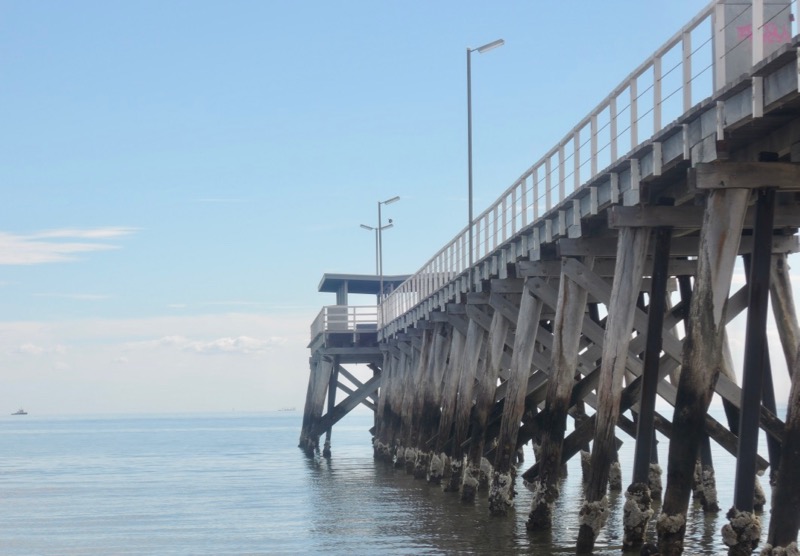
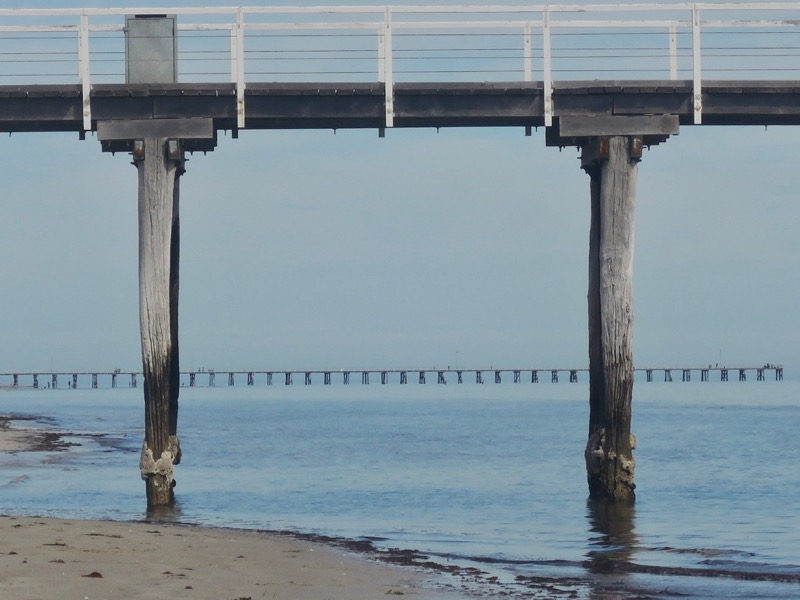
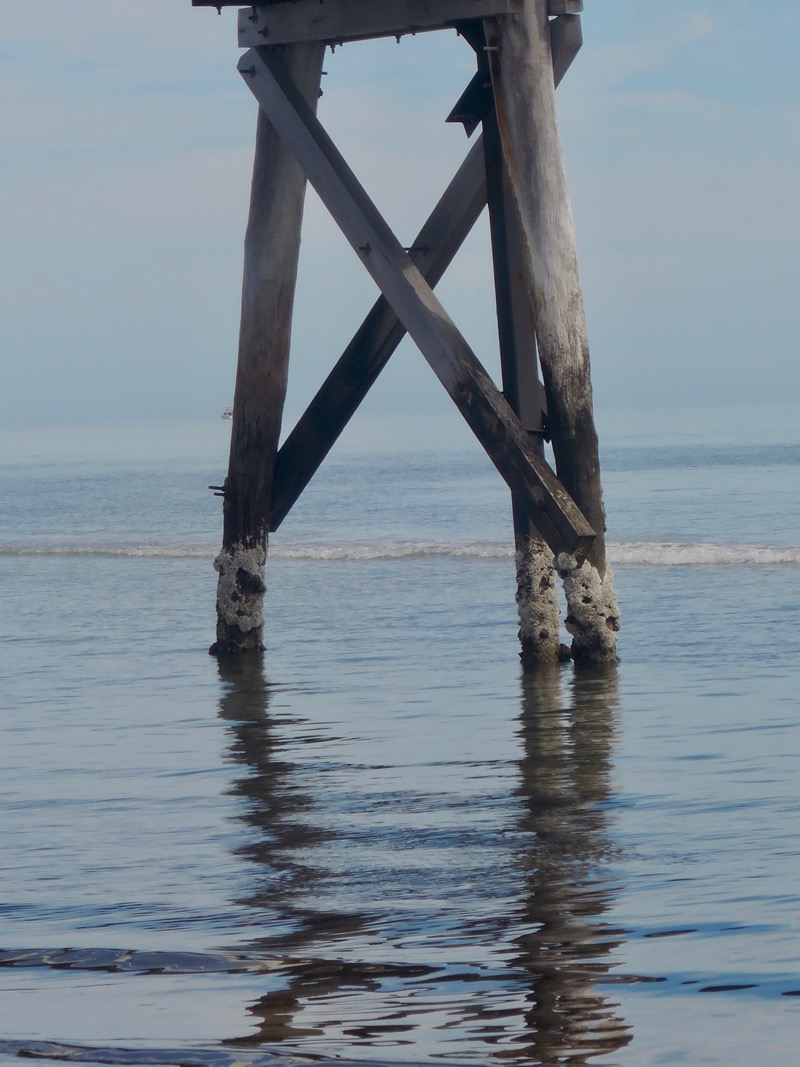
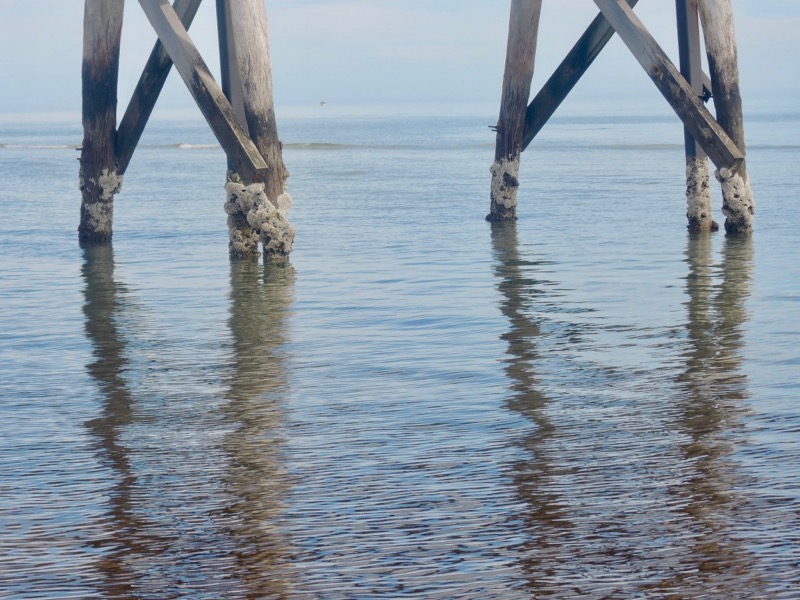
The beaches along the South Australian coast have their own seasons of peace and restlessness. Often, the early months of Autumn are times of softness and stillness, and this past April there were several days when the sea lay like blue, shining silk on a bed of sand.

As you can see from the photos in today’s post, which I took at the beach in the first week of April, the South Australian coastal world is utterly unlike Egan’s, but there is wildness at its essence, all the same.

Chasing clouds

‘Some athletes love to talk about what a simple sport running is.
They say that all you need is a pair of sneakers.
That’s not true.
What you need is some freedom of movement
and the ability to see a clear path ahead of you.
It took me years to see that path and to find my pace.
When I finally got moving, I hoped I might be able to run forever.’

From ‘The Long Run’
by Catriona Menzies-Pike

Around about a year ago, I wrote a post on this blog in response to lawyer-turned-long-distance-runner Robyn Arzón’s book Shut Up and Run. In that post, I wrote, in angry contradiction to Arzón, about the virtues of taking things slowly, of living humbly, of letting things unfold gently, whether or not your life is unfolding as you wish it would, or as you think it should. (You can read the post — which, by the way, I still stand by — in its entirety here.)

Here’s the thing about running, though, as an activity, as a practice: it lends itself to metaphors. That’s why so many runners, like Arzón and Menzies-Pike, write about it. Speed, distance, endurance, cadence, rhythm, pace — all of those things can be metaphors for something else: for life. It took me years to see that path and to find my pace, Menzies-Pike writes, of her running. And: When I finally got moving, I hoped I might be able to run forever.

Don’t tell me she’s not talking in metaphors.

As for me, I stopped mid-run — on a gorgeous, warm, still day last week; a day when all of coastal Adelaide seemed to be bathed in soft sunshine — to take the photos you see in today’s post. Afterwards, I put my camera away and lingered at the shore a while, before wandering back from the beach to the foreshore path and setting off again, back home.

Days like that — days of running beneath a soft blue sky, beside a silken blue sea — are days, simply, to be grateful for, days that feel as though they are unfolding as they should, or at least as you wish they would.

And so this post is the first in a new series on my blog entitled Chasing clouds. It is a companion series to my Out and about series, in essence. The theme in that series is walking; the theme in this one is running. Running, for me — like walking — is about wandering, about wondering. It is about chasing clouds.

Of course I’m using metaphors. Running, for me, is about hope.

Unpacked

Other people’s words about … surfing and the sea

Nearly all of what happens in the water is ineffable — language is no help. Wave judgment is fundamental, but how to unpack it? You’re sitting in a trough between waves, and you can’t see past the approaching swell, which will not become a wave you can catch. You start paddling upcoast and seaward. Why? If the moment was frozen, you could explain that, by your reckoning, there’s a fifty-fifty chance that the next wave will have a good takeoff spot about ten yards over and a little farther out from where you are now. This calculation is based on: your last two or three glimpses of the swells outside, each glimpse caught from the crest of a previous swell; the hundred-plus waves you have seen break in the past hour and a half; your cumulative experience of three or four hundred sessions at this spot, including fifteen or twenty days that were much like this one in terms of swell size, swell direction, wind speed, wind direction, tide, season, and sandbar configuration; the way the water seems to be moving across the bottom; the surface texture and the water colour; and, beneath these elements, innumerable subcortical perceptions too subtle and fleeting to express. The last factors are like the ones that the ancient Polynesian navigators relied upon when, on the open seas, they used to lower themselves into the water between the outriggers on their canoes and let their testicles tell them where in the great ocean they were.

Of course, the moment can’t be frozen.

From ‘Barbarian Days’
by William Finnegan

I know someone who is in his mid-fifties now, and who, like William Finnegan, has been surfing since he was a teenager. Though he and I are both avid beach-lovers, I know that when he looks at the sea, he sees something different from what I see.

I (from my admittedly middle-class, Western, leisured perspective) look at the sea for beauty. I don’t understand the sea’s tides, its swells, its waves. I understand, simply, how the sea makes me feel.

It’s hard to express my feelings about the sea in actual words, though. They are, to use Finnegan’s words in a slightly different way, subtle, fleeting,subcortical, ineffable.

And … good.


Miracle

Other people’s words about … running

Soon, he is at the base of the mountains, his heart rate is at least 140, and the peaks tower over him like wild, hungry beasts. It is this moment in which Russ understands himself best. In which he could easily say, my name is Russ Fletcher, I am a man living a certain sort of life, and I am happy.This gasping moment is free of obligation, of expectation and that bruised yellow past. It is only Russ and his beating man’s heart, Russ and the cloud of his breath as it unfurls white in the cold morning, Russ and the burn, burn of his legs. The needle-prick attention of his mind, as it focuses on blazing extremities. Running, Russ is okay. Running, he moves forward.

From ‘Girl in Snow
by Danya Kukafka

I have a chequered history with running, but recently, I’ve taken up the habit on my own terms. Here’s how it goes: every day, either before or after work, I make the effort to stroll down the road to the beach, and then, once I’m on the sand, a few metres from the shore, I break into a run for a few minutes. Often, honestly, I run for only five minutes or so before slowing down, turning around and heading back home. I guess it’s as much about getting fresh air into my lungs, moving my limbs a little before or after sitting at a desk all day, feeling sand crumble beneath the soles of my feet, as it is about anything you might want to call ‘fitness’ or ‘athleticism’.

Occasionally, though — once or twice a week, if I’m lucky — I run for a longer time, for twenty minutes or so, taking my camera with me (so that I can stop along the way to take photos like the ones in this post). No matter how slowly I run, or how heavy my legs seem to become, or how tired I was beforehand, or even, some days, how sub-par I felt before I set off, there is always a moment on these runs when I feel, like Russ in the passage above, that I understand [my]self best, a moment when I feel free of obligation, of expectation, of that bruised yellow past.

A couple of years ago, when I first took up running again after a lapse of twenty years, I hoped to run for much longer times, to run much further distances. That seemed to be what every other runner did, after all. And that’s what I wanted to be: a runner.

But running is like everything else in life: what works for other people isn’t necessarily what works for me. And over the last two or three years, I’ve learned — at first to my bitter (childish?) disappointment, and then, slowly, to my joy — that I can find a way to run on my own terms and still find pleasure in it. Still find release. Still find hope. And reason. And courage. And peace. And, like Russ, who runs when he’s both joyous (as in the first quote) and terribly sad (as in the next quote), freedom.

Russ runs. He takes off down the sterile … streets … All he can do now is push — move his body, sweat it out, keep inching forward. For now, he focuses on his own limbs and the miracle ways in which they serve him. The freedom of the open Colorado sky.

I thought at first, when I couldn’t run the distances I wanted to run, the distances I thought I should run, the way everyone else seemed to, that I was giving up. It took me a while to understand that finding a way to run that worked for me wasn’t so much about giving up as it was about learning to surrender.

Surrendering is not the same as giving up. I didn’t understand this before. I am glad that I am beginning to now.

Big

Other people’s words about … sunsets

The sun was setting. There were plenty of natural phenomena that went unrecognised (snowflakes kissing a windowsill, fingernails dug into the skin of a tangerine), but Cameron could see why people made such a big deal of sunsets. The sunset at Pine Ridge Point always made Cameron feel so disastrously human, caged inside his own susceptible self.

From ‘Girl in Snow
by Danya Kukafka

I found Danya Kukafka’s words in the passage above very poignant — although when I watch the sun set, I feel, unlike her character Cameron, as though I am escaping the cage of my susceptible [human] self to join with the rest of the natural world.

For me, both the sense of bigness, and the sense of being a tiny part of that bigness, make me feel at once grounded and free. Perhaps some of the photos below, which I took on a number of evenings this past January and February, might give you that sense, too?

Out and about: the last summer days

‘When you’re walking the view shifts and changes.
Walking’s a form of hope.’

from ‘The World Without Us
by Mireille Juchau


Here’s the thing I always forget as summer draws to a close and the annual grey-weather dread steals over me: there are moments, at this time of year, when the wind drops, and the sea becomes shining and silken and blue.

I took the photos in today’s post as I wandered the beach at Largs Bay one afternoon a few days ago, in the week before Easter. The day was so still, and the tide so low, that the pine trees along the Esplanade were reflected in small pools of seawater that had formed between the sandbar and the main ocean …

… and out on the water, ships hung suspended in blueness, somewhere between sea and sky:

It was an afternoon that reminded me that there’s joy and beauty in every season — yes, even in the seasons you’d rather not be heading into …

On labour

Other people’s words about … loneliness

Dad’s dying had been like a long labor, the work mostly his, but the experience for me was as profound, as isolating, as the labor of birth. For weeks after my son was delivered, I remember, I was stunned by it — by what I’d gone through, by how alone with it I’d felt, by how astonished I was by it, and by how isolating that astonishment was. Others held my son, admired him. They saw him simply as a big healthy baby. But when I looked at him, part of what I saw and felt was how he’d come to me, that long solitary labor, the amazing combination of agony and release that I felt I could explain to no one else. And in some nearly parallel way, this is what I felt about my father’s death. It was what I returned to frequently, it was privately where I lived, for a long time after it was over.

From ‘The Story of My Father
by Sue Miller

Let me start by explaining (hastily!) that the affinity I feel with the words in the quote above is not because I’ve ever given birth (I have not). Nor, more importantly, is it because I’ve recently experienced the death of anyone close to me, let alone my father, who is a strong, healthy, happy man whose company I hope to enjoy for many years to come. No, not at all.

I am a big fan of Sue Miller’s writing. What I most like is her attention to detail, her scrupulous examination of people’s inner workings — their thoughts, their feelings, their individual senses and perceptions — and the way she then builds on these ‘small’ things to make ‘big’ stories from them. A writer friend of mine who isn’t a fan of Miller’s books once said to me that she feels ‘dead inside’ when she reads a Miller novel. And I get that, actually. I think, in fact, that what my friend dislikes about Miller’s writing is exactly what I like: the precision, the detail, the refusal to hurry over anything, or to be swayed by sentiment or affection or a need for resolution for her characters.

I’ve explored loneliness and isolation a lot in my posts on this blog, but I thought the theme was worth returning to because of Miller’s words here. I was stunned by it, she says of giving birth, by how astonished I was by it, and by how isolating that astonishment was. This, for me, distils the experience of living itself, the realisation that each experience we have, however great or small, however joyful or devastating, is an experience we feel we [can] explain to no one else.

In the last couple of years, whenever I’ve experienced bouts of unwellness or anxiety (or both, combined) that have left me feeling isolated at home, struggling to go out, struggling to get to work or to catch up with people I love, I have found myself, afterwards, return[ing] to those experiences repeatedly in my mind; I have found that those times of illness were, for a while, privately where I lived.

Miller’s use of the word labor here refers only to giving birth, but the passage applies to other things, too, if you reframe it: to the labour of living, of loneliness — yes, to that astonishing labour.

And yet, still, it is worth labouring on.