Under big skies

Other people’s words about … the moon over the sea

He lay across the bed on top of the bedspread [in his room in the cottage by the sea]. Moon shadows of trees outside fell against the pine-based walls. The bedspread was tinged a bluish white, its pattern of roses transformed to a lunar landscape. He had forgotten about the particular lustre of a seaward moon. How when a moon hung over the ocean they were not separate entities, but a third element fused from their continuous correspondence. The planks of the cottage walls appeared fastened together by this faint glow.

From ‘The Dependents’
by Katharine Dion

I love Katharine Dion’s description, here, of the moon hanging over the sea. Years ago, when I worked the late shift, I used to drive home afterwards to spend time in a beach shack south of the city. The drive took me just under an hour, and by the time I turned off the main road onto the esplanade, it would be nearly midnight. From my car, I could see the beach beyond the cliffs, the waves rolling in to meet the shore and then falling back. The water was the colour of black ink, and on clear nights the moon hung above it in just the way Dion describes: as though it was connected to the ocean, as though the two were in communication with each other.

I would turn off the engine and climb out of my car at last, feeling freed of the shift I’d just worked, returned to the life I wanted to live, by the ocean, under big skies.

Evening skies

I haven’t worked the late shift for years now, but I still feel the same gratitude for the house by the beach where I now live, for the ocean at the end of the road, for the moon and the sun and the sky over the water, which I see every night and every day.

Every night. Every day.

The ocean at the end of the road

Lately I’ve been reading about …

An open and shut case

Other people’s words about … signs

[The waitress] leans over our table and turns the sign in the window so that it says CLOSED on the outside. But on our side, perfectly positioned between Mabel’s place and mine, it says OPEN. If this were a short story, it would mean something.

From ‘We Are Not Alone’
by Nina La Cour

I am the kind of person who, like Marin, the narrator in the passage above, can’t help seeing life through symbols and signs: I see metaphorical OPEN and CLOSED signs in my own life every day.

Lately, as some of you know, I’ve been released (at least for now) from the routine of salaried office work. I’m not answerable to an employer any more; I don’t have to be at the office at a particular time, or sign on and off at the beginning and end of my shift, or conform to a certain dress code, or take my lunch hour at a stipulated time for a stipulated duration. All of which implies a certain freedom, the kind of freedom I’ve often craved.

But I do have to hustle. If I want to get work as a freelancer, I have to go out and seek it, something I never had to do as a salaried employee. And in the daily transactions of that hustling — contacting people, letting them know of my existence and of the work I do, following up their responses, thinking of new people to contact and new ways to work — it’s all too easy to see signs everywhere I look. Someone doesn’t answer my email? That’s a CLOSED sign. Someone writes back, saying it’s lovely to hear from me? That’s an OPEN sign.

And so on.

It’s exhausting and exciting, both those things at once, and I don’t know yet where it will take me or what it will lead me to — or whether, ultimately, it will be sustainable. But for now, it’s early days, and I’m giving it a chance, and I still believe there might be some OPEN signs on the path ahead of me …

Signs and symbols: The way forward?

Lately I’ve been reading about …

Meanwhile, as always, I’ve been reading! Here’s the recent digest:

No time like now

Other people’s words about … cages

At not yet thirty, she can feel her life shrinking into the gentle sameness of her days and she knows she is pacing back and forth in a comfortable cage of her own construction. She needs someone to bump against, to disrupt things. she can’t go on like this, she knows. She must resolve the tension between longing and fear.

From ‘The Fragments
by Toni Jordan

I’m back! I’ve missed blogging. I’ve missed you all, too.

And I’ve gone on collecting other people’s words, gone on taking photographs of the world around me, gone on wanting to have a place to keep the words I’ve collected and the pictures I’ve taken. So I’ve decided, rather than ending this blog completely, as I first planned to do, to pop in every now and then with a quote I love or a photograph I’ve taken. I’d like to keep the practice up, and I hope that some of you will continue to enjoy reading the words I’ve found, or seeing the photographs I’ve taken, as you might have done in the past.

Last year, as some of you may remember, I lost my job. In the end, instead of looking for a new job straight away, I decided I would take a few weeks or months off first. And so that’s what I’ve been doing in the weeks since I last wrote: living on my savings and trying out, meantime, new habits, new practices. I’m trying to disrupt some of my old ways, like Caddie in the passage I’ve quoted above; I’m trying to stop pacing back and forth in a comfortable cage of [my] own construction; I’m trying to let my life expand, rather than to shrink. There’s no time like now!

Because there is always a way through … always

Thank you for accompanying me so far on my blogging journey. Thank you, too, to the readers who wrote to me and encouraged me to keep posting, if only sporadically: who told me I was missed. I hope you all find pleasure in the posts that are still to come.

Rebecca xo

Fleeting

Other people’s words about … happiness

Happiness doesn’t come in the way I expected; not a massing of good things over time, but a succession of small, strange and unowned moments — the sun makes a hot oblong on the bedroom floor and I stand in it with my eyes closed. The coriander germinates in the window box and up comes the seedling. The bled radiators stop knocking at night.

From ‘Dear Thief
by Samantha Harvey

I thought it was apt to write a post on happiness today, to accompany my previous post on sadness — though perhaps both posts are, after all, about the same thing, simply taken from opposing perspectives.

But also it seemed apt to me to write a post about happiness because today’s post, I think, will be my last post, at least on this blog, twenty-one words.

Over the years, I’ve written about many things on this blog — the sea, the sky, vomiting, writing, books, therapy, running, walking, travel, birds, flowers, hope, to name a few. But in many ways, I see, looking back, that I’ve been exploring, post by post, what it means to live a small life in the happiest, or at least the most meaningful and most humble, way I know.

Happiness, as Harvey says, isn’t something you can accumulate or amass; it most surely isn’t something you can own. It flits into our lives and out again. Writing this blog has been, for me, both a meaningful and a humbling experience — and in that sense it has been a happy experience for me, too. I don’t know if my posts have brought you, my readers, any moments of happiness, but I hope so: I do.

I spent over half my life waiting for the accumulation of happiness and then I realised that it doesn’t accumulate at all, it just occurs here and there, like snow that falls and never settles. Not the drifts that you and I imagined we would plough ourselves into, but instead gently, opportunistically, holding one’s tongue out to catch the flakes.

I’m not sure yet whether I’ll leave this blog up for posterity (i.e. for a little while!) or whether I’ll take it down altogether, or whether, perhaps, I’ll change its privacy settings so that you can only access it by contacting me first. (Please feel free to do that, if it’s what I do.)

In the meantime, I’ll go on running and walking and hoping and reading and looking, looking, looking.

Fleeting


Thank you to everyone who’s read this blog. Take care of yourselves. Keep reading and looking. Keep savouring those fleeting moments of happiness, whenever they come your way.

Observation

Other people’s words about … sadness

Why was she so sad? The unspoken question had dangled over the [therapist’s] beige couch and the framed degrees and the economy of Kleenex. He commanded a cache of Ohs and I sees in varying grades of volume and texture, knew when to prod and when to sink with her. Why was she so sad?

Ada was sad because she was sad because she was sad. She experienced extreme difficulty in reaching past the tautological.

From ‘Infinite Home
by Kathleen Alcott

Some time ago, for much the same reason as Ada in the passage above, I quit therapy. I had come to my therapist feeling sad; but years of therapy later, I still felt sad. It seemed to me at last that, whether my sadness was unique or universal or — like Ada’s — purely tautological, the time for exploring it was over.

In the years that have passed since then, I’ve learned that I feel better when I try to make peace with sadness than I do when I try to overcome it. There is much to be said for acceptance and for patience. And for seeing things through.

I took the pictures in today’s post on a day when I had just heard that I will be losing my job at the end of this year. I felt, that day, as though I had been cheated of something — of an income, yes, but also of something less tangible, some essential part of me that I couldn’t actually name. I felt anxious and old and vulnerable and as though I had failed. Most of all, I just felt sad.

What I saw

I couldn’t sit still with my sadness that day; I couldn’t see it through. So I did the only thing that seemed manageable to me in the moment: I took myself off for a run by the beach. I ran what seemed to me a long way, the furthest I’d ever run, in fact — although the distance didn’t matter, really. What mattered was that I was outside: moving, breathing deeply, looking around. Seeing. Sadness, I’ve found, stops me from seeing. But stepping outside returns my vision to me, at least for a while.

Losing a job — especially a job that you love, especially when you are nearing fifty — entails a specific kind of sadness, one that is wrapped up in grief and fear. Still, I’m curious. What do you do when you are sad?

Out & about: enough

‘When you’re walking the view shifts and changes.
Walking’s a form of hope.’

from ‘The World Without Us
by Mireille Juchau


Some days, after work, I don’t have time to go for the kind of walk that the passage above, which I quote on this blog so often, describes: a long walk, a wandering walk, a wondering walk. Some days there just aren’t enough hours of daylight left — not for that kind of walk.

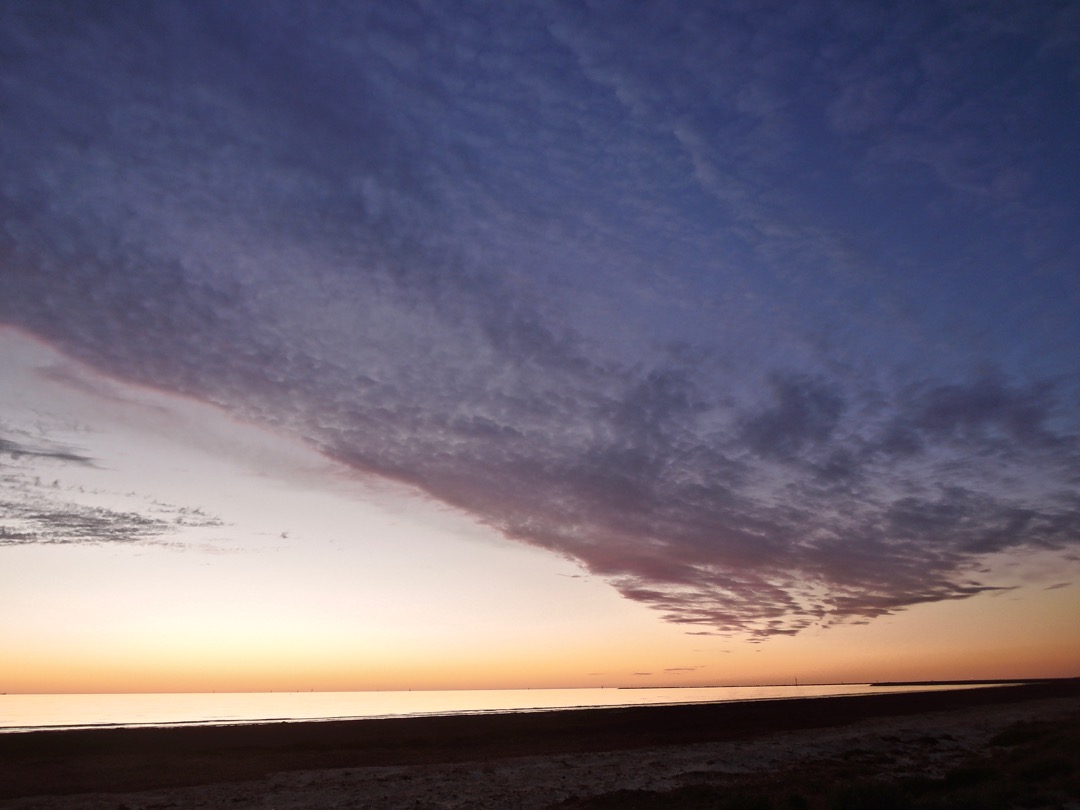
There might be a few moments, though — just enough moments to dash down the road and glimpse a dark swathe of clouds in the sky —

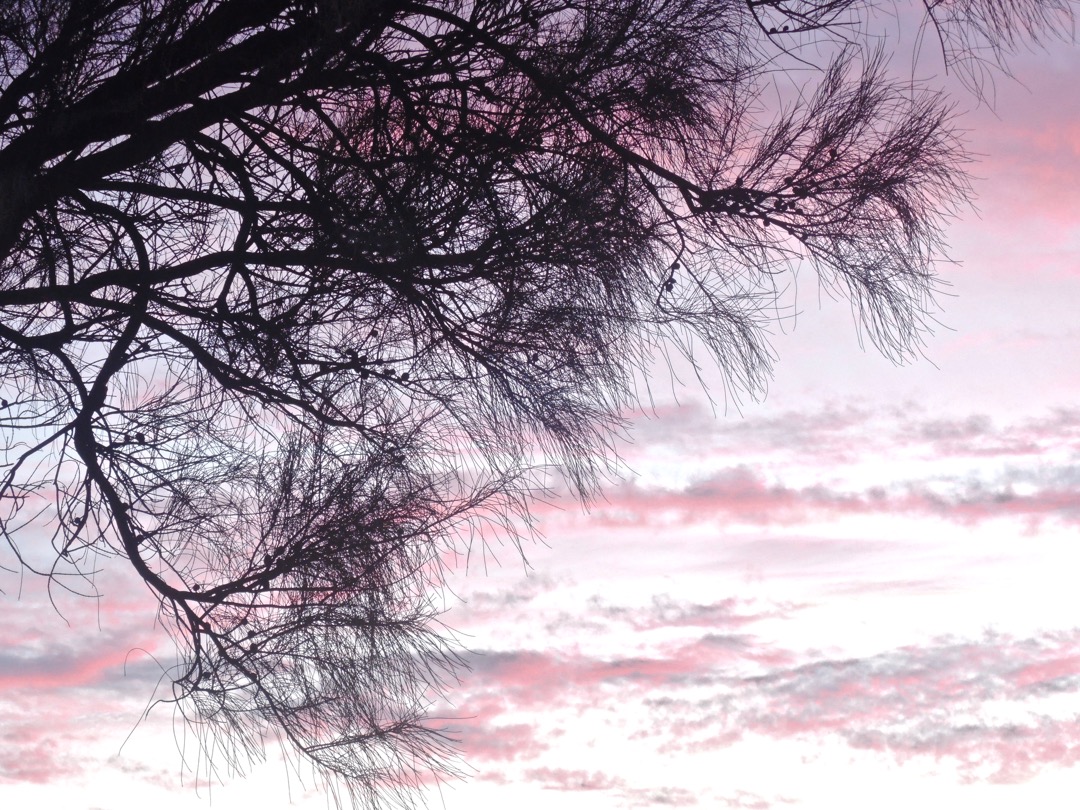
— or the branches of a sheoak tree silhouetted against cotton-pink clouds —

— or a sea turned opal.

Beacons to guide the ships home

The day I took the photos in this post was one of those days. All I had left of that day were those few moments — the last few moments of the day. So I told myself that they were enough, those few moments.

And for a few moments they were. They really were.

The end of the story

Other people’s words about … writing

April has never really known loneliness until now; she has had all tastes of its dregs, like cold milky coffee curdled at the bottom of the cup, but she has always had faith in the fact that it would pass. Now, she is not so sure. And this loneliness is entangled with her failure as a musician, another certainty in her life that seems to have gone.

Most days, she tries to write.

She sits by the window with her guitar and picks idly at notes, strumming chords underneath, humming to herself as she does so. But nothing ever sticks, and she feels as if she is just pretending, playing alone outside a room she can no longer enter.

from ‘Between a Wolf and a Dog
by Georgia Blain

I did something I had never expected to do this week: I stopped working on the book I’ve been writing, on and off, ever since my last novel was published in 2010. Actually, I stopped writing fiction altogether, at least for now.

The novel I’ve been writing all these years has gone through many, many permutations: I’ve written it as a ghost story for young adults; as a reworked ghost story for middle-grade readers; as a love story for ‘new’ adults’; as a coming-of-age story for women my own age. I’ve written it in the first person and in the third person, and in past tense and in present tense. I’ve written it using pen and paper, and Microsoft Word, and Scrivener.

I’ve written it. And written it. And written it.

All the time I’ve been writing this novel, I’ve been telling myself that the doubt I feel in myself, and in my ability to write a third novel — this third novel, anyway — would pass. But it hasn’t. Sometimes it’s quietened down for a period, but then it’s flared up again. And over the years, like April, the sense of inner loneliness I carry with me — which is in part an aspect of being me, Rebecca Burton, and in part an aspect of being me, a human being — has slowly become ensnared with the doubt I feel about my writing. [N]othing ever sticks, and she feels as if she is just pretending, playing alone outside a room she can no longer enter. Yup. Yup. Yup.

Ever since I wrote my first novel and it was accepted for publication, I’ve believed, with all of my heart, that writing books was something I would do for the rest of my life, because that’s what writers do, right? It’s what they want to do. It’s their privilege, and their gift. Or so the story goes.

But I just don’t think I believe that particular story anymore. That’s what I finally realised this week, after all this time. I don’t think — as April thinks, in this passage which I have loved so much for so long — that I am a failure as a writer, or as a person, if I stop writing, for a while, or forever. I think the world is bigger than that.

I don’t know what the future holds for me if I’m not a writer anymore — for now, or for a while, or forever. But you know what? Unlike April, I want to find out.

It’s a big, big world.

On labour

Other people’s words about … loneliness

Dad’s dying had been like a long labor, the work mostly his, but the experience for me was as profound, as isolating, as the labor of birth. For weeks after my son was delivered, I remember, I was stunned by it — by what I’d gone through, by how alone with it I’d felt, by how astonished I was by it, and by how isolating that astonishment was. Others held my son, admired him. They saw him simply as a big healthy baby. But when I looked at him, part of what I saw and felt was how he’d come to me, that long solitary labor, the amazing combination of agony and release that I felt I could explain to no one else. And in some nearly parallel way, this is what I felt about my father’s death. It was what I returned to frequently, it was privately where I lived, for a long time after it was over.

From ‘The Story of My Father
by Sue Miller

Let me start by explaining (hastily!) that the affinity I feel with the words in the quote above is not because I’ve ever given birth (I have not). Nor, more importantly, is it because I’ve recently experienced the death of anyone close to me, let alone my father, who is a strong, healthy, happy man whose company I hope to enjoy for many years to come. No, not at all.

I am a big fan of Sue Miller’s writing. What I most like is her attention to detail, her scrupulous examination of people’s inner workings — their thoughts, their feelings, their individual senses and perceptions — and the way she then builds on these ‘small’ things to make ‘big’ stories from them. A writer friend of mine who isn’t a fan of Miller’s books once said to me that she feels ‘dead inside’ when she reads a Miller novel. And I get that, actually. I think, in fact, that what my friend dislikes about Miller’s writing is exactly what I like: the precision, the detail, the refusal to hurry over anything, or to be swayed by sentiment or affection or a need for resolution for her characters.

I’ve explored loneliness and isolation a lot in my posts on this blog, but I thought the theme was worth returning to because of Miller’s words here. I was stunned by it, she says of giving birth, by how astonished I was by it, and by how isolating that astonishment was. This, for me, distils the experience of living itself, the realisation that each experience we have, however great or small, however joyful or devastating, is an experience we feel we [can] explain to no one else.

In the last couple of years, whenever I’ve experienced bouts of unwellness or anxiety (or both, combined) that have left me feeling isolated at home, struggling to go out, struggling to get to work or to catch up with people I love, I have found myself, afterwards, return[ing] to those experiences repeatedly in my mind; I have found that those times of illness were, for a while, privately where I lived.

Miller’s use of the word labor here refers only to giving birth, but the passage applies to other things, too, if you reframe it: to the labour of living, of loneliness — yes, to that astonishing labour.

And yet, still, it is worth labouring on.

Snatched phrases: stolen

‘[I] saw a squawking flash of cockatoos
go reeling and wheeling into the sky.
The soft secret underside of their wings,
so close, so tender.’

From ‘Skylarking’
by Kate Mildenhall


I was standing at the bus-stop the other day on my way to work when an odd commotion across the road caught my eye. A car had driven past, fast, and something had got caught up in the passage of its passing: something grey and small and warm and moving, something that gave the impression of flight, of flurrying. I wasn’t sure what it was at first, although subconsciously I registered feathers, but after the car had sped past, I saw that it was a small bird. In my memory I replayed what had just happened and this time, in my mind, I saw it: the bird had swooped down from the branch of a tree overlooking the street, but somehow it had mistimed its dive, and so it had got caught up in the passage of the car. Got hit, is what I mean.

The dove — that’s what it was, I saw: one of those spotted turtle doves with the iridescent sheen on their neck and the rash of white spots over a patch of purest black — had landed, after its collision with the car, on the ground in the middle of the far lane. Now the wind was playing with its feathers a little, and I saw the dove try get up on its legs but then fall back down again. It was young, not quite fully grown. I glanced around me, at my fellow commuters waiting at the bus-stop, but though I saw people looking, though I saw them seeing what I was seeing, no-one moved.

And so I ran out onto the road before the next car came past and crouched down beside the dove. I looked down at it, hesitating, and then I whispered to it, because I felt I should, I’m just going to pick you up and get you out of the way of all these cars; and then I reached for it and clasped it between my hands. I could feel its heart beating inside my two hands, and the warmth beneath its feathers, and I could feel it trying to gather itself and flap its wings to free itself from me; it didn’t want me to hold it, not at all. But it was too small or injured to shrug itself free and so I held it gently and lifted it and crossed to the far side of the road, opposite the bus-stop, and then I set it down on the footpath, there out of reach of the traffic.

Once I had put the dove down I crouched down beside it a moment on the footpath, watching it. I said to the bird, You’re safe now, and then it blinked — only it wasn’t a blink, not really. Its eyelid came down far too slowly, like a shutter, in a kind of world-weary exhaustion; and then its eyelid opened again, also too slowly. I could swear it had let out a little sigh as it blinked, although birds don’t sigh, do they? After that, it went utterly still. When I glanced across the road at the bus-stop, no-one was looking my way anymore; everyone was busy with their phones and their handbags and their earbuds. After a moment I stood up and walked back across the road and waited with them at the bus-stop. Five minutes later the bus arrived, and still no-one had spoken, and still the bird hadn’t moved from the place where I had set it to rest on the footpath.

I thought as I sat on the bus that the dove had died: that perhaps the shock of me lifting it up had added a final trauma to its day and its heart had stopped right then, as I crouched by it on the footpath and whispered to it, trying to comfort it. I thought about that all the way to work, and then I tried not to think about it anymore.

Doves are a dime a dozen, and there was nothing more I could have done, I guess, but still I felt sad. It was the intimacy of that moment, I think: feeling the secret beat of the dove’s heart between my hands, the warmth of its soft chest against my palm. I felt, perhaps, the way the narrator does in the passage above, as she observes the cockatoos in the sky, seeing the soft secret underside of their wings. It was the stolen, fleeting nature of the moment between the dove and me, tinged further with the thought that I hadn’t helped, and maybe — just maybe — I had made the dove’s last moments worse, not better.

When I got off at the bus-stop that evening, on my way home from work, I saw to my surprise and my slow delight that the body of the bird wasn’t there as I had expected it to be, cold and long dead. There were no feathers there, either, no signs of blood or injury or scuffle.

And I think now — I truly think — that when I set down the bird on the footpath and it let out that terrible not-sigh, it was in shock, but it was essentially uninjured; and so afterwards — after it had recovered from its shock — it got up and it flew away to safety.

That’s what I think.

This moment, now

Other people’s words about … the everyday

The sunlit room is silent and there rises a kind of aural transparency through which a deeper background of sound emerges, intricately embroidered like an ocean bed seen through clear water: the sound of passing cars outside, of dogs barking and the distant keening of gulls, of fragments of conversation from the pavements below and music playing somewhere, of phones ringing, pots and pans clattering in a faraway restaurant kitchen, babies crying, workmen faintly hammering, of footsteps, of people breathing, and beneath it all a kind of pulse, the very heartbeat and hydraulics of the day.

From ‘Aftermath’
by Rachel Cusk

I’ve been saving this quote for a while. My copy of Aftermath came from the library, and so I can’t look the quote up again and remind myself of the context; but from memory, Cusk, who was at the time living and working in the British seaside town of Brighton, is in this passage writing of a visit to the dentist.

It’s easy to focus our attention on the beautiful things we see and hear around us. (I do it in my posts on this blog all the time.) But I love the way that Cusk does the opposite here: she takes an everyday moment — not a remarkable one, not even a particularly pleasant one — and describes it so vividly that the moment shines; it sings.

Sometimes, as I go about my own day — at moments when I am particularly busy, or grumpy, or stressed, or anxious — I make myself stop. I glance around; I tilt my head to one side to listen; I sniff the air. I make myself take everything in, just for that moment. It’s a way of stepping back, I suppose: of absorbing rather than participating. However unremarkable my surrounds at that moment, the act of stepping back from them and observing them creates a stillness inside of me.

That stillness is useful. It reminds me that I’m alive.

Look up from your work
every now and then.
Take a step back.

I suppose you could call this a form of anxiety management. I suppose you could say that I am teaching myself to be present, or trying to practise mindfulness. But I’m not consciously striving to do any of these things: the act feels more instinctive than that. It feels, simply, as though it is an important — no, an essential — thing to do, every now and then.

And that’s what Cusk does in this passage, I think: she grabs a very ordinary moment, she witnesses it and she breathes life (a heartbeat, a kind of pulse) into it.

And somehow, along the way, with the words she uses, she breathes magic into her day.