‘ … We can be like sisters,’ she says. And then she freezes.
I smooth my hair behind my ear. I look at the snow.
‘I didn’t … ‘ She leans forward, cradles her head in her hands.
And I think of how time passes so differently for different people. Mabel and Jacob, their months in Los Angeles, months full of doing and seeing and going. Road trips, the ocean. So much living crammed into every day. And then me in my room. Watering my plant. Making ramen. Cleaning my yellow bowls night after night after night.
‘It’s okay,’ I say. But it isn’t.
from ‘We are Not Alone‘ by Nina La Cour
Some people in the Western world — most people, perhaps, if you take at face value the world we see portrayed on social media, and on TV, and in the ads — live big, busy, crammed lives, like Mabel and Jacob in the passage above. They go overseas on holiday. Borrow money to buy houses and cars. Renovate and redecorate. Eat out at restaurants. Drink lattes with their friends. Bungee jump. Skydive. Buy new clothes each season, colour their hair so it doesn’t go grey, replace their smartphones with the latest model. The words vibrant and noisy come to mind. They are not the same things, and yet it can be hard to tell the difference, sometimes.
Me, I live a quiet life. A small life.
Partly, this is of my choosing, and partly it isn’t. Partly, it’s because a small life, a simple life, has always appealed to me; partly, it’s because that small life found its way to me a long while ago, and foisted itself upon me. And partly, too, the simple truth is that it’s difficult, when you’ve started down a small, narrow track, to turn around and retrace your steps. To find yourself out in the open. To start again.
Most of the time, I’m okay with this. But sometimes, like Marin, the eighteen-year-old narrator in the passage above, there are moments when it isn’t okay, after all.
Those moments pass. They do. But I think they’re worth acknowledging, every now and then.
Correa flower in blossom in Aldinga Scrub May 2018 Small but beautiful, after all.
… I tried to keep busy. I haunted bookstores, sat in cafés, drinking coffee and smoking. As the weather got colder, I went often to the Gardner Museum — for the humidity, for the scent of jasmine in the courtyard.
But of course, the truth was that I was depressed, and that waiting for me the moment I stilled was a sorrow that filled my time amply with its emptiness, that kept me very busy even as I lay open-eyed on my bed or sat at my desk staring out at the houses across the street. I tried my hardest never to still.
From ‘While I was Gone’
by Sue Miller
You know the kind of depression Miller is describing here, right? It is not so much a clinical thing, requiring medical consultations and diagnosis and treatment, as it is a thing of sorrow, of emptiness, of lacklustre wakefulness. Of restlessness. Sudden, fleeting moments of despair.
I tried my hardest never to still, Miller says, simply. You’ve done that, too, right? — tried to match the sense of endless mental pacing with an equal sense of physical pacing.
Just as there are no diagnoses or treatments, I don’t think there’s any kind of cure. I find, as with so many difficult things, that it’s mostly a matter of waiting the thing out, giving it passage, allowing yourself to see it through.
And that, for me, is where I find the stillness that Miller’s narrator describes herself trying so hard to flee. The act of waiting, of riding something out, is itself paradoxically an act of stillness. Sometimes, just knowing this can be enough.
The world out there.
And then there’s always the matter of looking up, every once in a while. Of reminding yourself that there is a world out there, to which you will return. In a moment. In an hour. In a few weeks.
Dad’s dying had been like a long labor, the work mostly his, but the experience for me was as profound, as isolating, as the labor of birth. For weeks after my son was delivered, I remember, I was stunned by it — by what I’d gone through, by how alone with it I’d felt, by how astonished I was by it, and by how isolating that astonishment was. Others held my son, admired him. They saw him simply as a big healthy baby. But when I looked at him, part of what I saw and felt was how he’d come to me, that long solitary labor, the amazing combination of agony and release that I felt I could explain to no one else. And in some nearly parallel way, this is what I felt about my father’s death. It was what I returned to frequently, it was privately where I lived, for a long time after it was over.
From ‘The Story of My Father‘
by Sue Miller
Let me start by explaining (hastily!) that the affinity I feel with the words in the quote above is not because I’ve ever given birth (I have not). Nor, more importantly, is it because I’ve recently experienced the death of anyone close to me, let alone my father, who is a strong, healthy, happy man whose company I hope to enjoy for many years to come. No, not at all.
I am a big fan of Sue Miller’s writing. What I most like is her attention to detail, her scrupulous examination of people’s inner workings — their thoughts, their feelings, their individual senses and perceptions — and the way she then builds on these ‘small’ things to make ‘big’ stories from them. A writer friend of mine who isn’t a fan of Miller’s books once said to me that she feels ‘dead inside’ when she reads a Miller novel. And I get that, actually. I think, in fact, that what my friend dislikes about Miller’s writing is exactly what I like: the precision, the detail, the refusal to hurry over anything, or to be swayed by sentiment or affection or a need for resolution for her characters.
I’ve explored loneliness and isolation a lot in my posts on this blog, but I thought the theme was worth returning to because of Miller’s words here. I was stunned by it, she says of giving birth, by how astonished I was by it, and by how isolating that astonishment was. This, for me, distils the experience of living itself, the realisation that each experience we have, however great or small, however joyful or devastating, is an experience we feel we [can] explain to no one else.
In the last couple of years, whenever I’ve experienced bouts of unwellness or anxiety (or both, combined) that have left me feeling isolated at home, struggling to go out, struggling to get to work or to catch up with people I love, I have found myself, afterwards, return[ing] to those experiences repeatedly in my mind; I have found that those times of illness were, for a while, privately where I lived.
Miller’s use of the word labor here refers only to giving birth, but the passage applies to other things, too, if you reframe it: to the labour of living, of loneliness — yes, to that astonishing labour.
I am trying to find my dog, which is going to be put down. Not a dog I live with in my waking life, but another, a black Labrador. The dog has already been taken away and is awaiting its death at a pound on the edge of town. This awful knowledge permeates my sleep. When I get there, however, my dog has gone. In its place, lying sick and exhausted on the concrete floor inside a large cage, is a young, very beautiful red setter. As I enter, the creature raises its head towards me and I see with slow shock that its muzzle has been sewn up with fishing line. The red dog pulls itself off the ground and limps towards me. Rising on its hind legs, it puts its forelegs on my shoulders, and rests its head against the left side of my neck. I can sense it begging me to save it. I feel great pity; I embrace and try to comfort it. But there is no sense that I can or will do anything to help it. The burden would be too great. Words come into my head. The dog’s name: Gadget. (Why Gadget? I wonder, even in the dream.) Then the thought — with which I am already justifying my decision to abandon it — that red setters are not very intelligent dogs. I step away. The animal stands there, hopeless. I touch it on the back and I leave.
What to do with a dream like that?
From ‘Anaesthesia‘
by Kate Cole-Adams
What to do, indeed?
I love the words in this passage: this description of a dream, which is vivid and haunting and bewildering all at once, as dreams so often are. Over time, Cole-Adams goes on to say, various astute readers have suggested to me that this particular dream might not belong in this particular book, that it is a dream that emanates from somewhere else and that ought to be left there …. And yet she includes the dream in her book anyway. In doing so, she allows herself to write intuitively, blindly, instinctively, knowing — knowing — that what she is writing must be written, but not knowing why.
In the quiet after waking I lay curled on my side suffused with the knowledge of irrevocable loss. I had betrayed the red dog. And in doing so I understood that I had disavowed some helpless, voiceless part of me. The dream did not feel like a dream. The house was still and very dark. I did not know what the dog had been trying to say, but I could still feel almost physically the place above my left shoulder where it had nuzzled its head against my neck, and I accepted finally that I could not write this book without it.
Do you sometimes have dreams like Cole-Adams’s dream — a dream that [does] not feel like a dream? Do you feel memories rising in you that feel more alive than memories should ever feel? Do you get a feeling of sickness in your gut that you know — you just know — isn’t a sickness; and yet it is, it is?
I do.
These days, I’m not much one for grand resolutions. I don’t know what path I’ll follow this year (though, hopefully I’ll get to walk one of the sandy paths in Aldinga Scrub, like the one pictured above, every now and then). I don’t know what 2018 holds, for me or for you.
I do hope, though, that there will be some moments like Cole-Adams describes, for you and for me: those quiet moments after waking when you do not disavow the helpless, voiceless part of you; those moments when you accept finally that you cannot otherwise do what it is you need to do.
Nick didn’t call me that morning, or that night. He didn’t call me the next day, or the day after that. Nobody did. Gradually the waiting began to feel less like waiting and more like this was simply what life was: the distracting tasks undertaken while the thing you are waiting for continues not to happen. I applied for jobs and turned up for seminars. Things went on.
From ‘Conversations with Friends‘
by Sally Rooney
I hadn’t planned to write this post. I thought that I would be — I planned to be — too busy to post anything between now and next week. I had family celebrations planned, after all, and a holiday trip away with a dear friend, and even a couple of shifts at work.
But I haven’t been well this Christmas, and so most of my plans for the holiday period so far haven’t eventuated.
Christmas is a tricky time, isn’t it? For some reason, I often get sick around this time of the year (and at other times of celebration). Like Sally Rooney’s narrator, Frances, in the passage above, I keep waiting for this to change, but the thing I am waiting for — not to get sick at Christmas, not to feel sad about getting sick at Christmas — continue[s] not to happen.
So why am I writing a post now, after all? Partly, I’m writing because I have unexpected time on my hands. Mostly, though, I’m writing because I wanted to reach out to other people who might also be feeling sad — whether unexpectedly or otherwise — this Christmas.
I don’t have any advice. I wish I did. The only thing I can find to do at times like this is to wait them out — which is ironic, given Rooney’s words above.
Still, whoever you are, wherever you are, if you are feeling sad right now, know this: you are not alone. Sadness is part and parcel of the deal.
And it passes.
Like the weather, like the tide, like footsteps in the sand, like all those hackneyed things — like Christmas, even — sadness, too, passes.
When you’ve passed through a difficult period, it can be tempting to yearn for a delivery of good fortune, or for experience that feels redemptive somehow. You want suffering to have purpose, for pain to be justified by wisdom or abundance or growth.
I had an odd weekend recently, going through some of my old journals and photos for writing-related reasons. The entries I’d written in my journals back then, during a time in my twenties when I lived overseas — first in Texas, then England, then Germany, Cairo, Jakarta — were vividly descriptive of a life I no longer lead, nor will ever lead again. Those journal entries threw me back to a ‘me’ I hadn’t exactly forgotten but somehow, foolishly, thought I had let go of.
Although I have let go of that me, mostly.
My life, during those years I lived overseas, was filled with extremes — of loneliness, joy, excitement, fear, love, doubt, sorrow, terror, grief. There was one particularly difficult period, living in Jakarta with my then boyfriend, when one thing after another went terribly wrong, and I felt as though I was walking through my days — those days that made up my life as I then knew it — with my head down, just waiting for the next blow.
Like Gena, in the words I’ve quoted above, sometimes in Jakarta I just wanted those most difficult days to have a meaning. A purpose. But they didn’t. Even now, when I look back on those times, I find them hard to make sense of. I think I always will.
Gena quotes the Buddhist Nun Pema Chodron, who says the following in her book When Things Fall Apart:
We think that the point is to pass the test or overcome the problem, but the truth is that things don’t really get solved. They come together and they fall apart. Then they come together again and fall apart again. It’s just like that. The healing comes from letting there be room for all of this to happen: room for grief, for relief, for misery, for joy.
These days, I would quibble with Pema Chodron’s use of the word healing — isn’t that just another way of saying you can solve things? — but then, I’m not a Buddhist. Or a Nun.
Still, I like the notion of things falling apart and then coming together again, only to fall apart once more; I find it immensely comforting. Even more, I like Pema Chodron’s simple statement, neither defeatist not celebratory, that life is just like that.
It is just like that, isn’t it?
The photographs accompanying today’s posts come from a recent trip to Yorke Peninsula. It was mid-November, and the late-spring flowers dappled the dunes. Fan flowers, common sea heath, grasses, sedges, acacias and other flowers I couldn’t identify and don’t usually see at home had sprung up everywhere, in every bare patch of sandy ground, in every sheltered nook, in every little cranny in the rocks. Walking amongst them, I felt things come together again in my heart, for a little while.
I don’t know if I’ll make it to eight years of blogging. Probably not, to be honest. And that’s OK. Because the time I’ve spent in this corner of the internet has changed my life in the most unexpected and powerful way. That has nothing to do with me and everything to do with you, so THANK YOU.
It’s becoming quite a trend, isn’t it? Quitting blog writing. Decrying the blogosphere and what it has become. I’m saddened to find that some of my favourite bloggers, quoted in the passages dotted throughout this post, are pulling the plug on their blogging.
But I’m not about to do the same.
But it’s time friends. It’s time to pull the plug on my blog. I’ve been putting off this decision and this post for a very long time.
I’ve talked before about why I love blogging and the blogosphere. Many of the bloggers now leaving the blogosphere complain about how disingenuous bloggers are becoming: how curated so many blogs are; how inauthentic the bloggers’ voices have become; how blogs now function, simply, as the latest tool for a person who wants to build a portfolio in order to make a living through social media.
Rain in the vineyards
Honestly? In some ways, I agree. I wince when I realise I am wading through yet another post on a cooking blog filled with not one, not two, not five, but ten (or more) shots of the same dish, artfully presented amongst scrunched-up tea towels, autumnal leaves and battered enamel saucepans. And I wince even more when I find myself reading yet another post by a blogger announcing breathily, Guess what? Exciting news! I got a publishing contract!
I’m almost nostalgic for the early days of blogging (except I don’t really do nostalgia). It was enormous fun, but also an enormous consumer of time. I loved it at the beginning but foresaw early on many of the problems now associated with the internet, and now I’m happier doing it all in private. I always had faith that the appeal of printed books, face-to-face conversations, trips to the cinema, walking, swimming and camera-less experiences would never fade for me and now I am back where I was before I started blogging in 2005 … I’m writing a new book. I’ve moved on from writing about domesticity. I just live and breathe it, like I always did.
But there’s still room in the blogosphere for sincerity. For vitality. For authenticity. There is. You just have to look a little harder to find it.
Sheoaks in golden bloom, vineyards and … my bike (of course)
Some bloggers find joy in the blogging community; recently, for example, I read a lovely post by children’s author and fellow blogger Cynthia Reyes about bloggers helping bloggers. Her post would make any blogger think twice about stopping blogging.
Me? I blog for many reasons. I see blogging as a way of improving my writing: of learning to express myself better, learning to reach out to people, somehow, with my words. I see blogging as a form of connection to the rest of the world — if I show you my world, perhaps you will show me yours. I see it as a substitute for journal writing: a substitute that is better than the original because, due to the public nature of the domain in which my blog appears, there is discipline involved in the writing of each post, and discretion. And I see blogging, as I’ve said before, as a way of reaching towards beauty, wherever I can find it.
All of those are selfish reasons for blogging, I guess. But the corollary of writing a blog is spending time reading other people’s blogs: listening to what other bloggers have to say, seeing what they see, understanding what they believe (even if I don’t agree with them). Reading of any kind, no matter how enjoyable an activity it is, is inherently an unselfish act. It forces you to listen to other people. It can, if you let it, open your mind.
I think blogging offers a richer, more thoughtful, more all-compassing vehicle for expression than other forms of social media like, for example, Twitter (where pithiness is valued over thoughtfulness) and Instagram (where aesthetics are valued over normality). And for that reason alone, I will continue to participate in, and love, the blogosphere.
What about you? What do you think about the state of blogging today?
‘His sleep is so light it’s some smallness of sleep,
some rumour of sleep.’
From ‘Fourth of July Creek’ by Smith Henderson
You know the kind of night Henderson describes above? We all do, right? Nights like that can leave you feeling very fragile.
I don’t have any solutions, except to remember that sometimes the only thing you can do when you’re feeling fragile yourself is to seek solace in the fragile things all about you:
Stella had noticed that the woman in [the painting] ‘The Jewish Bride’ wore pearls. Also earrings. Maybe that was why she looked so intimately self-assured. Stella hadn’t had her ears pierced until her sixtieth birthday. She’d been squeamish about it but thought the pain would be balanced by the confidence the look would give her. She would become — finally — a woman taking her own decisions, a woman with authority over herself.
From ‘Midwinter Break’ by Bernard MacLaverty
The year I turned fifteen, I grew up, physically. That was the year that I turned from a slightly plump, almost-flaxen-haired girl into an adolescent woman with breasts and hips and thighs and lank, dirty-blonde hair. I wasn’t the kind of girl to celebrate any of these things: in fact, I wanted to turn back the clock. I didn’t want breasts and hips and thighs and lank, dirty-blonde hair. I wanted something else. I wanted to look the way I thought I had once looked, but I knew that I couldn’t. Not any more.
The strange thing is that the way I’d thought I had once looked as a child wasn’t the way I had actually looked as a child. I’d thought — all my life I’d thought this — that I had been skinny and elfin and girlish. In fact, I hadn’t been that at all, ever. But it wasn’t until my mid- to late teens that I understood this.
When I did, I was deeply shocked.
Looking for the horizon (1) (that line of disconnect between the sky and the sea)
Somewhere around the time of that realisation, and for a long time afterwards, I stopped eating enough. I’ve touched on this act of mine — of abstinence — before. In the early years, it was a conscious, deliberate act: an effort to force my body to a level of thinness that I thought had once been my natural state. Later, it became both a less strict and a less conscious act; indeed, it became more of a process than an act. I think that what I was trying to do, all those years, was to make abstinence a part of who I was, rather than all that I did.
It took a long to stop doing this, and even longer to stop trying to do it. In fact, it wasn’t until my mid-thirties that I really allowed myself to eat without any kind of enforced abstinence at all, though by then the things I abstained from were barely noticeable to anyone other than myself. Still, if such a thing as recovery from an eating disorder exists, that’s when it happened for me — halfway though my thirties. Not before.
But though I did eventually lose the compulsion to abstain, to this day I have still not lost the shock I feel when I am confronted with the real image of myself — in photos, in the mirror — as opposed to the image of myself that I carry around in my mind. I still think of myself, unconsciously, erroneously, as skinny and elfin and girlish. As light and slender and ethereal. As pretty. I am not any of these things, and I never have been; but that’s not how I feel.
I think we all live with a certain level of disconnect between the way we perceive ourselves and the way we actually are. You know that feeling you get when you turn forty (or fifty, or sixty, or seventy) and you think, ‘But I don’t feel like I’m forty (or fifty, or sixty, or seventy); I feel like I’m still twenty-five’? That’s the disconnect I mean, right there. I am not sure that everyone experiences it as strongly as I do: for me, it seems to run through my entire perception of myself. I’ve always had it, and always will; adolescence was just the first time that I was confronted with it. Even now, each time I am confronted once again with my misperception of myself — with the difference between the ‘me’ that people interact with and the ‘me’ that lives inside of me — I feel the same shock anew.
Looking for the horizon (2)
I like to think that this sense of disconnect between perception and reality is what Bernard MacLaverty is touching on, very lightly, very deftly, in the passage I’ve quoted above. Sixty-year-old Stella tells herself that getting her ears pierced will give her confidence; she genuinely believes that her new look will enable her to become a woman with authority over herself. But the earrings do not bring about the sense of intimate self-assurance that she seeks. Of course they don’t. Stella never becomes — finally — the woman she seeks to be: the woman she believes she is capable of being; the woman, I think, she secretly believes she might already be.
Perhaps here I’m reading too much into MacLaverty’s words. If nothing else, there is an affectionate sadness in his words to which I respond. Still, on those days when I feel deeply disconnected from my two selves, from the interacting ‘me’ and the internal ‘me’, I find solace in passages like his. I like to think that — like Stella, like me — you, too, are puzzled by the rift between your internal you and your external you. I like to think that you, too, feel as though there is a different — a better, a lovelier, a lonelier — you inside of you than anyone ever sees.
I like to think this, because thinking it lessens somehow the sense of disconnect I have between your experience and mine: between your world and mine. That, at least, is a point of connection. And a connection is the opposite of a rift, after all: it is a kind of affinity.
Sometime after midnight the rain and the wind stopped. The room filled with the sound and smell of the ocean, both amplified somehow, as if it were about to pour through the windows, full of storm debris — ground up shells, rotting wood, seaweed, the husks of marine animals, endless other fragments suspended in the salt water, all of it caught in the roar of the waves. But by then there was no one awake to hear.
from ‘The Restorer‘ by Michael Sala
Having lived in various houses by the sea ever since my early twenties, I’ve noticed how the smell that drifts towards my house from the beach differs not just from day to day, but from house to house. Where I live now, my house is pretty much at sea level, and though it stands several streets back from the beach, on days when the wind is westerly, blowing straight off the ocean, the air that drifts into my yard is rank with the smell of salt and damp sand and rotting seaweed.
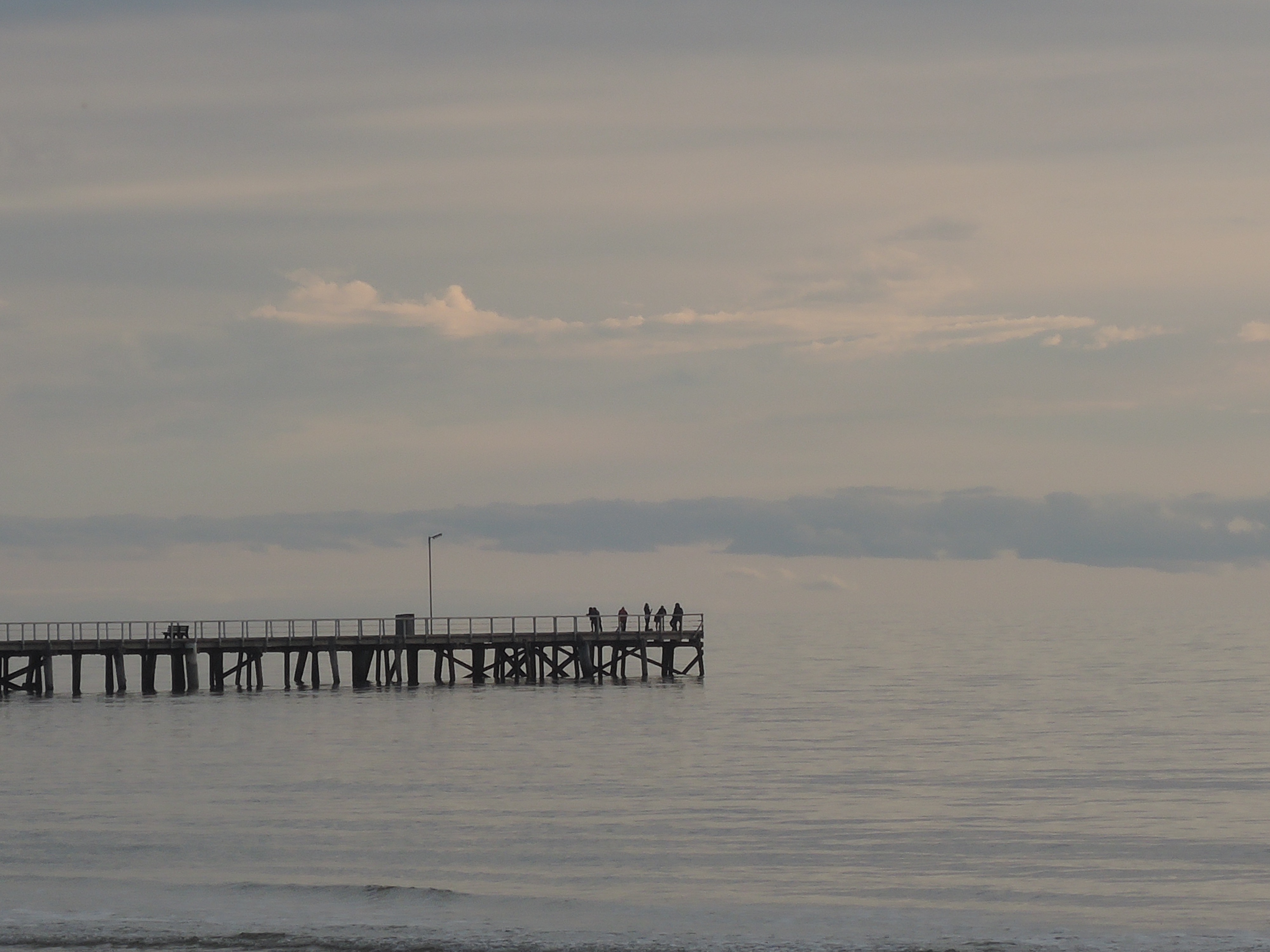
The sea is shallow here, too; you can wade out for quite some distance from the shore, heading towards the horizon, without the water rising much above waist level. You can see this, I hope, in the photos illustrating this post, all of which I took a few weeks ago on one of my early-autumn strolls along the beach.
But it’s the sound of the sea I’m thinking of right now, rather than the scents or the sights. As I write, it’s three o’clock in the morning and — unlike in Michael Sala’s description, quoted above — I am awake to hear the roar of the waves.
I’ve always been a light sleeper. Sometimes the sounds of the house wake me in the middle of the night — the rattle of my window, the sway of an open door. Sometimes it’s my dog who wakes me, sleeping on his blanket in the laundry, sighing and licking his chops, letting out a little snore.
I don’t always get back to sleep easily once I’ve woken. On nights like this, it’s the sound of the sea through the window that comforts me in my sleeplessness, connecting me to something outside myself, outside my house, outside the long, dark, lonely night.
In the morning, the sea will sound different — more distant, somehow, less intimate. But we’re not there yet.






 twenty-one words