What, then, is this?

Other people’s words about … therapy

Sometimes I wonder why I come here [to see my psychoanalyst] when the coming is so iterative, so forced. Having to come here sometimes feels like the biggest problem I have. I feel like a lonely man visiting a brothel, the money changing hands, paying for understanding as some people pay for love. And just as that is not love, so this cannot be understanding. What, then, is it?

from ‘Aftermath
by Rachel Cusk

As I’ve mentioned here before, I spent several years in and out of therapy, being treated for anorexia and its aftermath. I will be forever grateful to the therapists I saw during those years. They treated me with respect, patience, warmth and compassion. And they listened. Oh, they listened.

But I stayed in therapy too long, I think. I believed at the time that I was seeking a cure for my constant sense of malaise. That cure seemed terribly elusive. Now I think it was elusive because, subconsciously, I knew there wasn’t one. What I was really reaching out for was understanding, and that is not something I found in therapy sessions.

Therapy is a strange process. It is, as Rachel Cusk says in the passage above, a transaction of sorts. When that transaction starts to make you feel worse rather than better, when you feel lonelier leaving the therapist’s office than you did on arriving, it’s time to stop. It really is as simple as that, though it took me some time to figure this out.

Post-therapy, am I still seeking understanding? Yes, of course — just like everyone else. Have I found it? Not really. Perhaps no-one ever does. What I have found, though, is solace. I find solace in pots of tea, and walks along the beach, and wanders through the bush. I find it in cakes I bake, and books I’m reading, and holidays I plan to go on. I find it in birdsong, and in leisurely bike rides, and in the company of friends and family and pets.

And I find solace in other people’s stories.

Tell me, then, where do you find solace?

The big ‘I’

Other people’s words about … the view

Sit. Quietly. Turn your awareness to your heart space.

Now imagine you’re sitting on a small wooden bench with yourself. Imagine you’re doing so in that space in the centre of your chest. There you are, sitting to your right, the little nattering humanoid that you are, berating yourself for eating too much at lunch and debating whether to hang the washing out or not. This little nattering self is your little ‘i’. You (the big ‘I’) can watch it all. Yep, there you are, sitting quietly, looking out at a view, over treetops down to an ocean. On your little bench. Together. You’re just hanging, nowhere to go, nothing to do. The two of you …

From ‘First, We Make the Beast Beautiful
by Sarah wilson

It was my friend and fellow blogger, Anne, who first alerted me to the appeal of benches — I mean, real benches, in real life. In her ‘Bench Series‘, she posts photos of benches that she’s snapped from all over the world. I’d never really looked at benches before, except as convenient things to sit on while I rested and took a moment to enjoy the view before me. Now I find myself noticing them (and photographing them) all the time.

The kind of bench Sarah Wilson describes in the passage I’ve quoted above, though, is a metaphorical bench, one that you can only find within yourself. It’s a place where you can sit while you encounter, and learn to accommodate, your two selves: the busy, superficial, language-oriented self that churns out thoughts night and day, and the deeper, quieter, wordless self that lies beneath all the nagging chatter.

The idea of the two selves isn’t unique to Wilson. It’s an idea common to many systems of thought, one we’ve all become more familiar with since the recent popularisation of mindfulness-based practices and therapies. But I particularly like the way she uses the image of sitting on a bench to explain it. It’s a simple, vivid, accessible reminder of how easy it is to get caught up in (and believe) your own thoughts.

A thought, after all, is only that: a thought. It may be true; it may not. Thoughts and the truth exist independently of each other. When I first came across this idea (here), it seemed both counterintuitive and revolutionary to me. I’m still grappling with it.

Wilson again:

And then it might occur to you that your little mate ‘i’ is just that — a little mate sitting next to you. And that this Big ‘I’ is who you really are. It feels deep and close and yet so vast.

Okay, I’ll admit I winced, at first, when I read these words. First, I’m not sure that the quieter self (the one Wilson calls the Big ‘I’) is deep or close or vast — or, indeed, in any way somehow ‘better’ than any other part of our self. I think that it just is.

Second, I was troubled by her use of the phrase little mate both to describe the thinking self, and to distinguish that self from the non-thinking self. I found the phrase overly colloquial, like some kind of condescending attempt to make a difficult concept more user-friendly to her less educated readers. But I have slowly come to feel the opposite way about her wording. The word mate implies friendship: it implies love, acceptance, forgiveness. Also fun. That’s helpful, I think. Why vilify a part of yourself, when you can instead smile and make friends with it?

Wilson uses meditation to find her bench. As you know, I don’t. But I don’t think that matters. What matters is that you know the bench exists — and that you know how to find it, however you get there.

And whether or not your prefer your benches real or whether you prefer them metaphorical, I wish you many sun-dappled, peaceful benches of your own in your life, wherever you happen to be.

When the wall comes down

Other people’s words about … the view

When I was about fourteen or so, I studied a poem in school by David Campbell, called ‘On the Birth of a Son‘. It was a sonnet, and I didn’t know much about sonnets, except that Shakespeare wrote a lot of them. It never occurred to me that a contemporary poet might write one.

This sonnet by David Campbell has stayed in my mind ever since. It remains one of my favourite poems. Here it is, in its entirety:

The day the boy was born, the wall fell down
That flanks our garden. There’s an espaliered pear,
And then the wall I laboured with such care,
Such sweat and foresight, locking stone with stone,
To build. Well, it’s just a wall, but it’s my own,
I built it. Sitting in a garden chair
With flowers against the wall, it’s good to stare
Inwards. But now some freak of wind has blown
and tumbled it across the lawn — a sign
Perhaps. Indeed, when first I saw the boy,
I thought, he’s humble now, but wait a few
Years and we’ll see! — out following a line
Not of our choice at all. And then with joy
I looked beyond the stones and saw the view.

On the face of it, this poem is about becoming a parent — the fears new parents have; the limitations parenthood imposes on their lives; the unexpected, unsettling joys it rewards them with. So it might seem strange that Campbell’s words have always resonated with me, though I have chosen, deliberately, never to become a parent.

But that’s the thing about great poems: they are universal. They manage to strike a chord in different people at different times for different reasons.

For myself, every time I read this poem I am moved by the contrast the poet makes between the act of looking inward — at his safe, pretty, cosy life — and the act of looking up, out, to glimpse a view of the world, and his life, beyond.

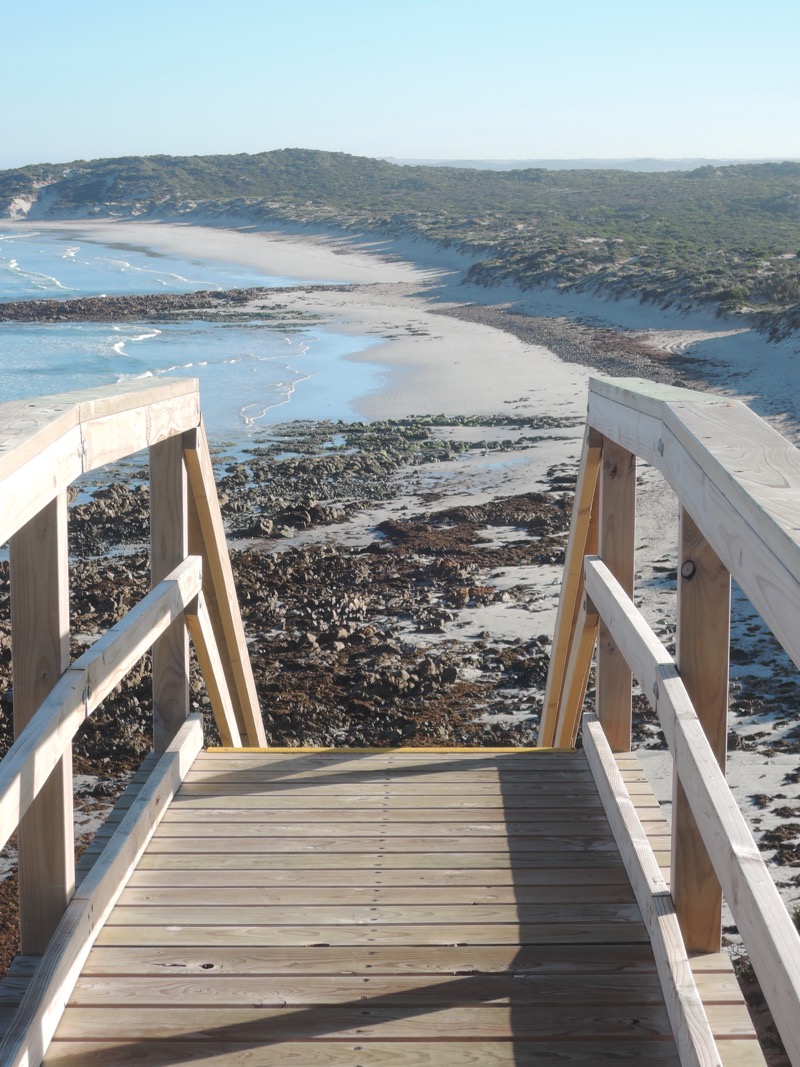
The view beyond. Recently, I went on a holiday in Yorke Peninsula. I returned to one of my favourite spots, following a long, undulating, unpaved road to get there — one that is corrugated and dotted with puddle-holes, dusty with sand stirred up by other passing vehicles, and lined with dense thickets of bush where brown snakes lie coiled, sleeping.

Each day I passed my time the way I always pass my time there. Each day I woke to the same view.

But it is a spectacular view: of open skies, of wide seas, of sprawling cliffs and rolling sand dunes. It is a view of a life beyond the life I normally lead. It is a view that sets me free.

I live a small life: small things give me pleasure. I consider myself, mostly, lucky to be able to live this way. And yet it’s good to escape from time to time: to look up and out and beyond.

And to see, again, the beautiful view.

Notes

You can find a link to this poem here and here.

From one year to the next

Other people’s words about … loneliness

She had told herself more than once not to call it loneliness, since it wasn’t any different from one year to the next, it was just how her body felt, like hungry or tired, except it was always there, always the same. Now and again she had distracted herself from it for a while. And it always came back and felt worse.

from ‘Lila
by Marilynne Robinson

A couple of years ago, I began to experience recurrent bouts of unexplained nausea. The waves of sickness came every three or four weeks, and left me feeling depleted and frustrated. My symptoms of illness were made more difficult by the fear that accompanied them: a fear that I’ve touched on here and here, and will no doubt touch on again.

In her memoir Slipstream, Elizabeth Jane Howard mentions in passing a phase in her life, when she was a young woman, during which she experienced something like this.

In those days, I had bouts of being unable to eat that sometimes lasted for weeks. This seemed to be one of them. I was very tired from my illness, but encouragement to build up my strength by these kindly people was of no avail. I’d sit before an immense juicy steak and delicious salad, trying to swallow the first pieces of meat, my stomach heaving, and wanting to cry from embarrassment. ‘I’m so sorry. I don’t eat much,’ I had to say.

It was my mother who, just recently, introduced me to Slipstream. When I read the passage above, I wished that Howard was still alive, so that I could write to her and thank her for these words. It helps, when you are going through difficult times, or when you are experiencing something troubling and bewildering for which you yourself have no words, to read someone else’s words on the same thing. Here is Howard again:

I had no energy for writing, I didn’t like living alone, and I could hardly drag myself to the office every other week to earn the six pounds that barely kept the wolf from the door … I remember the misery of sitting in restaurants faced with enormous menus and finally asking for something like a piece of cold chicken only some of which I managed to force down.

During the worst phase of my own bouts of nausea, I felt my life began to fold in on itself. Although I wasn’t ill all the time — although there were days and weeks when I felt well: days, even, when I felt as though I’d never feel sick again — those bouts took a toll on me. I called in sick at work frequently, and worried about the consequences. (Would I be put on a performance plan? Would I get sacked? What if I couldn’t hold my job down anymore? How would I live with myself if I couldn’t make a living?) I worried about my social life. (What if I lost all my friends because I kept cancelling on them at the last moment? What if they didn’t believe me when I told them I was sick? What if they thought I was just neurotic, or antisocial?) And I fretted about people in my family, whom I wanted to see more frequently than I did. (Did they know I still loved them? Did my absence hurt them? Were they, too, judging me?) I began to feel disabled on all fronts — by my symptoms of illness, by my fear of those symptoms, and by my shame about my fear.

The sickness happens less often now, I am glad to say, though it still comes, accompanied by symptoms that feel worse than they sound: fatigue, headaches, nausea, heavy eyes, weak limbs. I am as yet to find a cause. In the meantime, when I do experience bouts of illness like this, I try not to let myself feel the way I felt during that worst phase. Isolated is one word that comes to mind to describe the way I felt. Lonely is another.

And here is where reading helps. Reading Howard’s words I feel a sense of kinship. The kinship makes me reflect, as I so often do, that writing is an act of sharing, and that sometimes — sometimes — reading can feel like a defence against loneliness.

It wasn’t until I read Toni Bernhard’s How to Live Well with Chronic Pain and Illness that it finally became clear to me that illness — whether it’s serious or mild, whether it’s intermittent or constant, whether it’s accompanied by fear or not — is, inherently, lonely. Experienced long-term, it is all the more so. Bernhard, who lives with a fatigue-related chronic illness that keeps her largely bedridden, is illuminating on the theme. She writes:

In these moments when I accept that some of the people I know may never understand what life with chronic illness is like for me, I’m able to let go of the painful longing and fruitless desire for them to behave as I want them to. It’s like putting down a heavy load because I’m finally giving up a fight I cannot win. This gives rise to equanimity –- that calm sense of peace and well-being with my life as it is, whether others understand it or not.

Read those sentences again: Some of the people I know may never understand. Those words go to the heart of loneliness. So do these: painful longing. Fruitless desire. Illness should not entail any of these kinds of feelings, but it does. It is a very lonely experience. (If you are experiencing illness-related loneliness, I highly recommend Bernhard’s book. Her words are both wise and comforting. They may even impart a sense of kinship.)

The main character in Marilynne Robinson’s book, from which I quoted at the top of this post, is lonely in another way. Lila’s loneliness is the result of poverty and an extreme lack of love in her upbringing, and her experience of it is utterly embodied. I’ve never heard loneliness described this way before, but I find the interpretation as enlightening as Bernhard’s. Loneliness, Robinson is saying, is a physical — a visceral — thing. It is as much a part of living as hunger and fatigue; it is with us from our first breath to our last. Like illness, it is a part of the cycle of being alive in this world.

dscn3063

Perhaps the difficulty we have with loneliness, then, is not so much with its actual presence, nor with its cause — whatever that may be — as it is with the way we experience it and interpret it. I find this thought strangely consoling.

Is it possible to feel consolation and loneliness simultaneously? Probably — but it’s much harder.

Note:
There are a number of bloggers who write about their experience of living with serious or long-term illness. Here is where the blogging community comes into its own! Two bloggers whose frank, clear-sighted words on illness I particularly admire are Elana Amsterdam of Elana’s Pantry, who lives with Multiple Sclerosis and writes about managing her illness through a grain-free diet and a low-stress lifestyle, and Ali Feller from Ali on the Run, a passionate runner who blogs about living (and running) with Crohn’s Disease.

Snatched phrases (on hope)

‘It’s maybe why her mother took to walking, Tess thinks  as she clambers through thickets of ash, brown kurrajong, weeping fig.
When you’re walking the view shifts and changes.
Walking’s a form of hope.’

from ‘The World Without Us
by Mireille Juchau

When you're walking ...
When you’re walking …
... the view shifts and changes.
… the view shifts and changes.
Walking's a form of hope.
Walking’s a form of hope.

Some books say

Other people’s words about … self-help

Some books say sing to your plants

Sometimes I am guilty of believing that if I can just read the ‘right’ book, I will know how to change my life. If I can just follow the right advice (and adhere to it), I will know how to live.

That’s the appeal of self-help books, right? You don’t have to think for yourself anymore. You just have to do what the author says, and you’ll find happiness. Success. Wealth. Health. Glory. Inner peace.

Then again …

Some books say start a garden, sing to your plants. Some books say join a book club, take music lessons, start a stamp collection, get a pet. Some books say brew your own beer. Some books say try paintball, enter a local trivia competition, take dance lessons, learn to rumba. Some books say listen to James Brown. Some books say give yourself a hug. Some books say when someone hugs you, let them be the first to let go. Some books say let a dog lick your face. Some books say swim naked. Some books say kiss a stranger. Some books say climb a mountain. Some books say overcome a phobia. some books say change begins with pain. Some books say get busy living or get busy dying. Some books say never say the word try. Some books say there’s nothing you can’t do. Some books say accept your limitations. Some books say don’t take no for an answer. Some books say buy a karaoke machine and invite friends over. Some books say learn a new language. Some books say leave no regrets. Some books say beware a person who has nothing to lose. Some books say do no harm. Some books say never cut what can be untied. Some books say admit your mistakes. Some books say you are not your mistakes. Some books say forgive everyone everything. Some books say never criticise what can’t be changed. Some book say don’t be afraid to say I don’t know. Some books say don’t bore people with your problems. Some books say when someone asks you how you feel, say terrific, never better. Some books say ask questions. Some books say don’t ask too many questions. Some books say carry someone. Some books say let yourself be carried. Some books say there’s nothing to fear. Some books say it’s okay to be afraid. Some books say whistle in the dark. Some books say give more than you take. Some books say God never gives you more than you can take. Some books say God never blinks. Some books say God grant me the serenity to accept the things I cannot change, the courage to change the things I can, and the wisdom to know the difference. Some books say read the Psalms. Some books say if something seems too good to be true, it probably is. Some books say choose your life partner carefully. Some books say tape-record your spouse’s laughter. Some books say that if you live with a partner, one usually dies first. Some books say surrender. Some books say do not go gently. Some books say recognise that you are lost. Some books say put yourself back together piece by piece. Some books say it’s never too late. Some books say it’s not unusual to live to ninety. Some books say you will probably be old for a long time. Some books say you can’t kiss your own ear. Some books say it’s nice to meet someone after a long absence. Some books say reunion is a type of heaven. Some books sat there’s no good in goodbye. Some books say never say goodbye, better to say see you later, see you soon, see you someday, until we meet again.

from The Book of Why
by Nicholas Montemarano

Maybe it’s time for us (me?) to remember that there is no single, right way to live: that for every piece of truth someone offers you, there is another, opposite truth.

But maybe there is comfort in that plurality. Maybe that’s the point. Maybe it’s all about acceptance, and making peace with that acceptance.

And maybe — just maybe — that’s part of the adventure …

The circle of life

I can’t resist coming back to Kim Leine’s ‘The Prophets of Eternal Fjorde’ today to post a couple more quotes. This time, we are not focusing on intestinal discomfort. (Enough already!)

My constitution would seem to be better than I would have thought, for I have survived two attacks upon my life this winter and may thereby once more look forward to further prolongation of my futile destiny.
(p. 406)

Morten Falck, a Danish missionary, struggles with his own fleshly weakness, with his desires and cravings, and with the despair that comes from leading a life whose purpose is not entirely clear to him.

I cannot go back … I can only go forward, in a ceaseless circle, and my only hope  is that when the circle is complete and the motion halts I shall have arrived at the place that is best for me …
(p. 505)

Life as a ceaseless circle:
Don’t you, too, sometimes feel you are pushing forward blindly, hoping — hoping — that you will one day arrive at a place that makes sense?

Everyday cake

Other people’s words about … cake

The other day, in a dark moment, I was trying to compile a list of things that make me feel better when I’m feeling bad.
(I write these lists often. You can draw your own conclusions about what this says about me!)
DSCN2556
One of the things that’s always on my list of consolations is: CAKE.
Cake never fails, right?
Lovely blogger Stacy Ladenburger talks about this over on her blog Delightful Crumb.
Her solution is something she calls ‘
Everyday Cake’ —
a cake to eat and bake through all life’s trials and tribulations.

DSCN2033

Everyday cake.
Even the idea consoles me …

Note:
I have never posted a recipe on my blog, and don’t intend to. One reason is my self-imposed word limit. It’s hard to publish a recipe in a post that’s 101 words or less.
But if you would like a recipe for everyday cake, I’d try Stacy’s recipes here and here.
And whatever recipe you try, I hope that baking and eating the end-result will console you as I have found it consoles me…

Happy/sad

So, this is my life. And I want you to know that I am both happy and sad and I’m still trying to figure out how that could be.

From The Perks of Being a Wallflower
By Stephen Chbosky

Have you read The Perks of Being a Wallflower?
I came to it a few years ago — later than most people, long after the film was released. I think I thought (cynically) that it was a kind of super-cool rewrite of The Catcher in the Rye. And I don’t like super-cool books.
But it isn’t.
I like Charlie’s voice. The narrative is simple and poignant, and gets at the heart of the loneliness of being an adolescent.
Happy/sad.
That’s not just adolescence, though, is it?

PS Happy birthday to my mother for today! ❤