If only I’d known

Other people’s words about … what’s important (or not)

I found a studio where I could practise a particular kind of semi-cultish yoga; I sweated on my purple mat for ninety minutes to pounding trance beats, drank smoothies in the vegan cafe, relished the feeling of freezing sweat on my cheeks when I threw my coat on over my leggings and walked in the snow to the Q train.

Maybe this will be the year I’ll learn to stand on my head, I thought, maybe a headstand is the thing I will accomplish in 2014. I thought about it a lot, like a headstand was a thing that was important.

From ‘This Really isn’t About You’
by Jean Hannah Edelstein

If only I’d known. That’s the feeling Jean Hannah Edelstein is describing in the passage above. In her case, these words applied to a period in her life when she didn’t yet know that she had Lynch syndrome, a hereditary condition that predisposes her to developing cancer later in her life.

If only. If only. Who hasn’t said that to themselves, at some point in their lives? If only I’d known, I’d have focused on other things. If only I’d known, I’d have made different plans. I’d have done more; I’d have said more; I’d have tried more. I’d have been more.

Don’t tell me you haven’t ever thought that.

*

It’s been a quiet couple of weeks over here in my nook of the world, as I continue to try to find my way in the freelance world. I don’t know whether I’ll manage to make a living from freelance editing, in the end. But on tough days, uncertain days, I remind myself that at least I’ll always know that I tried.

Which makes for one less if only in my life.

Grey skies

And meanwhile, in my spare time, I’ve gone wandering beneath grey skies, and blue skies, and cloudy skies, and clear skies. Because there’s no hint of an if only whenever I’m out wandering.

Blue(-ish) skies

Lately I’ve been reading about …

Chasing clouds

When the run does its work, I will become lost in its beating heart.
We run on.

From ‘Running with the Pack’
by Mark Rowlands

Today’s photos come from a run I went on in early September on a day when the first faint hint of spring was in the air.

I followed a path that wound through scrub and vineyards and wetlands and beach.

Somewhere along the path, an elderly couple were standing, leaning against a wooden fence. The man greeted me as I came closer, and called out, ‘Where have you come from? Where does this path lead to?’ And so I stopped to chat to them, describing how to get to the beach from where they were.

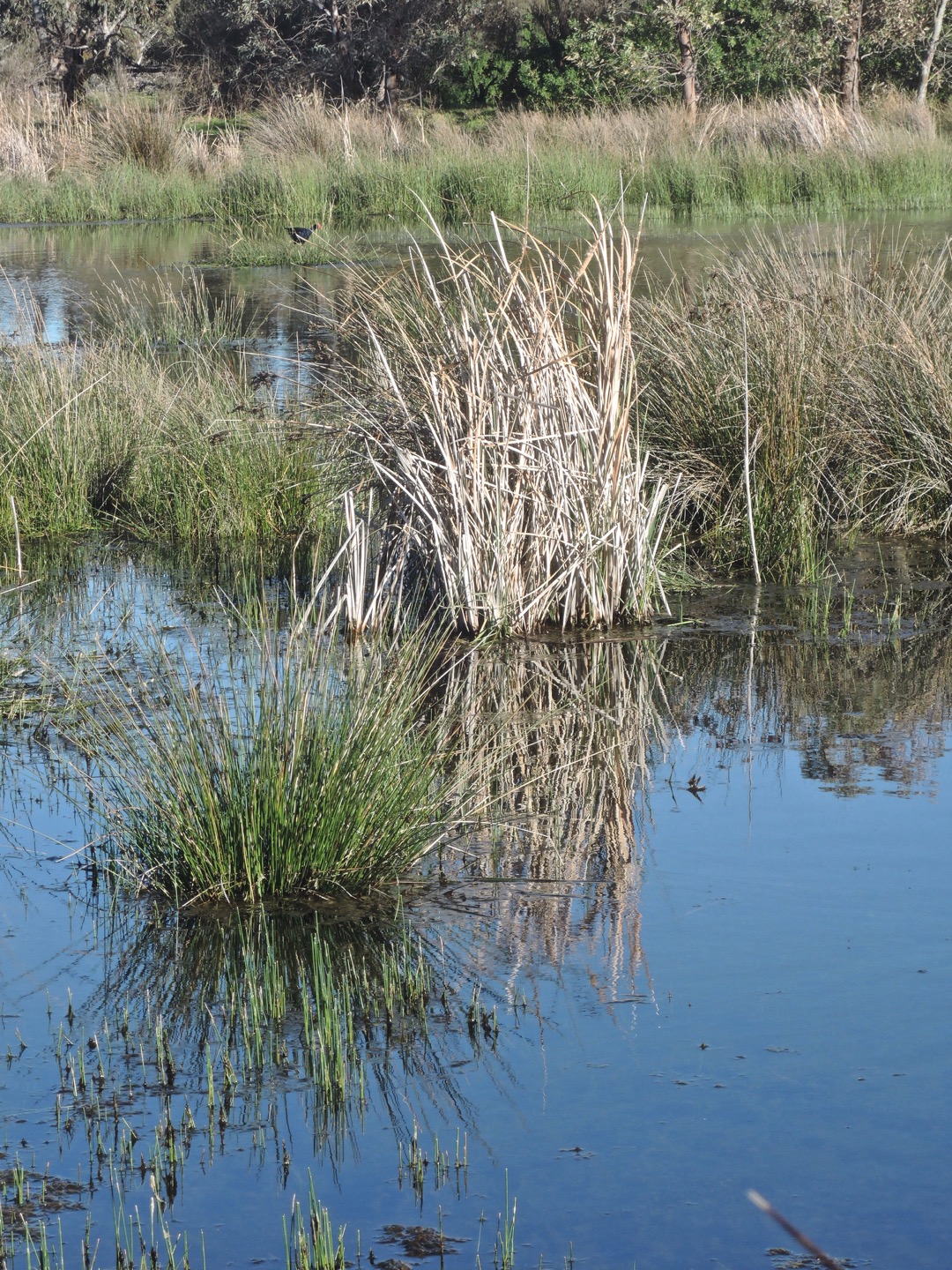
In the wetlands I pulled out my camera. The pictures show the landscape, but they don’t convey the sounds — frogs croaking, a hidden moorhen squawking wildly in amongst the reeds.

And they don’t convey the feeling of the sun on my skin, either: warm and sweet and new, the way the sun always feels in the first, early days of spring.

Out & about: spring flowers

‘When you’re walking the view shifts and changes.
Walking’s a form of hope.’

from ‘The World Without Us
by Mireille Juchau


I’ve just spent a week on holiday, during which I did a lot of walking.

Common (variegated) groundsel

I had planned to go running as much as I could, but due to illness, in the end I had to opt for a gentler form of movement.

Vanilla lily

And that turned out to be not such a bad thing.

Red parrot pea

The sun was gentle and soft most days, though the wind felt distinctly chilly. On a walk through Aldinga Scrub, I saw native flowers blossoming everywhere, in every colour: yellow, purple, orange, white, pink, blue.

Rice flowers

Paper flowers

Blue Grass Lily (Caesia calliantha)

Even the parts of plants that weren’t flowering seemed exotic and gorgeously coloured.

Twining vines (devil’s twine)

Crimson branches

Bees darted about, drinking nectar.

Bee on a coast beard heath plant (or a rice flower?)
with curling shoot

And though they’re not pictured here, roos observed me as I walked the sandy trail, while whistlers burbled hidden in the trees and a frogmouth boomed in the distance.

Yellow bush peas
(that’s what I call them, but apparently they’re called common eutaxia)

Spring has truly arrived.

Small

Other people’s words about … the passage of time

‘ … We can be like sisters,’ she says. And then she freezes.

I smooth my hair behind my ear. I look at the snow.

‘I didn’t … ‘ She leans forward, cradles her head in her hands.

And I think of how time passes so differently for different people. Mabel and Jacob, their months in Los Angeles, months full of doing and seeing and going. Road trips, the ocean. So much living crammed into every day. And then me in my room. Watering my plant. Making ramen. Cleaning my yellow bowls night after night after night.

‘It’s okay,’ I say. But it isn’t.

from ‘We are Not Alone
by Nina La Cour

Some people in the Western world — most people, perhaps, if you take at face value the world we see portrayed on social media, and on TV, and in the ads — live big, busy, crammed lives, like Mabel and Jacob in the passage above. They go overseas on holiday. Borrow money to buy houses and cars. Renovate and redecorate. Eat out at restaurants. Drink lattes with their friends. Bungee jump. Skydive. Buy new clothes each season, colour their hair so it doesn’t go grey, replace their smartphones with the latest model. The words vibrant and noisy come to mind. They are not the same things, and yet it can be hard to tell the difference, sometimes.

Me, I live a quiet life. A small life.

Partly, this is of my choosing, and partly it isn’t. Partly, it’s because a small life, a simple life, has always appealed to me; partly, it’s because that small life found its way to me a long while ago, and foisted itself upon me. And partly, too, the simple truth is that it’s difficult, when you’ve started down a small, narrow track, to turn around and retrace your steps. To find yourself out in the open. To start again.

Most of the time, I’m okay with this. But sometimes, like Marin, the eighteen-year-old narrator in the passage above, there are moments when it isn’t okay, after all.

Those moments pass. They do. But I think they’re worth acknowledging, every now and then.

Correa flower in blossom in Aldinga Scrub
May 2018
Small but beautiful, after all.

Out and about: dragons & damsels

‘When you’re walking the view shifts and changes.
Walking’s a form of hope.’

from ‘The World Without Us
by Mireille Juchau


I wasn’t expecting anything special on my most recent walk in the Scrub. It was mid-February, a warm Sunday at the end of a warm week, after a very warm January. I figured everything in the Scrub — bushes, birds, animals — would be going through what I always think of as mid-summer somnolence.

But things in the Scrub were thriving. Passing sea box bushes resplendent with red berries (above) and sheoak trees whose branches were clustered with woody fruit (below), I walked south, towards the little lagoon just behind the boundary fence that runs along Acacia Terrace.

Damselflies skimmed the (somewhat scummy) surface of the water, and a pair of ducks paddled amongst the reeds in the lagoon. As I followed the curve of the bank around to the other side of the pond, I saw a family of kangaroos lazing in the shade of the nearby bushes, one of them poised upright, ears pricked, standing sentry.

There was a bush in flower that I’d never seen before, too — I think it was a hakea, though I’m not entirely sure. Its white flowers reflected the bright summer sun so that the petals seemed to glow.

And just outside the Scrub, perched on an upright stump by the side of the road, a little dragon caught my eye.

He (or she, I’m not sure) was very still, so still that I thought at first he was an oddly shaped twig sticking out at the top of the stump. We regarded each other silently for quite some time — I, fascinated, he, less so — before I turned to go.

I swear I could feel that dragon’s eyes on me all the way home …

I see you

Other people’s words about … love

The bright lights had been switched off and the place was lit only by small windows. Then there she was — Stella — the top of her head highlighted as she looked down, reading. It never ceased to amaze him the thrill he got at seeing her. Catching her unawares.

From ‘Midwinter Break
by Bernard MacLaverty

Every time I read these words by Bernard MacLaverty, I feel my breath catch. They describe so perfectly those tiny, stolen glimpses we get of the people we love.

The photo accompanying this post is one I took while I was in Yorke Peninsula recently. It was very early summer: fan flower season. One evening just after sunset, as I wandered along the top of the cliffs, I came to a fork in the path where there were fan flower bushes growing at every corner.

And there, in the dim glow of the early-evening sky, the petals of the fan flowers — which in the warm, bright light of the middle of the day are a strong, cheery blue — seemed to shine for a few moments: pale, spectral, luminescent.

Perhaps my talk of fan flowers seems an odd match for the words I began this post with. But this was another one of those tiny, stolen moments we’re given in life from time to time, and it seems to me a good way to honour Bernard MacLaverty’s lovely words …

PS One other thing: a quick shout-out to my mother, who celebrates her birthday today, and who is a person responsible for many lovely moments in my life .

Walk on

Other people’s words about … things falling apart

When you’ve passed through a difficult period, it can be tempting to yearn for a delivery of good fortune, or for experience that feels redemptive somehow. You want suffering to have purpose, for pain to be justified by wisdom or abundance or growth.

from Weekend Reading
by Gena of The Full Helping blog

I had an odd weekend recently, going through some of my old journals and photos for writing-related reasons. The entries I’d written in my journals back then, during a time in my twenties when I lived overseas — first in Texas, then England, then Germany, Cairo, Jakarta — were vividly descriptive of a life I no longer lead, nor will ever lead again. Those journal entries threw me back to a ‘me’ I hadn’t exactly forgotten but somehow, foolishly, thought I had let go of.

Although I have let go of that me, mostly.

My life, during those years I lived overseas, was filled with extremes — of loneliness, joy, excitement, fear, love, doubt, sorrow, terror, grief. There was one particularly difficult period, living in Jakarta with my then boyfriend, when one thing after another went terribly wrong, and I felt as though I was walking through my days — those days that made up my life as I then knew it — with my head down, just waiting for the next blow.

Like Gena, in the words I’ve quoted above, sometimes in Jakarta I just wanted those most difficult days to have a meaning. A purpose. But they didn’t. Even now, when I look back on those times, I find them hard to make sense of. I think I always will.

Gena quotes the Buddhist Nun Pema Chodron, who says the following in her book When Things Fall Apart:

We think that the point is to pass the test or overcome the problem, but the truth is that things don’t really get solved. They come together and they fall apart. Then they come together again and fall apart again. It’s just like that. The healing comes from letting there be room for all of this to happen: room for grief, for relief, for misery, for joy.

These days, I would quibble with Pema Chodron’s use of the word healing — isn’t that just another way of saying you can solve things? — but then, I’m not a Buddhist. Or a Nun.

Still, I like the notion of things falling apart and then coming together again, only to fall apart once more; I find it immensely comforting. Even more, I like Pema Chodron’s simple statement, neither defeatist not celebratory, that life is just like that.

It is just like that, isn’t it?


The photographs accompanying today’s posts come from a recent trip to Yorke Peninsula. It was mid-November, and the late-spring flowers dappled the dunes. Fan flowers, common sea heath, grasses, sedges, acacias and other flowers I couldn’t identify and don’t usually see at home had sprung up everywhere, in every bare patch of sandy ground, in every sheltered nook, in every little cranny in the rocks. Walking amongst them, I felt things come together again in my heart, for a little while.

And then — well, then I let go. And walked on.

Tangled

Other people’s words about … writing a journal

She put the card carefully on her knee under the journal, which she opened at the middle to a sprawl of furious and barely legible writing. There were circles and boxes and in some places the pen had been pressed so hard against the paper that it had torn. Clare snapped the journal shut and for the second time in as many days she put her head in her hands and cried.

There wasn’t, she thought, a single page in all the [boxes of journals] that was worth keeping. For twenty-seven years she had written the same things over and over.

from ‘Closing Down’
by Sally Abbott

Like the character Clare in the passage above, I was an avid journal writer for many years — from the age of about twelve years old, in fact. I began writing a journal because my Year 7 English teacher made the activity a part of our curriculum for the year: she gave us ten minutes at the beginning of each class to write in our journals. She saw journal writing as a way of encouraging us to learn to write fluently, spell correctly, express ourselves clearly and perhaps — as a corollary of the writing — to read widely.

Like Clare, I still have all my old journals, stored away in a plastic crate. Those old childhood ones are filled with pages of neat handwriting in blue fountain-pen ink, drawings, doodles, comic strips I cut out from the newspaper and pasted in, pictures from old magazines, stickers, and notes other people wrote to me (on the odd occasion when I allowed someone access to my journal). They are bright and colourful and their tone is, mostly, chatty and cheerful.
But the later journals, which were written during my move from childhood to adolescence through to early adulthood and beyond, are filled with more handwriting and less colour. The writing takes over. It fills the pages. There is page after page after page of it.

It was a grief counsellor who had recommended Clare start keeping a journal … It was a way of beginning to articulate her feelings, the woman had explained, and Clare remembered her sad, earnest face and the huge weight she gave to the word ‘feelings’, as if they were something Clare could take out of herself and put on a table and carefully untangle and separate and tidy up. And perhaps, for a little while, it had helped. But what had she been thinking … to write over and over and over that she was sad or angry or okay? I only wrote what I felt, she thought. I never wrote what I saw. I never wrote what I did. I never wrote that I’ve made it this far.

In my early adulthood, like Clare, I was encouraged by various health professionals to continue keeping a journal as a part of my therapy; indeed, I was told I could see journal writing as a kind of therapy in itself.

And it was, I guess. For many years, it was.
Or at least I thought it was. I only wrote what I felt, Abbott’s character Clare realises in the passage above (my emphasis): I never wrote what I saw. These are wise words. There came a time, in my own journal writing, when I looked back over all those handwritten pages and was dismayed to see that what I had thought of as a process of therapy and healing was more like a process of emotional purging, repeated over and over and over again.

Reading (or rather, trying to read) those passages felt oppressive, overwhelming. Why did I always have the same feelings? Why did I always write about those feelings? Why didn’t writing change the feelings? Why couldn’t I find a cure?

I’ve talked before about my scepticism when it comes to dubious concepts like recovery and healing and cure. That’s part of my theme today (again), but what interests me more here is the way Abbott, using the character Clare, focuses on another dubious concept: the huge weight we place these days on our feelings, and therefore on our need to untangle them and tidy them up.
Meditators often talk about the practice of watching their thoughts and feelings arise and then letting them pass by without becoming ‘attached’ to them. Though, intellectually, I’ve understood the reasoning behind this for years, it wasn’t until I saw it expressed through Clare’s character that I actually got it.

Feelings are repetitive, yes: I hadn’t been wrong about that, in re-reading my journals. What I had been wrong about was letting this bother me. And measuring myself by it.

I never wrote that I’ve made it this far. Here, Clare realises that feelings, as measuring tools of ourselves and of our worth, will always fail. They do not mark where we are in our lives. They do not necessarily affect what we see, what we do, where we go. (Or they don’t have to, anyway.) In this sense they are, ultimately, irrelevant. Our feelings accompany us on our passage through life, but they don’t determine the actual passage itself.

And they don’t have to be cured.

Interestingly, given the recurrent out & about theme of some of my posts on this blog, the character Clare in Abbott’s book is a great walker. She walks at night when she can’t sleep: she walks, and walks, and walks. And, in contrast to when she’s writing her journal, when she walks, she sees. When she sees, she learns. Her feelings, as she walks, are a backdrop. They are not the main event.
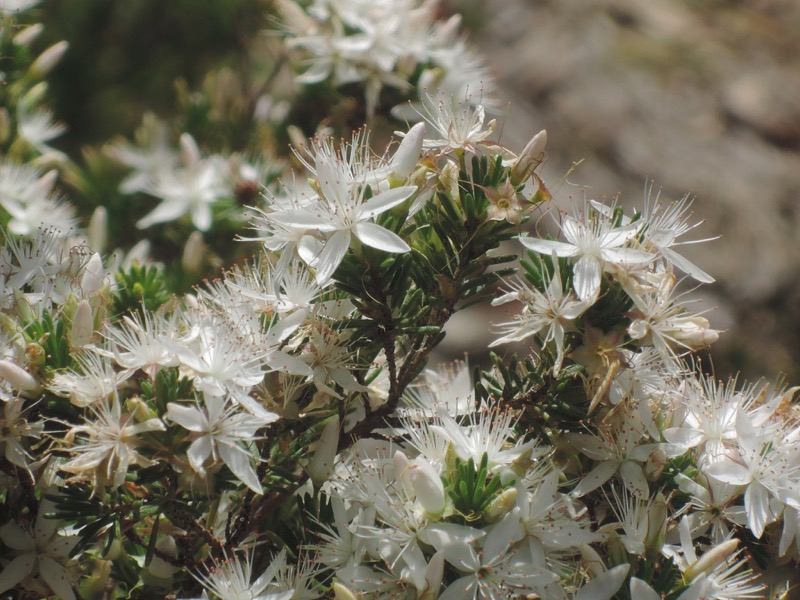
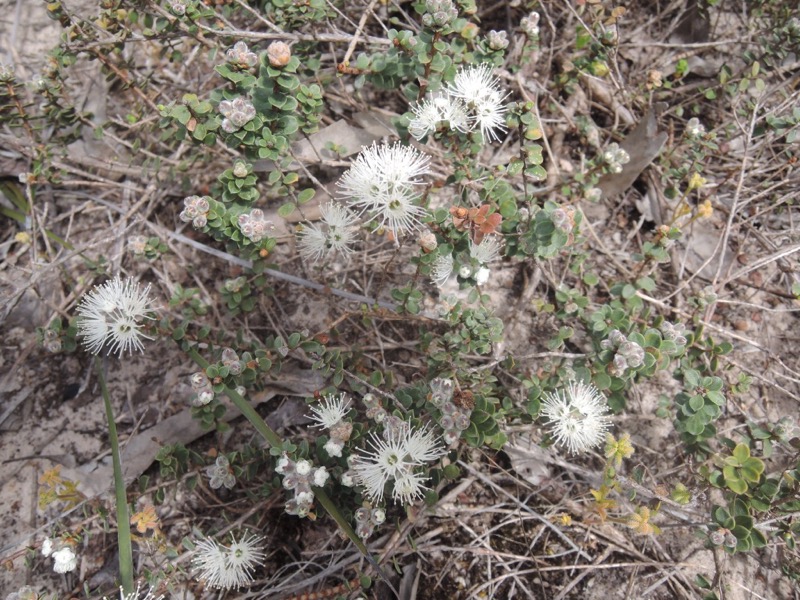
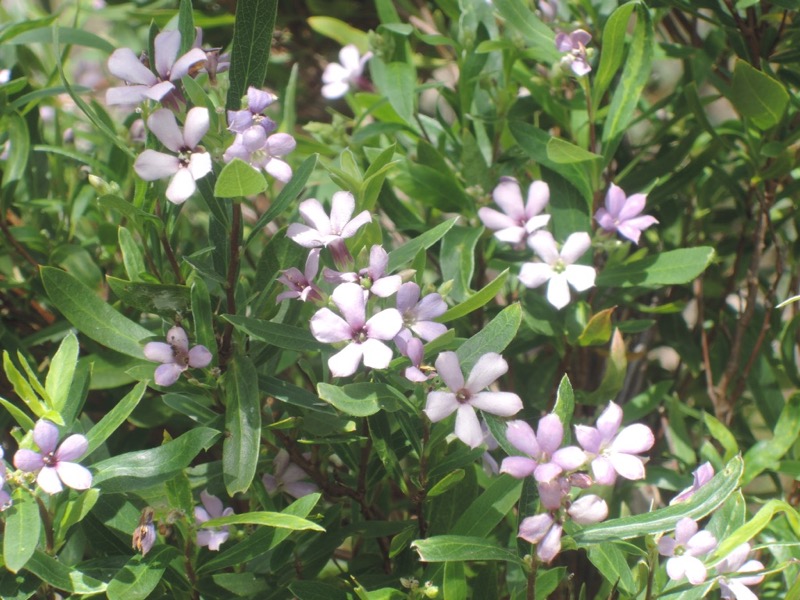
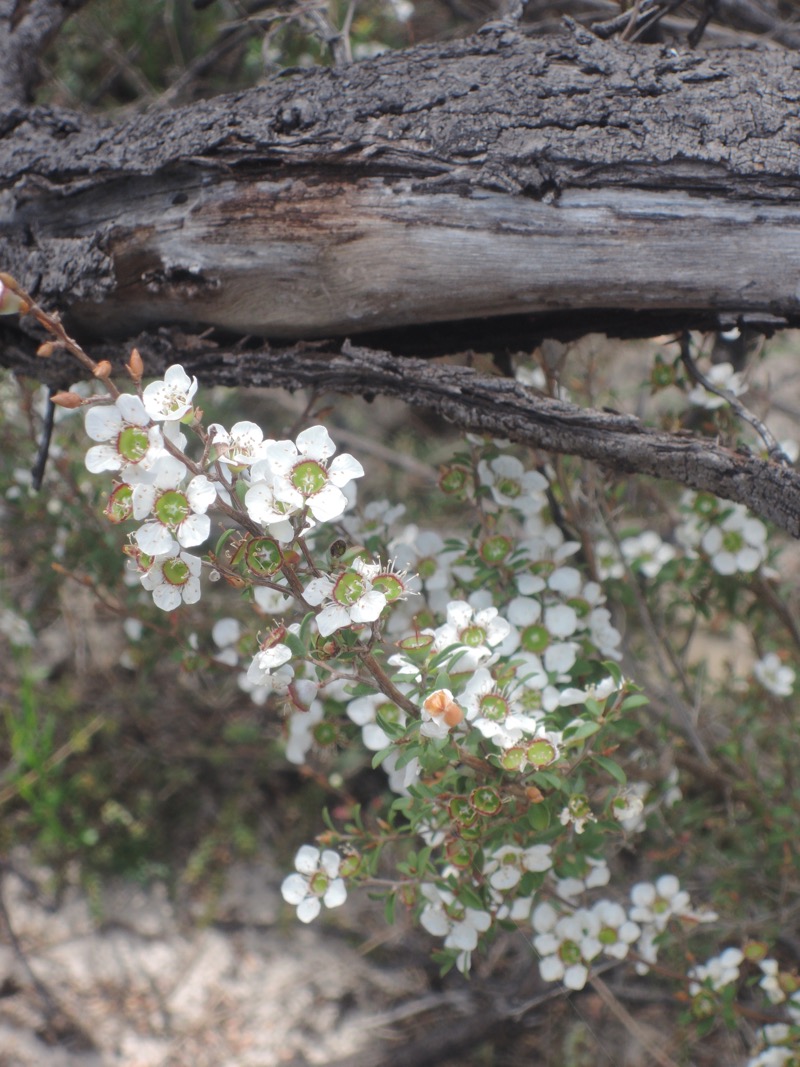
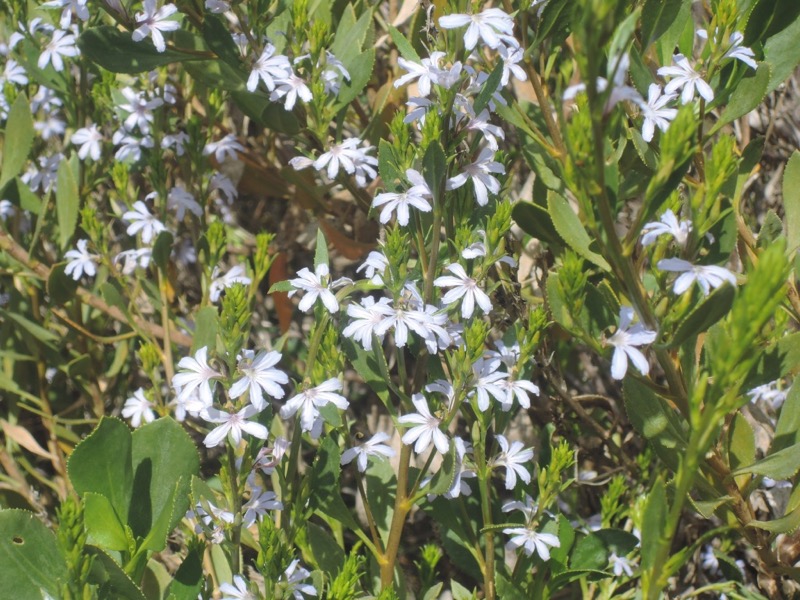
As for me? I took the pictures in today’s post on a recent bushwalk, a day in late October when there were spring flowers everywhere, purple and blue and pink and white. I was feeling fairly gloomy at the time of that walk — unwell; stressed about being unwell; stressed about my jobs; stressed about feeling stressed about all of these things — but the pictures don’t convey that stress.

And that is as it should be. The feelings were a backdrop to the walk. What I saw was real and lasting. That’s what matters.

Ubiquitous

Other people’s words about … fatigue

My legs, when I got up to go to the toilet or kitchen, felt light and shaky, far away from the rest of me …

Even speaking was too much. My words seemed pinned to the bottom of my jaw, and came out compressed and monosyllabic. I don’t remember crying much, but there was a dampness, as if moisture were constantly seeping through my skin, and sinking. As if everything inside me had become viscous, liquid, beholden to gravity and I was draining always to the lowest point; the soles of my feet, my buttocks, my back.

from ‘Anaesthesia’
by Kate Cole-Adams

The year I turned forty, I caught glandular fever (known by my North American readers as mononucleosis). It was a pretty typical case, I think: for the next year or so, I caught colds and viruses and coughs at the drop of a hat, and meanwhile I experienced a tiredness that — like the tiredness Kate Cole-Adams describes in the passage above, in a depiction of her own experience of adult-onset glandular fever — was beyond any kind of tiredness I had ever experienced before. It wasn’t tiredness at all, really: it was lethargy, lassitude, limpness, listlessness, languor — all those ‘L’ words, combined with a clammy, vaguely feverish kind of exhaustion. My limbs felt heavy and my head felt swirly and the floor seemed spongy beneath my feet.

Though the fatigue and exhaustion eventually, two or so years down the track, dissipated, I have found that even now, years later, I still get the occasional, sudden bout of glandular-fever-type fatigue. It always happens when I’m least expecting it and lasts for a few days, sometimes a week or more. If I think about it deeply enough, I am usually able to explain it by pointing to a higher than normal level of stress in my life.

I had one of those bouts again just recently. Serendipitously, I had a few days off between shifts at work, and so I decided to spend some time away in that place I love, Aldinga. I was sapped of energy and appetite: too tired to walk on the beach or catch up with family and friends as I’d hoped; too tired, even, to write or to bake. Instead, I lay on a sofa in a pool of sun, and read, and dozed, and waited for the fatigue to pass. I knew that it would. I just didn’t know when. (Actually, I still don’t know. As I write this post, a couple of weeks down the track, I’m still experiencing fatigue and unwellness. But it will pass, as all things do.)

The first day that I felt even vaguely up to it, I went for a wander in the Aldinga Scrub. I was still very tired, and so I took the walk slowly, following the path marked out by signposts for tourists, which takes you on a small loop: first south, parallel with the coast, then east towards the hills, then back northwards and west to the starting point. (Its official name is the Coral Lichen Circuit, and you can find more out about it here.)

It was late spring: whistlers burbled (mostly) unseen in the branches. The yellow months had passed, and now it was the time for blues and purples and pinks and whites. And everywhere that I walked there were twining fringe lilies growing. As the photos in this post illustrate, I found them peeking through the leaves and branches and stalks and branches of sea box bushes, and rock ferns, and mallee pea-bushes, and muntries, and sheoaks, and grass trees, just to name a few.

They are common native flowers in South Australia, I gather — neither delicate nor rare. And yet each time I saw one on my walk that day, I felt a little thrust of joy at their very ubiquity. It was partly to do with the fact that I was able to identify them; partly to do with the fact that I’d reached a point in the ebb and flow of my own exhaustion where I felt I had enough stamina to go on another of those wanders, however gentle that wander was; and partly, simply, to do with the lovely prettiness of the lilies themselves.

Perhaps the fringe lilies were a symbol for me that day, growing and twining — despite their appearance of delicate fragility — in amongst all the other greenery. Thriving, despite everything.

Or perhaps symbols are unnecessary here. Perhaps it was enough just to see them and enjoy them exactly for what they were.

Note:
I recently found a wonderful resource for anyone who is interested in learning more about the Aldinga Scrub. It is the Flickr account of the Friends of the Aldinga Scrub, which has hundreds of wonderful photos taken in the scrub, not only capturing but also identifying the native flora, fauna and fungi. Check it out here.

Out and about: after the rain

‘When you’re walking the view shifts and changes.
Walking’s a form of hope.’

from ‘The World Without Us
by Mireille Juchau


This year, July was exceptionally dry in South Australia. Then August blew in and it has been bitterly cold, windy and rainy ever since.

There is a manic wind whipping through the treetops today … the sort of wind that’s somewhat unsettling and leaves me feeling a bit scratchy, Belinda Jeffery writes in her August 5 entry in her wonderful cookbook-cum-nature diary The Country Coobook. And I know what she means. In the middle week of August, I spent a week on holiday near the coast down south, and much of the time the squalls of rain were so frequent and unpredictable, there wasn’t much of a chance for me to get out.

Rain in the vineyards

Still, one morning mid-week the sun shone between showers and I risked a walk. I headed down a path that skirted wetlands and vineyards (on one side) and bush (on the other side) and then turned south to follow the path back into the bush.

Flooded bush

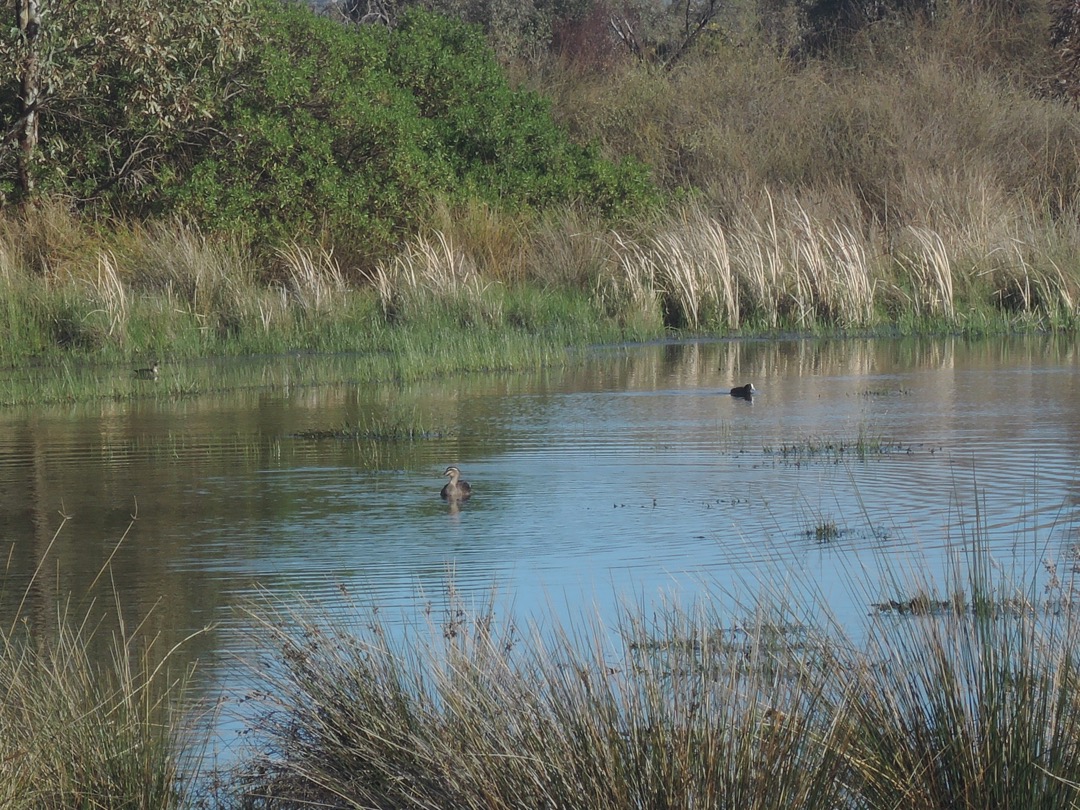
The low-lying parts of the land along the trail had flooded. Beyond the reeds that bordered the flooded land, I saw trees with their trunks submerged, and waterbirds diving and swooping from branch to branch.

Submerged trunks

There was even a family of ducks.

If I crouched down to peek through the reeds, I could just see the green grassy banks rising above the flooded land, further within, beyond the path.

Is the grass always greener on the other side?

Once I’d walked far enough south, I turned west, deep into the bush, where there were no more floods, and where yellow blossom dotted the landscape (more about which in an upcoming post). But even as I walked, the sky darkened and the temperature dropped.

I made it home just before the next burst of rain …