
Other people’s words about … places that reside within our hearts
During our visit to the jungle, while we slept on the verandah at 3 AM, night would be suddenly alive with disturbed peacocks. A casual movement from one of them roosting in the trees would waken them all and, so fussing, sounding like branches full of cats, they would weep weep loud into the night.
One evening I kept the tape recorder beside my bed and wakened by them once more out of a deep sleep automatically pressed the machine on to record them. Now, and here, Canadian February, I write this in the kitchen and play that section of cassette to hear not just peacocks but all the noises of the night behind them — inaudible then because they were always there like breath. In this silent room (with its own unheard hum of fridge fluorescent light) there are these frogs as loud as river, grunting, the whistle of other birds brash and sleepy, but in that night so modest behind the peacocks they were unfocused by the brain — nothing more than darkness, all those sweet loud younger brothers of the night.from ‘Running in the Family‘
by Michael Ondaatje
I have just spent a week away in Deep Creek, having been chosen as this year’s lucky winner of the Deep Creek Residency for writers. I spent that week away writing, reading, bushwalking, running, writing again, then writing some more. It was a joyous time, the rarest privilege, to be given time away simply to write.
 Daytime, Deep Creek, October 2024.
In our lives, I think that there are some places, connected to some times, that are somehow magic, that come to us through luck or stealth or a great deal of planning and then reside with us forever. These places become a part of the fabric of who we are, though we may not always understand why, and what we feel, when we think of them or remember them or revisit them, is a sense of awe — a sense of connection to something deeper than we can articulate.
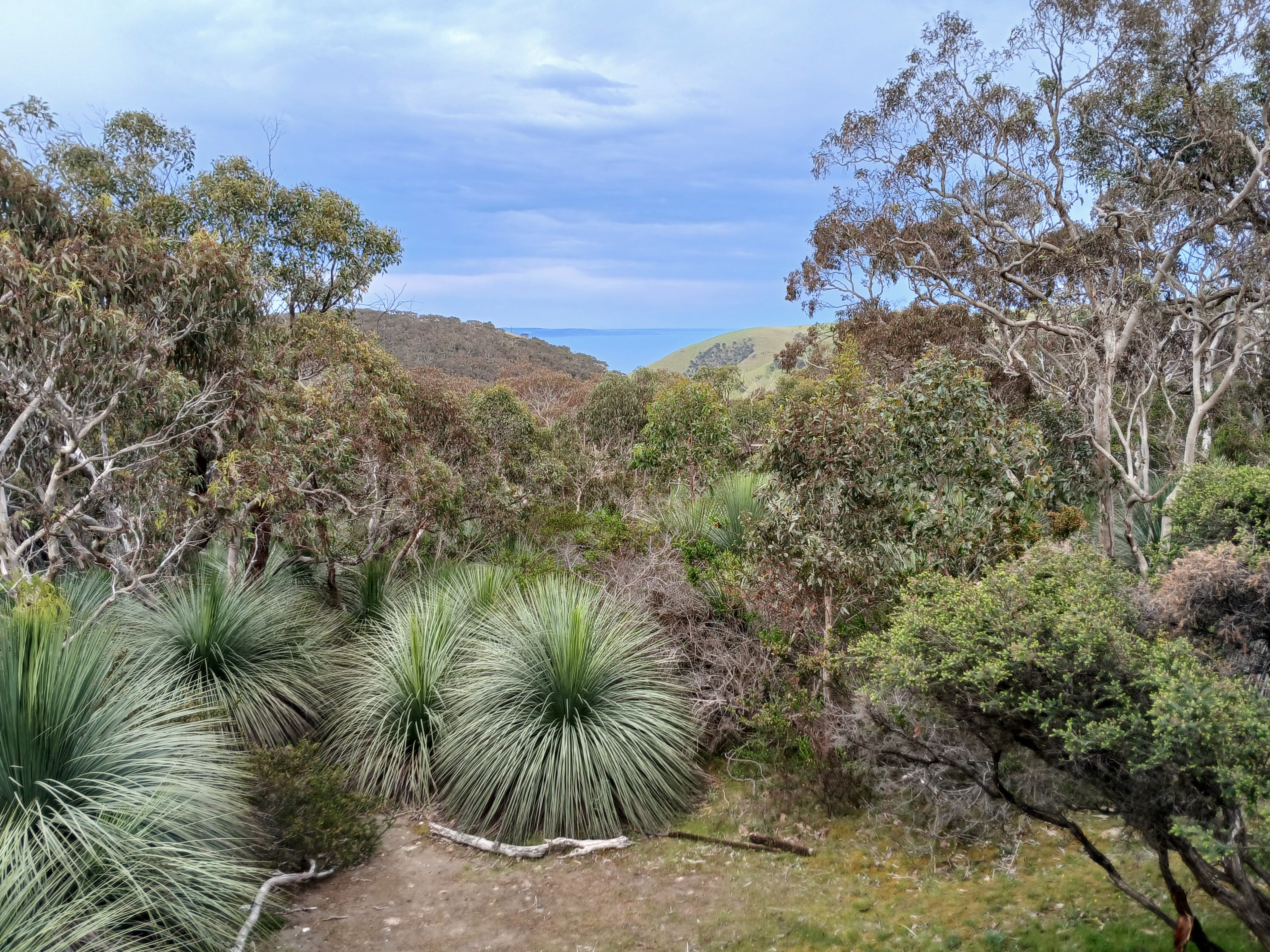
 Gully of grass trees, Deep Creek, October 2024.
Deep Creek, place of grass trees and rolling hills and shrike thrushes calling in the trees, place of kangaroos and echidnas and sheep and shingleback lizards, place of tawny frogmouths and fogs and sunshine and rain and big, big skies — Deep Creek is, anyway, one of those places for me, a place close to my heart. I have left Deep Creek now, and the hopes and dreams I went there with — that I would write copiously and productively, that the story I’m writing is worth telling, that the manuscript I’m working on might one day get published — may or may not come true, but Deep Creek is still with me and always will be. I don’t know how else to put it.
 Resting place, Deep Creek, October 2024.
And this is what I love about the passage I’ve quoted above by Michael Ondaatje, the way he captures the mystery of a place, its essence; the way it has become a part of him. I have never been to the jungle that he writes of, never heard peacocks who weep weep loud into the night. But in Deep Creek I have felt what Ondaatje describes. In Deep Creek I have felt that I have found a place that will, like breath, always be with me.
 First light, Deep Creek, October 2024.
Lately I’ve been reading …
-
- Working on that novel was like visiting a little town every day for four years, a place so dear and sweet. Then I sold it: Thea Lim explores the commodification of art, and of our lives.
- I was so numbed by life that month, by all the accumulative sadnesses of being 50-something in a whirlpool of life change, that I wasn’t sure how to feel. But when I stood up from my computer to walk around the neighborhood and look at all the familiar things, so many of which had years of memories attached to them, each their own little story, I let myself feel happy. This wasn’t the novel. It wasn’t the Big 5. But it felt truer to the writer I wanted to be: On a related theme, Amy Stuber, on writing short stories, trying to write a novel, and then returning to short story writing. On writing what she wants to write, not what the industry tells her to write. And on growing older.
- Ethical Consumption can ultimately serve as a type of delusion or fantasy where we tell ourselves that our economic actions are righteous and that we’re doing our small part to make a difference, even in the face of underwhelming evidence: Elizabeth L Cline, exploring the problems with ethical consumerism and making the argument for returning to Consumer Activism.
- Even now, years later and sober multiple times over, the story I recount reflexively about Nick’s death and my concurrent relapse is not the true story: Adam Spiegelman, on heroin addiction and the aftermath.














 twenty-one words