
Other people’s words about … tea
You made me tea
while I shook the rain from my jacket
You stooped to fit into the kitchen
but handled the cups as if they’d been
the fontanelles of two young sons
whose picture sits in the hip of your 501s.
We spoke of — what? Not much.
You weren’t to know how your touch
with the teaspoon stirred me,
how the tendons of your wide, divining hands
put me in mind of flight.You wouldn’t have known
when you bent to tend a plant
that your shirt fell open a smile’s breadth.
You parted the leaves and plucked
a tiny green bud. Best to do that
with the early ones, you said.
I thought of the salt in the crook
of your arm where a fine vein kicks.
Of what it might be like to know
the knot and grain and beat of you;
the squeak of your heart’s pips.From ‘Tea’
By Tiffany Atkinson
Once upon a time, I used to describe myself as someone who drank ‘endless cups of tea’ — which was indeed true, once upon a time — but these days I’m sensitive to caffeine, and so my morning pot of tea, the treasured pot of tea, is the only tea I drink for the day.
And while I drink that pot of tea, I write. Some years ago, when I decided to make a commitment to writing something every day, no matter how little, I linked the commitment I’d made, very strategically, to my morning pot of tea. That way, I told myself, even when I’m filled with doubt about whatever it is I’m writing at the time, even if every part of me wants to give up on it, even if procrastination and writer’s block are overwhelming me, I still put myself through the process each morning — because of the cup of tea that accompanies it.
That’s how I wrote Ravenous Girls, in fact — one pot of tea at a time.
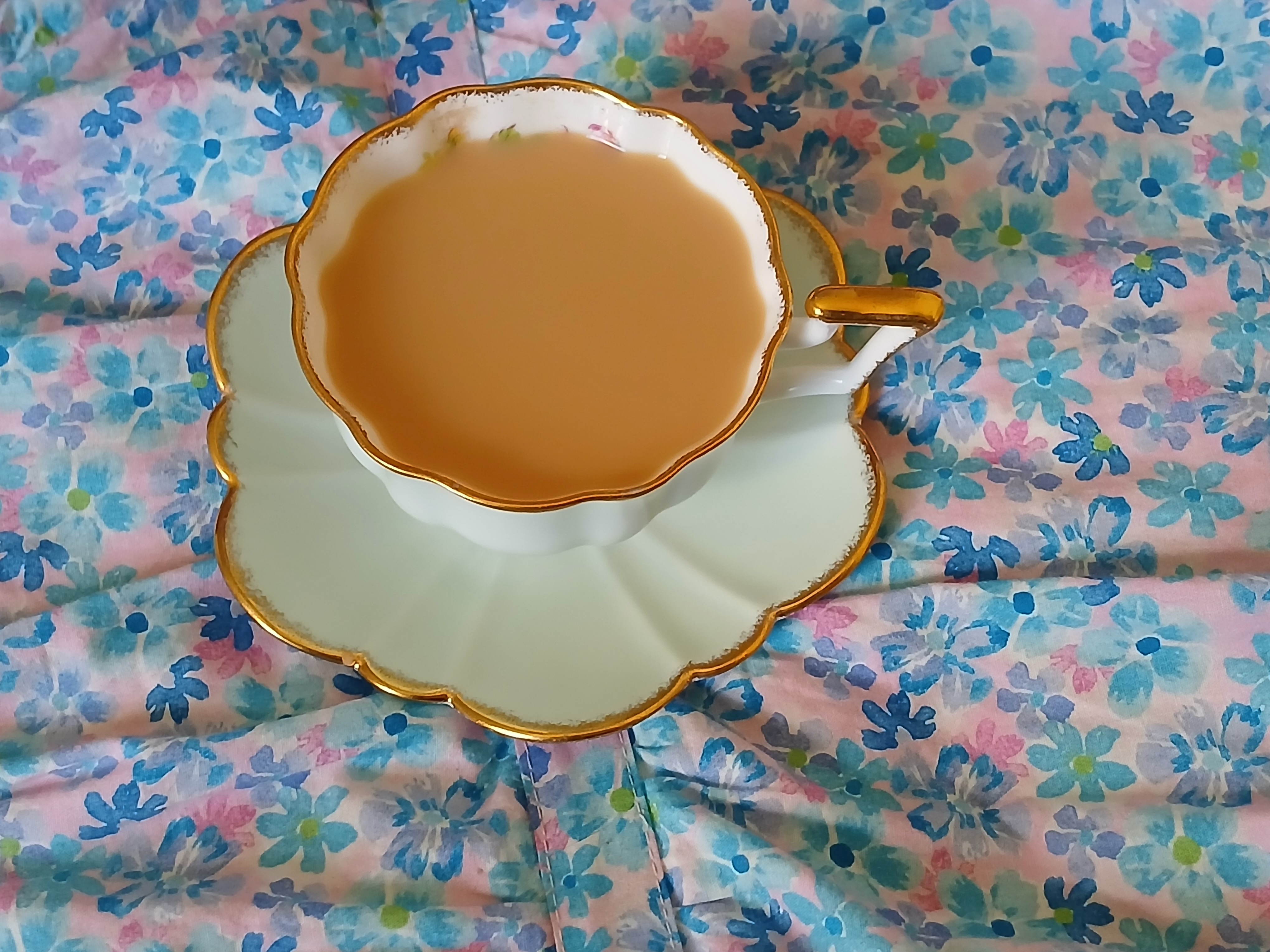
Morning pot of tea, June 2025.
Tiffany Atkinson’s beautiful poem Tea — which I found in a book that a dear friend gave me, Sophie Dahl’s Ten Poems about Tea — isn’t about tea, not really. It starts with a simple, everyday gesture, a man making a woman a cup of tea, and then, like all the best poems, it takes flight. It soars.
It’s a poem to be read slowly, to be savoured, just like a pot of tea.
Lately I’ve been reading …
- Bluebells are popping up and there are patches of bracken: Phoebe Weston explores the ‘ghost woodlands’ of England, tracts of land that have been grazed for centuries but are now being returned to their original woodlands.
- I am actually grateful that I have an opportunity to correct the record on this because I think people have the wrong idea about my path: Brandon Taylor, in an interview at The Republic of Letters. I am a huge fan of Taylor’s fiction, and perhaps for this reason it has come to me only slowly that I am less enthusiastic about his online presence. I don’t know why this realisation astonishes me — this is true about many of the writers whose fiction I admire: it’s their work I love, not them. Be that as it may, this is a fascinating interview in which Taylor articulates his thoughts on writing, writing success, the state of fiction in the US today, micro-agression, and literary criticism.
- The New York Times called it “the first great perimenopause novel”, which is incorrect – not because you could easily name 10 others, rather because what it ignited was not an honest heart-to-heart about hormones, but something far more radical. What if a woman just told the truth, about sex, monogamy, marriage, mortality, domesticity, friendship, the life of the mind?: Zoe Williams in conversation with Miranda July, author of the novel All Fours. This is an interesting interview, even if, like me, you are not a fan of All Fours. Disclosure: I didn’t plan to read this novel. I felt that I would loathe it, for reasons that are essentially encapsulated in the quote I’ve used here. Having now (reluctantly) read it, I can say that I found it both unexpectedly better than I thought it would be and just as irksome and loathsome as I had thought I would find it. Mostly, though, I think what I object to has less to do with July’s writing (which is at the very least thoughtful and entertaining) than with the way that since publication All Fours has been heralded as ‘the truth’ about ‘perimenopausal’ women. Why do we even need to look for one single ‘truth’? July’s truth is not mine, but in all fairness, she may not have set out to write ‘the’ perimenopausal novel in the first place. What do you think?
- One of the admirable things about All Fours is that July lets her protagonist have such ugly feelings: Okay, or maybe the reason I didn’t enjoy All Fours is simply that it offended me? Here’s Garth Greenwell on why it’s important to set aside your offence as a reader.
- The dog barks only at pigeons, no other bird species. The amount of discussion the owners have given this topic could constitute a peer reviewed paper: And finally, a piece of short fiction, Weike Wang’s hilarious and poignant story about dogs and their owners.









 twenty-one words