Out & about: winter solstice

‘When you’re walking the view shifts and changes.
Walking’s a form of hope.’

from ‘The World Without Us
by Mireille Juchau


I spent the week of the winter solstice on holiday. I had planned to go camping to Yorke Peninsula, but various things conspired against these plans. In the end, it didn’t matter. I live by the beach. That’s holiday enough in itself.

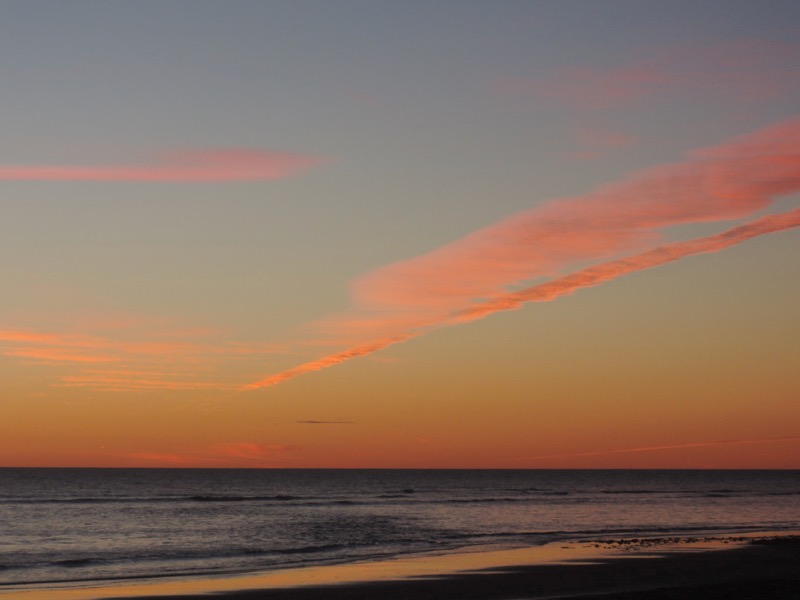
Winter solstice sunset (1)

The weather that week was unusually dry, cold and sunny for June in Adelaide, with overnight temperatures getting down to as low as 2 degrees Celsius. That made for beautiful weather in which to go walking.

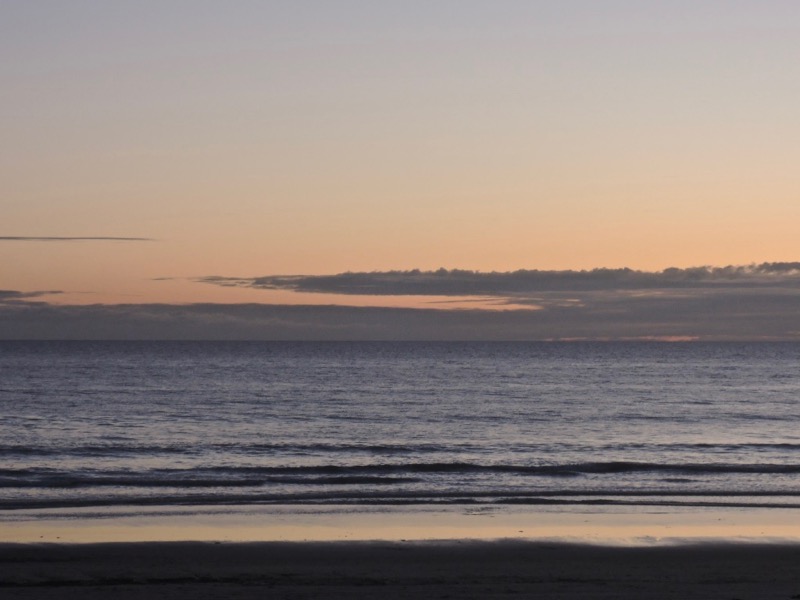
Winter solstice sunset (2): dying light

The sunset on the evening of the winter solstice was cold, clear and beautiful. Though the time of the year when the days are at their shortest often leaves me feeling light-starved and sunshine-deprived, that evening was still worth celebrating.

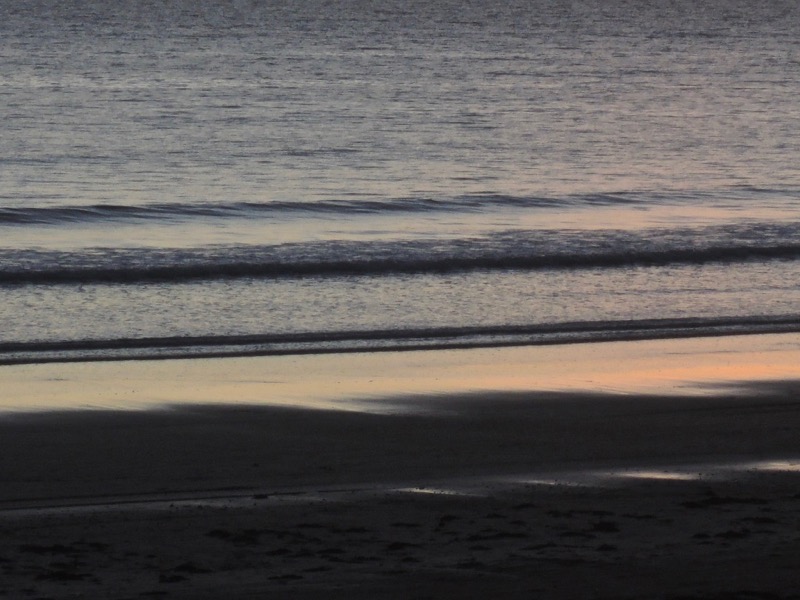
Winter solstice sunset (3): last glow of light

An additional note: I took these photos between about 5.15 pm and 5.30 pm. The sunsets from hereonin will be later every day … and that’s another thing worth celebrating!

One day

Other people’s words about … the sea

After lunch, as a reward for their fine behaviour, Nurse allowed them to bundle into coats and hats and bolt from a back door along a path that ran behind Mr Styles’s house to a private beach. A long arc of snow-dusted sand tilted down to the sea. Anna had been to the docks in winter, many times, but never to a beach. Miniature waves shrugged up under skins of ice that crackled when she stomped them. Seagulls screamed and dove in the riotous wind, their bellies stark white. The twins had brought along Buck Rogers ray guns, but the wind turned their shots and death throes into pantomime.

From ‘Manhattan Beach’
by Jennifer Egan

I have never been to a beach in the kind of winter that Jennifer Egan describes in the passage above. Many years ago, in Michigan, I walked across a frozen lake (and thereby learnt the meaning of the term ‘wind chill factor’), but that was a lake, not the ocean. I’d like to experience that wild, violent chill, just once in my life.

The beaches along the South Australian coast have their own seasons of peace and restlessness. Often, the early months of Autumn are times of softness and stillness, and this past April there were several days when the sea lay like blue, shining silk on a bed of sand.

As you can see from the photos in today’s post, which I took at the beach in the first week of April, the South Australian coastal world is utterly unlike Egan’s, but there is wildness at its essence, all the same.

Chasing clouds

‘It took me years to see that path and to find my pace.
When I finally got moving, I hoped I might be able to run forever.’

From ‘The Long Run’
by Catriona Menzies-Pike

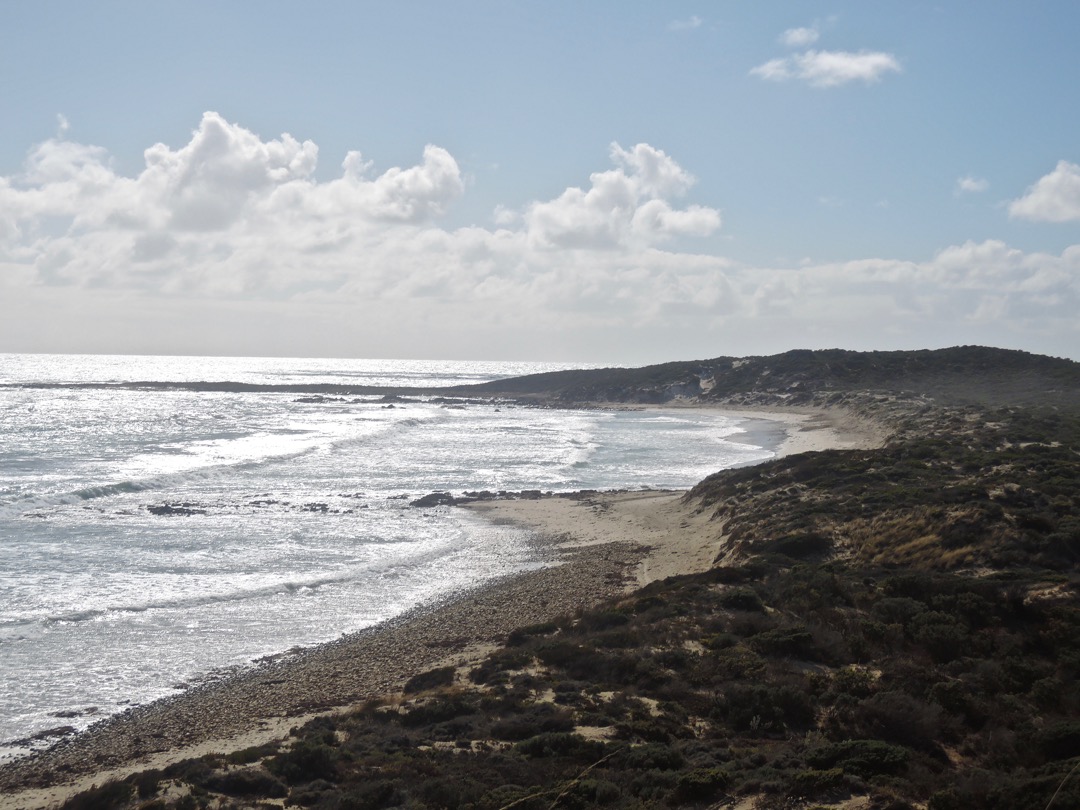
I recently spent a week holidaying in one of my favourite spots, near a clifftop in the Yorke Peninsula region. It was mid-Autumn, and the weather, like the view, changed every day, sometimes every minute.

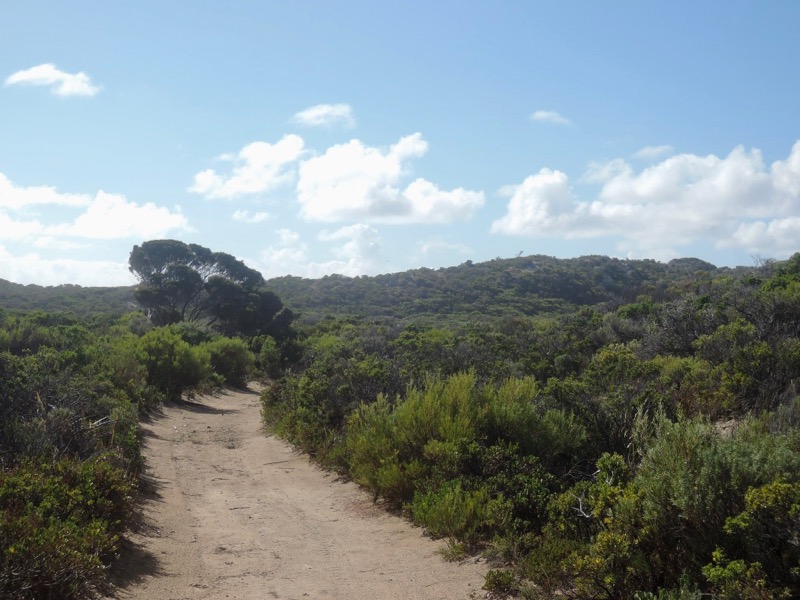
During one of the sunnier hours, I went for a run in the bushland that lies behind the dunes and cliffs. I took off my running shoes and ran barefoot along the winding sandy track that rises and dips through the scrubland. Despite the lack of rain in the previous months, the bushland here seemed to me quite lush (at least by South Australian standards).

I finished my run at the base of the highest dune, and then I trundled up to the top of the dune to look down on the beach and shoreline below.

It was a moment of silver seas and blue skies — a moment worth celebrating.

Chasing clouds

‘Some athletes love to talk about what a simple sport running is.
They say that all you need is a pair of sneakers.
That’s not true.
What you need is some freedom of movement
and the ability to see a clear path ahead of you.
It took me years to see that path and to find my pace.
When I finally got moving, I hoped I might be able to run forever.’

From ‘The Long Run’
by Catriona Menzies-Pike

Around about a year ago, I wrote a post on this blog in response to lawyer-turned-long-distance-runner Robyn Arzón’s book Shut Up and Run. In that post, I wrote, in angry contradiction to Arzón, about the virtues of taking things slowly, of living humbly, of letting things unfold gently, whether or not your life is unfolding as you wish it would, or as you think it should. (You can read the post — which, by the way, I still stand by — in its entirety here.)

Here’s the thing about running, though, as an activity, as a practice: it lends itself to metaphors. That’s why so many runners, like Arzón and Menzies-Pike, write about it. Speed, distance, endurance, cadence, rhythm, pace — all of those things can be metaphors for something else: for life. It took me years to see that path and to find my pace, Menzies-Pike writes, of her running. And: When I finally got moving, I hoped I might be able to run forever.

Don’t tell me she’s not talking in metaphors.

As for me, I stopped mid-run — on a gorgeous, warm, still day last week; a day when all of coastal Adelaide seemed to be bathed in soft sunshine — to take the photos you see in today’s post. Afterwards, I put my camera away and lingered at the shore a while, before wandering back from the beach to the foreshore path and setting off again, back home.

Days like that — days of running beneath a soft blue sky, beside a silken blue sea — are days, simply, to be grateful for, days that feel as though they are unfolding as they should, or at least as you wish they would.

And so this post is the first in a new series on my blog entitled Chasing clouds. It is a companion series to my Out and about series, in essence. The theme in that series is walking; the theme in this one is running. Running, for me — like walking — is about wandering, about wondering. It is about chasing clouds.

Of course I’m using metaphors. Running, for me, is about hope.

Unpacked

Other people’s words about … surfing and the sea

Nearly all of what happens in the water is ineffable — language is no help. Wave judgment is fundamental, but how to unpack it? You’re sitting in a trough between waves, and you can’t see past the approaching swell, which will not become a wave you can catch. You start paddling upcoast and seaward. Why? If the moment was frozen, you could explain that, by your reckoning, there’s a fifty-fifty chance that the next wave will have a good takeoff spot about ten yards over and a little farther out from where you are now. This calculation is based on: your last two or three glimpses of the swells outside, each glimpse caught from the crest of a previous swell; the hundred-plus waves you have seen break in the past hour and a half; your cumulative experience of three or four hundred sessions at this spot, including fifteen or twenty days that were much like this one in terms of swell size, swell direction, wind speed, wind direction, tide, season, and sandbar configuration; the way the water seems to be moving across the bottom; the surface texture and the water colour; and, beneath these elements, innumerable subcortical perceptions too subtle and fleeting to express. The last factors are like the ones that the ancient Polynesian navigators relied upon when, on the open seas, they used to lower themselves into the water between the outriggers on their canoes and let their testicles tell them where in the great ocean they were.

Of course, the moment can’t be frozen.

From ‘Barbarian Days’
by William Finnegan

I know someone who is in his mid-fifties now, and who, like William Finnegan, has been surfing since he was a teenager. Though he and I are both avid beach-lovers, I know that when he looks at the sea, he sees something different from what I see.

I (from my admittedly middle-class, Western, leisured perspective) look at the sea for beauty. I don’t understand the sea’s tides, its swells, its waves. I understand, simply, how the sea makes me feel.

It’s hard to express my feelings about the sea in actual words, though. They are, to use Finnegan’s words in a slightly different way, subtle, fleeting,subcortical, ineffable.

And … good.


Big

Other people’s words about … sunsets

The sun was setting. There were plenty of natural phenomena that went unrecognised (snowflakes kissing a windowsill, fingernails dug into the skin of a tangerine), but Cameron could see why people made such a big deal of sunsets. The sunset at Pine Ridge Point always made Cameron feel so disastrously human, caged inside his own susceptible self.

From ‘Girl in Snow
by Danya Kukafka

I found Danya Kukafka’s words in the passage above very poignant — although when I watch the sun set, I feel, unlike her character Cameron, as though I am escaping the cage of my susceptible [human] self to join with the rest of the natural world.

For me, both the sense of bigness, and the sense of being a tiny part of that bigness, make me feel at once grounded and free. Perhaps some of the photos below, which I took on a number of evenings this past January and February, might give you that sense, too?

Out and about: the last summer days

‘When you’re walking the view shifts and changes.
Walking’s a form of hope.’

from ‘The World Without Us
by Mireille Juchau


Here’s the thing I always forget as summer draws to a close and the annual grey-weather dread steals over me: there are moments, at this time of year, when the wind drops, and the sea becomes shining and silken and blue.

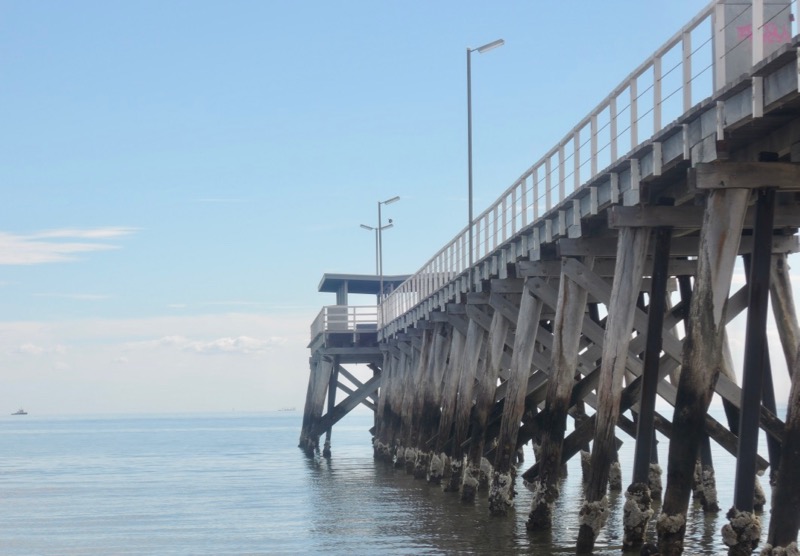
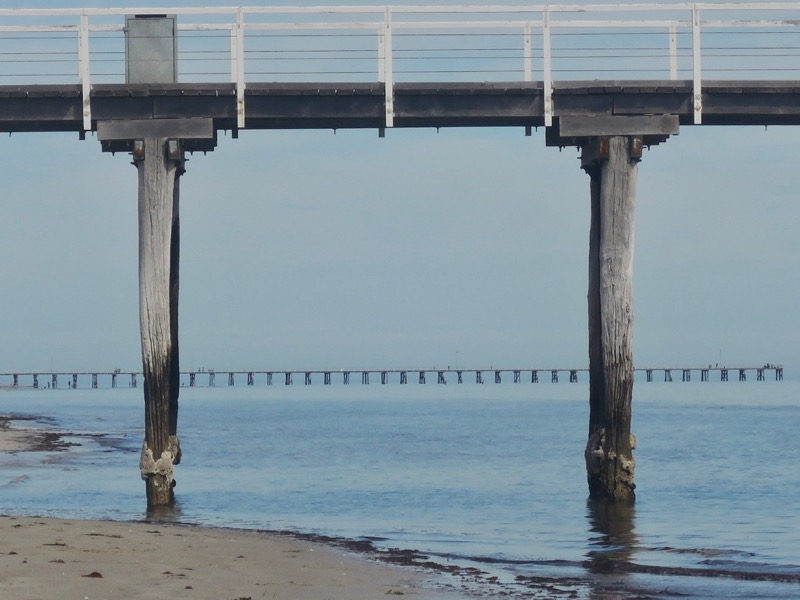
I took the photos in today’s post as I wandered the beach at Largs Bay one afternoon a few days ago, in the week before Easter. The day was so still, and the tide so low, that the pine trees along the Esplanade were reflected in small pools of seawater that had formed between the sandbar and the main ocean …

… and out on the water, ships hung suspended in blueness, somewhere between sea and sky:

It was an afternoon that reminded me that there’s joy and beauty in every season — yes, even in the seasons you’d rather not be heading into …

Hint

Other people’s words about … the world below

For a time I was obsessed with the idea that I could live under the sea. Not … using a great tank of air strapped to my neck. No, I wanted to dive deep down, skimming the sandy bottom of the ocean with my bare skin. I wanted to glide through fingers of pink weed and velvety fronds of green and come face to face with a mullet, or a gummy shark, slide up to the rubbery flank of a great whale and feel her song vibrate through my cheek to the very centre of my brain and understand what she told me.

From ‘Skylarking
by Kate Mildenhall

We’ve all felt like the narrator in Skylarking, at some point in our lives, haven’t we? Living by the ocean, as she does in Kate Mildenhall’s novel, I often think about the world below the surface of the water.

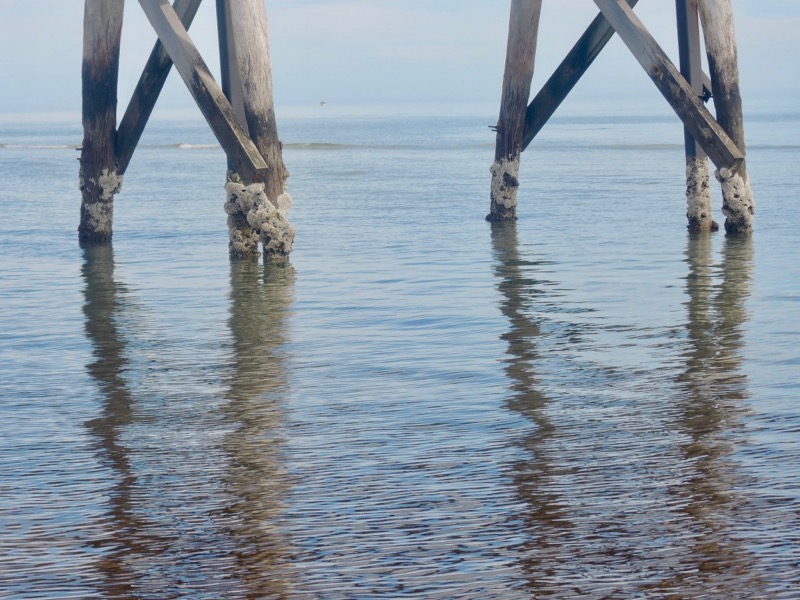
In the summer heat, on days like the one pictured below, I feel like that even more. It was about 5 pm on a day in the middle of January when I took this photo, and it was 42 degrees Celsius. It was too hot, truly, to spend much time with a camera in my hand. Moments after I’d put the camera away, I slipped into that silky, blue expanse and felt the water washing softly over my skin.

Sometimes when I swim on afternoons like this, I see shoals of little white fish darting ahead of me, or a blue swimmer crab scuttling along the bottom of the sand bed. Sometimes I see a sting-ray. Sometimes I feel fronds of seagrass and kelp brushing over my limbs as I swim. They are tiny hints of that underwater world that seems so fascinating and so close, and yet, somehow, so very far from reach …