Darkness encroaching

Other people’s words about … winter

Minutes after that the sun came out: brilliant, stunning us all. Still, it was no surprise when we were let out of school a half hour early due to the windchill. I made my way home from the bus stop at a rigid trot. I crunched along the snow-packed trail, felt the wind come off the lake in blasts, heard the pines groan and creak overhead. Halfway up the hill, my lungs started to feel raggedy. My face changed into something other than face, got rubbed out. When I finally got to the top of the hill, when I slowed down to brush ice from my nose, I turned and saw a puff of exhaust across our lake. I had to squint against all that white to make it out.

From ‘History of Wolves
by Emily Fridlund

Many years ago, I spent a winter in Michigan in the USA. For a whole month, the temperature did not lift above zero degrees Celsius. Having lived in South Australia most of my life, I had never seen a lake freeze over before. I walked across the surface of the frozen water, and grasped for the first time the meaning of the term ‘windchill’, a term I realised I had never understood before. A little way further out, a fisherman sat in a folding camp chair with his line cast down into a carved-out pool at his feet. I thought of taking a photograph, but my hands grew numb in the few seconds it took me to take off my gloves and fiddle with the lens on my camera. How can you grow so cold so quickly? It didn’t seem possible.

My American friends, knowing my love of ice cream, suggested taking me to the ice cream parlour in their local town, but it was shut down for the winter. We did a quick march up and down each side of the main street to look at the ice sculptures standing outside the shops. I kept expecting them to melt. I am Australian: I expect ice to melt. That’s just what it does.

For me, Emily Fridlund’s words, which I’ve threaded above and below throughout this post, capture the essence of that winter I spent in the northern hemisphere.

Overhead each afternoon we could hear the Canada geese coming back. We could hear them giving directions, labouring through wind currents, setting down their Vs. When the sun had just about set, we turned around, Paul lagging, getting farther and farther behind, so as the day grew truly cold –- miniature winter setting in, the way it does at night in April –- I put the backpack on … and we headed back toward his house on the lake.

What a lovely phrase, don’t you think?: Miniature winter.

Here in South Australia, where our climate is temperate, we don’t have four distinct seasons. Autumn is the beginning of what I always think of as the grey months. Our native trees are mostly evergreen, so they don’t shed their leaves; the weather simply grows windy, rainy and cold. As winter approaches, the days grow greyer still, and the hours of daylight shorten. The sky seems to sink lower over the earth, closing everything in. The world grows monochrome.

But then, in the middle of March, the temperature shot up to fifty and miraculously stayed there. Within a couple of weeks, the south slope drifts had eroded to stalagmite pillars. A wet sheen appeared across the surface of the ice, and in the late afternoons you could hear the whole lake pop and zing. Cracks appeared. It was warm enough to gather wood from the pile without mittens, to unfreeze the latches on the dogs’ chains with the heat of your fingers.

This time of the year — the first days of March, the very beginning of autumn — I always grow nostalgic for summer. Down the road at the beach, the sea is still warm enough to swim in, and the sand crumbles soft and dry and warm beneath my bare feet. A sense of urgency comes over me as I look up at the upside-down bowl of blue sky above me. I murmur spells at it, trying to make it stay.

The grey months are coming but not yet, not yet.

Note:
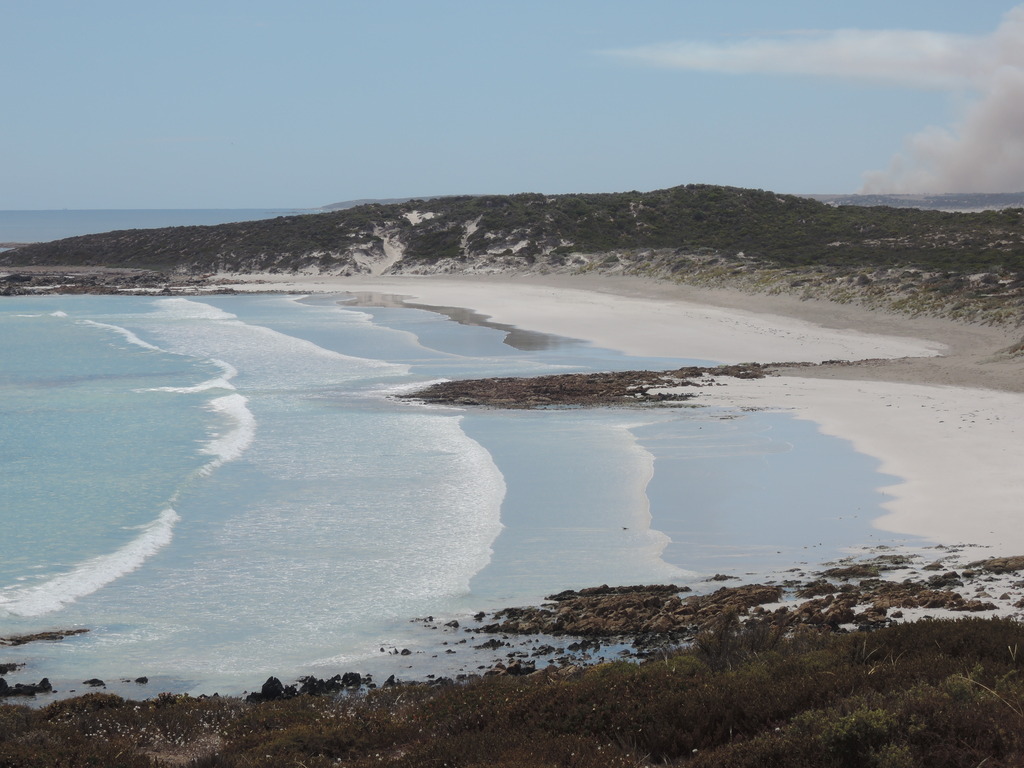
The pictures accompanying today’s posts are photos I’ve taken over the last few years during the South Australian winter. It may look as though I used black-and-white film, but I didn’t. That’s just the way it is.

Inhabitant

Other people’s words about … noticing

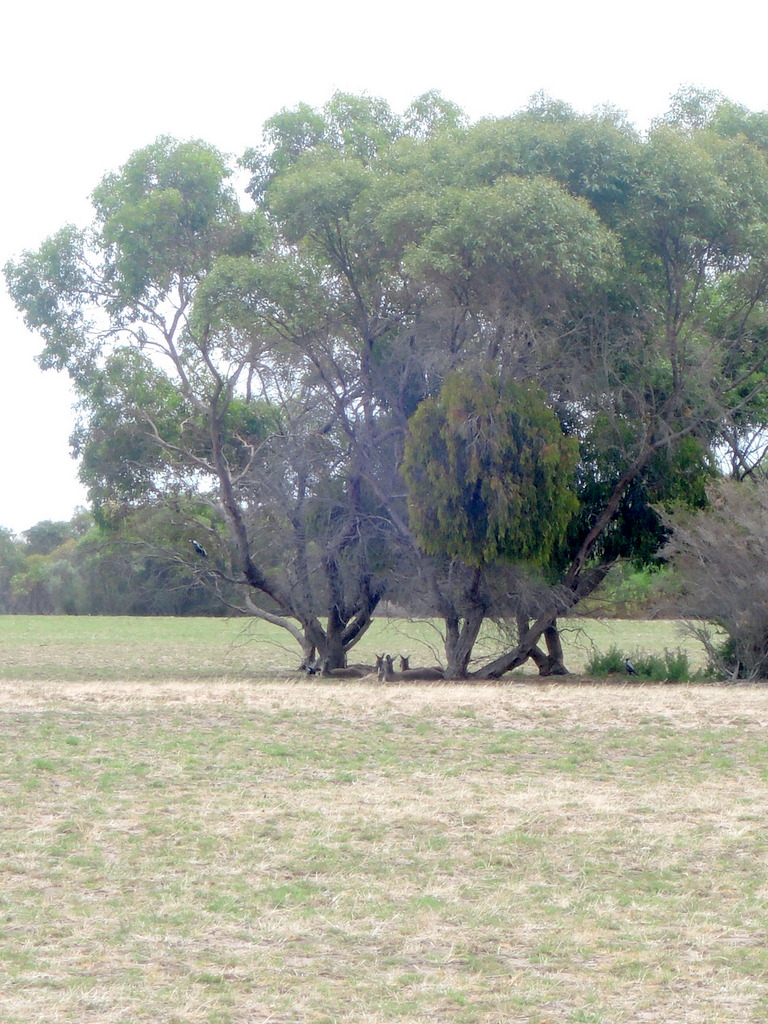
Over the last year I have discovered a passion for birds and wildflowers in particular, along with the ever-present kangaroos. I love the texture of bark, the colour of leaves and mosses, I’m utterly fascinated with the fact that I can walk around our small patch of natural bushland each day and find something I’ve never noticed before. Or find something I have noticed before, but it catches my eye for a different reason.

from ‘Fifteen Acres: A Small Slice of Paradise‘ blog
by Lisa from Central Victoria, Australia

I came across Lisa’s blog only recently and instantly realised she is a kindred blogger. Her blog documents her growing understanding of, knowledge about, and love for all the species of native flora and fauna that live on her block of land in rural Central Victoria. I get the feeling that Lisa has learned about her patch of land simply by walking through it and observing.

One of my favourite parts of the world in my state is Aldinga Scrub. I didn’t even know about the scrub’s existence until I was well into adulthood: it was the beach nearby — with its beautiful cliffs, its blue waters, its fish-inhabited and bird-dotted reef, its wide sands — which initially attracted me.

The first time I walked through the Aldinga Scrub, I was just curious. I had heard that it was the last remnant of original coastal bushland in South Australia, and so I wanted to see what it was like. A year later, going through another phase of feeling inexplicably agitated and uncomfortable in my own skin, I decided to try walking there more often. I thought that, if I made the effort to look outwards at the world around me instead of looking inwards into my own seething internal landscape, I might find solace.

And I did.

A small kind of miracle happened as I revisited the Scrub again and again. As I wandered, I began to wonder. As I wondered, I stopped. As I stopped, I observed. As I observed, I noticed, as Lisa puts it. And then, at last, I started to see and to learn.

Something else happened, too. I began to inhabit the world around me during those walks. Inhabitation — it’s a powerful word. Maybe it’s pretentious. Maybe it’s corny? And yet that’s how it feels.

It never stops, this seeing, learning, wondering, inhabiting. That’s another kind of miracle.

The pictures in this post are photographs I’ve taken over the years on my many visits to, and walks through, the Aldinga Scrub. Here you can see it in its many moods, its many seasons, its many tempers. I don’t know if my photographs can convey the wonder I felt as I took them, or the remembered sense of discovery I feel now when I return to them, but I hope that they convey, at least, the deep joy that my wandering has brought me.

That’s the thing, you see — noticing is both a humble and a joyful process. It’s a privilege to inhabit this kind of joy.

Snatched phrases (on the sea)

‘[I] stare at the water.
It’s shot with moon, silver leaking all over the surface.’

from ‘Words in Deep Blue
by Cath Crowley

Okay, so I don’t have any photos of the sea in moonlight, because I have as yet to figure out night-time photography.

But the words above reminded me of one of the things I love about the sea, and one of the reasons I so frequently post other people’s words about it, accompanied by my own photos: I love how the sea changes colour, depending on the season, the temperature, the weather, the time of day, the tide. The colours you see below — blue, green, pewter, turquoise, gold, silver — are just some of the many colours of the sea.

You may recognise some of these photos from earlier posts on this blog. Forgive the repetitiveness. That is one of the things about the ocean, I think: the wonder it instils in you, each time you see it, each time you visit it. It repeats itself, over and over.

Where song begins

Other people’s words about … birdcalls

A bird calls with a sound like a pot being scraped,
and the moist air is cool on our skin.

from ‘The Collaborator
by Margaret Leroy

I love the way that worlds sometimes collide in the space of a few words. What kind of bird is Margaret Leroy describing here? I’m not sure: the characters in her book live on the Channel Islands during the Occupation in World War II — which is a long way from Australia.

And yet when I read her phrase, I thought instantly of our native red wattlebirds.

Wattlebirds (from a photo of a sheet of Earth Greetings wrapping paper: https://www.earthgreetings.com.au)
Wattlebirds
(from a photo of a sheet of Earth Greetings wrapping paper: https://www.earthgreetings.com.au)

Australian birds are known for their startlingly loud calls. In fact, biologist Tim Low has devoted a whole book to this theme. In Where Song Began, he proposes that Australian plants produce such an abundance of nectar that some birds — honeyeaters in particular, including wattlebirds — have evolved with strong aggressive tendencies, which enable them to fight over and defend their sources of nectar. Their loud, harsh calls are a part of that aggression. (You can find a brief summary of this argument here.)

I have struggled for years to come up with words to describe the calls that red wattlebirds make. They are a mixture of chuckles, coughs, clicks, screeches, rattles, squawks and whistles: you can hear a sample on the website Birds in Backyards, whichprovides a link to a recording on this factsheet. (Click on ‘Top 40 Bird Songs’ at the top of the factsheet, and then click on the ‘Soundfile’ for the red wattlebird, which is the fourteenth bird on the list. But turn your volume up first. Wattlebirds are very noisy.)

Wattlebird on a wire

The recording misses something, though, as do my words. Neither effort really conveys the sound of the wattlebird’s call accurately: somehow, Margaret Leroy’s words come closer.

Serendipity, perhaps? Now, whenever I hear a wattlebird call, I will think of these words.


How (not) to surf

Other people’s words about … surfing

He tried to show me the basics [of surfing], but he made it look too simple. Surfing was in his muscle memory, in his blood, in his thoughts. It was like his shadow, simply part of him …

We got back into the water one more time, and the sea tugged me under and tossed me around under a wave, like a plaything, like it was laughing at me. I came up ready to go home, mouth full of salt, hair full of sand.

from Season of Salt & Honey
by Hannah Tunnicliffe
( p. 134)

I know a man who is a surfer. In his fifties now, he started surfing in his teens, catching a ride to the south coast with an older friend who had a driver’s licence.

Though I love the sea, I have a fear of waves, of getting dumped. Still, when I first came to know this man (nearly twenty years ago now), I wanted to give surfing a go. I wanted to see what made him love it so. I asked him if he could help me brave the waves.

So one day, we paddled out into the salt water, he on his surfboard and I on my boogie board, paddling hard. He set me up for a couple of waves. Each time, when the wave rolled towards me, he said, ‘Now!’ and then, when I froze, he gave my board a push, and away I went. I rode the wave towards shore, lying flat on my belly on the board as he’d shown me, and it was fast and terrifying and exhilarating all at once.

And I got it. I got what he felt out there in the ocean. I got the magic of it. The awe.

Yorke Peninsula waves
Waves

But I’ve never attempted it again. I can’t read the waves or the currents. I’m afraid of getting caught in a rip. I don’t understand the sea. I love it; I’m awed by it; but I don’t know it.

She gives me that sad, hopeful look that says [surfing] can be for everyone, should be for everyone. That surfing is the best thing in the world. Her strange, blue-grey eyes fix on me, like she wants to explain. I imagine her in the sea, like a fish, moving as though made for the water. She would know where to put her feet, how to balance, how to fall without hurting herself, without drowning. She’s probably one of those girls who rides the waves as though she’s dancing with the whole of the ocean; her and the water taking different roles, moving in different ways. The ocean leads and she simply responds.

(p. 134)

I think, for me, the sea will always remain a beautiful, mysterious, unknown quantity. There are different ways of loving it, perhaps. Mine isn’t the way of the surfer, but it’s still there. It will always be there. I have lived by the sea for twenty years or more now, and the sand and the salt and the sea are in my blood.

And that is enough for me.

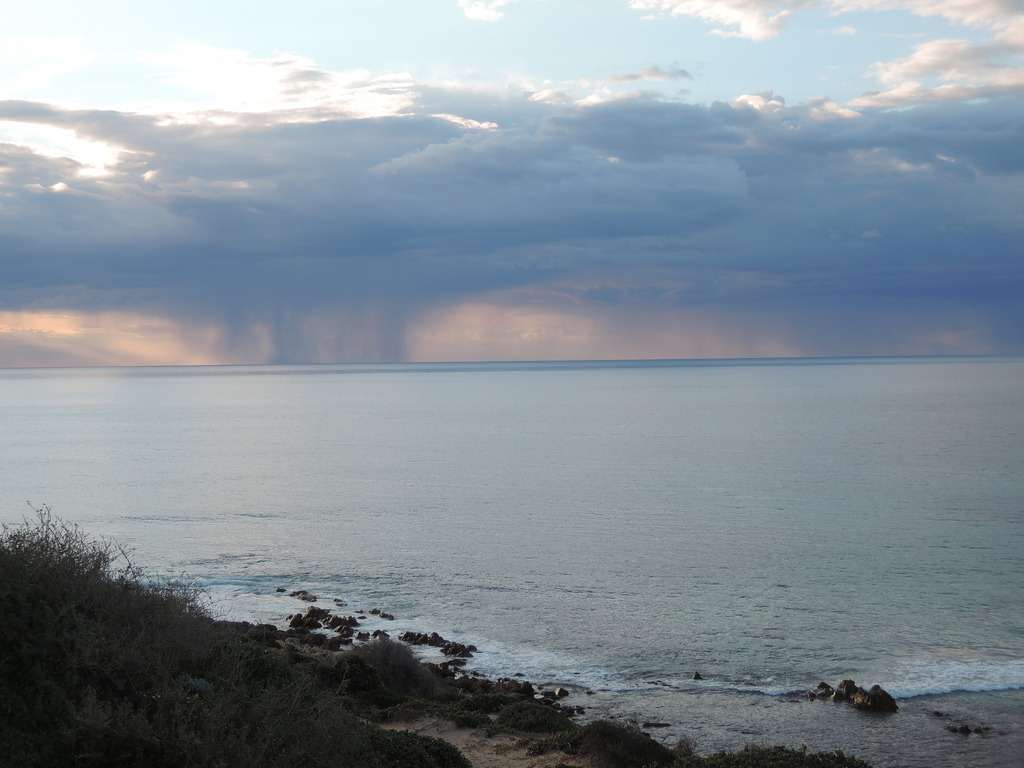
Storm approaching, Yorke Peninsula
Storm approaching.

The one-legged seagull

Questions, questions, questions

Sunset at Taperoo 17 January 2016 7.15 pm

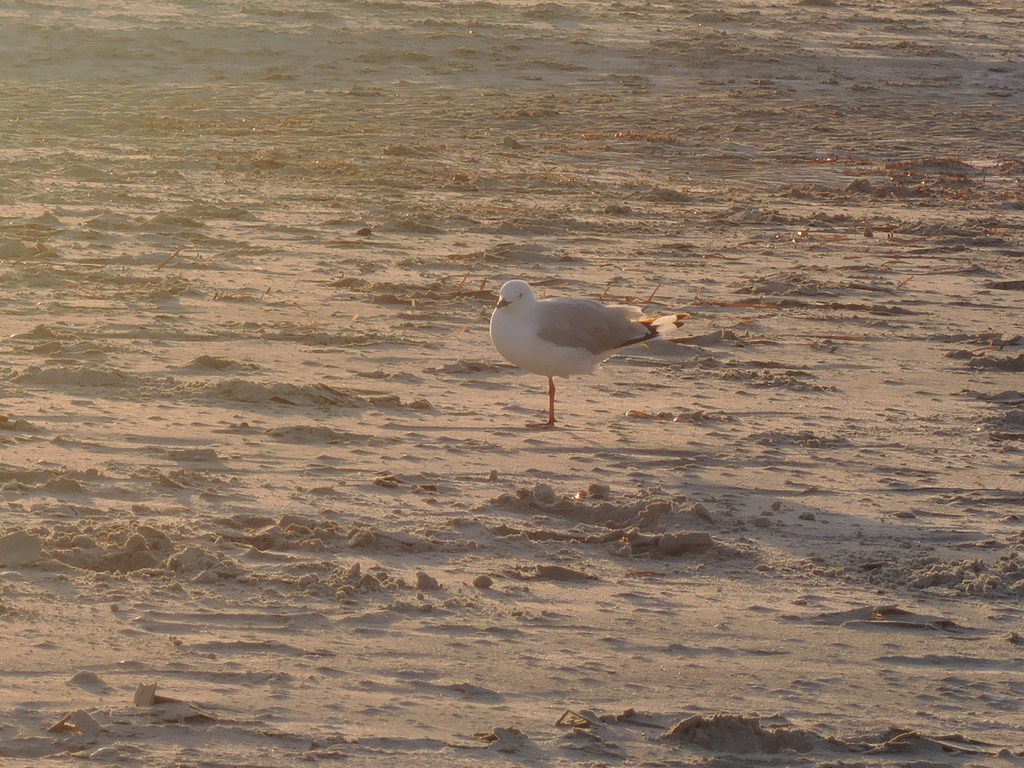
If you’ve seen a one-legged seagull, you’ll know what I mean.
Why are there so many of them?
Do they lose their legs during epic battles for territory?
Why don’t their predators attack other parts of their bodies? (Do seagulls have predators?)
And then, too:
How do one-legged seagulls survive?
Do they grow replacement legs, like reptiles grow new tails?
Or does the remaining leg grow stronger over time?
So many questions.
I could google for answers, I suppose,
but I’m enjoying the mystery …

Self-transcendence

If you are ever in need of an answer or feel a little lost in this great big world, go out there and hit the trails. Leave the Garmin at home and just get out there and be. Connect with nature. Listen to the whispers of breeze in the trees or the ramblings of the nearby stream. Eventually, you will find what you are looking for and perhaps, in time, you will find yourself as well.


The words I’ve quoted above come from the blog So what? I run.
(Read the whole post here.)
For me, they apply whether I’m walking or running.

Because of my knee injury, it’s all about walking for me right now.
And I’m okay with that.

It’s all about the connection with the world around me:
it’s vital.
It’s healing.

And in the spirit of the quote above,
I’m posting today some photos from one of my favourite walks.

You don’t need phones or apps or pedometers or fitbits.
You just need time to look,
to listen,
to breathe.