(And meanwhile, feel free to enjoy the pictures that accompany this post, which have nothing to do with my question, but everything to do with all the usual reasons I keep writing this blog … )
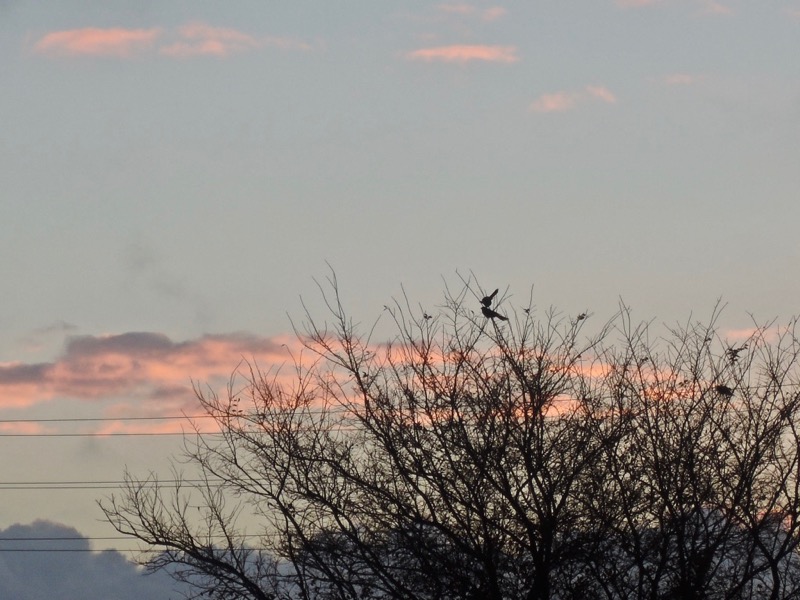
Autumn sunset
The list of books I’ve quoted and discussed on this blog is growing and growing, and the current page of links I have to them is growing and growing, too. I’m thinking of reorganising that page, sorting the books into more categories than the current ones (which are fiction and literature; non-fiction; poetry; magazine/newspaper/blog posts).
Winter sunrise
How would you like to see these lists organised? Would you like further subdivisions of the current categories (e.g. fiction: Australian; fiction: American, etc.)? Or would you prefer categories that don’t distinguish between, say, fiction and non-fiction or between book and non-book but are theme-based instead (e.g. running; walking; love; nature; life; health)?
I thought about the kind of people who come to the sea to look at it: how they put themselves down on whatever rock or bench is around and gaze for hours into the distance as though something out there makes life seem meaningful, or at least less incomprehensible. What are they looking at? I asked myself. What do they see when they see the sea? Most people seemed to find the sea deeply interesting but it held no particular depth or virtue for me. The most profound effect the sea had on me was that sometimes, from the living-room window, it quite literally made me want to throw up. I’d always thought that people who liked the sea were people who didn’t like society, that it was people who’d failed in their relationships who turned to the sea. There was something in their glazed faces — leaning on harbour railings, walking along the crumbling promenade, staring over the tops of their newspapers — which disturbed me. It seemed they wanted to be immersed in it, that as they looked out at the sea they entered into a special relationship with it which, to a certain extent, entitled them to speak to it. Because people who spent too much time looking at the sea did start to commune with it, as if nature held the answer to all of life’s important questions, their expressions suggesting that they were not so much watching the sea as conversing with it. I could tell from the way they sat, dead still, that the sea spoke to them and that they, for their part, were receptive to its communication. But what was the sea saying to them? The sea didn’t speak to me. What do you say to them that you won’t say to me? I asked the sea, but the sea was silent and had no communication to make.
from ‘Somehow‘ by Danielle Dutton (in the Paris Review, #224)
This passage made me laugh (which I think — although I’m not entirely sure — was the writer’s mischievous intention). So I had to include it in my collection of passages about the sea, didn’t I?
Anyone who even glances at my blog will know that I fall into that category of people to whom the narrator in the passage above, Mr Field, refers as people who spen[d] too much time looking at the sea …
‘ … We can be like sisters,’ she says. And then she freezes.
I smooth my hair behind my ear. I look at the snow.
‘I didn’t … ‘ She leans forward, cradles her head in her hands.
And I think of how time passes so differently for different people. Mabel and Jacob, their months in Los Angeles, months full of doing and seeing and going. Road trips, the ocean. So much living crammed into every day. And then me in my room. Watering my plant. Making ramen. Cleaning my yellow bowls night after night after night.
‘It’s okay,’ I say. But it isn’t.
from ‘We are Not Alone‘ by Nina La Cour
Some people in the Western world — most people, perhaps, if you take at face value the world we see portrayed on social media, and on TV, and in the ads — live big, busy, crammed lives, like Mabel and Jacob in the passage above. They go overseas on holiday. Borrow money to buy houses and cars. Renovate and redecorate. Eat out at restaurants. Drink lattes with their friends. Bungee jump. Skydive. Buy new clothes each season, colour their hair so it doesn’t go grey, replace their smartphones with the latest model. The words vibrant and noisy come to mind. They are not the same things, and yet it can be hard to tell the difference, sometimes.
Me, I live a quiet life. A small life.
Partly, this is of my choosing, and partly it isn’t. Partly, it’s because a small life, a simple life, has always appealed to me; partly, it’s because that small life found its way to me a long while ago, and foisted itself upon me. And partly, too, the simple truth is that it’s difficult, when you’ve started down a small, narrow track, to turn around and retrace your steps. To find yourself out in the open. To start again.
Most of the time, I’m okay with this. But sometimes, like Marin, the eighteen-year-old narrator in the passage above, there are moments when it isn’t okay, after all.
Those moments pass. They do. But I think they’re worth acknowledging, every now and then.
Correa flower in blossom in Aldinga Scrub May 2018 Small but beautiful, after all.
‘When you’re walking the view shifts and changes.
Walking’s a form of hope.’
from ‘The World Without Us‘ by Mireille Juchau
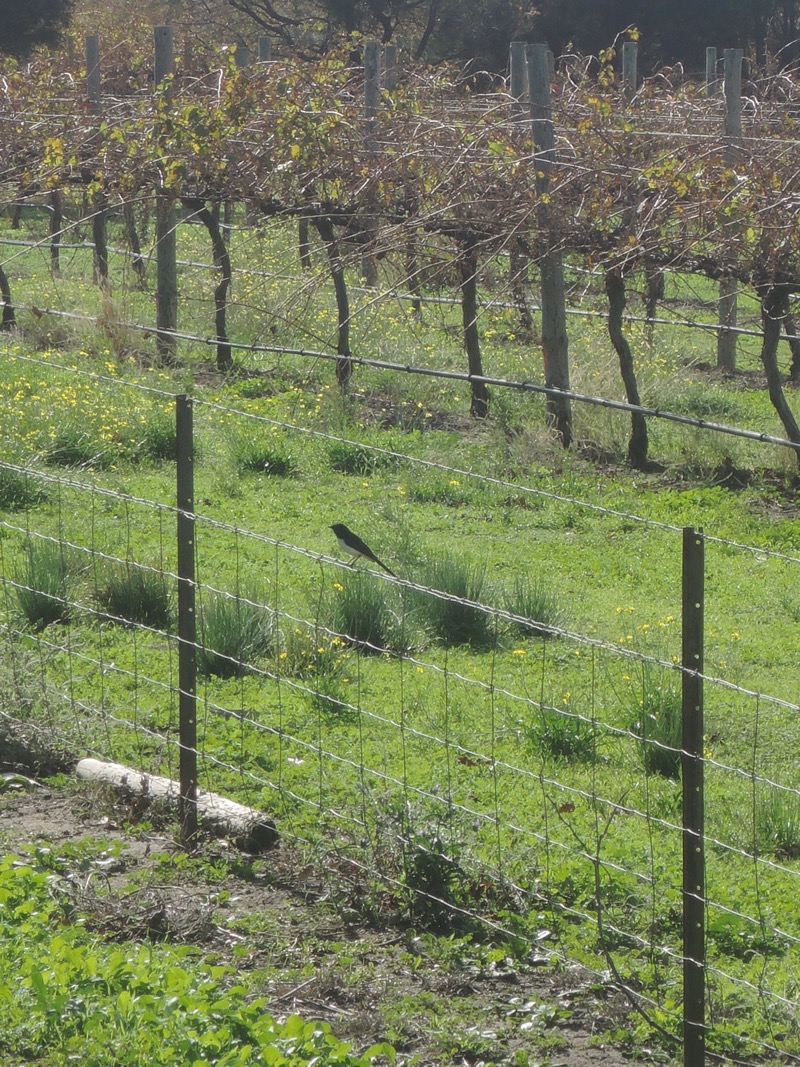
Autumn arrived in the vineyards in mid-May. One weekend in the last week of May or so, I spent some time walking near the Aldinga Scrub, on a track that skirts the wetlands, the Scrub, the vineyards and the farms.
It was one of those autumn days when the sky changes every moment that you look up at it, and with it the light. One moment the sky was blue and the grass shone bright and green; the next, the sun disappeared behind clouds, and the sky darkened, and the grass turned a pale, sombre green.
As I took the photos you see in this post, I became aware of stinging sensations at my ankles and wrists. There had been had rain overnight, and the ground was damp, though the temperature was mild. Mosquitoes were everywhere, biting, biting. I kept stopping to scratch: my ankles, my wrists, my hands. Still, it was peaceful and green.
Can you see the willy wagtail perched on the wire fencing in the photograph above? It darted about as I wandered the track, zigzagging and dipping and feinting, the way willy wagtails do. There were fairy wrens on the path, too, but I didn’t manage to capture them.
After lunch, as a reward for their fine behaviour, Nurse allowed them to bundle into coats and hats and bolt from a back door along a path that ran behind Mr Styles’s house to a private beach. A long arc of snow-dusted sand tilted down to the sea. Anna had been to the docks in winter, many times, but never to a beach. Miniature waves shrugged up under skins of ice that crackled when she stomped them. Seagulls screamed and dove in the riotous wind, their bellies stark white. The twins had brought along Buck Rogers ray guns, but the wind turned their shots and death throes into pantomime.
From ‘Manhattan Beach’
by Jennifer Egan
I have never been to a beach in the kind of winter that Jennifer Egan describes in the passage above. Many years ago, in Michigan, I walked across a frozen lake (and thereby learnt the meaning of the term ‘wind chill factor’), but that was a lake, not the ocean. I’d like to experience that wild, violent chill, just once in my life.
The beaches along the South Australian coast have their own seasons of peace and restlessness. Often, the early months of Autumn are times of softness and stillness, and this past April there were several days when the sea lay like blue, shining silk on a bed of sand.
As you can see from the photos in today’s post, which I took at the beach in the first week of April, the South Australian coastal world is utterly unlike Egan’s, but there is wildness at its essence, all the same.
April has never really known loneliness until now; she has had all tastes of its dregs, like cold milky coffee curdled at the bottom of the cup, but she has always had faith in the fact that it would pass. Now, she is not so sure. And this loneliness is entangled with her failure as a musician, another certainty in her life that seems to have gone.
Most days, she tries to write.
She sits by the window with her guitar and picks idly at notes, strumming chords underneath, humming to herself as she does so. But nothing ever sticks, and she feels as if she is just pretending, playing alone outside a room she can no longer enter.
from ‘Between a Wolf and a Dog‘ by Georgia Blain
I did something I had never expected to do this week: I stopped working on the book I’ve been writing, on and off, ever since my last novel was published in 2010. Actually, I stopped writing fiction altogether, at least for now.
The novel I’ve been writing all these years has gone through many, many permutations: I’ve written it as a ghost story for young adults; as a reworked ghost story for middle-grade readers; as a love story for ‘new’ adults’; as a coming-of-age story for women my own age. I’ve written it in the first person and in the third person, and in past tense and in present tense. I’ve written it using pen and paper, and Microsoft Word, and Scrivener.
I’ve written it. And written it. And written it.
All the time I’ve been writing this novel, I’ve been telling myself that the doubt I feel in myself, and in my ability to write a third novel — this third novel, anyway — would pass. But it hasn’t. Sometimes it’s quietened down for a period, but then it’s flared up again. And over the years, like April, the sense of inner loneliness I carry with me — which is in part an aspect of being me, Rebecca Burton, and in part an aspect of being me, a human being — has slowly become ensnared with the doubt I feel about my writing. [N]othing ever sticks, and she feels as if she is just pretending, playing alone outside a room she can no longer enter. Yup. Yup. Yup.
Ever since I wrote my first novel and it was accepted for publication, I’ve believed, with all of my heart, that writing books was something I would do for the rest of my life, because that’s what writers do, right? It’s what they want to do. It’s their privilege, and their gift. Or so the story goes.
But I just don’t think I believe that particular story anymore. That’s what I finally realised this week, after all this time. I don’t think — as April thinks, in this passage which I have loved so much for so long — that I am a failure as a writer, or as a person, if I stop writing, for a while, or forever. I think the world is bigger than that.
I don’t know what the future holds for me if I’m not a writer anymore — for now, or for a while, or forever. But you know what? Unlike April, I want to find out.
‘It took me years to see that path and to find my pace.
When I finally got moving, I hoped I might be able to run forever.’
From ‘The Long Run’ by Catriona Menzies-Pike
I recently spent a week holidaying in one of my favourite spots, near a clifftop in the Yorke Peninsula region. It was mid-Autumn, and the weather, like the view, changed every day, sometimes every minute.
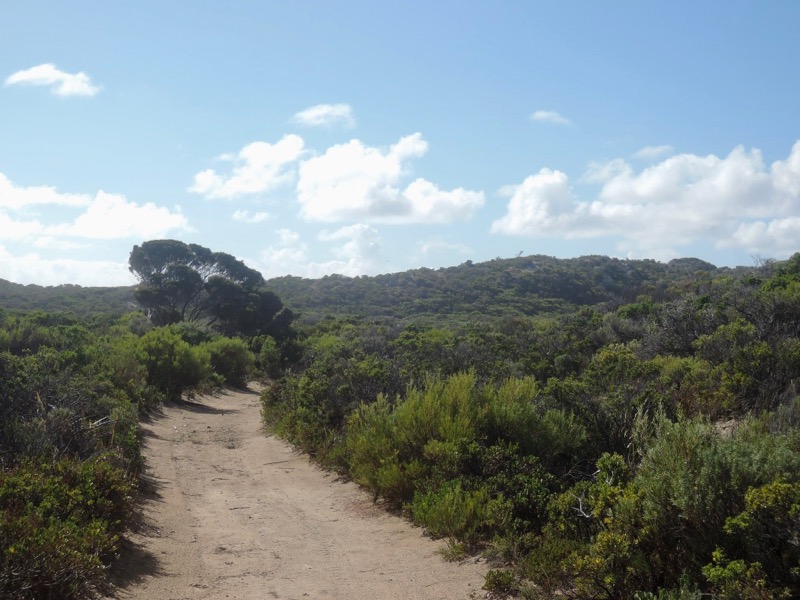
During one of the sunnier hours, I went for a run in the bushland that lies behind the dunes and cliffs. I took off my running shoes and ran barefoot along the winding sandy track that rises and dips through the scrubland. Despite the lack of rain in the previous months, the bushland here seemed to me quite lush (at least by South Australian standards).
I finished my run at the base of the highest dune, and then I trundled up to the top of the dune to look down on the beach and shoreline below.
It was a moment of silver seas and blue skies — a moment worth celebrating.
After Bunty died, days slid into one another like the colours in a sunset. Whole afternoons passed as Christabel drank tea in the kitchen … If there was a book in front of her, she would look away frequently and forget to turn its pages — she no longer read in the old, urgent way. The taste for reading had started to withdraw from her; she felt it pulling gently away, like a tide. Books contained hard truths, waiting like splinters in their pages. Over the years, many had lodged in her unnoticed. Little anticipations of life’s awfulness, they might have served as a defence against it but pierced instead with knowledge of damage, error, waste.
From ‘The Life to Come’
by Michelle de Kretser
CS Lewis once wrote that we read fiction and literature to seek an enlargement of our being; we read because [w]e want to see with other eyes, to imagine with other imaginations, to feel with other hearts, as well as with our own. I don’t subscribe to Lewis’s Christian practices and beliefs, but I do — oh, I do — subscribe to his views on reading.
And so Michelle de Kretser’s words in the passage above affected me deeply. I cannot imagine a life in which [t]he taste for reading had started to withdraw from me; the thought that the truths I treasure finding within a book’s pages might begin to feel like splinters horrifies me.
Reading for me is an activity that provides solace. The solace comes most strongly from finding kinship within the pages of the books I read: kinship with the book’s characters, and, vicariously, with the book’s writer, who created the characters. That’s not quite what Lewis is saying, but it’s part of it, I think: it’s hidden in his words. When de Kretser’s character Christabel finds herself losing the taste for reading, losing the urgency that was inherent for her in the act, what she is really experiencing is loss. Loneliness. Desolation.
If I was a praying person, as Lewis certainly was, I would offer up a prayer here, in response to de Kretser’s words. I would pray: Please don’t let me ever experience this particular form of loss.
I would pray: Please don’t let me lose the companionship of books.
Understand, for instance, that having a sad thought, even having a continual succession of sad thoughts, is not the same as being a sad person. You can walk through a storm and feel the wind but you know you are not the wind.
That is how we must be with our minds. We must allow ourselves to feel their gales and downpours, but all the time knowing this is just necessary weather.
From ‘Reasons to Stay Alive’
by Matt Haig
It was Toni Bernhard who first introduced me, in her book How to Live Well with Chronic Pain and Illness, to the idea that moods are like the weather: impermanent, changeable. She writes elsewhere:
In ‘How to be Sick’, I call it Weather Practice. I like to think of emotions and moods as being as changeable and unpredictable as the weather. They blow in; they blow out. Working with this weather metaphor allows me to hold emotions and moods more lightly, knowing that, like the weather pattern of the moment, they’ll be changing soon. One moment, life looks grey and foreboding; the next moment, a bit of brightness — maybe even a rainbow — begins to break through.
Both Bernhard and Haig are covering the same theme here, a theme that is one of the basic tenets of any kind of mindfulness practice. But while I like Bernhard’s clear, practical prose, there is something about Haig’s phrasing (despite his erratic sense of grammar) that particularly speaks to me.
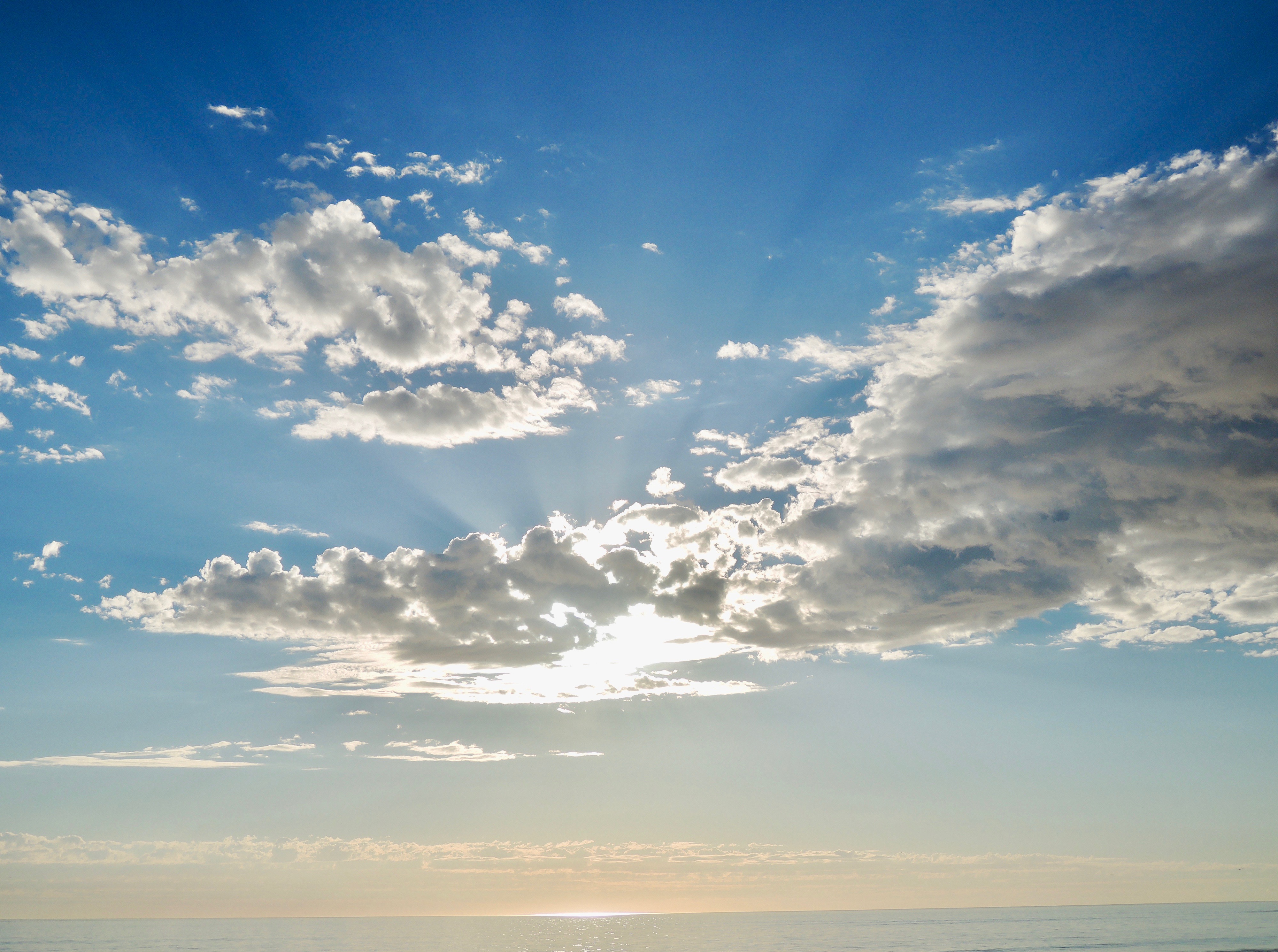
Silver and shining
Necessary weather. Those two words, paired together, feel to me immensely comforting, and true. I murmur them to myself on days when my mind and my mood feel clouded and grey like the clouds pictured in today’s post.
Call these words a mantra, if you like. They bear repeating.








 twenty-one words