Astonished

Other people’s words about … ageing

When I was thirty, I felt sure that a paradoxical reward awaited me at sixty, if I made it that far. Having never had any beauty to lose, I reasoned, I’d be exempted from mourning its loss. But as I’ve grown older, this proposition has turned inside out. I see now that I did have at least some beauty — not much, but some — and exactly because I had so little, I could hardly afford to lose it. Now, at this inconvenient moment, I realise that I do care about my looks. I find myself spending more energy compensating for my inadequacies than I used to. I search for becoming clothes. I color my hair. I experiment, in a gingerly [sic] way, with makeup. I suspect these efforts don’t do a lot for me, though they do make some difference, if only in letting people know I’m trying.

From ‘At Sixty-Five’
by Emily Fox Gordon

I am closer to fifty years old than I am to sixty-five: my fiftieth birthday is next year, 2020. And yet, already I understand that inconvenient moment Emily Fox Gordon describes in the passage above.

When I was a young woman — that is to say, when I was in my twenties and thirties — I went makeup-free. I washed my (uncoloured) hair and let it drip dry; I applied nothing other than sunblock to my skin (not even moisturiser). And, oh, I bought all my clothes from op-shops: jeans, shirts, trousers for work, jackets. I still remember the pretty, floral-patterned strappy dress I once bought from my local St Vincent’s op-shop to wear to a relative’s wedding, which cost $3. I happened to be very thin at that time, because of a digestive illness, and within six months of the wedding, I was well again, which meant that I could no longer fit into it. But I kept that dress for years afterwards. Every now and then, I would pull it out of my wooden chest to look at it: to run my fingers over the soft, thin, flowered fabric.

$3! To prepare for the wedding, I’d pulled the dress over my head twenty minutes beforehand, brushed my hair and tied it back in an elastic band, slipped on a pair of sandals (the only pair I owned), and then spent a couple of minutes debating over whether I’d need a (secondhand) jacket or not, because it was an outdoor wedding, and there was a cool breeze blowing through my window. And then I left for the wedding.

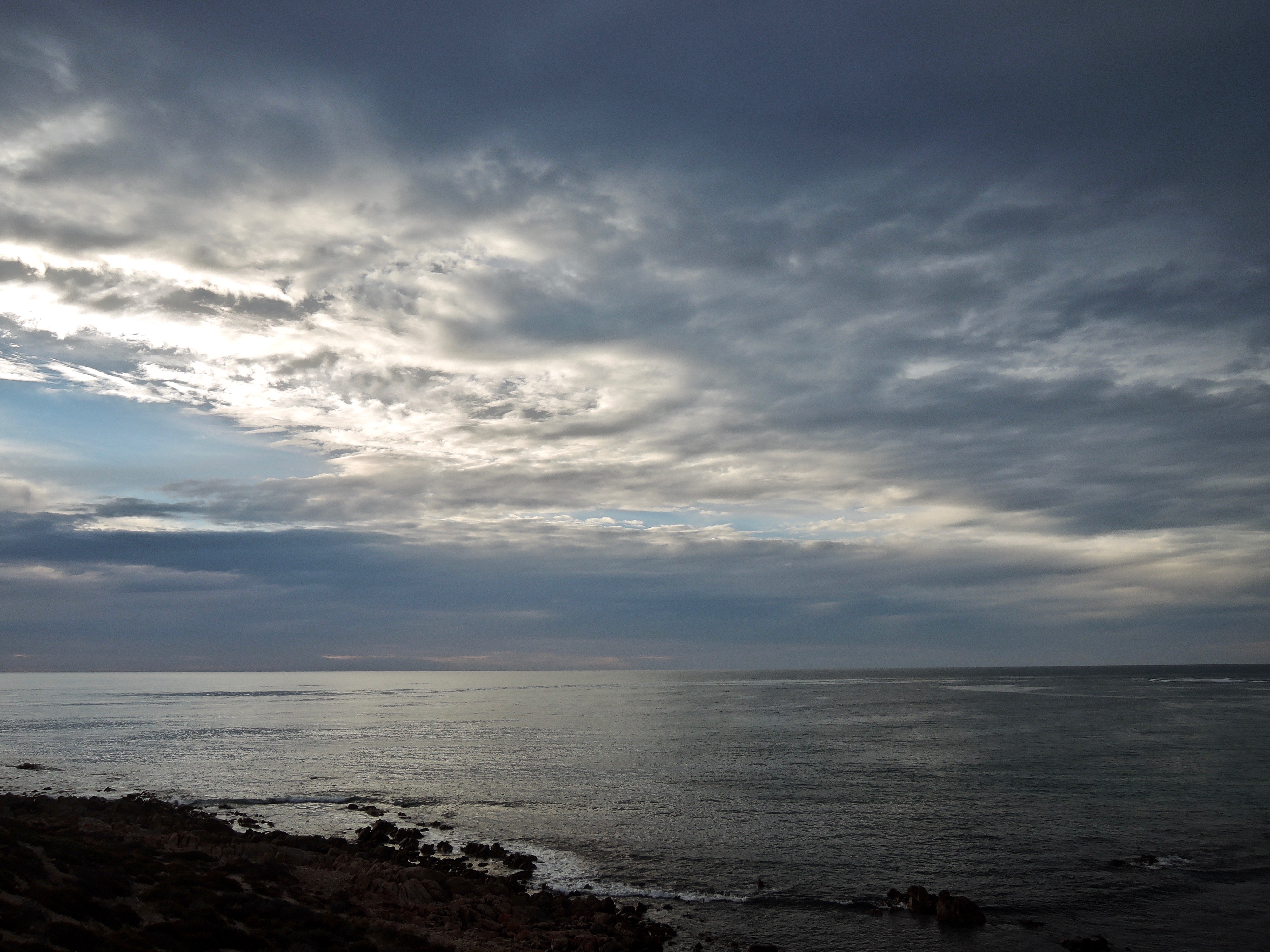
Yorke Peninsula: View from the cliffs

If you had asked me during those years what guided my fashion style, I would have said — very proudly, very innocently — that I went for a ‘natural’ look. What I wouldn’t have said, because I didn’t yet realise it, was that I went for a young, natural look. I didn’t yet understand that the word ‘natural’, when it comes to a woman’s beauty, her appearance, is synonymous with the word ‘young’. I couldn’t have understood it back then. I was too young.

*

I found Fox Gordon’s essay in The Best American Essays 2014, a copy of which I borrowed from my local library to take with me on my latest trip to Yorke Peninsula. (Yes, I’m still enjoying reading essays.) It is a short essay, as essays go, but it is wise and witty and forthright, and almost every word in it rings true for me. (You can read it in its entirety here.)

Thirty years ago I assumed I would take the eccentric route as I aged, become one of those bluff, outspoken, truth-telling old women people claim to admire, even as they avoid them. That would have been in keeping with my strong contrarian impulse. But instead of growing bolder and more heedless, I seem to be growing more circumspect, more nervously observant of the proprieties, more conscious of other people’s feelings.

Now that I’m (almost) fifty, I, too, find myself becoming more circumspect, both in the way I dress and in the way I speak and act. I feel [my age] in my invisibility to strangers, Fox Gordon writes. And it fascinates me — no, let me be honest here: it astonishes me — that as women like Fox Gordon, women like me, grow more invisible, we grow in tandem more worried about how other people perceive us. This is a contrarian impulse that we could, perhaps, never have predicted when we were younger — again, precisely because we were younger.

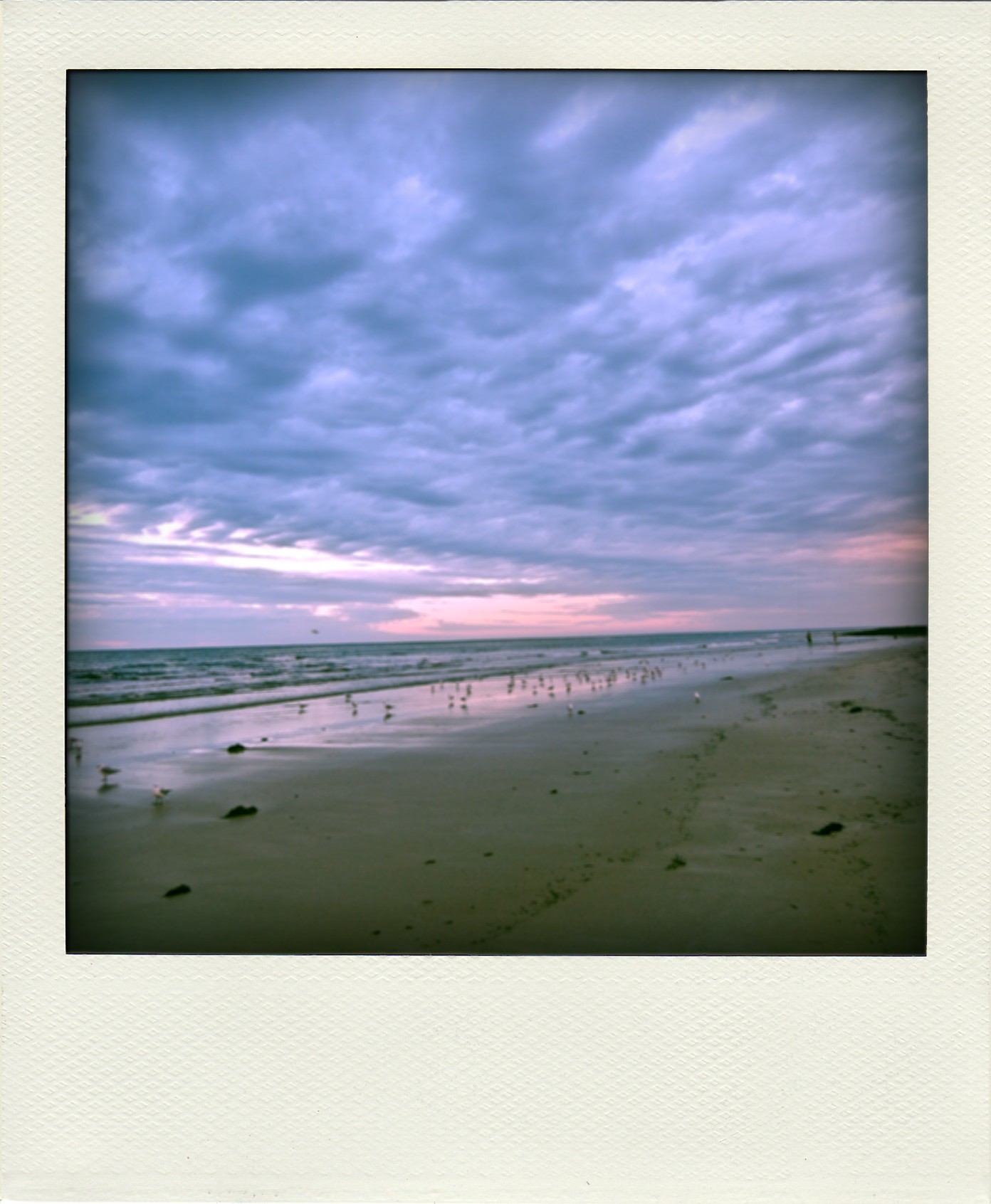
Yorke Peninsula again: Clouds, reflected

*

The day after I got back from Yorke Peninsula, I rode my bike to Semaphore, where I often go to buy my groceries and to borrow my library books. I parked and locked my bike outside the sushi shop, bought a sushi roll, and then wandered down the main street towards the library. There was a woman at the ATM as I walked by, her back to me as she withdrew her cash. She was around my age, or perhaps a little older: tall, lean, wearing easy, worn clothes, her hair tied back in a long, straight, grey ponytail. She had a slender face but a strong profile: short eyelashes, pointy nose. No makeup, as far as I could tell. I glanced at her as I walked by — once, and then again. Then again.

I thought of Fox Gordon. I thought of the old(er) woman I hope I will one day become. It came to me, then, that I was looking right at her, my role model, standing at the ATM in all her natural, worn, grey beauty.

There is room, I believe, for all of us. We can be contrarian, if we dare.

Yorke Peninsula again: Three clouds


Lately I’ve been reading about …

Meanwhile, here’s what I’ve been reading online lately:

The stories we tell

Lately I’ve been reading about … river red gums

I didn’t just notice the river red gums, but also the cracked mud of receding water, rotting gum leaves, greater eastern egrets, kingfisher, heron, ibis, ducks, emus, kangaroos, wild horses, wasps and flies. I even saw (threatened) Murray cod foraging in the shallow water along the lake’s bank, and quickly learnt to look for them at the centre of the ripples of golden tannin their fins sent out. It was the first time I’d seen them surface, amphibian-like, in this manner. The effect was prehistoric. A single galah feather caught in a spider web stretched, strong as rope, between two river gums, waved gently in the corner of my vision.

From ‘Biyala Stories
by Sophie Cunningham

This year I’m taking regular walks through one of my favourite parts of the world, the Aldinga Scrub — the same walk each time, along the Coral Lichen Circuit, which follows a gentle, undulating loop, with spots that overlook both the coast (to the west) and the hills (to the east) — to watch the seasons ring their changes on the landscape. On previous walks through the Scrub I’ve taken pictures of the trees and the flowers, listened to the birdsong and the sound of the waves in the distance, to the wind moving through the trees. But I want to know the Scrub better, to know it intimately, to witness it. I want to know its intricacies — the kinds of intricacies that Sophie Cunningham describes so beautifully in the passage I’ve quoted above.

Cunningham’s essay is about the river red gums that grow in the part of the world where she lives: Melbourne (mostly), Victoria. It’s a thoughtful, erudite, poetic essay, at least in part about the stories these trees can tell us, the stories they might add to our own (human) narrative if we were able to listen. (You can read it here.)

From what I have read, the trees of the Aldinga Scrub, like the river red gums in Cunningham’s essay, are struggling to survive. So are the plants of the Scrub, the birds and the animals. Their survival is threatened by many things, including encroaching housing developments; farming practices that have, since World War II, diverted the natural water flow away from the Scrub to nearby crops; pollution; climate change; islandisation; the spread of weeds from people’s carefully curated gardens and lawns.

I’m neither a scientist nor an ecologist; I can’t use any particular knowledge or training to save the trees or the plants or the birds on a large scale. But I can keep wandering and and witnessing, and sharing, in the process, the things I see and learn, the passage of the seasons, the stories I discover.

I can ensure those stories don’t go untold. That, at least, is a start.

Betrayed

Other people’s words about … anxiety

It took me years to work out that what the experts tell you isn’t always right, no matter how expert they may be, nor how much you may have paid them to tell you what they’ve told you. Fiona Wright explores this theme in the passage below, in relation to her own experience of searching for a cure for her anxiety — a cure that the experts she has consulted have not, despite their expertise, as yet been able to help her find.

This was not supposed to be the lesson that I learnt, she writes. And that, right there, is the power that those so-called experts can hold over us: that they can make us feel that way; that we can come to believe, from them, that there is a lesson — one particular lesson and no other — that we are supposed to learn.

It’s enough, I think, to struggle with poor health, mental or physical or both, without also coming to feel a failure for not responding to the treatment or advice that the experts offer us. Betrayal is the word Wright uses — a strong word, but it is apt.

This feeling, I was right to be nervous, is to me the worst of all the things I think and feel out of anxiety, at least in part because it feels like a cruel joke. Clinical psychologists insist that the problem with anxiety is that the anxiousness — that tension in the gut and shoulders, the clamped jaw and cramping rib cage, the wildly circulating thinking and breathless panic — is always disproportionate, always misplaced; that the fear itself, that is, is always worse than the thing that makes us afraid. And so the treatment focuses on exposure, on deliberately coming into contact with the things we fear and then coming out the other side unscathed in order to learn the hollowness of the focus (and locus) of our fear. So when I get this feeling — I was right to be nervous — it always feels like a betrayal: this was not supposed to be the lesson that I learnt.

From ‘A Regular Choreography
in ‘The World was Whole’
by Fiona Wright

Wildly circulating

Note:
Fiona Wright is an Australian poet and writer. In her essays, she writes with candid, almost forensic insight into her experience of living with chronic physical and mental illness. You can read more of her work here.

This new place

Lately I’ve been reading … essays

What makes an essay an essay? Does it have to be scholarly? Does it need a central argument? Must it be informative? Can it be purely autobiographical? How literary, how poetic, how lyrical can an essay — any kind of essay — be?

As William Deresiewicz observed in an essay about essays for the Atlantic, ‘what makes a personal essay an essay and not just an autobiographical narrative is precisely that it uses personal material to develop, however speculatively or intuitively, a larger conclusion.’
Is that, then, the definition of an essay? Everyone has their own theory. According to my own (evolving) criteria, an essay is not a poem (nonfiction though a poem often is); nor is it a speech which operates according to rhythmic and textual laws of its own. Not all works of journalism, memoir or criticism are essays, though they can be if they reach beyond their subject and offer more, including the capacity to move … That’s about as far as my definition goes.

From Anna Goldsworthy’s introduction
in ‘‘The Best Australian Essays’ 2017
Edited by Anna Goldsworthy

As a young woman, I focused my reading solely on works of fiction, but the longer I live, the more curious I grow about the world: the way it works, and how I fit into it. Perhaps in response, I often find myself, these days, turning to nonfiction and, in particular, to essays — those nonfiction equivalents of fiction’s short stories. Like Anna Goldsworthy, quoted in the passage above, I particularly like the reach that some essays, the best essays, have — the places they can take you, if you let them.

Note:
For many years, Black Inc. publishers published an annual ‘Best Australian Essays’ volume. The series has recently ceased, but you can see the back catalogue here.

Raw

Other people’s words about … making art

What is it that makes some artists productive all their lives, while others founder at the slightest hurdle, convinced of their own lack of talent? Are those who continue to produce art more gifted? Or are they simply more certain of themselves?

But perhaps her ambition outweighed her abilities, or else her perfectionist’s unappeasable eye scuttled what talent she had, for at art college she soon discovered she was no longer the best student — and indeed could not even capture the attention of her teachers … She was full of self-doubt, forced to recognise that a modicum of talent got you so far and no further, and that while she had imagined she was climbing the mountain, in truth she was only ever at the bottom.

From ‘The Landing
by Susan Johnson

A long time ago, just after I had had my second novel for young adults published, I talked with a woman who had just had her own first novel published. She told me that the thing she worried about most, as a writer, was that she would run out of time. She had so many more novels inside of her, she told me: so many ideas. What if she didn’t live long enough to write them all down?

I wonder now: was it an awareness of her own talent that enabled my writer friend to ask this question, or was it simply self-confidence? I don’t know. What I do know is that this was ten years ago, and she has written and published several more novels since then, and time does not appear to be running out for her. Not at all.

She made one last, honourable effort to become a full-time artist, but nothing she made satisfied her, nothing seemed original or bold or magnificent enough, everything was only half good. She strove for an aesthetic perfection she could never reach, and every day she did not reach it was a misery, the febrile pressure she placed on herself impossible to bear. She could not transfer to the canvas the perfect illuminated world inside her head; she was her own harshest critic and could not accept work she knew was not first rate. In the end, art had to be wonderful or nothing; there was no in between.

Perhaps an artist’s talent will wither away and die unless she nourishes it with a certain, requisite amount of self-confidence. Or perhaps her productivity has more to do with her courage and fortitude — with her dogged determination to carry on, free of caring — as Penny, the character about whom Susan Johnson is writing in the passages I’ve quoted in today’s post, finally discovers.

And Penny will pick up her paintbrush in an ecstasy of release … [S]he will try to make whatever she is making, imperfectly and full of mistakes. She will take long-service leave; not certain what she is going to do with what remains of her life, but certain she is making something manifest, exploiting to the best of her abilities — or the worst! — her raw materials. She is herself, no-one finer. She might travel, or she might not; her project might come to something, or it might not, but, suddenly, she will be free of caring. She will see how far she can take a line for a walk.

Perfect illuminated world

A year of words

Other people’s words about … other people’s words

I’ve been thinking about reading again recently — what it means to me, what it gives to me, why, even though it’s a solitary activity, it makes me feel connected to the world. I like Sarah Clarkson’s use of the word journey, in the passage below, to describe the act of reading. Reading, like life, is a journey. You never know where it might take you.

Reading, rather, is a journey. Reading is the road you walk to discover yourself and your world, to see with renewed vision as you encounter the vision of another … Reading is a way to live.

From ‘Book Girl
by Sarah Clarkson

Reading is a journey

PS It’s good to be back in the blogging world. I’m changing the format of my posts slightly this year, but it’s still all about celebrating other people’s words. So … here’s to another year! xo

Fleeting

Other people’s words about … happiness

Happiness doesn’t come in the way I expected; not a massing of good things over time, but a succession of small, strange and unowned moments — the sun makes a hot oblong on the bedroom floor and I stand in it with my eyes closed. The coriander germinates in the window box and up comes the seedling. The bled radiators stop knocking at night.

From ‘Dear Thief
by Samantha Harvey

I thought it was apt to write a post on happiness today, to accompany my previous post on sadness — though perhaps both posts are, after all, about the same thing, simply taken from opposing perspectives.

But also it seemed apt to me to write a post about happiness because today’s post, I think, will be my last post, at least on this blog, twenty-one words.

Over the years, I’ve written about many things on this blog — the sea, the sky, vomiting, writing, books, therapy, running, walking, travel, birds, flowers, hope, to name a few. But in many ways, I see, looking back, that I’ve been exploring, post by post, what it means to live a small life in the happiest, or at least the most meaningful and most humble, way I know.

Happiness, as Harvey says, isn’t something you can accumulate or amass; it most surely isn’t something you can own. It flits into our lives and out again. Writing this blog has been, for me, both a meaningful and a humbling experience — and in that sense it has been a happy experience for me, too. I don’t know if my posts have brought you, my readers, any moments of happiness, but I hope so: I do.

I spent over half my life waiting for the accumulation of happiness and then I realised that it doesn’t accumulate at all, it just occurs here and there, like snow that falls and never settles. Not the drifts that you and I imagined we would plough ourselves into, but instead gently, opportunistically, holding one’s tongue out to catch the flakes.

I’m not sure yet whether I’ll leave this blog up for posterity (i.e. for a little while!) or whether I’ll take it down altogether, or whether, perhaps, I’ll change its privacy settings so that you can only access it by contacting me first. (Please feel free to do that, if it’s what I do.)

In the meantime, I’ll go on running and walking and hoping and reading and looking, looking, looking.

Fleeting


Thank you to everyone who’s read this blog. Take care of yourselves. Keep reading and looking. Keep savouring those fleeting moments of happiness, whenever they come your way.

This day, and the next, and the next

Other people’s words about … the vastness of the ocean

For every day went ahead like a ferry on its cables, from one shore to the other, passing on its route those same red buoys tasked with breaking up the water’s monopoly on vastness, making it measurable, and in so doing giving a false impression of control.

From ‘Flights
by Olga Tokarczuk
(translated by Jennifer Croft)

A false impression of control:
breakwater in the foreground and a line of buoys on the horizon …

Snatched phrases: on translation

But a certain dullness of mind seems an almost necessary qualification, if not for every public man, at least for everyone seriously engaged in making money.

From ‘The Idiot’
by Fyodor Dostoevsky

Hmmm … read and weep. Dostoevsky’s observation about people is as relevant now as it was when he wrote it in the late nineteenth century. If only our public figures, our business people, our politicians would take heed!

But onto other things — no more weeping for now. One of the overarching reasons I’ve had for writing this blog in the last few years has been to give myself (and hopefully you, my readers) the chance to explore the joys of reading: to revel in other people’s words, to find meaning in their thoughts and the way they express them, to learn from them, to find communion and kinship with them. As I’ve remarked before, without books and reading, I would be a far lonelier person.

Recently, I’ve found a different kind of companionship in my reading. On Mother’s Day earlier this year, my mother and I started a reading ‘project’ together, our own little two-woman book club. At her suggestion, we have decided to read works of translation. We take it in turns to pick a title and read it, and then we exchange titles, and, having read them, meet up for coffee or for a walk to talk about them. The Idiot was one of her choices.

My mother is an inveterate reader. She reads widely, hungrily, curiously. Her joy in reading is contagious and almost palpable. I’m glad — and privileged — to have ‘caught’ that joy from her. And I’m extra glad to be exploring new books with her, to be having my world opened by her and by the writers she chooses.

Meanwhile, while we’re on the subject of translation, here’s the thing about reading, and the happiness you can find in it: it translates into life.

And that happiness is only amplified when it is shared.

A question

A quick, extra post today, because …

I have a question for you …

(And meanwhile, feel free to enjoy the pictures that accompany this post, which have nothing to do with my question, but everything to do with all the usual reasons I keep writing this blog … )

Autumn sunset

The list of books I’ve quoted and discussed on this blog is growing and growing, and the current page of links I have to them is growing and growing, too. I’m thinking of reorganising that page, sorting the books into more categories than the current ones (which are fiction and literature; non-fiction; poetry; magazine/newspaper/blog posts).

Winter sunrise

How would you like to see these lists organised? Would you like further subdivisions of the current categories (e.g. fiction: Australian; fiction: American, etc.)? Or would you prefer categories that don’t distinguish between, say, fiction and non-fiction or between book and non-book but are theme-based instead (e.g. running; walking; love; nature; life; health)?

Summer clouds

I’d love your feedback. Pop a comment here …