Yellow

Other people’s words about … spring


After Matthew left I lost the knack of sleeping. Brighton seemed unsettled and at night it was very bright … At periodic intervals throughout the day I felt that I was drowning, and it was all I could do not to fling myself to the ground and wail like a child. These feelings of panic, which in more sober moments I knew were temporary and would soon pass, were somehow intensified by the loveliness of that April. The trees were flaring into life: first the chestnut with its upraised candles and then the elm and beech. Amid this wash of green the cherry began to flower and within days the streets were filled with a flush of blossom that clogged the drains and papered the windscreens of parked cars.

from ‘To the River
by Olivia Laing


I continue to be fascinated with the notion of seasons, and how the idea of a season is as much a cultural and traditional one as it is a quantifiable or temporal one. Here in my part of South Australia, if you were to measure the year out using temperature and climate as your basic season markers, you might say that we begin the year in January and February with dry, glaring, windy heat. In March and April the weather is often warm and dry but the wind drops off; in May and June the days grow cold, though they remain frequently sunny and still. Somewhere around July and August, the serious clouds and rain begin; in September and October there may be both storms and patchy sun; in November and December the weather is dry and warm but variable.

That, at least, would be one way to mark out the seasons where I live.

But temperature and weather are only half the picture. Plant life and animal life have their own seasons, too. In the northern hemisphere, spring is often celebrated as a season of growth and birth, much as Laing describes it so vividly in the passage above, but here in South Australia, that season of growth is far more staggered and gradual. In late July, when the temperatures are still winter-cold, the native plants begin to flower, and the birds begin to build their nests. By November, that cycle of birth and growth has already begun to slow and drop off.

And then there are the different seasonal colours. Myself, I tend to think of July and August, in my own world, as the yellow months. So many of the native plants that flower at this time of the year have yellow blossoms: acacias, guinea flowers, groundsel flowers, punty bushes, bush peas, goodenias.

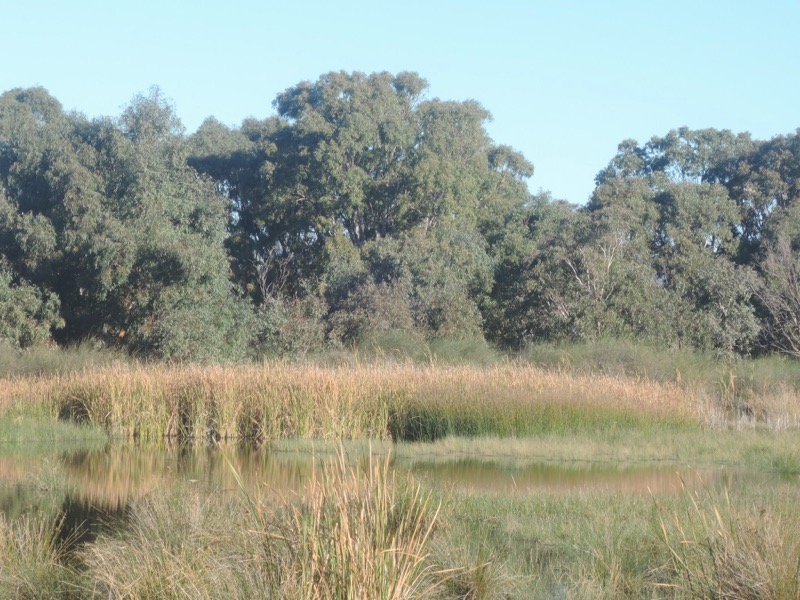
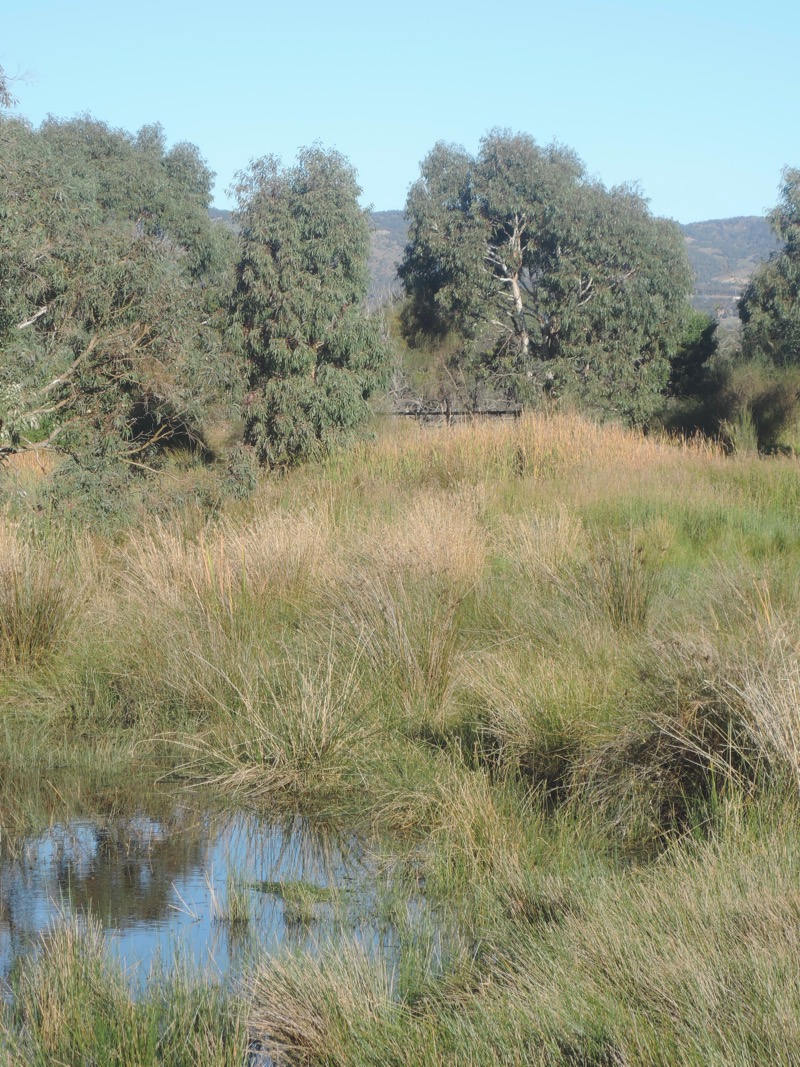
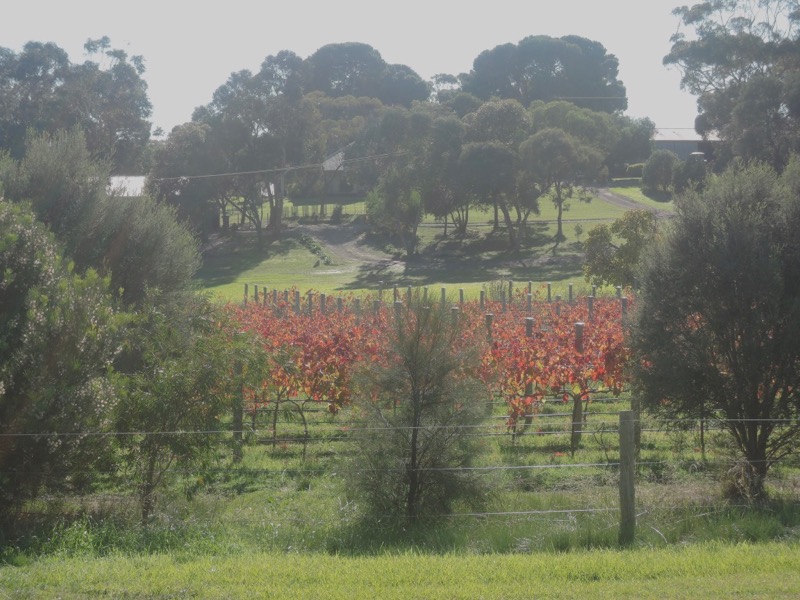
Many of the plants I’ve just named were in flower on one of my latest bushwalks, as you can see in the pictures accompanying this post. Everywhere I looked, from the tops of the trees right down to the ground, there were sprinklings of yellow.

So it was a yellow walk through a yellow world. Perhaps we should call this time of year the yellow season?

Out and about: after the rain

‘When you’re walking the view shifts and changes.
Walking’s a form of hope.’

from ‘The World Without Us
by Mireille Juchau


This year, July was exceptionally dry in South Australia. Then August blew in and it has been bitterly cold, windy and rainy ever since.

There is a manic wind whipping through the treetops today … the sort of wind that’s somewhat unsettling and leaves me feeling a bit scratchy, Belinda Jeffery writes in her August 5 entry in her wonderful cookbook-cum-nature diary The Country Coobook. And I know what she means. In the middle week of August, I spent a week on holiday near the coast down south, and much of the time the squalls of rain were so frequent and unpredictable, there wasn’t much of a chance for me to get out.

Rain in the vineyards

Still, one morning mid-week the sun shone between showers and I risked a walk. I headed down a path that skirted wetlands and vineyards (on one side) and bush (on the other side) and then turned south to follow the path back into the bush.

Flooded bush

The low-lying parts of the land along the trail had flooded. Beyond the reeds that bordered the flooded land, I saw trees with their trunks submerged, and waterbirds diving and swooping from branch to branch.

Submerged trunks

There was even a family of ducks.

If I crouched down to peek through the reeds, I could just see the green grassy banks rising above the flooded land, further within, beyond the path.

Is the grass always greener on the other side?

Once I’d walked far enough south, I turned west, deep into the bush, where there were no more floods, and where yellow blossom dotted the landscape (more about which in an upcoming post). But even as I walked, the sky darkened and the temperature dropped.

I made it home just before the next burst of rain …

Out and about: a new series

‘When you’re walking the view shifts and changes.
Walking’s a form of hope.’

from ‘The World Without Us
by Mireille Juchau


As I’ve mentioned before, I have two part-time jobs, which I move between each week. One of my jobs involves editing manuscripts for an academic press, while the other involves call centre work.

The job at the call centre doesn’t involve sales work; I work for a not-for-profit community health organisation. My calls are mostly from clients wondering what time their nurse is coming or needing an unscheduled visit from a nurse due to an unexpected health crisis, or from members of the public wanting to find out how to go about becoming a client. Around me, as I take call after call, my colleagues do the same. We work in a bubble of chatter and noise: phones ringing; people laughing or raising their voices for a client who’s hard of hearing; people taking complaints; the lunch lady ringing her bell as she pushes her trolley between desks to sell food to anyone who didn’t bring their own lunch with them.

During each shift, I am allotted a thirty-minute lunch break at a stipulated time (which varies depending on what time my shift starts). There is a lunch room at the end of the corridor, with a toaster and a microwave and a dishwasher, but I rarely eat my lunch there. Though I’m proud to work for the organisation — though I enjoy the work and value what we all do there — I think of those thirty minutes as my chance to escape.

And so I wander outside the office with my lunch. Our office is on the fringes of the city, and just down the road from our building is a stretch of park land that runs between the main road and the railway track. I walk there each day, and despite the hum of traffic and the rattle of trains passing, it’s a peaceful time. Swallows dive in front of me; parrots chirp; magpies sing; mynah birds chortle.

You can’t go far in thirty minutes, and I walk briskly along the path on a designated route. Still, despite my hurry, there are moments enough in which I have the chance to notice the passing of the seasons. In the cold months of the year, the grass is long and wet and the trees sway in wild, wet winds, their branches silhouetted against the grey sky. In the hot months, the grass dies off and the sun beats down between the branches, and the birds murmur amongst themselves.

Today’s pictures come from one of those lunch breaks a couple of weeks ago: late July, early August. Officially, these months are still classified as winter, at least according to the Western calendar. I’ve heard, though, that Indigenous Australians traditionally mark the time differently, recognising more than four seasons each year — and on this walk I saw why. Despite the cold, blustery wind, and the wet grass, and the leaden clouds above me threatening squalls of rain, the native bushes along the path had begun to flower. Acacia trees were heavy with musty yellow blossom (as pictured in the top photo), and I came upon a couple of hardenbergia vines in full bloom, their vines resplendent with purple flowers (as pictured in the remaining photos).

Perhaps you recognise the words I’ve quoted at the top of this passage: I’ve quoted them before. I think the words bear repeating, here and elsewhere, which is why this is the first post in a new series on my blog — a series I’m entitling ‘Out and About’. In these posts, you’ll find pictures and thoughts that I’ve collected together after one of my frequent wanders. It’s not a new topic for my blog, really — just a new way of gathering these kinds of post together: a recognition of how much this part of my life means to me.

Walking is a form of hope. It’s also a form of joy. That’s how those lunchtime walks seem to me.

On turning forty-seven

Other people’s words about … living small

He wasn’t a big man anymore. He wouldn’t be famous, like he’d dreamed as a kid, teaching himself to sign his name in all curved letters so he would be prepared to autograph a football. He would live a small life, and instead of depressing him, the thought became comforting. For the first time, he no longer felt trapped. Instead, he felt safe.

from ‘The Mothers
by Brit Bennett

Each year, as the number of years I’ve lived on this planet grows, I feel my own life shrink in the scheme of things. And to my own surprise, I have come to find this process, in the words of the protagonist in the passage I’ve quoted above, comforting and safe rather than depressing.

Call it ageing …

Small …

… or perspective …

Smaller …

… or necessity.

Smaller still …

Whatever it is — this passage to smallness, this losing yourself within the bigness of the world — can feel downright joyful, you know?

Note:
I’m not the only blogger who likes to reflect on their birthdays. I loved this post from Nicole from Eat this Poem , who reads Elizabeth Bishop’s poem ‘The Bight’ each year on her birthday. I had not come across this poem before and am so grateful Nicole has drawn my attention to it. It’s a beautiful poem, definitely worth reading each year (if not more often)!

How to live well

Other people’s words about … health and wellbeing

My Top 10 Tips for Health and Wellbeing

  • Listen to your body
  • Keep moving
  • Get plenty of sleep
  • Read the small print
  • Eat out less; cook at home more
  • Reconnect with nature
  • Reduce your stress
  • Appreciate the simple things
  • Share the love
  • Be grateful

from ‘Feel Good Good
by Valli Little

I am fascinated by other people’s tips for living well. I like Valli Little’s suggestions above, which are simple and practical, and come from years of experience.

My own strategies for living well vary, depending on my mood, but here are my current top ten:

1. Eat plenty of fruit and vegetables. And some cake.

2. Move — however you can, whatever your physical limitations.

3. Step outside.

4. Read books.

5. Spend time with people you love. Let them know you love them.

6. Know that happiness and sadness are like the clouds and the wind. They blow in. They blow out.

7. Practise gratitude for how things are. Don’t fret about how they could be.

8. Enjoy solitude. Know that you can survive loneliness.

9. Cultivate humility.

10. Find things …

… that make your heart sing.

Snatched phrases on … the weather

‘Someone once told me it was bad blogging and boring writing
to wax lyrical about the weather but I can’t help it.
And I am not sorry.’

from Ruby and Cake blog,
this
post

Well, as you may have guessed by now, I’m with Ruby on this. I love waxing lyrical about the weather, and have been doing so, on and off, ever since I began writing this blog, back in April 2014.

And when I’m not waxing lyrical about the weather, I’m taking photographs in celebration of it instead. So, to continue the weather celebrations, here are some photos from one of my latest saunters out and about.

This particular jaunt took place in early June, a time of year when we expect rain and clouds and wind here in South Australia. But, as I’ve mentioned several times before recently, in my usual waxing-lyrical-about-the-weather mode, that’s not the weather we’ve had at all this June. This day was just one of a number lately that began cold, crisp and clear, and progressed into soft, still sunniness.

If I were to say anything more here about how clear and true the sun shone as I wandered through the wetlands that day, or about how the sunshine filled me with joy, I’d be venturing into waxing-purple territory. (That, I believe, is the stage that follows the waxing-lyrical stage.) So I’ll leave you to enjoy these photos without further ado.

Although PS Like Ruby, as far as talking about the weather goes, I’m. Just. Not. Sorry.

Out and about … but still reading!

I don’t have a quote for you today: just a link to a post by the lovely Sophie of Wholehearted Eats, whose healthy-cooking blog I often drop in and read. In her post, Sophie, someone who has experienced anxiety all her life, suggests creating an anxiety toolbox — a kit you can (metaphorically) carry around with you at all times, full of techniques and strategies you can use when and if you need to. I’ve often toyed with the idea of sharing some of the techniques that I’ve learned over the years to cope with anxiety, she writes, but never got around to it.

Till now, that is.

Vineyards

Head on over and see what you think. Perhaps you, like me, will find some of Sophie’s techniques helpful.

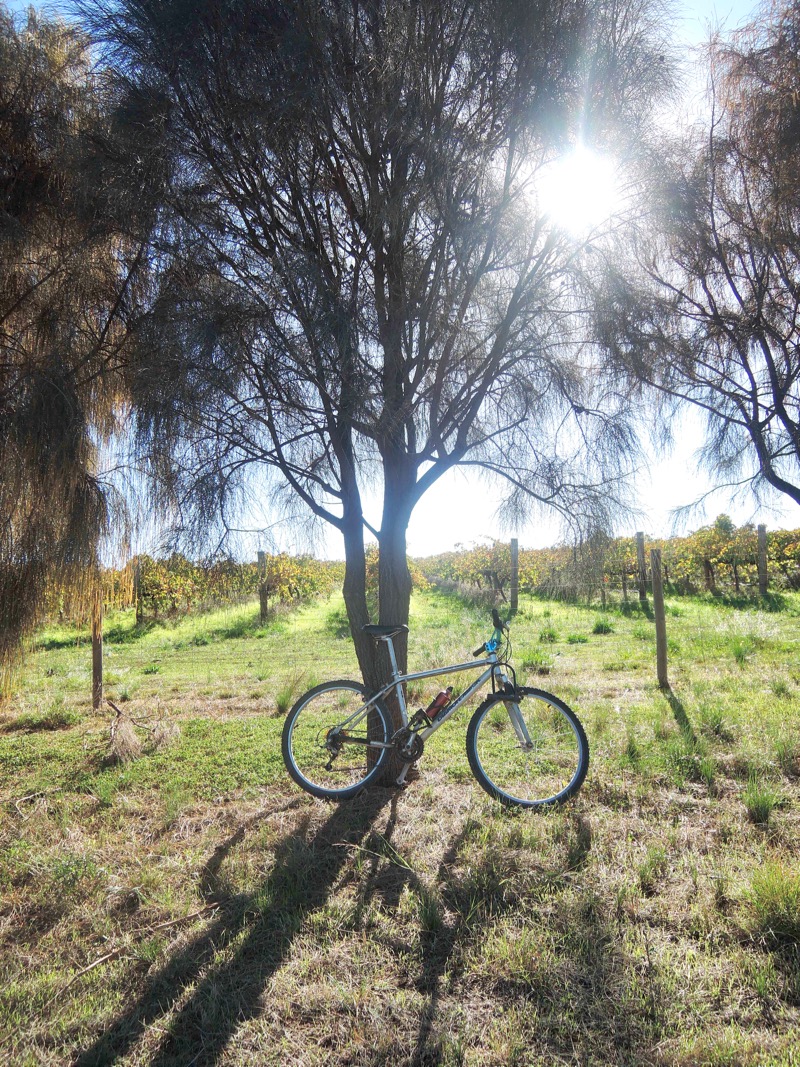
Meanwhile, as for me, I’ve been out and about a lot on my bike recently, exercise being one of the greatest feel-good strategies I know and keep in my own toolbox. The gorgeous sunny weather we’ve been having this autumn and winter has added to the joy I’ve felt getting on my bike.

Eucalypt and vines
The different shades of autumn

The photos in today’s post all come from one of my recent bike rides. It was a still, sunny day, and every moment of that ride was uplifting.

At the top of the hill
Sheoaks in golden bloom, vineyards and … my bike (of course)

I hope these photos leave you feeling uplifted, too.

What, then, is this?

Other people’s words about … therapy

Sometimes I wonder why I come here [to see my psychoanalyst] when the coming is so iterative, so forced. Having to come here sometimes feels like the biggest problem I have. I feel like a lonely man visiting a brothel, the money changing hands, paying for understanding as some people pay for love. And just as that is not love, so this cannot be understanding. What, then, is it?

from ‘Aftermath
by Rachel Cusk

As I’ve mentioned here before, I spent several years in and out of therapy, being treated for anorexia and its aftermath. I will be forever grateful to the therapists I saw during those years. They treated me with respect, patience, warmth and compassion. And they listened. Oh, they listened.

But I stayed in therapy too long, I think. I believed at the time that I was seeking a cure for my constant sense of malaise. That cure seemed terribly elusive. Now I think it was elusive because, subconsciously, I knew there wasn’t one. What I was really reaching out for was understanding, and that is not something I found in therapy sessions.

Therapy is a strange process. It is, as Rachel Cusk says in the passage above, a transaction of sorts. When that transaction starts to make you feel worse rather than better, when you feel lonelier leaving the therapist’s office than you did on arriving, it’s time to stop. It really is as simple as that, though it took me some time to figure this out.

Post-therapy, am I still seeking understanding? Yes, of course — just like everyone else. Have I found it? Not really. Perhaps no-one ever does. What I have found, though, is solace. I find solace in pots of tea, and walks along the beach, and wanders through the bush. I find it in cakes I bake, and books I’m reading, and holidays I plan to go on. I find it in birdsong, and in leisurely bike rides, and in the company of friends and family and pets.

And I find solace in other people’s stories.

Tell me, then, where do you find solace?

Meadowlands

Other people’s words on … wandering

Musing takes place in a kind of meadowlands of the imagination, a part of the imagination that has not yet been plowed, developed, or put to any immediately practical use. Environmentalists are always arguing that those butterflies, those grasslands, those watershed woodlands, have an utterly necessary function in the grand scheme of things, even if they don’t produce a market crop. The same is true of the meadowlands of imagination; time spent there is not work time, yet without that time the mind becomes sterile, dull, domesticated. The fight for free space — for wilderness and public space — must be accompanied by a fight for free time to spend wandering in that space. Otherwise the individual imagination will be bulldozed over for the chain-store outlets of consumer appetite, true-crime titillations, and celebrity crises.

from ‘Wanderlust
by Rebecca Solnit

Most of you would know by now that one of the greatest pleasures in my life is wandering: along the beach, through the bush. We read a great deal these days about the value of high-intensity exercise (the dreaded HIIT), and though I understand the principle — short bursts of intense exercise, in order to get your heart going — I find the practice intimidating and somewhat soulless. I’m not interested in exercising purely to become ‘fit’, or to ‘get healthy’, or to try to do something epic.

What I’m interested in is wellbeing — a concept that includes mental, emotional and spiritual aspects as well as the more obvious physical ones.

That’s why I like to wander. Wandering, for me, can be a slow stroll through the bush, or it can be a steady march along the shore. Hopping on my bike and riding places — that’s a form of wandering, too. It’s about breathing in fresh air, moving through beautiful surroundings, looking around, and — yes — musing. As Solnit points out, it’s about being unfettered in time as well as space. Musing takes place in a kind of meadowlands of the imagination, she says.

Oh, yes.

So today’s round-up of photos comes from another one of my recent wanders in the bush, back at the end of April. It was a dull, still day, and not many of the plants along the trail were in flower. The bush seemed stripped of bright colour: it was all earthy greens and sandy browns. The birdsong was muted, too — the whistlers don’t call much at this time of year in South Australia; the shrike thrush songs are shorter and softer than in the warmer months. A crow croaked and muttered in the distance, and I heard snatches of broken magpie song.

But then I noticed the banksia trees, which were all in flower. I hadn’t seen them at first because I’d stepped in from a louder, brighter world beyond the trail, a world of fences and bitumen streets and painted houses. Banksia leaves are a dark, khaki green, and the flowers blend in with the surrounding vegetation, varying in colour from pale yellow, through light green, to drab brown. Their beauty is as muted as the birdsong I described above, and in order not to miss it — in order to appreciate it — you have to be willing to slow down. To stop. To muse.

And that is what I did.

A prayer

Other people’s words about … the view

At the back of the hotel was a garden. Along its edge ran an earthen pathway pillared by palms. it ended in a low iron gate. They had not noticed the gate before, but now they saw it opened directly onto the beach. Stepping through the gate, they were confronted by the white and blue of ocean and beach in limpid morning light. Bare-chested fishermen were pushing wooden boats into the surf, chanting prayers together for luck. Women in fluorescent knee-high saris walked past in pairs and threes, with fish-baskets on their heads.

From ‘Sleeping on Jupiter
by Anurahda Roy

First, an update: I didn’t go to Yorke Peninsula during my fortnight of annual leave as I’d planned, after all. For a variety of reasons, it was impossible to get there. Instead, I spent some time holidaying along the coast down south. So the view from the steps down to the beach was different from the one I’d anticipated, though it was still a view to revel in.

A view to revel in

I complained recently about my dread of autumn and winter, those months of the year I always think of as the grey months. But my complaints this year were premature. Sometimes in South Australia, in the early weeks of autumn, the wind dies off, giving way to still, sunny days; endless blue skies; cold, clear nights. That’s how it’s been here for the last four weeks. I could not have picked better weather for a holiday by the sea, despite my last-minute change in location.

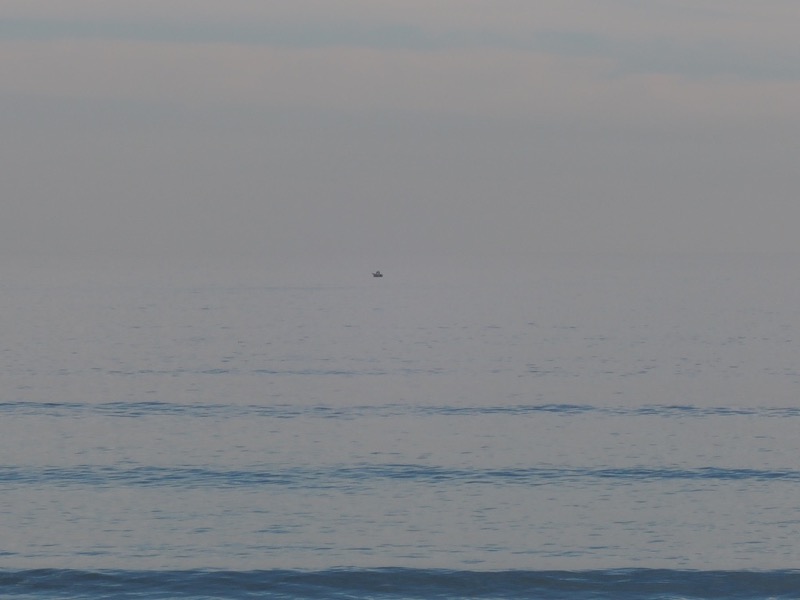
One afternoon I took a walk heading south along Aldinga Beach, beyond the spot where cars are permitted to drive onto the beach to launch fishing boats. It was one of those days where the horizon — that mysterious line between the sky and the sea — seems almost invisible. A boat glided over the surface, somehow suspended between the two, and the headland in the distance was shrouded in a mist of sea spray. The sea changed colour as I walked, from opaque blue, to glassy blue, and then to silver.

Tyre tracks in the sand
Invisible horizon
Gliding boat
Sea spray shrouding the headland
Opaque blue
Glassy blue
Silver and shining

As I walked, I thought about the words I’ve quoted right at the top of this post. I write about the beach here on my blog as a place, always, of beauty and wonder: a place where I swim and stroll, wander and wonder. But that’s a very Western, privileged, twenty-first-century way of viewing it, isn’t it? The beach in the world Anurahda Roy describes — modern-day India — is another place entirely; and her sea is a different entity. In her world, the sea provides the means for people to strive to make a living, and the making of that living obscures the beautiful view.

I am lucky enough, mostly, not to feel the need to chant a morning prayer for luck, as the fishermen in Roy’s passage do. But if I were the praying type, I would utter a prayer of thanks for the view of the beach I had that day, and for every moment I got to spend by it.