Out and about: a new series

‘When you’re walking the view shifts and changes.
Walking’s a form of hope.’

from ‘The World Without Us
by Mireille Juchau


As I’ve mentioned before, I have two part-time jobs, which I move between each week. One of my jobs involves editing manuscripts for an academic press, while the other involves call centre work.

The job at the call centre doesn’t involve sales work; I work for a not-for-profit community health organisation. My calls are mostly from clients wondering what time their nurse is coming or needing an unscheduled visit from a nurse due to an unexpected health crisis, or from members of the public wanting to find out how to go about becoming a client. Around me, as I take call after call, my colleagues do the same. We work in a bubble of chatter and noise: phones ringing; people laughing or raising their voices for a client who’s hard of hearing; people taking complaints; the lunch lady ringing her bell as she pushes her trolley between desks to sell food to anyone who didn’t bring their own lunch with them.

During each shift, I am allotted a thirty-minute lunch break at a stipulated time (which varies depending on what time my shift starts). There is a lunch room at the end of the corridor, with a toaster and a microwave and a dishwasher, but I rarely eat my lunch there. Though I’m proud to work for the organisation — though I enjoy the work and value what we all do there — I think of those thirty minutes as my chance to escape.

And so I wander outside the office with my lunch. Our office is on the fringes of the city, and just down the road from our building is a stretch of park land that runs between the main road and the railway track. I walk there each day, and despite the hum of traffic and the rattle of trains passing, it’s a peaceful time. Swallows dive in front of me; parrots chirp; magpies sing; mynah birds chortle.

You can’t go far in thirty minutes, and I walk briskly along the path on a designated route. Still, despite my hurry, there are moments enough in which I have the chance to notice the passing of the seasons. In the cold months of the year, the grass is long and wet and the trees sway in wild, wet winds, their branches silhouetted against the grey sky. In the hot months, the grass dies off and the sun beats down between the branches, and the birds murmur amongst themselves.

Today’s pictures come from one of those lunch breaks a couple of weeks ago: late July, early August. Officially, these months are still classified as winter, at least according to the Western calendar. I’ve heard, though, that Indigenous Australians traditionally mark the time differently, recognising more than four seasons each year — and on this walk I saw why. Despite the cold, blustery wind, and the wet grass, and the leaden clouds above me threatening squalls of rain, the native bushes along the path had begun to flower. Acacia trees were heavy with musty yellow blossom (as pictured in the top photo), and I came upon a couple of hardenbergia vines in full bloom, their vines resplendent with purple flowers (as pictured in the remaining photos).

Perhaps you recognise the words I’ve quoted at the top of this passage: I’ve quoted them before. I think the words bear repeating, here and elsewhere, which is why this is the first post in a new series on my blog — a series I’m entitling ‘Out and About’. In these posts, you’ll find pictures and thoughts that I’ve collected together after one of my frequent wanders. It’s not a new topic for my blog, really — just a new way of gathering these kinds of post together: a recognition of how much this part of my life means to me.

Walking is a form of hope. It’s also a form of joy. That’s how those lunchtime walks seem to me.

How to live well

Other people’s words about … health and wellbeing

My Top 10 Tips for Health and Wellbeing

  • Listen to your body
  • Keep moving
  • Get plenty of sleep
  • Read the small print
  • Eat out less; cook at home more
  • Reconnect with nature
  • Reduce your stress
  • Appreciate the simple things
  • Share the love
  • Be grateful

from ‘Feel Good Good
by Valli Little

I am fascinated by other people’s tips for living well. I like Valli Little’s suggestions above, which are simple and practical, and come from years of experience.

My own strategies for living well vary, depending on my mood, but here are my current top ten:

1. Eat plenty of fruit and vegetables. And some cake.

2. Move — however you can, whatever your physical limitations.

3. Step outside.

4. Read books.

5. Spend time with people you love. Let them know you love them.

6. Know that happiness and sadness are like the clouds and the wind. They blow in. They blow out.

7. Practise gratitude for how things are. Don’t fret about how they could be.

8. Enjoy solitude. Know that you can survive loneliness.

9. Cultivate humility.

10. Find things …

… that make your heart sing.

Leafless

Other people’s words about … winter light

The sun was like a moon in this country, and in its light I felt as if I was looking at everything through a pearl. It was cold and the trees had no leaves. I had never seen a leafless tree before.

from ‘Sleeping on Jupiter
by Anuradha Roy

I love this description by Anuradha Roy of a Northern Hemisphere winter, as seen through the eyes of a young Indian woman accustomed to living in the tropics. I remember feeling the same way myself when I left Australia in my twenties to travel through Britain, Europe and North America (and, later, elsewhere). For a year I lived and worked in Germany, as I’ve mentioned once before, in a small industrial town in Nordrhein-Westfalen, not far from Dortmund and Dusseldorf. To begin with, from November through to April, before my German was fluent enough for me to find another job, I worked in a factory.

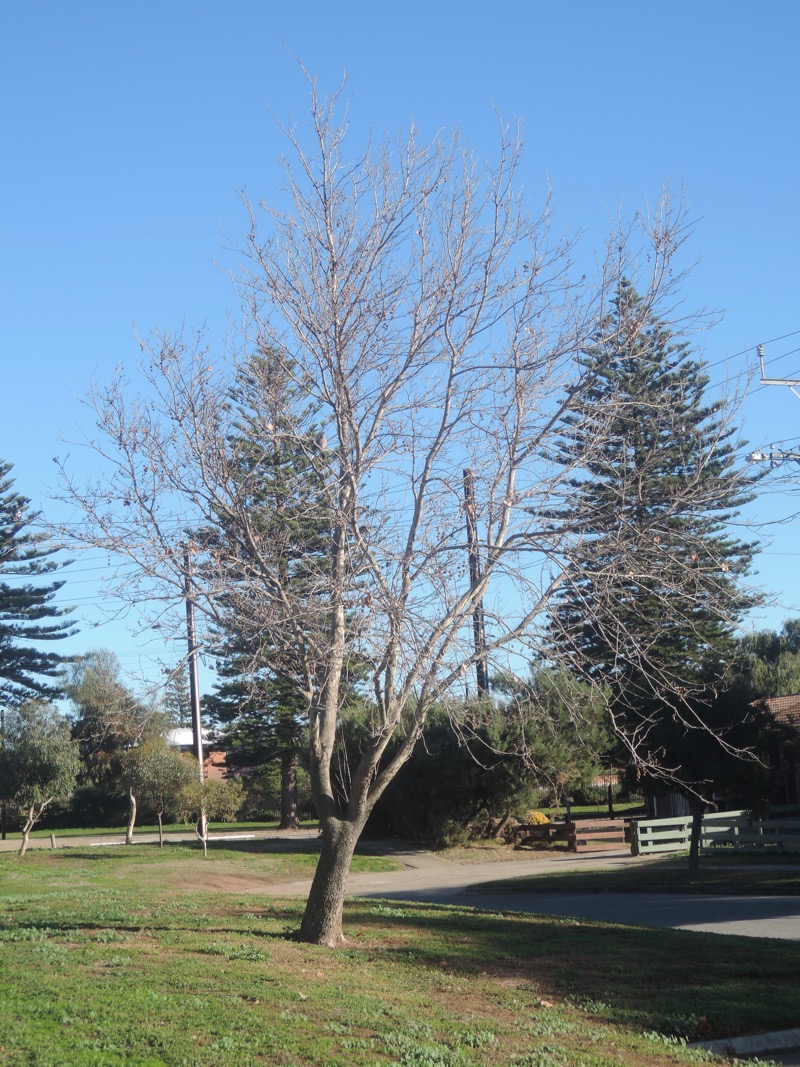
Leafless tree on Gedville Street,
between the coast and the railway station

During those winter months in Germany, I rose each day just before six o’clock and walked through the dark streets of town to the station, where I caught a train and then a bus to the factory district. My shift started at around seven-thirty, but daylight didn’t filter through the glass panels of the workshop ceiling until well after nine-thirty. I left work at four o’clock — first back on the bus and then onto the train; then back on foot through the streets towards the fourth-floor apartment I shared with a German friend. By the time I reached the door that led from the street of our apartment building into the stairwell, the sky had darkened again.

I thought, as I shuttled from home to railway station to bus to factory and then back in reverse, that I might never see broad daylight again.

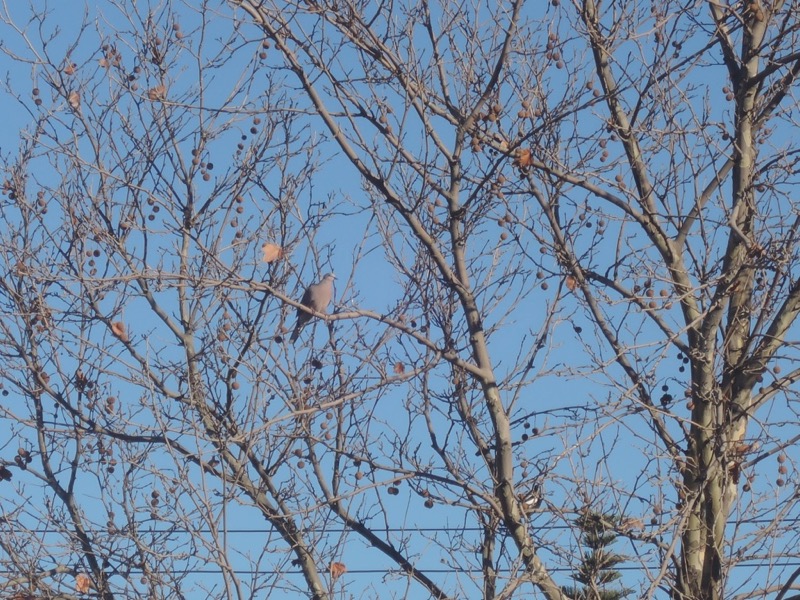
Dove in leafless tree

The trees that lined the street on which I lived during those months were European trees, native to the area, and so they were deciduous. Their leafless, bare branches formed stark silhouettes against the grey apartment buildings and the grey, clouded sky. It didn’t snow, but even in the few hours of daylight we were granted, the sun stayed hidden, a faded white ball in that streak of grey sky. Everything seemed cold and grey. I, too, felt cold and grey.

Leafless tree leaning into a house near Largs Bay School

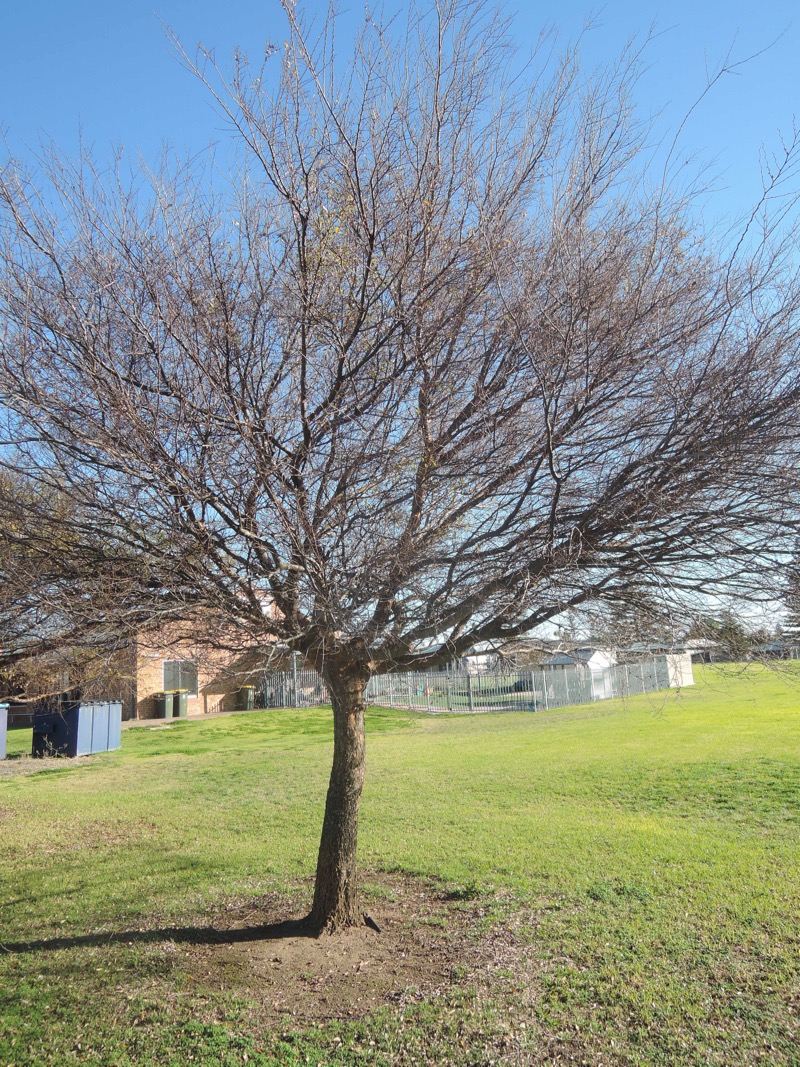
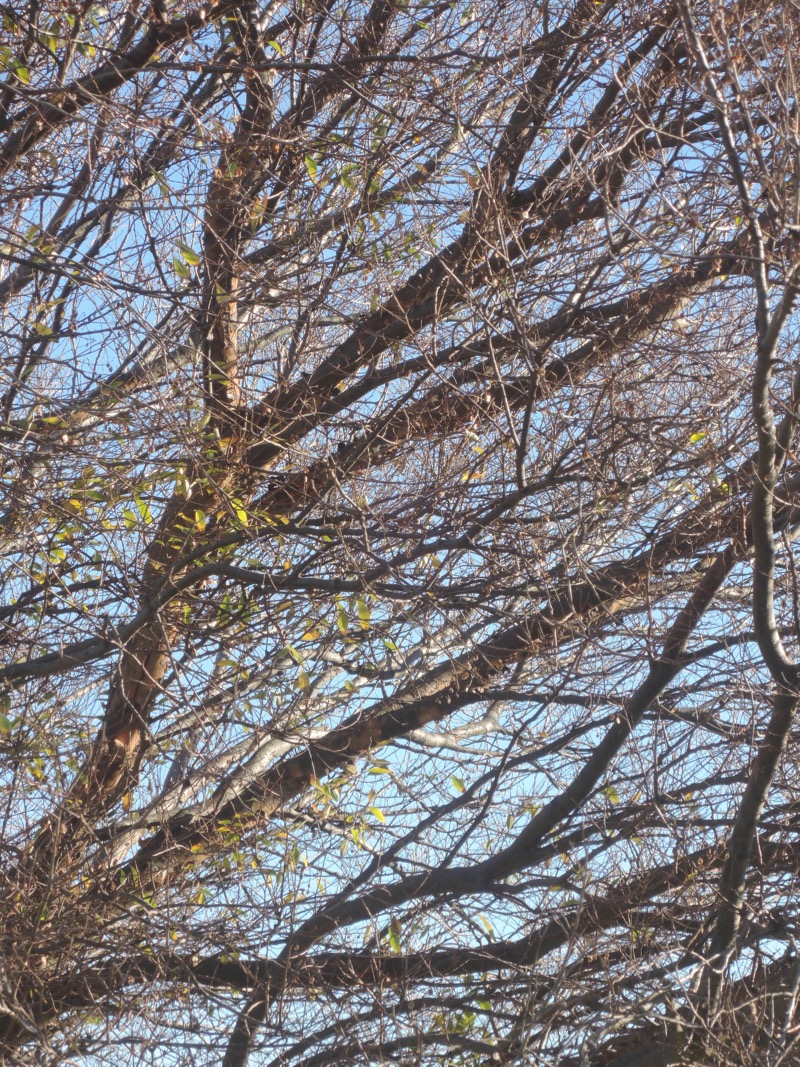
Though Australia does have a few native deciduous trees, most native vegetation is evergreen. And so, even though the winters here in South Australia can at times feel very grey, most leafless trees — like the ones I photographed to accompany today’s post, all of which grow in the neighbourhood where I live — are imports from countries like Germany: cousins of those trees that lined the streets of the town where I worked all those years ago.

Leafless tree on the school oval
on Gedville Street

I’m a home-body these days. I love the Australian sun. I love the wide arch of sky and the shifting, glittering, restless ocean. I love the grey-green leaves of eucalypts, the drooping pods of acacia trees, the red bristles of bottlebrush flowers, the golden needles of the sheoaks. I couldn’t live anywhere else now. This is home to me.
Travelling brought me a lot of joy, though, and it taught me things I could never have learned if I’d stayed at home. My love for this place is a part of what my travels taught me, I think. Those bare-branched trees were a gift. They led me back home.

Even leafless trees don’t seem leafless here
when you look at them closely!

What, then, is this?

Other people’s words about … therapy

Sometimes I wonder why I come here [to see my psychoanalyst] when the coming is so iterative, so forced. Having to come here sometimes feels like the biggest problem I have. I feel like a lonely man visiting a brothel, the money changing hands, paying for understanding as some people pay for love. And just as that is not love, so this cannot be understanding. What, then, is it?

from ‘Aftermath
by Rachel Cusk

As I’ve mentioned here before, I spent several years in and out of therapy, being treated for anorexia and its aftermath. I will be forever grateful to the therapists I saw during those years. They treated me with respect, patience, warmth and compassion. And they listened. Oh, they listened.

But I stayed in therapy too long, I think. I believed at the time that I was seeking a cure for my constant sense of malaise. That cure seemed terribly elusive. Now I think it was elusive because, subconsciously, I knew there wasn’t one. What I was really reaching out for was understanding, and that is not something I found in therapy sessions.

Therapy is a strange process. It is, as Rachel Cusk says in the passage above, a transaction of sorts. When that transaction starts to make you feel worse rather than better, when you feel lonelier leaving the therapist’s office than you did on arriving, it’s time to stop. It really is as simple as that, though it took me some time to figure this out.

Post-therapy, am I still seeking understanding? Yes, of course — just like everyone else. Have I found it? Not really. Perhaps no-one ever does. What I have found, though, is solace. I find solace in pots of tea, and walks along the beach, and wanders through the bush. I find it in cakes I bake, and books I’m reading, and holidays I plan to go on. I find it in birdsong, and in leisurely bike rides, and in the company of friends and family and pets.

And I find solace in other people’s stories.

Tell me, then, where do you find solace?

A breakfast of clouds and chocolate

Other people’s words about … what works

Chocolate at breakfast has always seemed wrong to me somehow. It seemed too decadent and lusty, entirely out of place, like watching a sex scene on television when your parents are in the room. But I have now spent eight mornings eating chocolate granola for breakfast, and I have concluded –- with all due gratitude to [my husband] Brandon, my personal granola pusher –- that chocolate is, once and for all, perfectly acceptable at any time of day. I had been a doubter for so many years, but now, good lord, I get it. And I think this revelation might, quite possibly, be the cosmic purpose of our marriage.

From ‘All We Ever Really Want to Do
by Molly Wizenberg of Orangette blog

I came to Molly Wizenberg’s blog only recently, many years behind most people. There are so many cooking blogs out there in the internet-world now, and so many of them are so beautiful, that it is easy to feel overwhelmed, or bored, or cynical. Moreover, the idea of using a recipe to introduce a post that discusses a theme entirely unrelated to food — in other words, to discuss life — has become such a common approach amongst food bloggers that it seems to me to be verging on the clichéd. But Molly was one of the early bloggers to take this approach, and she writes well, which makes all the difference. I will be reading her blog again, I’m sure.

As for chocolate at breakfast — well, why not? A therapist I used to see once said to me, as I agonised over how to live my life better (or rather, how not to live it so very, very badly): Life is short. Do what works. Though I’ve left much of his counsel far behind, I think about these particular words of his from time to time. Life is short, indeed. If chocolate works, then eat it. Please.

(Alternatively, you could try cake. Cake never fails for me.)

Meanwhile, today is my first day of two weeks’ annual leave. I currently have two part-time jobs, so time away from both of them simultaneously can be hard to pull off. The next fortnight feels incredibly precious to me.

For some of that time, I plan to go to Yorke Peninsula again. Autumn is in full swing now: my holiday there will be different from my last trip to Yorkes, back in February. There will be clouds; there will be rain; there will be wind. It will be too cold to swim, so I’ll walk miles down the beach and along the clifftops. I’ll sleep late into the morning and go to bed early at night. And I will read.

I’ll read.

I’ll read.

Afterwards, I’ll come home grateful for heaters and hot showers, and ready — already — for the next trip, whenever that happens to be.

I don’t know if, like Molly, I’ll be eating chocolate for breakfast while I’m away. It doesn’t matter. Life is short, and these are the things that work for me. That’s why I do them.

All in all, it’s not such a bad way to live.

The big ‘I’

Other people’s words about … the view

Sit. Quietly. Turn your awareness to your heart space.

Now imagine you’re sitting on a small wooden bench with yourself. Imagine you’re doing so in that space in the centre of your chest. There you are, sitting to your right, the little nattering humanoid that you are, berating yourself for eating too much at lunch and debating whether to hang the washing out or not. This little nattering self is your little ‘i’. You (the big ‘I’) can watch it all. Yep, there you are, sitting quietly, looking out at a view, over treetops down to an ocean. On your little bench. Together. You’re just hanging, nowhere to go, nothing to do. The two of you …

From ‘First, We Make the Beast Beautiful
by Sarah wilson

It was my friend and fellow blogger, Anne, who first alerted me to the appeal of benches — I mean, real benches, in real life. In her ‘Bench Series‘, she posts photos of benches that she’s snapped from all over the world. I’d never really looked at benches before, except as convenient things to sit on while I rested and took a moment to enjoy the view before me. Now I find myself noticing them (and photographing them) all the time.

The kind of bench Sarah Wilson describes in the passage I’ve quoted above, though, is a metaphorical bench, one that you can only find within yourself. It’s a place where you can sit while you encounter, and learn to accommodate, your two selves: the busy, superficial, language-oriented self that churns out thoughts night and day, and the deeper, quieter, wordless self that lies beneath all the nagging chatter.

The idea of the two selves isn’t unique to Wilson. It’s an idea common to many systems of thought, one we’ve all become more familiar with since the recent popularisation of mindfulness-based practices and therapies. But I particularly like the way she uses the image of sitting on a bench to explain it. It’s a simple, vivid, accessible reminder of how easy it is to get caught up in (and believe) your own thoughts.

A thought, after all, is only that: a thought. It may be true; it may not. Thoughts and the truth exist independently of each other. When I first came across this idea (here), it seemed both counterintuitive and revolutionary to me. I’m still grappling with it.

Wilson again:

And then it might occur to you that your little mate ‘i’ is just that — a little mate sitting next to you. And that this Big ‘I’ is who you really are. It feels deep and close and yet so vast.

Okay, I’ll admit I winced, at first, when I read these words. First, I’m not sure that the quieter self (the one Wilson calls the Big ‘I’) is deep or close or vast — or, indeed, in any way somehow ‘better’ than any other part of our self. I think that it just is.

Second, I was troubled by her use of the phrase little mate both to describe the thinking self, and to distinguish that self from the non-thinking self. I found the phrase overly colloquial, like some kind of condescending attempt to make a difficult concept more user-friendly to her less educated readers. But I have slowly come to feel the opposite way about her wording. The word mate implies friendship: it implies love, acceptance, forgiveness. Also fun. That’s helpful, I think. Why vilify a part of yourself, when you can instead smile and make friends with it?

Wilson uses meditation to find her bench. As you know, I don’t. But I don’t think that matters. What matters is that you know the bench exists — and that you know how to find it, however you get there.

And whether or not your prefer your benches real or whether you prefer them metaphorical, I wish you many sun-dappled, peaceful benches of your own in your life, wherever you happen to be.

Epic

Other people’s words about … sweat

‘Swagger’ might be common jargon now, but let’s not confuse the situation. Swagger is earned. It can be grimy or graceful. It can be innate, but it’s also finessed. It’s the feeling that makes you sit a little taller and reinforces your backbone. We sweat with swagger when we infuse a shameless confidence into movement. To sweat with swagger is to redefine what it means to be an athlete and create unapologetic greatness along the way. When we sweat with swagger, we test the limits of human potential. When our footsteps are powered by motivation and a strong community, the cadence is a drumbeat to doing something epic. Sweat is magic. Swagger is the glisten.

from ‘Shut up and Run
by Robyn Arzón

First, a story of my own, before I address the words I’ve quoted above.

The day before Easter, I woke with my stomach roiling. It was my first official day off work for a while, and when I pulled the curtains back from the window above my bed, I saw clear skies and sunshine through the glass. Lying there in bed, a little before seven o’clock, I felt every part of me rebel at the thought of languishing the day away inside, sprawled out on the sofa, feeling ill.

And so I got up, and I pulled on my oldest pair of trousers — the pair with the faint bike-chain stain on the left leg. I threw my camera and some spare coins into my backpack, and I got on my bike and rode away from the house.

The moment I started cycling, I could feel something inside of me begin to unfurl. I am a tense person, and mostly this tension is a mental thing, but it manifests itself in me physically, too: in my muscles. This is something I have only just begun to realise. I had been sore for days before this bike ride, my right hip aching from stooping over the computer in the office, the muscles in the hollow of my back raw from constantly bracing myself (against what? staying still?), my stomach queasy and unsettled.

So I pedalled slowly. Gently.

The route took me south-west — first along the coast, past two jetties; then south-east a little way,  where the coastal road came to a dead end. Then, when the coastal road started back up again, I turned back west and cycled alongside the sea once more, past the third jetty. I rode with my head up, glancing about me: at the wide, cloudless sky, and the opal-coloured sea, and the faint line dividing the two of them. Lycra-clad cyclists sped by me in a whoosh of tyres and sweat — mostly men, some women; most of them younger than me, but some older — and I said, ‘G’day’ to each one of them and gave them a little smile of greeting and acknowledgment, though I’m not sure that any of them heard me or noticed.

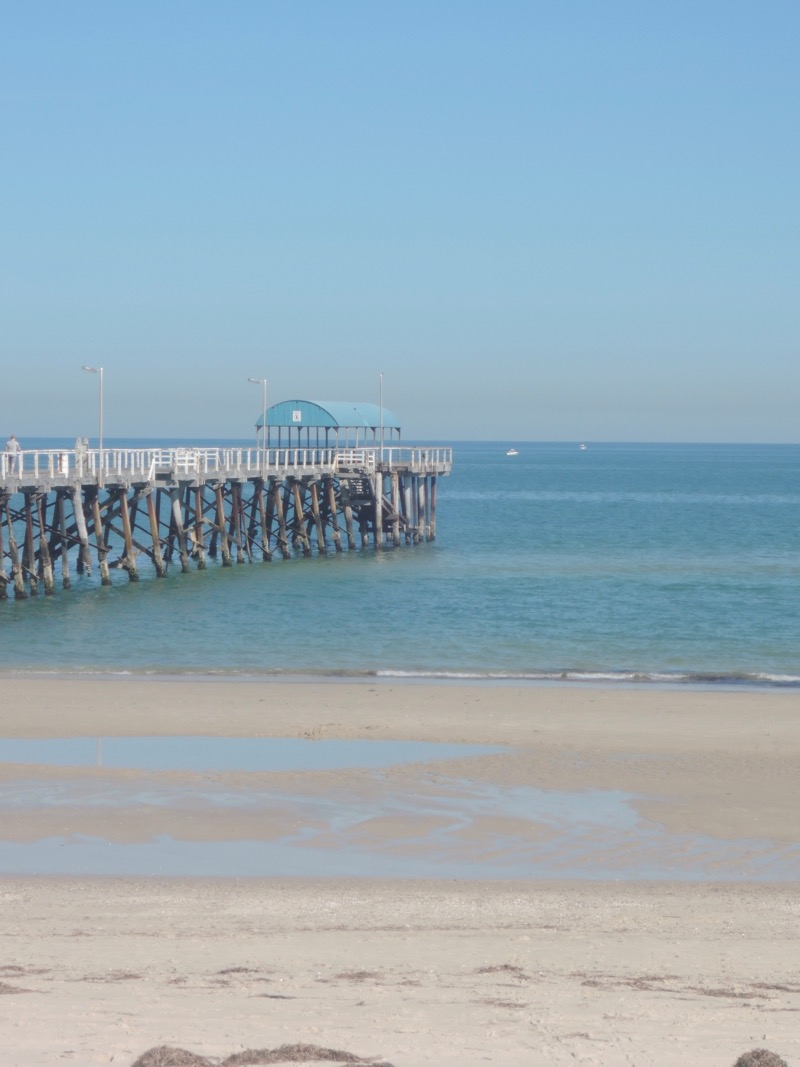
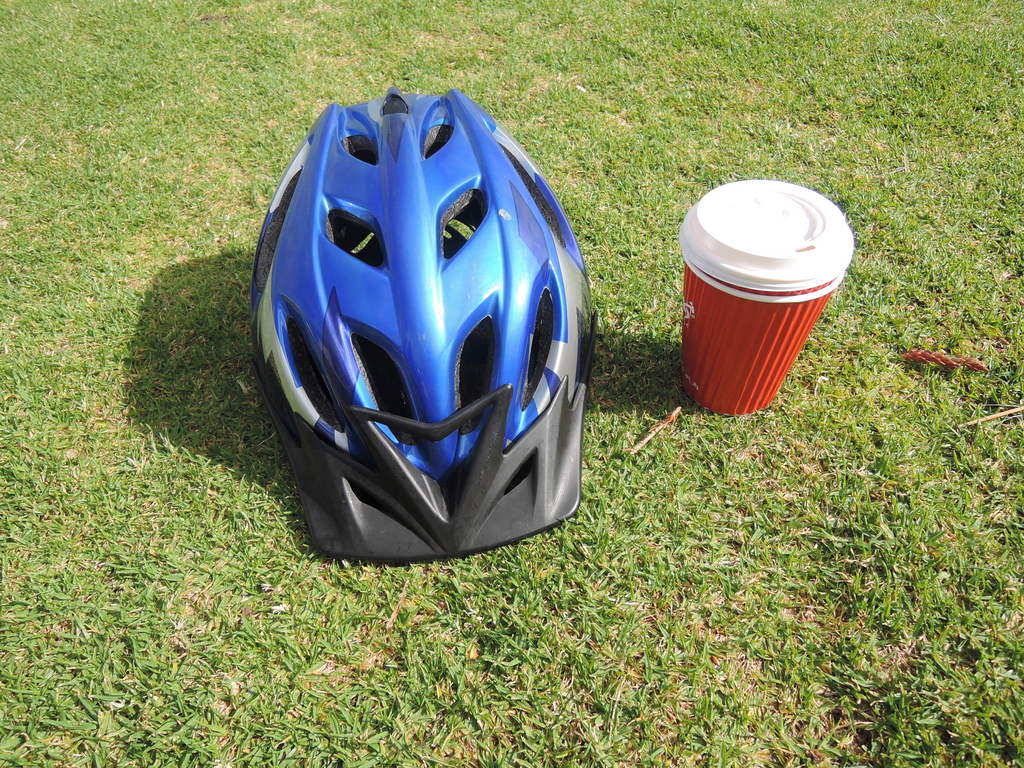
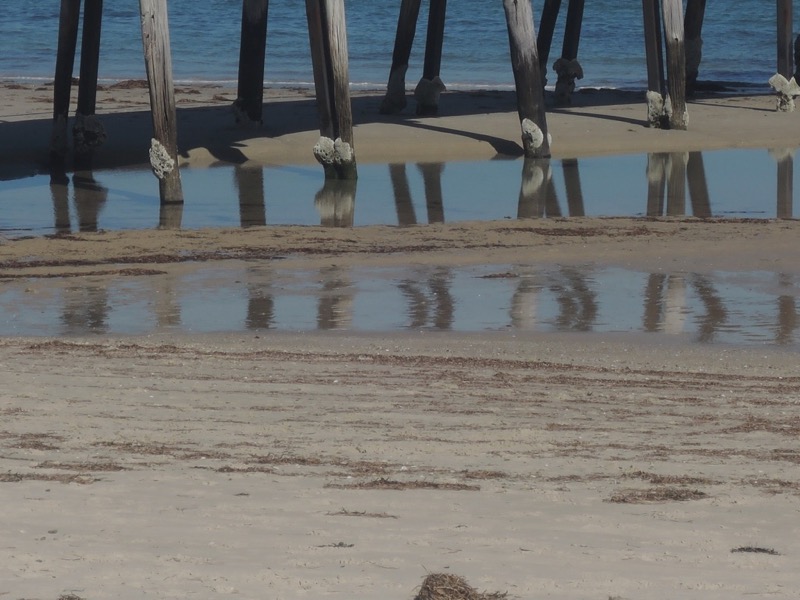
When I got to the fourth jetty (the one pictured in most of the photos in today’s post) I stopped and parked my bike. I wandered across the main road to the supermarket and bought some dried-fruit-and-nut mix, and then I dropped into my favourite café at that particular beach and ordered a take-away cup of tea. They’ve recently started selling tea made from leaf tea instead of teabags there, even for take-away drinks, which is a little thing, I know, but it makes me very happy. I carried my lidded red cardboard cup of too-milky leaf tea back across the road and plopped myself down in the middle of the foreshore square. And there I sat, cross-legged on the sun-warmed grass, nibbling my fruit and nuts, sipping my tea, looking (and looking) at the sea.

In a few weeks’ time, the grass in that foreshore square will be wet with rain, and a cold wind will whip between the lamp-posts up over the grey roof of the pavilion. I contemplated this a while, stretching my arms out behind me, resting my weight back, feeling the blades of grass tickle my palms. The beach was only a few steps away from where I sat on the grass, and I could see the jetty pylons reflected in the water, and I’ve said it once already in this post, but little things like that — they make me very happy indeed.

So what has this to do with the words I quoted at the beginning of this post? There was a bit of sweat involved in my bike ride, sure, but there was no swagger. I cannot say I moved with shameless confidence or unapologetic greatness. I was motivated, certainly, but I did nothing epic or magic. I am certain I did not glisten.

Thank goodness.

I do not wish this post to be unkind. I do not wish to say, as Arzón herself says many times throughout her book, I call bullshit on her words. But then there’s this:

Our inner monologue can turn can’t into can and dreams into realities. Extinguish doubt with action. Let’s write the story that says we are a little better than yesterday. We can push ourselves to where we want to be. It’s going to take a little sweat, though. Happy is something you do, baby, and only you are responsible for your happiness. Life is happening right now, so stop making up excuses and tell me, what do you want your story to be? Do you want to be a runner? Have you always dreamed of completing a marathon? Whatever it is, write it down, look back on it, and own it.

These sentences — sentences like this — worry me. Arzón’s thoughts are not unique; her words are a part of a general conversation, one that I hear around me almost every day. And it is a conversation I can’t help fretting about. I am alarmed when I hear someone confuse athletic prowess with personal greatness. Or when I hear someone link the idea of their becoming a better person, of their living a better life, with the act of slipping on a pair of running shoes. Or when I hear someone use words and phrases like ‘strive’ and ‘focus’ and ‘dedication’ and human potential (that last is Arzón again) to describe, not acts of goodness, let alone greatness, but essentially self-centred feats of fitness and strength, speed and endurance.

I decided to do one thing with my life — epic shit — and I want you to come along for the ride, Arzón writes, of her long-distance running. Maybe I’m wrong, but those words make me feel empty and sad.

Having said that, I also do not wish this post to turn into a lecture, or a rant. I do not wish to moralise. So I will just say this: I took my bike ride that morning slowly, because that was what the day asked of me, and what my life seems to be asking of me generally right now — regardless of my dreams, regardless of whatever kind of story I might prefer to write about myself. It was a gentle ride, and I felt gentler for it afterwards (though still somewhat unwell).

And that, I think, is how I want to live out my days: gently. Slowly. With kindness, both to myself and to others. With humility.

Tell me, am I alone in this? How do you want to live?

The beast

Snatched phrases (on being present)

Do the anxiety. Then leave it there. This is our challenge.

from ‘First, We Make the Beast Beautiful: A New Story about Anxiety
by Sarah Wilson

Simple words, huh? They apply to all manner of ills, I think — not just anxiety. They are about staying in the present: doing the hard stuff when it comes up, not questioning it or agonising over it … and then leaving it behind and moving on.

There are no solutions to anxiety out there, Wilson argues further on: no cures or fixes. So you just do it …

… and then you leave it.

This makes great sense to me.

Today’s photos? They’re from one of my latest bushwalks, a couple of weeks ago: mid-March. It was a still, grey afternoon, and when I first began to walk, the colours seemed drab, and the birdsong was muted, and the air felt unkind and cold.

But as I wandered on, I began to see a few flowers despite the greyness, and I came upon a kangaroo, which stiffened at my bumbling approach and then bounded away. I heard the sea murmur somewhere through and beyond the thicket of trees, and a magpie began to carol, low and soft.

I had done my day, and I had left it there, and things were fine. Just fine.

Differentiation

Other people’s words about … wild animals

As Paul and I were cresting the last hill, as I was squinting into the darkening woods to make out the path, a couple of deer lifted their heads at once and differentiated themselves from the trees.

We stared at them, and they at us, for a full thirty seconds without moving. They multiplied as we looked at them. There were three at first, then there were four, then there were five. They were the exact color of the bark and leaves –- gray brown –- but the skin around their eyes was red. I felt the breeze on their backs lift the braid from my chest and set it down over my shoulder.

‘They’re going to get us,’ Paul whispered. He reached for my hand.

‘They’re a herd,’ I reminded him. ‘They’re afraid of us.’

Two more appeared. Paul shivered.

From ‘History of Wolves
by Emily Fridlund

There are many places I like to go bushwalking in, but one of my favourites is the Aldinga Scrub. When I walk there, particularly at certain times of the day, I am always conscious that I might encounter a roo or too. There are traces of them throughout the Scrub.

Sometimes a kangaroo appears before me in plain sight — in a clearing in a patch of sunlight, enjoying the last rays of the sun, joey in pouch.

But sometimes there are roos in front of me all the time, without my even realising it. I don’t know what alerts me to them then. It might be the faintest rustle in the leaves around me, or a slight movement — an ear-twitch, perhaps. Sometimes a sense comes over me, simply: a dawning awareness that I am not alone any more, that I am being watched, and regarded, and assessed.

Kangaroos are not naturally aggressive towards humans, as far as I know, or not during encounters like this. But still, like all wild animals, they are protective of each other and of their young. And so, when I come across a roo or two (or more) in this way — when they differentiate themselves from the bushes around them, as Linda, the narrator in the passage above, beautifully puts it — I make sure to stop and take one or two steps back. I let the kangaroos know I’m not a threat. We regard each other a while, creature to creature, acknowledging each other. It’s not fear I feel then, like Paul, the little boy in the quote above: it’s respect.

And then I move on, leaving them to their world, re-entering my own.

When the wall comes down

Other people’s words about … the view

When I was about fourteen or so, I studied a poem in school by David Campbell, called ‘On the Birth of a Son‘. It was a sonnet, and I didn’t know much about sonnets, except that Shakespeare wrote a lot of them. It never occurred to me that a contemporary poet might write one.

This sonnet by David Campbell has stayed in my mind ever since. It remains one of my favourite poems. Here it is, in its entirety:

The day the boy was born, the wall fell down
That flanks our garden. There’s an espaliered pear,
And then the wall I laboured with such care,
Such sweat and foresight, locking stone with stone,
To build. Well, it’s just a wall, but it’s my own,
I built it. Sitting in a garden chair
With flowers against the wall, it’s good to stare
Inwards. But now some freak of wind has blown
and tumbled it across the lawn — a sign
Perhaps. Indeed, when first I saw the boy,
I thought, he’s humble now, but wait a few
Years and we’ll see! — out following a line
Not of our choice at all. And then with joy
I looked beyond the stones and saw the view.

On the face of it, this poem is about becoming a parent — the fears new parents have; the limitations parenthood imposes on their lives; the unexpected, unsettling joys it rewards them with. So it might seem strange that Campbell’s words have always resonated with me, though I have chosen, deliberately, never to become a parent.

But that’s the thing about great poems: they are universal. They manage to strike a chord in different people at different times for different reasons.

For myself, every time I read this poem I am moved by the contrast the poet makes between the act of looking inward — at his safe, pretty, cosy life — and the act of looking up, out, to glimpse a view of the world, and his life, beyond.

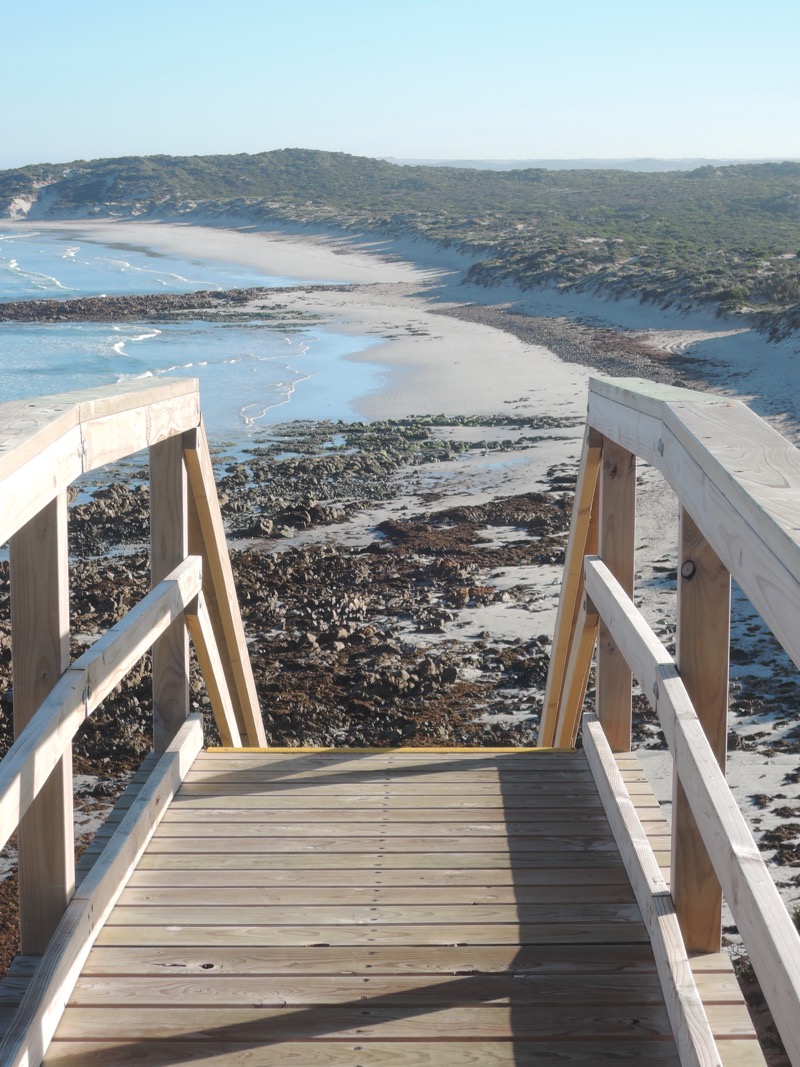
The view beyond. Recently, I went on a holiday in Yorke Peninsula. I returned to one of my favourite spots, following a long, undulating, unpaved road to get there — one that is corrugated and dotted with puddle-holes, dusty with sand stirred up by other passing vehicles, and lined with dense thickets of bush where brown snakes lie coiled, sleeping.

Each day I passed my time the way I always pass my time there. Each day I woke to the same view.

But it is a spectacular view: of open skies, of wide seas, of sprawling cliffs and rolling sand dunes. It is a view of a life beyond the life I normally lead. It is a view that sets me free.

I live a small life: small things give me pleasure. I consider myself, mostly, lucky to be able to live this way. And yet it’s good to escape from time to time: to look up and out and beyond.

And to see, again, the beautiful view.

Notes

You can find a link to this poem here and here.