Out and about: the last summer days

‘When you’re walking the view shifts and changes.
Walking’s a form of hope.’

from ‘The World Without Us
by Mireille Juchau


Here’s the thing I always forget as summer draws to a close and the annual grey-weather dread steals over me: there are moments, at this time of year, when the wind drops, and the sea becomes shining and silken and blue.

I took the photos in today’s post as I wandered the beach at Largs Bay one afternoon a few days ago, in the week before Easter. The day was so still, and the tide so low, that the pine trees along the Esplanade were reflected in small pools of seawater that had formed between the sandbar and the main ocean …

… and out on the water, ships hung suspended in blueness, somewhere between sea and sky:

It was an afternoon that reminded me that there’s joy and beauty in every season — yes, even in the seasons you’d rather not be heading into …

On labour

Other people’s words about … loneliness

Dad’s dying had been like a long labor, the work mostly his, but the experience for me was as profound, as isolating, as the labor of birth. For weeks after my son was delivered, I remember, I was stunned by it — by what I’d gone through, by how alone with it I’d felt, by how astonished I was by it, and by how isolating that astonishment was. Others held my son, admired him. They saw him simply as a big healthy baby. But when I looked at him, part of what I saw and felt was how he’d come to me, that long solitary labor, the amazing combination of agony and release that I felt I could explain to no one else. And in some nearly parallel way, this is what I felt about my father’s death. It was what I returned to frequently, it was privately where I lived, for a long time after it was over.

From ‘The Story of My Father
by Sue Miller

Let me start by explaining (hastily!) that the affinity I feel with the words in the quote above is not because I’ve ever given birth (I have not). Nor, more importantly, is it because I’ve recently experienced the death of anyone close to me, let alone my father, who is a strong, healthy, happy man whose company I hope to enjoy for many years to come. No, not at all.

I am a big fan of Sue Miller’s writing. What I most like is her attention to detail, her scrupulous examination of people’s inner workings — their thoughts, their feelings, their individual senses and perceptions — and the way she then builds on these ‘small’ things to make ‘big’ stories from them. A writer friend of mine who isn’t a fan of Miller’s books once said to me that she feels ‘dead inside’ when she reads a Miller novel. And I get that, actually. I think, in fact, that what my friend dislikes about Miller’s writing is exactly what I like: the precision, the detail, the refusal to hurry over anything, or to be swayed by sentiment or affection or a need for resolution for her characters.

I’ve explored loneliness and isolation a lot in my posts on this blog, but I thought the theme was worth returning to because of Miller’s words here. I was stunned by it, she says of giving birth, by how astonished I was by it, and by how isolating that astonishment was. This, for me, distils the experience of living itself, the realisation that each experience we have, however great or small, however joyful or devastating, is an experience we feel we [can] explain to no one else.

In the last couple of years, whenever I’ve experienced bouts of unwellness or anxiety (or both, combined) that have left me feeling isolated at home, struggling to go out, struggling to get to work or to catch up with people I love, I have found myself, afterwards, return[ing] to those experiences repeatedly in my mind; I have found that those times of illness were, for a while, privately where I lived.

Miller’s use of the word labor here refers only to giving birth, but the passage applies to other things, too, if you reframe it: to the labour of living, of loneliness — yes, to that astonishing labour.

And yet, still, it is worth labouring on.

Out and about: dragons & damsels

‘When you’re walking the view shifts and changes.
Walking’s a form of hope.’

from ‘The World Without Us
by Mireille Juchau


I wasn’t expecting anything special on my most recent walk in the Scrub. It was mid-February, a warm Sunday at the end of a warm week, after a very warm January. I figured everything in the Scrub — bushes, birds, animals — would be going through what I always think of as mid-summer somnolence.

But things in the Scrub were thriving. Passing sea box bushes resplendent with red berries (above) and sheoak trees whose branches were clustered with woody fruit (below), I walked south, towards the little lagoon just behind the boundary fence that runs along Acacia Terrace.

Damselflies skimmed the (somewhat scummy) surface of the water, and a pair of ducks paddled amongst the reeds in the lagoon. As I followed the curve of the bank around to the other side of the pond, I saw a family of kangaroos lazing in the shade of the nearby bushes, one of them poised upright, ears pricked, standing sentry.

There was a bush in flower that I’d never seen before, too — I think it was a hakea, though I’m not entirely sure. Its white flowers reflected the bright summer sun so that the petals seemed to glow.

And just outside the Scrub, perched on an upright stump by the side of the road, a little dragon caught my eye.

He (or she, I’m not sure) was very still, so still that I thought at first he was an oddly shaped twig sticking out at the top of the stump. We regarded each other silently for quite some time — I, fascinated, he, less so — before I turned to go.

I swear I could feel that dragon’s eyes on me all the way home …

I see you

Other people’s words about … love

The bright lights had been switched off and the place was lit only by small windows. Then there she was — Stella — the top of her head highlighted as she looked down, reading. It never ceased to amaze him the thrill he got at seeing her. Catching her unawares.

From ‘Midwinter Break
by Bernard MacLaverty

Every time I read these words by Bernard MacLaverty, I feel my breath catch. They describe so perfectly those tiny, stolen glimpses we get of the people we love.

The photo accompanying this post is one I took while I was in Yorke Peninsula recently. It was very early summer: fan flower season. One evening just after sunset, as I wandered along the top of the cliffs, I came to a fork in the path where there were fan flower bushes growing at every corner.

And there, in the dim glow of the early-evening sky, the petals of the fan flowers — which in the warm, bright light of the middle of the day are a strong, cheery blue — seemed to shine for a few moments: pale, spectral, luminescent.

Perhaps my talk of fan flowers seems an odd match for the words I began this post with. But this was another one of those tiny, stolen moments we’re given in life from time to time, and it seems to me a good way to honour Bernard MacLaverty’s lovely words …

PS One other thing: a quick shout-out to my mother, who celebrates her birthday today, and who is a person responsible for many lovely moments in my life .

Tangled

Other people’s words about … writing a journal

She put the card carefully on her knee under the journal, which she opened at the middle to a sprawl of furious and barely legible writing. There were circles and boxes and in some places the pen had been pressed so hard against the paper that it had torn. Clare snapped the journal shut and for the second time in as many days she put her head in her hands and cried.

There wasn’t, she thought, a single page in all the [boxes of journals] that was worth keeping. For twenty-seven years she had written the same things over and over.

from ‘Closing Down’
by Sally Abbott

Like the character Clare in the passage above, I was an avid journal writer for many years — from the age of about twelve years old, in fact. I began writing a journal because my Year 7 English teacher made the activity a part of our curriculum for the year: she gave us ten minutes at the beginning of each class to write in our journals. She saw journal writing as a way of encouraging us to learn to write fluently, spell correctly, express ourselves clearly and perhaps — as a corollary of the writing — to read widely.

Like Clare, I still have all my old journals, stored away in a plastic crate. Those old childhood ones are filled with pages of neat handwriting in blue fountain-pen ink, drawings, doodles, comic strips I cut out from the newspaper and pasted in, pictures from old magazines, stickers, and notes other people wrote to me (on the odd occasion when I allowed someone access to my journal). They are bright and colourful and their tone is, mostly, chatty and cheerful.
But the later journals, which were written during my move from childhood to adolescence through to early adulthood and beyond, are filled with more handwriting and less colour. The writing takes over. It fills the pages. There is page after page after page of it.

It was a grief counsellor who had recommended Clare start keeping a journal … It was a way of beginning to articulate her feelings, the woman had explained, and Clare remembered her sad, earnest face and the huge weight she gave to the word ‘feelings’, as if they were something Clare could take out of herself and put on a table and carefully untangle and separate and tidy up. And perhaps, for a little while, it had helped. But what had she been thinking … to write over and over and over that she was sad or angry or okay? I only wrote what I felt, she thought. I never wrote what I saw. I never wrote what I did. I never wrote that I’ve made it this far.

In my early adulthood, like Clare, I was encouraged by various health professionals to continue keeping a journal as a part of my therapy; indeed, I was told I could see journal writing as a kind of therapy in itself.

And it was, I guess. For many years, it was.
Or at least I thought it was. I only wrote what I felt, Abbott’s character Clare realises in the passage above (my emphasis): I never wrote what I saw. These are wise words. There came a time, in my own journal writing, when I looked back over all those handwritten pages and was dismayed to see that what I had thought of as a process of therapy and healing was more like a process of emotional purging, repeated over and over and over again.

Reading (or rather, trying to read) those passages felt oppressive, overwhelming. Why did I always have the same feelings? Why did I always write about those feelings? Why didn’t writing change the feelings? Why couldn’t I find a cure?

I’ve talked before about my scepticism when it comes to dubious concepts like recovery and healing and cure. That’s part of my theme today (again), but what interests me more here is the way Abbott, using the character Clare, focuses on another dubious concept: the huge weight we place these days on our feelings, and therefore on our need to untangle them and tidy them up.
Meditators often talk about the practice of watching their thoughts and feelings arise and then letting them pass by without becoming ‘attached’ to them. Though, intellectually, I’ve understood the reasoning behind this for years, it wasn’t until I saw it expressed through Clare’s character that I actually got it.

Feelings are repetitive, yes: I hadn’t been wrong about that, in re-reading my journals. What I had been wrong about was letting this bother me. And measuring myself by it.

I never wrote that I’ve made it this far. Here, Clare realises that feelings, as measuring tools of ourselves and of our worth, will always fail. They do not mark where we are in our lives. They do not necessarily affect what we see, what we do, where we go. (Or they don’t have to, anyway.) In this sense they are, ultimately, irrelevant. Our feelings accompany us on our passage through life, but they don’t determine the actual passage itself.

And they don’t have to be cured.

Interestingly, given the recurrent out & about theme of some of my posts on this blog, the character Clare in Abbott’s book is a great walker. She walks at night when she can’t sleep: she walks, and walks, and walks. And, in contrast to when she’s writing her journal, when she walks, she sees. When she sees, she learns. Her feelings, as she walks, are a backdrop. They are not the main event.
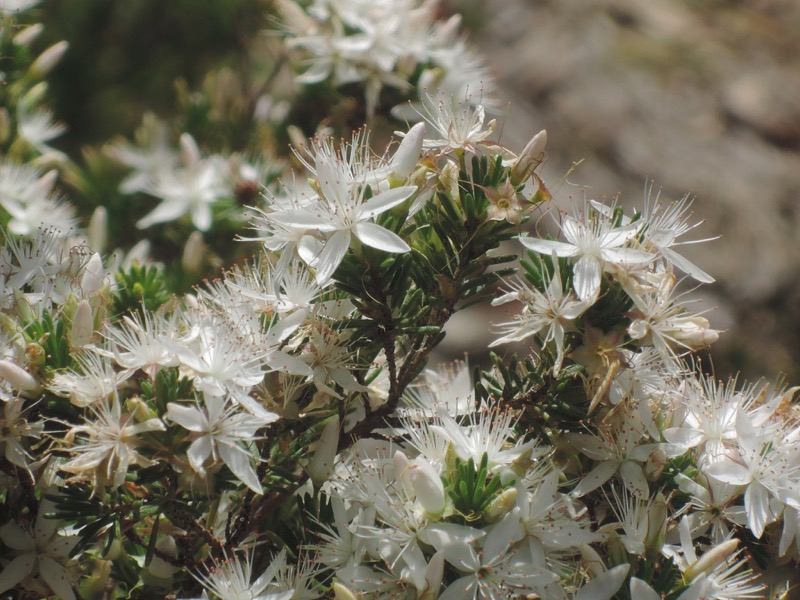
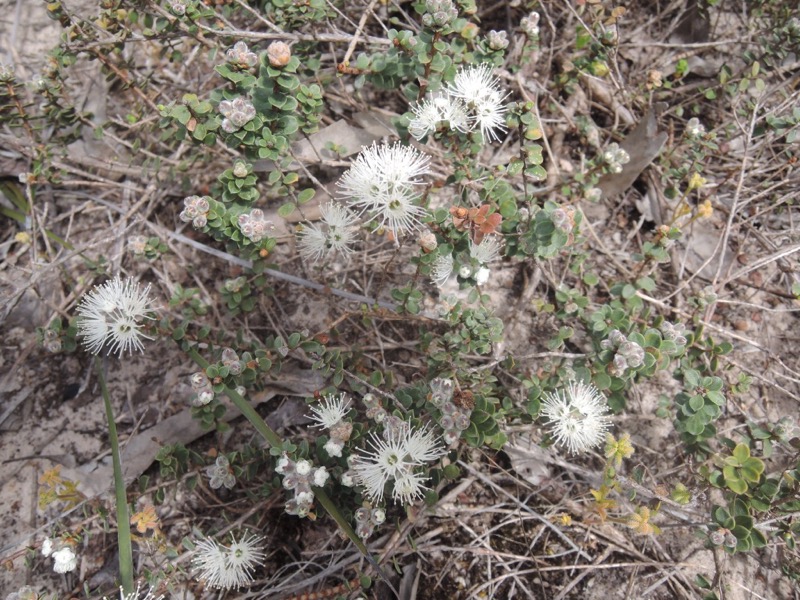
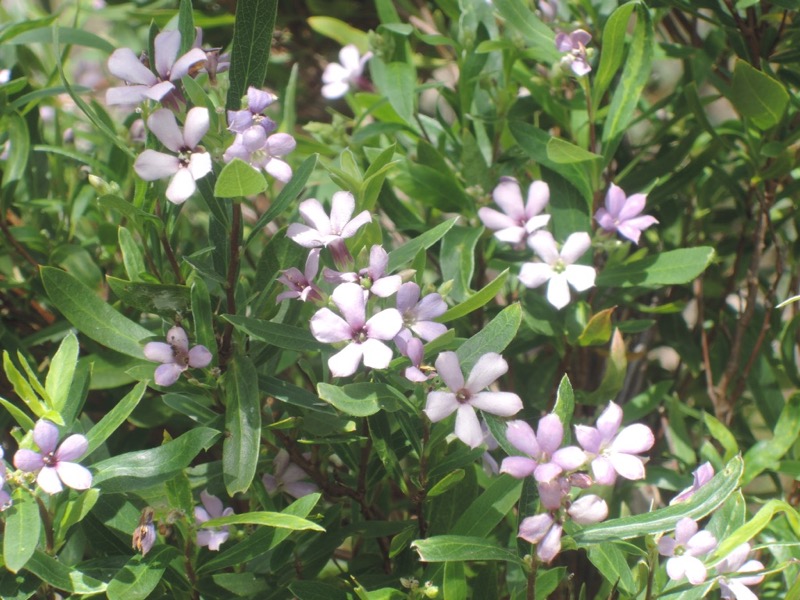
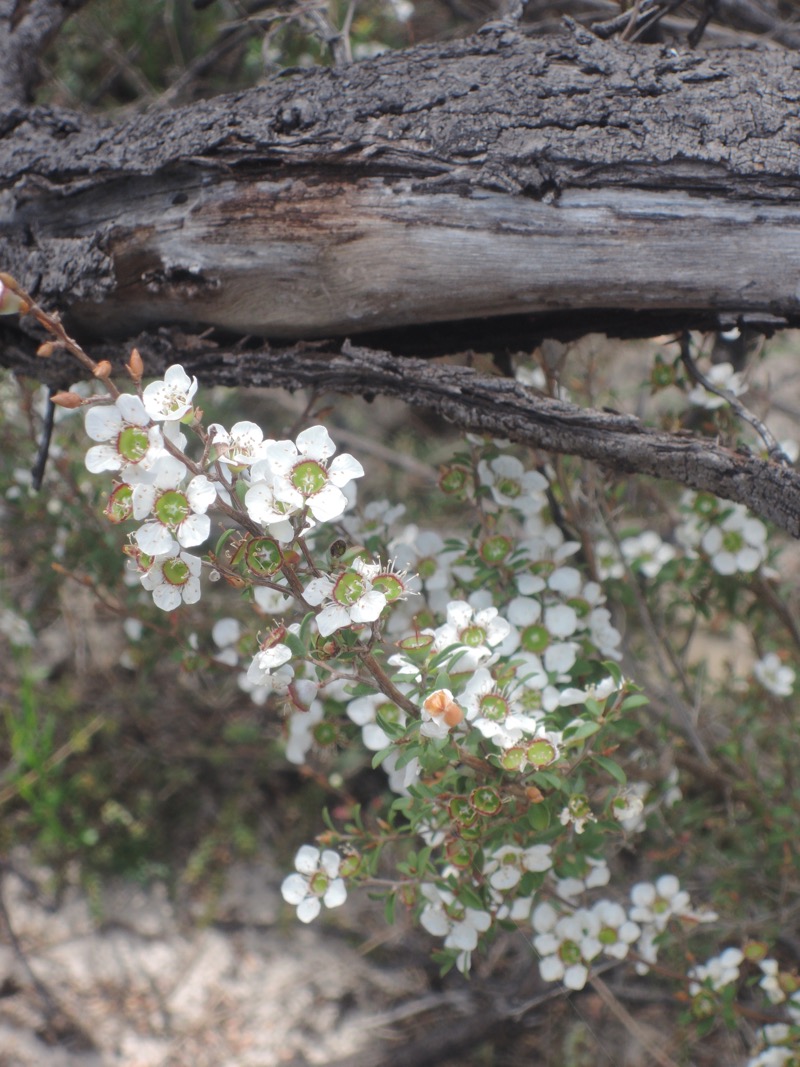
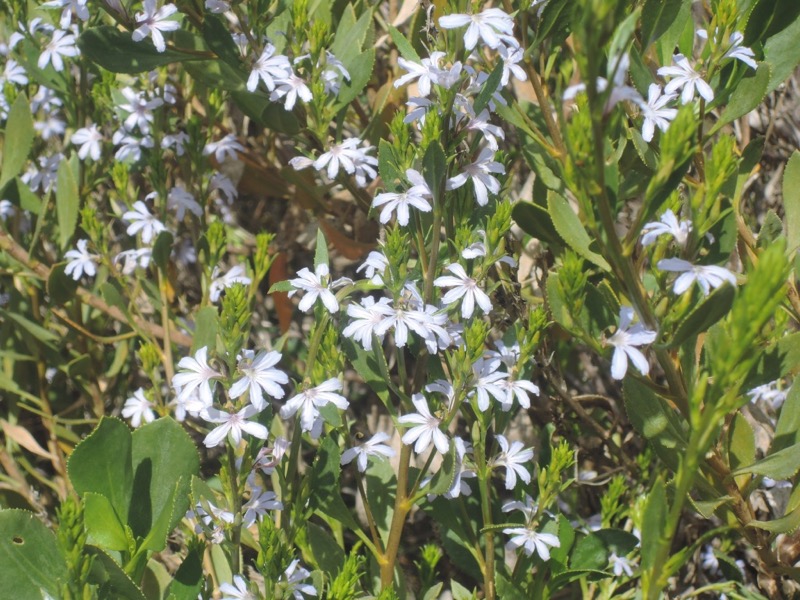
As for me? I took the pictures in today’s post on a recent bushwalk, a day in late October when there were spring flowers everywhere, purple and blue and pink and white. I was feeling fairly gloomy at the time of that walk — unwell; stressed about being unwell; stressed about my jobs; stressed about feeling stressed about all of these things — but the pictures don’t convey that stress.

And that is as it should be. The feelings were a backdrop to the walk. What I saw was real and lasting. That’s what matters.

This moment, now

Other people’s words about … the everyday

The sunlit room is silent and there rises a kind of aural transparency through which a deeper background of sound emerges, intricately embroidered like an ocean bed seen through clear water: the sound of passing cars outside, of dogs barking and the distant keening of gulls, of fragments of conversation from the pavements below and music playing somewhere, of phones ringing, pots and pans clattering in a faraway restaurant kitchen, babies crying, workmen faintly hammering, of footsteps, of people breathing, and beneath it all a kind of pulse, the very heartbeat and hydraulics of the day.

From ‘Aftermath’
by Rachel Cusk

I’ve been saving this quote for a while. My copy of Aftermath came from the library, and so I can’t look the quote up again and remind myself of the context; but from memory, Cusk, who was at the time living and working in the British seaside town of Brighton, is in this passage writing of a visit to the dentist.

It’s easy to focus our attention on the beautiful things we see and hear around us. (I do it in my posts on this blog all the time.) But I love the way that Cusk does the opposite here: she takes an everyday moment — not a remarkable one, not even a particularly pleasant one — and describes it so vividly that the moment shines; it sings.

Sometimes, as I go about my own day — at moments when I am particularly busy, or grumpy, or stressed, or anxious — I make myself stop. I glance around; I tilt my head to one side to listen; I sniff the air. I make myself take everything in, just for that moment. It’s a way of stepping back, I suppose: of absorbing rather than participating. However unremarkable my surrounds at that moment, the act of stepping back from them and observing them creates a stillness inside of me.

That stillness is useful. It reminds me that I’m alive.

Look up from your work
every now and then.
Take a step back.

I suppose you could call this a form of anxiety management. I suppose you could say that I am teaching myself to be present, or trying to practise mindfulness. But I’m not consciously striving to do any of these things: the act feels more instinctive than that. It feels, simply, as though it is an important — no, an essential — thing to do, every now and then.

And that’s what Cusk does in this passage, I think: she grabs a very ordinary moment, she witnesses it and she breathes life (a heartbeat, a kind of pulse) into it.

And somehow, along the way, with the words she uses, she breathes magic into her day.

You are not special

Other people’s words about … transformation

I looked out the window at the station. I had the sense that something in my life had ended [since my diagnosis], my image of myself as a whole or normal person maybe. I realised my life would be full of mundane physical suffering, and that there was nothing special about it. Suffering wouldn’t make me special, and pretending not to suffer wouldn’t make me special. Talking about it, or even writing about it, would not transform the suffering into something useful. Nothing would. I thanked my mother for the lift to the station and got out of the car.

From ‘Conversations with Friends’
by Sally Rooney

I’ve written before about sickness and my own experiences of it (here, for example). What I like about Rooney’s words are the way she addresses what I believe is our culture’s pernicious need to make sense of our physical suffering and of our ills.

There are many, many ways we may try to do this. Some of us, for example, tell ourselves there must be a reason for our pain or our illness. Some of us tell ourselves that our condition makes us special, or different, or somehow better than we might otherwise have been if we hadn’t experienced it. Some of us try to see our condition as character-building. And some of us believe that if we talk about it, or write about it, we can make something useful of the suffering that it causes us, and of our lives.

But I think Rooney is right. There is no reason for illness and pain and suffering — not really. These things are, as she calls them, a mundane fact of our existence.

I don’t think this is a depressing realisation — or, at least, I don’t think it has to be — and I wish I had figured it out for myself a long time ago. The important thing, I think, is to accept the truth of your situation, however far away it is from the one you would prefer, and then to get on with the business of living your life — however you choose, however you can, however it happens to you.

Because the light will always filter through, if you look for it hard enough …

Snatched phrases on … the sea

‘The sea pronounces something,
over and over, in a hoarse whisper;
I cannot quite make it out. But God knows I have tried.’

From ‘Teaching a Stone to Talk’
by Annie Dillard

Sometimes when I’m walking on the beach I close my eyes and listen to the sea as I keep walking. It’s a way of shutting out the beauty of the visual world, in order to concentrate on the other kinds of beauty accessible to me at that moment, in that particular space.

The sea murmurs.
It sighs.
It whispers.
It roars.

Like Dillard, I can’t make out the language of the sea  …

… although unlike her I’m not sure that I want to try.

I’m happy just to keep listening.

Snatched phrases on … pretty days

‘The grass had been cut and gave off a warm, allergenic smell.
The sky was soft like cloth
and birds ran over it in long threads.’

from ‘Conversations with friends’
by Sally Rooney

The image in today’s post doesn’t quite match the words, I’m afraid:

Still, it’s a pretty image, and perhaps it captures a little of the essence of Rooney’s soft spring day …

Yellow

Other people’s words about … spring


After Matthew left I lost the knack of sleeping. Brighton seemed unsettled and at night it was very bright … At periodic intervals throughout the day I felt that I was drowning, and it was all I could do not to fling myself to the ground and wail like a child. These feelings of panic, which in more sober moments I knew were temporary and would soon pass, were somehow intensified by the loveliness of that April. The trees were flaring into life: first the chestnut with its upraised candles and then the elm and beech. Amid this wash of green the cherry began to flower and within days the streets were filled with a flush of blossom that clogged the drains and papered the windscreens of parked cars.

from ‘To the River
by Olivia Laing


I continue to be fascinated with the notion of seasons, and how the idea of a season is as much a cultural and traditional one as it is a quantifiable or temporal one. Here in my part of South Australia, if you were to measure the year out using temperature and climate as your basic season markers, you might say that we begin the year in January and February with dry, glaring, windy heat. In March and April the weather is often warm and dry but the wind drops off; in May and June the days grow cold, though they remain frequently sunny and still. Somewhere around July and August, the serious clouds and rain begin; in September and October there may be both storms and patchy sun; in November and December the weather is dry and warm but variable.

That, at least, would be one way to mark out the seasons where I live.

But temperature and weather are only half the picture. Plant life and animal life have their own seasons, too. In the northern hemisphere, spring is often celebrated as a season of growth and birth, much as Laing describes it so vividly in the passage above, but here in South Australia, that season of growth is far more staggered and gradual. In late July, when the temperatures are still winter-cold, the native plants begin to flower, and the birds begin to build their nests. By November, that cycle of birth and growth has already begun to slow and drop off.

And then there are the different seasonal colours. Myself, I tend to think of July and August, in my own world, as the yellow months. So many of the native plants that flower at this time of the year have yellow blossoms: acacias, guinea flowers, groundsel flowers, punty bushes, bush peas, goodenias.

Many of the plants I’ve just named were in flower on one of my latest bushwalks, as you can see in the pictures accompanying this post. Everywhere I looked, from the tops of the trees right down to the ground, there were sprinklings of yellow.

So it was a yellow walk through a yellow world. Perhaps we should call this time of year the yellow season?