A prayer

Other people’s words about … the view

At the back of the hotel was a garden. Along its edge ran an earthen pathway pillared by palms. it ended in a low iron gate. They had not noticed the gate before, but now they saw it opened directly onto the beach. Stepping through the gate, they were confronted by the white and blue of ocean and beach in limpid morning light. Bare-chested fishermen were pushing wooden boats into the surf, chanting prayers together for luck. Women in fluorescent knee-high saris walked past in pairs and threes, with fish-baskets on their heads.

From ‘Sleeping on Jupiter
by Anurahda Roy

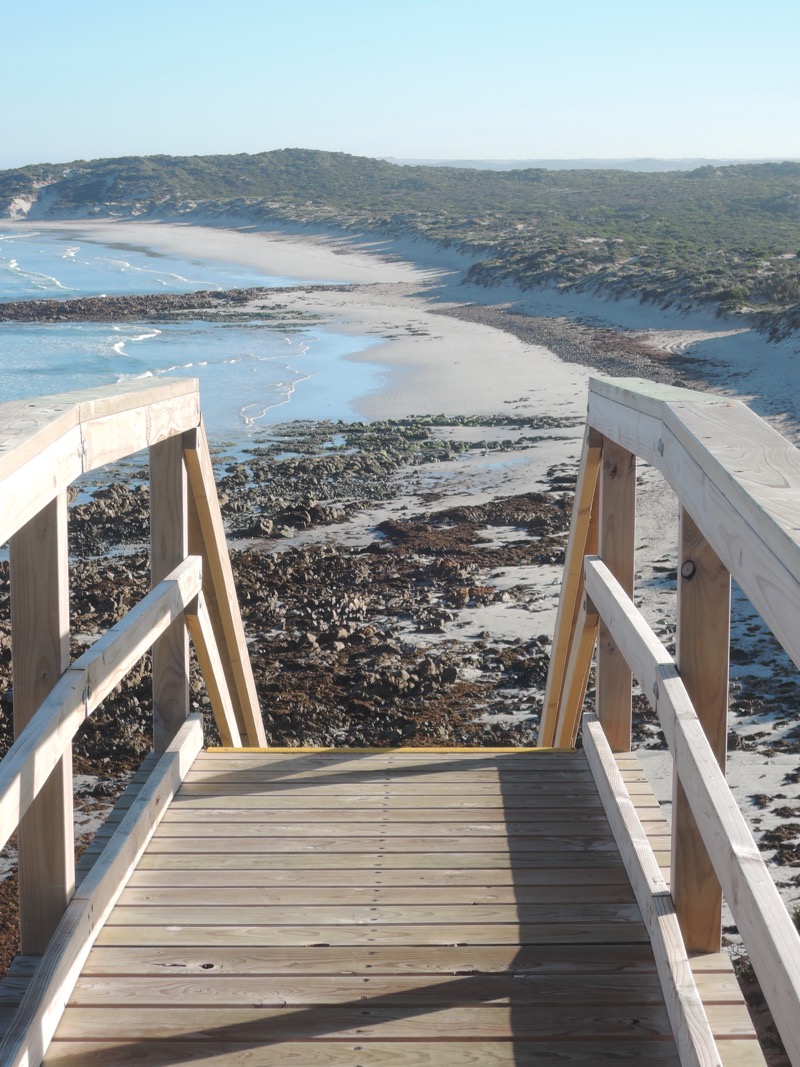
First, an update: I didn’t go to Yorke Peninsula during my fortnight of annual leave as I’d planned, after all. For a variety of reasons, it was impossible to get there. Instead, I spent some time holidaying along the coast down south. So the view from the steps down to the beach was different from the one I’d anticipated, though it was still a view to revel in.

A view to revel in

I complained recently about my dread of autumn and winter, those months of the year I always think of as the grey months. But my complaints this year were premature. Sometimes in South Australia, in the early weeks of autumn, the wind dies off, giving way to still, sunny days; endless blue skies; cold, clear nights. That’s how it’s been here for the last four weeks. I could not have picked better weather for a holiday by the sea, despite my last-minute change in location.

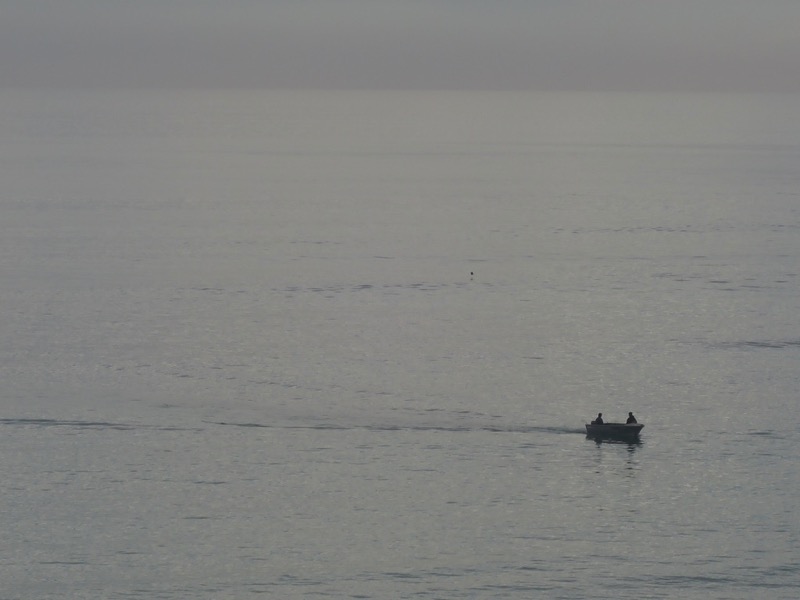
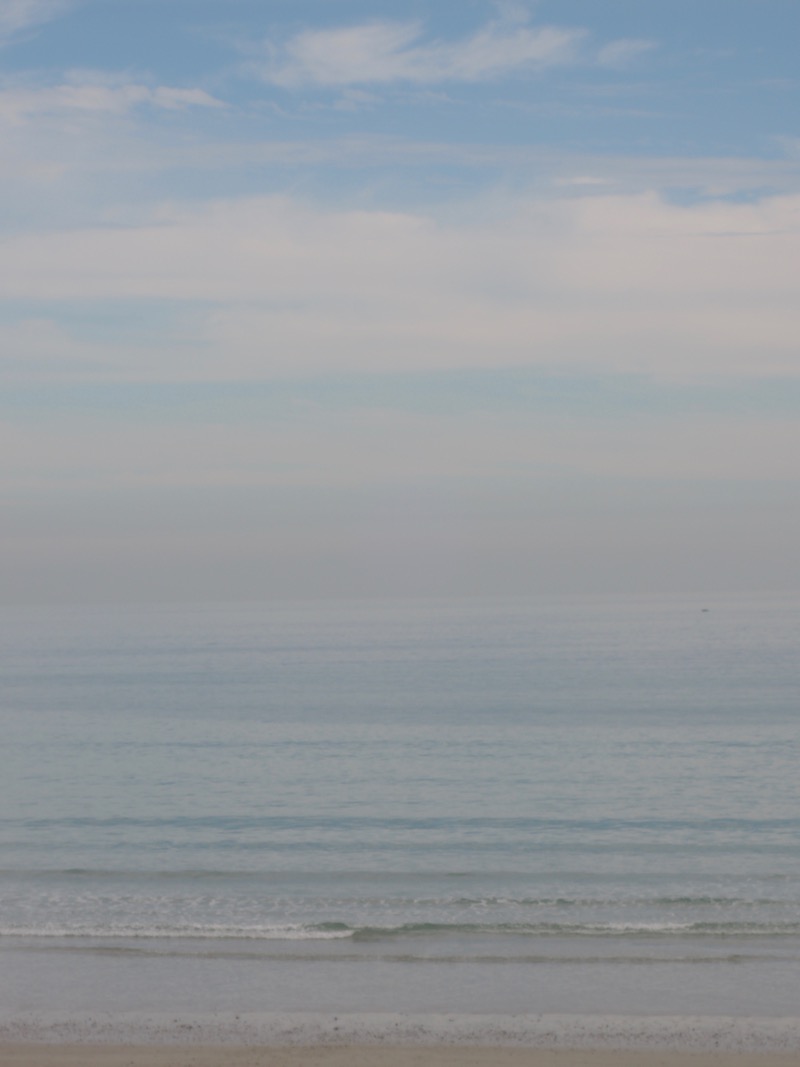
One afternoon I took a walk heading south along Aldinga Beach, beyond the spot where cars are permitted to drive onto the beach to launch fishing boats. It was one of those days where the horizon — that mysterious line between the sky and the sea — seems almost invisible. A boat glided over the surface, somehow suspended between the two, and the headland in the distance was shrouded in a mist of sea spray. The sea changed colour as I walked, from opaque blue, to glassy blue, and then to silver.
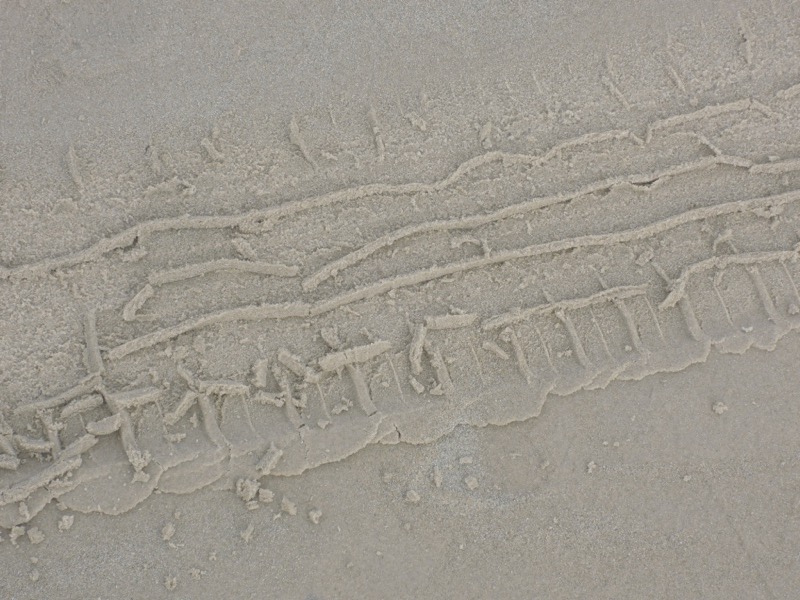
Tyre tracks in the sand
Invisible horizon
Gliding boat
Sea spray shrouding the headland
Opaque blue
Glassy blue
Silver and shining

As I walked, I thought about the words I’ve quoted right at the top of this post. I write about the beach here on my blog as a place, always, of beauty and wonder: a place where I swim and stroll, wander and wonder. But that’s a very Western, privileged, twenty-first-century way of viewing it, isn’t it? The beach in the world Anurahda Roy describes — modern-day India — is another place entirely; and her sea is a different entity. In her world, the sea provides the means for people to strive to make a living, and the making of that living obscures the beautiful view.

I am lucky enough, mostly, not to feel the need to chant a morning prayer for luck, as the fishermen in Roy’s passage do. But if I were the praying type, I would utter a prayer of thanks for the view of the beach I had that day, and for every moment I got to spend by it.

A breakfast of clouds and chocolate

Other people’s words about … what works

Chocolate at breakfast has always seemed wrong to me somehow. It seemed too decadent and lusty, entirely out of place, like watching a sex scene on television when your parents are in the room. But I have now spent eight mornings eating chocolate granola for breakfast, and I have concluded –- with all due gratitude to [my husband] Brandon, my personal granola pusher –- that chocolate is, once and for all, perfectly acceptable at any time of day. I had been a doubter for so many years, but now, good lord, I get it. And I think this revelation might, quite possibly, be the cosmic purpose of our marriage.

From ‘All We Ever Really Want to Do
by Molly Wizenberg of Orangette blog

I came to Molly Wizenberg’s blog only recently, many years behind most people. There are so many cooking blogs out there in the internet-world now, and so many of them are so beautiful, that it is easy to feel overwhelmed, or bored, or cynical. Moreover, the idea of using a recipe to introduce a post that discusses a theme entirely unrelated to food — in other words, to discuss life — has become such a common approach amongst food bloggers that it seems to me to be verging on the clichéd. But Molly was one of the early bloggers to take this approach, and she writes well, which makes all the difference. I will be reading her blog again, I’m sure.

As for chocolate at breakfast — well, why not? A therapist I used to see once said to me, as I agonised over how to live my life better (or rather, how not to live it so very, very badly): Life is short. Do what works. Though I’ve left much of his counsel far behind, I think about these particular words of his from time to time. Life is short, indeed. If chocolate works, then eat it. Please.

(Alternatively, you could try cake. Cake never fails for me.)

Meanwhile, today is my first day of two weeks’ annual leave. I currently have two part-time jobs, so time away from both of them simultaneously can be hard to pull off. The next fortnight feels incredibly precious to me.

For some of that time, I plan to go to Yorke Peninsula again. Autumn is in full swing now: my holiday there will be different from my last trip to Yorkes, back in February. There will be clouds; there will be rain; there will be wind. It will be too cold to swim, so I’ll walk miles down the beach and along the clifftops. I’ll sleep late into the morning and go to bed early at night. And I will read.

I’ll read.

I’ll read.

Afterwards, I’ll come home grateful for heaters and hot showers, and ready — already — for the next trip, whenever that happens to be.

I don’t know if, like Molly, I’ll be eating chocolate for breakfast while I’m away. It doesn’t matter. Life is short, and these are the things that work for me. That’s why I do them.

All in all, it’s not such a bad way to live.

The beast

Snatched phrases (on being present)

Do the anxiety. Then leave it there. This is our challenge.

from ‘First, We Make the Beast Beautiful: A New Story about Anxiety
by Sarah Wilson

Simple words, huh? They apply to all manner of ills, I think — not just anxiety. They are about staying in the present: doing the hard stuff when it comes up, not questioning it or agonising over it … and then leaving it behind and moving on.

There are no solutions to anxiety out there, Wilson argues further on: no cures or fixes. So you just do it …

… and then you leave it.

This makes great sense to me.

Today’s photos? They’re from one of my latest bushwalks, a couple of weeks ago: mid-March. It was a still, grey afternoon, and when I first began to walk, the colours seemed drab, and the birdsong was muted, and the air felt unkind and cold.

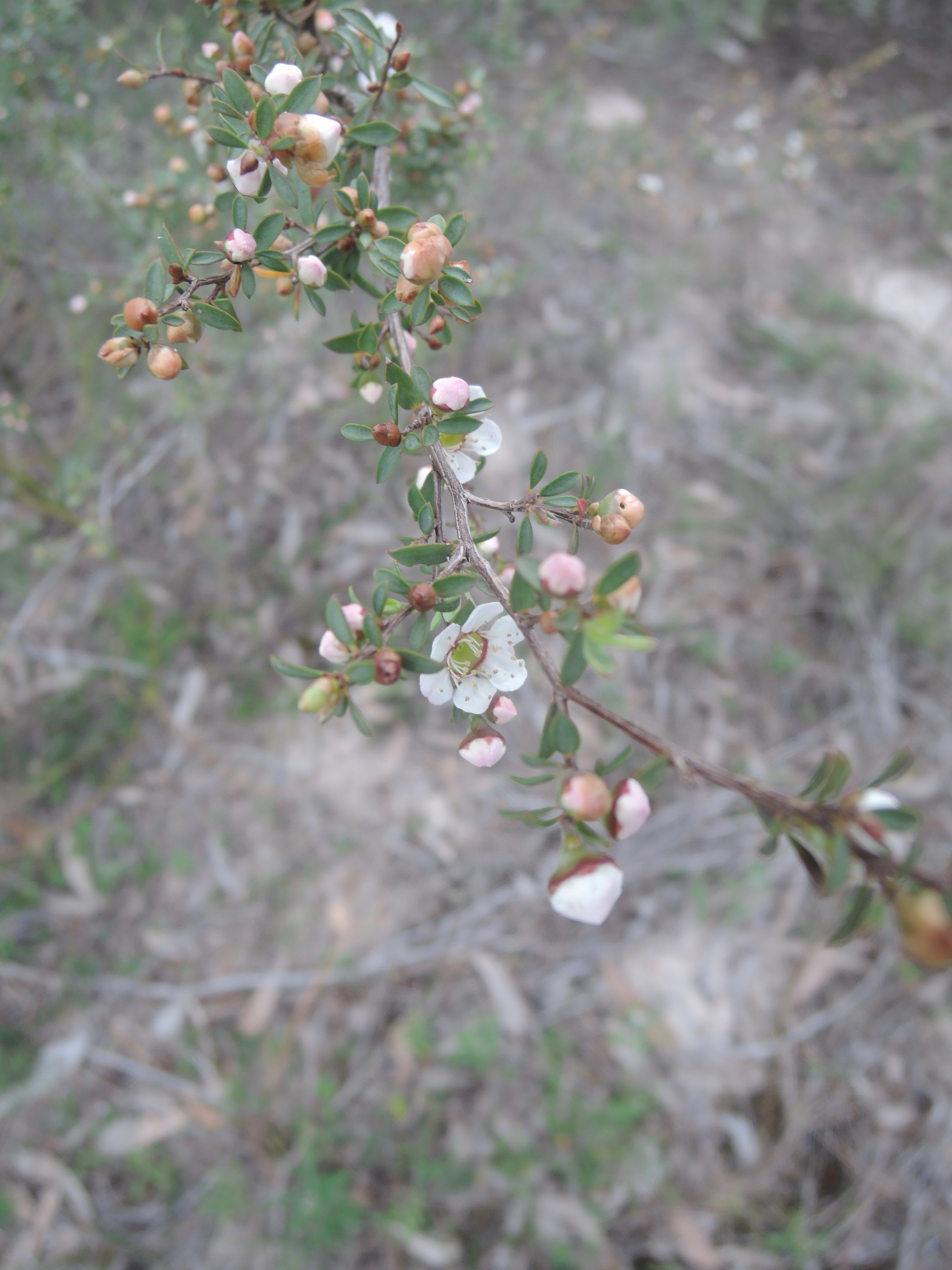
But as I wandered on, I began to see a few flowers despite the greyness, and I came upon a kangaroo, which stiffened at my bumbling approach and then bounded away. I heard the sea murmur somewhere through and beyond the thicket of trees, and a magpie began to carol, low and soft.

I had done my day, and I had left it there, and things were fine. Just fine.

In the middle of ordinary life

Other people’s words about … meditation

While I was [at Maharishi’s meditation course in the Alps] I managed to meditate for up to four hours a day, but back home it all seemed difficult again. And then, gradually, as I listened to the lectures it dawned on me that meditation was for recluses or people inclined that way. Prolonged practice could only result in a detachment from life that, although it might be better, I didn’t want. I didn’t want to become indifferent to anything, and as I watched those closest to Maharishi it seemed to me that they had this desire, gift, need — however you want to put it. I wanted to be in the middle of ordinary life trying to make the best of it even if — I could see more clearly now — it entailed my making the same mistakes many times. I didn’t want to give my life to anyone, I wanted to have it and use it and be an ordinary householder. So gradually I stopped. I think of Maharishi with great respect and affection, and I am sure that there is a spiritual hierarchy in which I am merely on the lower rungs. That was it.

from ‘Slipstream
by Elizabeth Jane Howard

I’ve written before about how I tried meditation recently (again), before deciding, finally, that it didn’t work for me. I don’t want to bore you by repeating myself endlessly on this blog; please feel free to read my older posts about the topic if you’re interested. Most particularly, what has worked for me, post-meditation, has been learning to spend my days looking outward rather than inward.

I do particularly like Elizabeth Jane Howard’s spin on the theme, though. That’s why I’m revisiting it today. Perhaps, when she wrote the words above, meditation wasn’t considered to be the cure-all that it often is now; perhaps, for that reason, her words were less transgressive than they seem to me as I read them today. Still, I find her words wise and humble and filled with gratitude. Ironic, isn’t it? Those three things — wisdom, humility, gratitude — are all things we are often told we may develop through practising meditation.

Tea for one —
an ordinary pleasure,
all the more worth treasuring for its ordinariness

Like Howard, the older I get, the more I realise how attached I am to life — and how much I want to stay attached. My days are filled with petty, mucky angst, and I like them that way. Yes, I have bad days — days when my head aches, and my stomach churns, and my throat crawls with a hot kind of sickness and I can’t figure out why; days when my thoughts seem fevered and panicked and tumbling and disconnected; days when it takes all my effort to get dressed for work, and go in, and sit at my desk, and stay seated there, and stay still, oh, just stay still.

Still, even as I wait the bad days out, not knowing how else to get through them, I find myself wanting, in my strange, fierce way, to hold onto them. Because, like Howard, I want to be in the middle of ordinary life trying to make the best of it.

It’s about honouring life, really, isn’t it? That’s what I want to strive for. That’s all. That’s really all.

Differentiation

Other people’s words about … wild animals

As Paul and I were cresting the last hill, as I was squinting into the darkening woods to make out the path, a couple of deer lifted their heads at once and differentiated themselves from the trees.

We stared at them, and they at us, for a full thirty seconds without moving. They multiplied as we looked at them. There were three at first, then there were four, then there were five. They were the exact color of the bark and leaves –- gray brown –- but the skin around their eyes was red. I felt the breeze on their backs lift the braid from my chest and set it down over my shoulder.

‘They’re going to get us,’ Paul whispered. He reached for my hand.

‘They’re a herd,’ I reminded him. ‘They’re afraid of us.’

Two more appeared. Paul shivered.

From ‘History of Wolves
by Emily Fridlund

There are many places I like to go bushwalking in, but one of my favourites is the Aldinga Scrub. When I walk there, particularly at certain times of the day, I am always conscious that I might encounter a roo or too. There are traces of them throughout the Scrub.

Sometimes a kangaroo appears before me in plain sight — in a clearing in a patch of sunlight, enjoying the last rays of the sun, joey in pouch.

But sometimes there are roos in front of me all the time, without my even realising it. I don’t know what alerts me to them then. It might be the faintest rustle in the leaves around me, or a slight movement — an ear-twitch, perhaps. Sometimes a sense comes over me, simply: a dawning awareness that I am not alone any more, that I am being watched, and regarded, and assessed.

Kangaroos are not naturally aggressive towards humans, as far as I know, or not during encounters like this. But still, like all wild animals, they are protective of each other and of their young. And so, when I come across a roo or two (or more) in this way — when they differentiate themselves from the bushes around them, as Linda, the narrator in the passage above, beautifully puts it — I make sure to stop and take one or two steps back. I let the kangaroos know I’m not a threat. We regard each other a while, creature to creature, acknowledging each other. It’s not fear I feel then, like Paul, the little boy in the quote above: it’s respect.

And then I move on, leaving them to their world, re-entering my own.

Darkness encroaching

Other people’s words about … winter

Minutes after that the sun came out: brilliant, stunning us all. Still, it was no surprise when we were let out of school a half hour early due to the windchill. I made my way home from the bus stop at a rigid trot. I crunched along the snow-packed trail, felt the wind come off the lake in blasts, heard the pines groan and creak overhead. Halfway up the hill, my lungs started to feel raggedy. My face changed into something other than face, got rubbed out. When I finally got to the top of the hill, when I slowed down to brush ice from my nose, I turned and saw a puff of exhaust across our lake. I had to squint against all that white to make it out.

From ‘History of Wolves
by Emily Fridlund

Many years ago, I spent a winter in Michigan in the USA. For a whole month, the temperature did not lift above zero degrees Celsius. Having lived in South Australia most of my life, I had never seen a lake freeze over before. I walked across the surface of the frozen water, and grasped for the first time the meaning of the term ‘windchill’, a term I realised I had never understood before. A little way further out, a fisherman sat in a folding camp chair with his line cast down into a carved-out pool at his feet. I thought of taking a photograph, but my hands grew numb in the few seconds it took me to take off my gloves and fiddle with the lens on my camera. How can you grow so cold so quickly? It didn’t seem possible.

My American friends, knowing my love of ice cream, suggested taking me to the ice cream parlour in their local town, but it was shut down for the winter. We did a quick march up and down each side of the main street to look at the ice sculptures standing outside the shops. I kept expecting them to melt. I am Australian: I expect ice to melt. That’s just what it does.

For me, Emily Fridlund’s words, which I’ve threaded above and below throughout this post, capture the essence of that winter I spent in the northern hemisphere.

Overhead each afternoon we could hear the Canada geese coming back. We could hear them giving directions, labouring through wind currents, setting down their Vs. When the sun had just about set, we turned around, Paul lagging, getting farther and farther behind, so as the day grew truly cold –- miniature winter setting in, the way it does at night in April –- I put the backpack on … and we headed back toward his house on the lake.

What a lovely phrase, don’t you think?: Miniature winter.

Here in South Australia, where our climate is temperate, we don’t have four distinct seasons. Autumn is the beginning of what I always think of as the grey months. Our native trees are mostly evergreen, so they don’t shed their leaves; the weather simply grows windy, rainy and cold. As winter approaches, the days grow greyer still, and the hours of daylight shorten. The sky seems to sink lower over the earth, closing everything in. The world grows monochrome.

But then, in the middle of March, the temperature shot up to fifty and miraculously stayed there. Within a couple of weeks, the south slope drifts had eroded to stalagmite pillars. A wet sheen appeared across the surface of the ice, and in the late afternoons you could hear the whole lake pop and zing. Cracks appeared. It was warm enough to gather wood from the pile without mittens, to unfreeze the latches on the dogs’ chains with the heat of your fingers.

This time of the year — the first days of March, the very beginning of autumn — I always grow nostalgic for summer. Down the road at the beach, the sea is still warm enough to swim in, and the sand crumbles soft and dry and warm beneath my bare feet. A sense of urgency comes over me as I look up at the upside-down bowl of blue sky above me. I murmur spells at it, trying to make it stay.

The grey months are coming but not yet, not yet.

Note:
The pictures accompanying today’s posts are photos I’ve taken over the last few years during the South Australian winter. It may look as though I used black-and-white film, but I didn’t. That’s just the way it is.

When the wall comes down

Other people’s words about … the view

When I was about fourteen or so, I studied a poem in school by David Campbell, called ‘On the Birth of a Son‘. It was a sonnet, and I didn’t know much about sonnets, except that Shakespeare wrote a lot of them. It never occurred to me that a contemporary poet might write one.

This sonnet by David Campbell has stayed in my mind ever since. It remains one of my favourite poems. Here it is, in its entirety:

The day the boy was born, the wall fell down
That flanks our garden. There’s an espaliered pear,
And then the wall I laboured with such care,
Such sweat and foresight, locking stone with stone,
To build. Well, it’s just a wall, but it’s my own,
I built it. Sitting in a garden chair
With flowers against the wall, it’s good to stare
Inwards. But now some freak of wind has blown
and tumbled it across the lawn — a sign
Perhaps. Indeed, when first I saw the boy,
I thought, he’s humble now, but wait a few
Years and we’ll see! — out following a line
Not of our choice at all. And then with joy
I looked beyond the stones and saw the view.

On the face of it, this poem is about becoming a parent — the fears new parents have; the limitations parenthood imposes on their lives; the unexpected, unsettling joys it rewards them with. So it might seem strange that Campbell’s words have always resonated with me, though I have chosen, deliberately, never to become a parent.

But that’s the thing about great poems: they are universal. They manage to strike a chord in different people at different times for different reasons.

For myself, every time I read this poem I am moved by the contrast the poet makes between the act of looking inward — at his safe, pretty, cosy life — and the act of looking up, out, to glimpse a view of the world, and his life, beyond.

The view beyond. Recently, I went on a holiday in Yorke Peninsula. I returned to one of my favourite spots, following a long, undulating, unpaved road to get there — one that is corrugated and dotted with puddle-holes, dusty with sand stirred up by other passing vehicles, and lined with dense thickets of bush where brown snakes lie coiled, sleeping.

Each day I passed my time the way I always pass my time there. Each day I woke to the same view.

But it is a spectacular view: of open skies, of wide seas, of sprawling cliffs and rolling sand dunes. It is a view of a life beyond the life I normally lead. It is a view that sets me free.

I live a small life: small things give me pleasure. I consider myself, mostly, lucky to be able to live this way. And yet it’s good to escape from time to time: to look up and out and beyond.

And to see, again, the beautiful view.

Notes

You can find a link to this poem here and here.

Inhabitant

Other people’s words about … noticing

Over the last year I have discovered a passion for birds and wildflowers in particular, along with the ever-present kangaroos. I love the texture of bark, the colour of leaves and mosses, I’m utterly fascinated with the fact that I can walk around our small patch of natural bushland each day and find something I’ve never noticed before. Or find something I have noticed before, but it catches my eye for a different reason.

from ‘Fifteen Acres: A Small Slice of Paradise‘ blog
by Lisa from Central Victoria, Australia

I came across Lisa’s blog only recently and instantly realised she is a kindred blogger. Her blog documents her growing understanding of, knowledge about, and love for all the species of native flora and fauna that live on her block of land in rural Central Victoria. I get the feeling that Lisa has learned about her patch of land simply by walking through it and observing.

One of my favourite parts of the world in my state is Aldinga Scrub. I didn’t even know about the scrub’s existence until I was well into adulthood: it was the beach nearby — with its beautiful cliffs, its blue waters, its fish-inhabited and bird-dotted reef, its wide sands — which initially attracted me.

The first time I walked through the Aldinga Scrub, I was just curious. I had heard that it was the last remnant of original coastal bushland in South Australia, and so I wanted to see what it was like. A year later, going through another phase of feeling inexplicably agitated and uncomfortable in my own skin, I decided to try walking there more often. I thought that, if I made the effort to look outwards at the world around me instead of looking inwards into my own seething internal landscape, I might find solace.

And I did.

A small kind of miracle happened as I revisited the Scrub again and again. As I wandered, I began to wonder. As I wondered, I stopped. As I stopped, I observed. As I observed, I noticed, as Lisa puts it. And then, at last, I started to see and to learn.

Something else happened, too. I began to inhabit the world around me during those walks. Inhabitation — it’s a powerful word. Maybe it’s pretentious. Maybe it’s corny? And yet that’s how it feels.

It never stops, this seeing, learning, wondering, inhabiting. That’s another kind of miracle.

The pictures in this post are photographs I’ve taken over the years on my many visits to, and walks through, the Aldinga Scrub. Here you can see it in its many moods, its many seasons, its many tempers. I don’t know if my photographs can convey the wonder I felt as I took them, or the remembered sense of discovery I feel now when I return to them, but I hope that they convey, at least, the deep joy that my wandering has brought me.

That’s the thing, you see — noticing is both a humble and a joyful process. It’s a privilege to inhabit this kind of joy.

When summer came

Other people’s words about … summer

Summer came, clanging days of glaring sunshine in the seaside town where I live, the gulls screaming in the early dawn, a glittering agitation everywhere, the water a vista of smashed light.

From ‘Aftermath
by Rachel Cusk

I live in a seaside suburb like Rachel Cusk. Gulls scream outside my window most mornings, flapping over the roof, perching on the top of the stobie poles. I find great solace in their shrieks. Like the call of a wattlebird, there is nothing elegant or beautiful in a gull’s cry. It is gloriously unapologetic, and harsh, and guttural, and wild.

There is a particular kind of summer day at the beach: the sand is so hot along the path from the road across the dunes that if you are making your way barefoot — or if you are a dog — you have to run over it towards the shore to prevent the soles of your feet (or paws!) from burning. The sky throbs; the air is windless, hot, salt-scented; and gulls stand in the shallows, waggling their legs as they stare down into the clear water, searching (I think) for fish. It’s so quiet in the hot stillness that you can hear the little lapping, bubbling noises the water makes as the gulls’ legs move about in it.

A vista of smashed light.
A vista of smashed light

I haven’t swum in the sea much this summer. Due to the storms in December and early January, the water is muddied and polluted. But I love the beach at this time of the year, regardless. I feel no glittering agitation, as Cusk does: only joy.

It’s the heat. And the light. And the gull-shriek-rent air.

Snatched phrases (on hope)

‘It’s maybe why her mother took to walking, Tess thinks  as she clambers through thickets of ash, brown kurrajong, weeping fig.
When you’re walking the view shifts and changes.
Walking’s a form of hope.’

from ‘The World Without Us
by Mireille Juchau

When you're walking ...
When you’re walking …
... the view shifts and changes.
… the view shifts and changes.
Walking's a form of hope.
Walking’s a form of hope.