Epic

Other people’s words about … sweat

‘Swagger’ might be common jargon now, but let’s not confuse the situation. Swagger is earned. It can be grimy or graceful. It can be innate, but it’s also finessed. It’s the feeling that makes you sit a little taller and reinforces your backbone. We sweat with swagger when we infuse a shameless confidence into movement. To sweat with swagger is to redefine what it means to be an athlete and create unapologetic greatness along the way. When we sweat with swagger, we test the limits of human potential. When our footsteps are powered by motivation and a strong community, the cadence is a drumbeat to doing something epic. Sweat is magic. Swagger is the glisten.

from ‘Shut up and Run
by Robyn Arzón

First, a story of my own, before I address the words I’ve quoted above.

The day before Easter, I woke with my stomach roiling. It was my first official day off work for a while, and when I pulled the curtains back from the window above my bed, I saw clear skies and sunshine through the glass. Lying there in bed, a little before seven o’clock, I felt every part of me rebel at the thought of languishing the day away inside, sprawled out on the sofa, feeling ill.

And so I got up, and I pulled on my oldest pair of trousers — the pair with the faint bike-chain stain on the left leg. I threw my camera and some spare coins into my backpack, and I got on my bike and rode away from the house.

The moment I started cycling, I could feel something inside of me begin to unfurl. I am a tense person, and mostly this tension is a mental thing, but it manifests itself in me physically, too: in my muscles. This is something I have only just begun to realise. I had been sore for days before this bike ride, my right hip aching from stooping over the computer in the office, the muscles in the hollow of my back raw from constantly bracing myself (against what? staying still?), my stomach queasy and unsettled.

So I pedalled slowly. Gently.

The route took me south-west — first along the coast, past two jetties; then south-east a little way,  where the coastal road came to a dead end. Then, when the coastal road started back up again, I turned back west and cycled alongside the sea once more, past the third jetty. I rode with my head up, glancing about me: at the wide, cloudless sky, and the opal-coloured sea, and the faint line dividing the two of them. Lycra-clad cyclists sped by me in a whoosh of tyres and sweat — mostly men, some women; most of them younger than me, but some older — and I said, ‘G’day’ to each one of them and gave them a little smile of greeting and acknowledgment, though I’m not sure that any of them heard me or noticed.

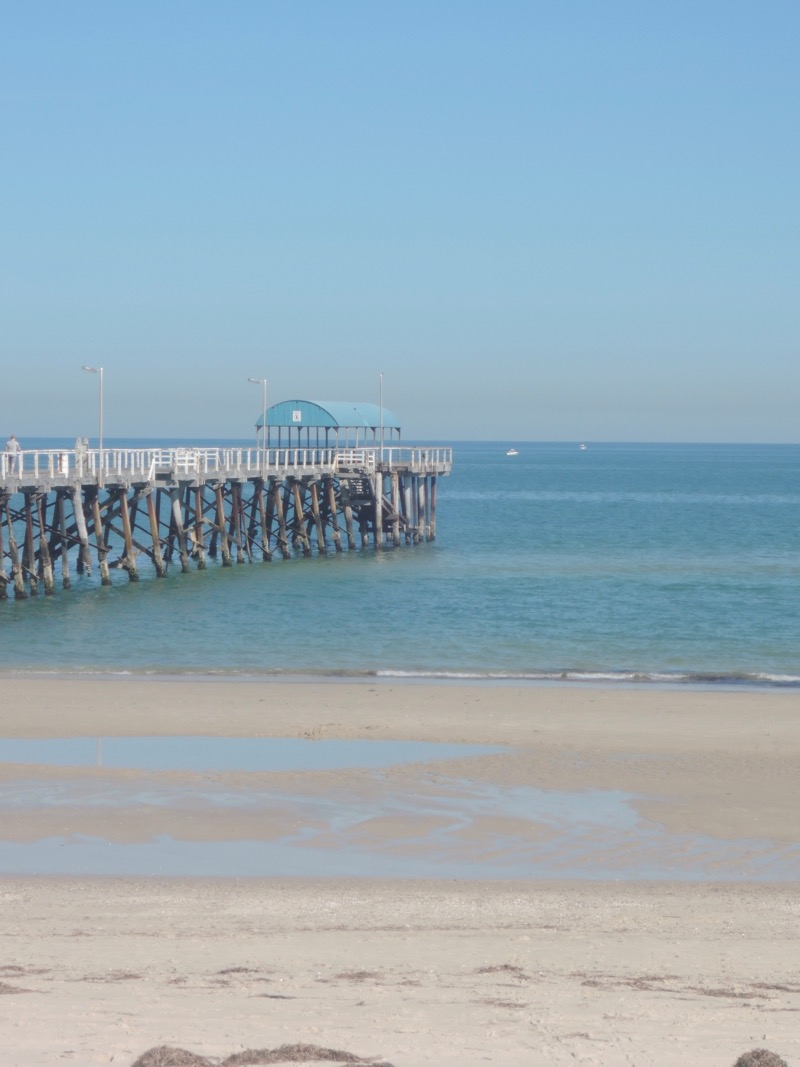
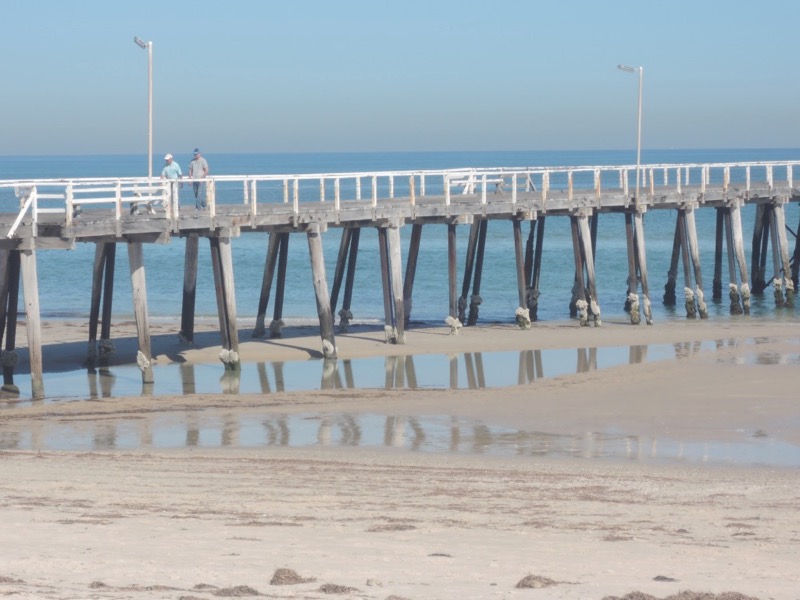
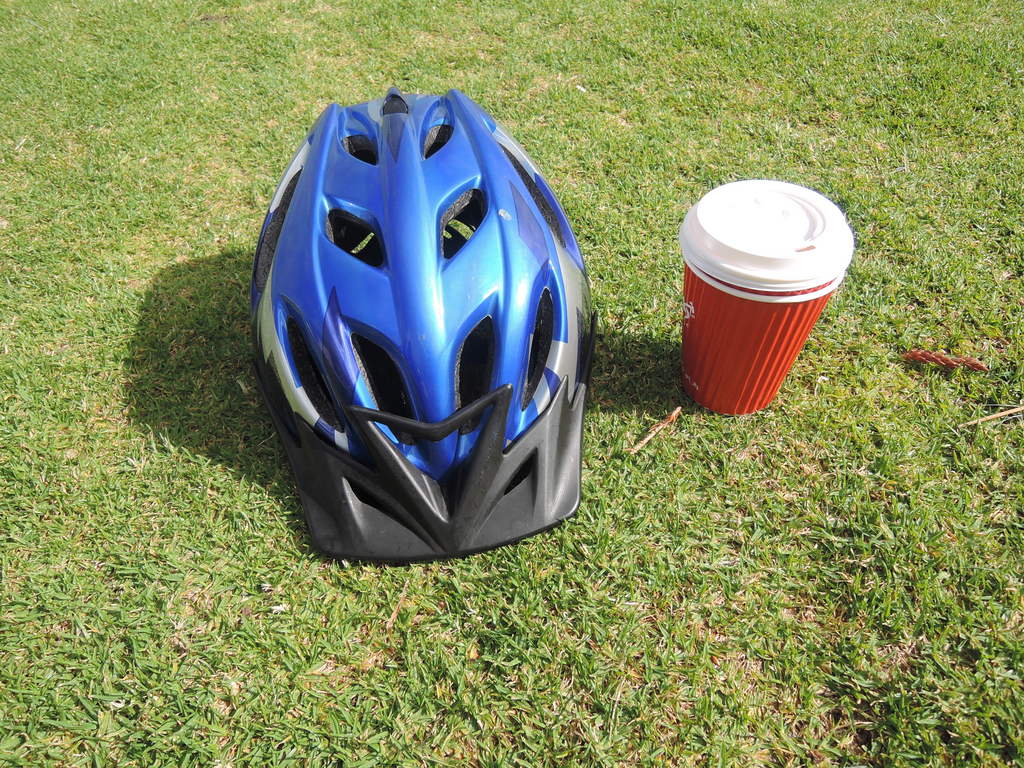
When I got to the fourth jetty (the one pictured in most of the photos in today’s post) I stopped and parked my bike. I wandered across the main road to the supermarket and bought some dried-fruit-and-nut mix, and then I dropped into my favourite café at that particular beach and ordered a take-away cup of tea. They’ve recently started selling tea made from leaf tea instead of teabags there, even for take-away drinks, which is a little thing, I know, but it makes me very happy. I carried my lidded red cardboard cup of too-milky leaf tea back across the road and plopped myself down in the middle of the foreshore square. And there I sat, cross-legged on the sun-warmed grass, nibbling my fruit and nuts, sipping my tea, looking (and looking) at the sea.

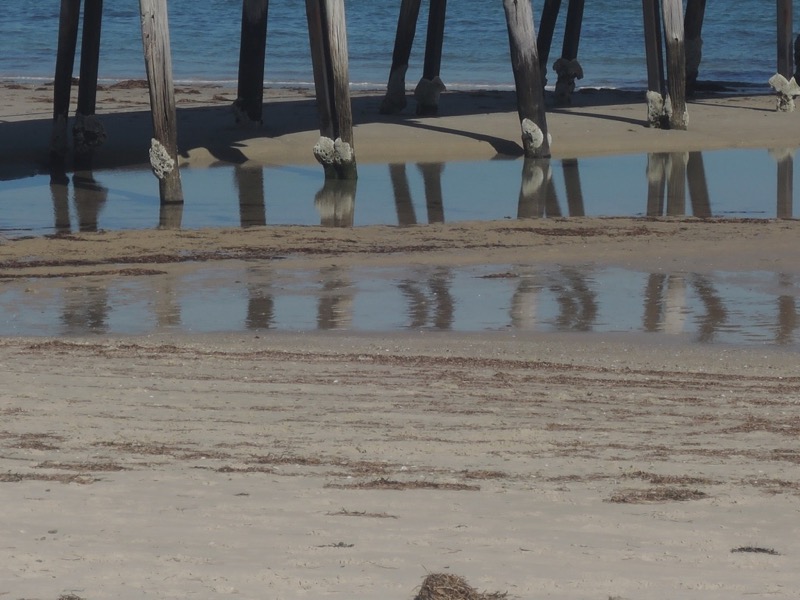
In a few weeks’ time, the grass in that foreshore square will be wet with rain, and a cold wind will whip between the lamp-posts up over the grey roof of the pavilion. I contemplated this a while, stretching my arms out behind me, resting my weight back, feeling the blades of grass tickle my palms. The beach was only a few steps away from where I sat on the grass, and I could see the jetty pylons reflected in the water, and I’ve said it once already in this post, but little things like that — they make me very happy indeed.
So what has this to do with the words I quoted at the beginning of this post? There was a bit of sweat involved in my bike ride, sure, but there was no swagger. I cannot say I moved with shameless confidence or unapologetic greatness. I was motivated, certainly, but I did nothing epic or magic. I am certain I did not glisten.

Thank goodness.
I do not wish this post to be unkind. I do not wish to say, as Arzón herself says many times throughout her book, I call bullshit on her words. But then there’s this:

Our inner monologue can turn can’t into can and dreams into realities. Extinguish doubt with action. Let’s write the story that says we are a little better than yesterday. We can push ourselves to where we want to be. It’s going to take a little sweat, though. Happy is something you do, baby, and only you are responsible for your happiness. Life is happening right now, so stop making up excuses and tell me, what do you want your story to be? Do you want to be a runner? Have you always dreamed of completing a marathon? Whatever it is, write it down, look back on it, and own it.

These sentences — sentences like this — worry me. Arzón’s thoughts are not unique; her words are a part of a general conversation, one that I hear around me almost every day. And it is a conversation I can’t help fretting about. I am alarmed when I hear someone confuse athletic prowess with personal greatness. Or when I hear someone link the idea of their becoming a better person, of their living a better life, with the act of slipping on a pair of running shoes. Or when I hear someone use words and phrases like ‘strive’ and ‘focus’ and ‘dedication’ and human potential (that last is Arzón again) to describe, not acts of goodness, let alone greatness, but essentially self-centred feats of fitness and strength, speed and endurance.

I decided to do one thing with my life — epic shit — and I want you to come along for the ride, Arzón writes, of her long-distance running. Maybe I’m wrong, but those words make me feel empty and sad.
Having said that, I also do not wish this post to turn into a lecture, or a rant. I do not wish to moralise. So I will just say this: I took my bike ride that morning slowly, because that was what the day asked of me, and what my life seems to be asking of me generally right now — regardless of my dreams, regardless of whatever kind of story I might prefer to write about myself. It was a gentle ride, and I felt gentler for it afterwards (though still somewhat unwell).

And that, I think, is how I want to live out my days: gently. Slowly. With kindness, both to myself and to others. With humility.

Tell me, am I alone in this? How do you want to live?

Snatched phrases (on terror)

In the actual moment, you do not have a choice.
Grace finds you.
Acceptance hunts you down.

From ‘The Violet Hour: Great Writers at the End
by Katie Roiphe

Forgive me, but I’ve pulled Roiphe’s words out of context here. She is talking, specifically, about death: her fear of it, and her admiration of the way others face it. I don’t have the same preoccupation with death — or not yet, anyway: not in my mid-forties. I like to hope I have some way to go before it crosses my path.

Still, sometimes I think that fear is the great equaliser. Maybe you get through the terror because you have to get through the terror, Roiphe writes. It’s the same with all great fears, isn’t it?

Grace, acceptance, resilience, surrender — these are all things I’ve touched on before on this blog (here, for example, and here). May they come to you, too, in your moments of greatest fear: may they be your companions along the way.

The beast

Snatched phrases (on being present)

Do the anxiety. Then leave it there. This is our challenge.

from ‘First, We Make the Beast Beautiful: A New Story about Anxiety
by Sarah Wilson

Simple words, huh? They apply to all manner of ills, I think — not just anxiety. They are about staying in the present: doing the hard stuff when it comes up, not questioning it or agonising over it … and then leaving it behind and moving on.

There are no solutions to anxiety out there, Wilson argues further on: no cures or fixes. So you just do it …

… and then you leave it.

This makes great sense to me.

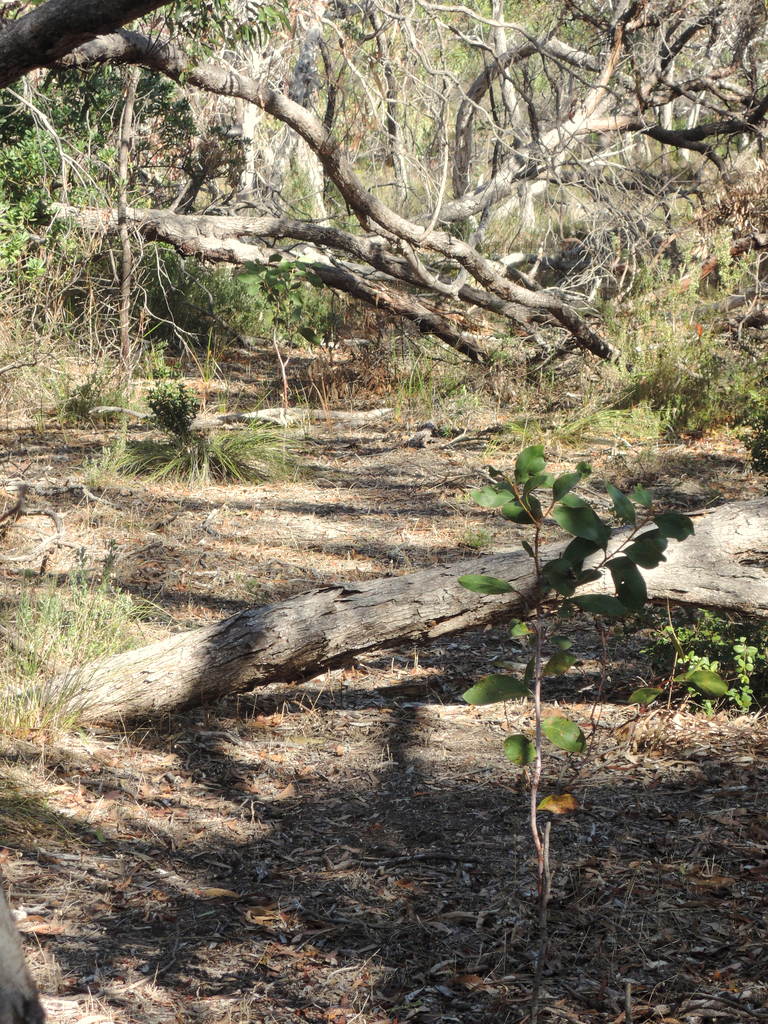
Today’s photos? They’re from one of my latest bushwalks, a couple of weeks ago: mid-March. It was a still, grey afternoon, and when I first began to walk, the colours seemed drab, and the birdsong was muted, and the air felt unkind and cold.

But as I wandered on, I began to see a few flowers despite the greyness, and I came upon a kangaroo, which stiffened at my bumbling approach and then bounded away. I heard the sea murmur somewhere through and beyond the thicket of trees, and a magpie began to carol, low and soft.

I had done my day, and I had left it there, and things were fine. Just fine.

In the middle of ordinary life

Other people’s words about … meditation

While I was [at Maharishi’s meditation course in the Alps] I managed to meditate for up to four hours a day, but back home it all seemed difficult again. And then, gradually, as I listened to the lectures it dawned on me that meditation was for recluses or people inclined that way. Prolonged practice could only result in a detachment from life that, although it might be better, I didn’t want. I didn’t want to become indifferent to anything, and as I watched those closest to Maharishi it seemed to me that they had this desire, gift, need — however you want to put it. I wanted to be in the middle of ordinary life trying to make the best of it even if — I could see more clearly now — it entailed my making the same mistakes many times. I didn’t want to give my life to anyone, I wanted to have it and use it and be an ordinary householder. So gradually I stopped. I think of Maharishi with great respect and affection, and I am sure that there is a spiritual hierarchy in which I am merely on the lower rungs. That was it.

from ‘Slipstream
by Elizabeth Jane Howard

I’ve written before about how I tried meditation recently (again), before deciding, finally, that it didn’t work for me. I don’t want to bore you by repeating myself endlessly on this blog; please feel free to read my older posts about the topic if you’re interested. Most particularly, what has worked for me, post-meditation, has been learning to spend my days looking outward rather than inward.

I do particularly like Elizabeth Jane Howard’s spin on the theme, though. That’s why I’m revisiting it today. Perhaps, when she wrote the words above, meditation wasn’t considered to be the cure-all that it often is now; perhaps, for that reason, her words were less transgressive than they seem to me as I read them today. Still, I find her words wise and humble and filled with gratitude. Ironic, isn’t it? Those three things — wisdom, humility, gratitude — are all things we are often told we may develop through practising meditation.

Tea for one —
an ordinary pleasure,
all the more worth treasuring for its ordinariness

Like Howard, the older I get, the more I realise how attached I am to life — and how much I want to stay attached. My days are filled with petty, mucky angst, and I like them that way. Yes, I have bad days — days when my head aches, and my stomach churns, and my throat crawls with a hot kind of sickness and I can’t figure out why; days when my thoughts seem fevered and panicked and tumbling and disconnected; days when it takes all my effort to get dressed for work, and go in, and sit at my desk, and stay seated there, and stay still, oh, just stay still.

Still, even as I wait the bad days out, not knowing how else to get through them, I find myself wanting, in my strange, fierce way, to hold onto them. Because, like Howard, I want to be in the middle of ordinary life trying to make the best of it.

It’s about honouring life, really, isn’t it? That’s what I want to strive for. That’s all. That’s really all.

Darkness encroaching

Other people’s words about … winter

Minutes after that the sun came out: brilliant, stunning us all. Still, it was no surprise when we were let out of school a half hour early due to the windchill. I made my way home from the bus stop at a rigid trot. I crunched along the snow-packed trail, felt the wind come off the lake in blasts, heard the pines groan and creak overhead. Halfway up the hill, my lungs started to feel raggedy. My face changed into something other than face, got rubbed out. When I finally got to the top of the hill, when I slowed down to brush ice from my nose, I turned and saw a puff of exhaust across our lake. I had to squint against all that white to make it out.

From ‘History of Wolves
by Emily Fridlund

Many years ago, I spent a winter in Michigan in the USA. For a whole month, the temperature did not lift above zero degrees Celsius. Having lived in South Australia most of my life, I had never seen a lake freeze over before. I walked across the surface of the frozen water, and grasped for the first time the meaning of the term ‘windchill’, a term I realised I had never understood before. A little way further out, a fisherman sat in a folding camp chair with his line cast down into a carved-out pool at his feet. I thought of taking a photograph, but my hands grew numb in the few seconds it took me to take off my gloves and fiddle with the lens on my camera. How can you grow so cold so quickly? It didn’t seem possible.

My American friends, knowing my love of ice cream, suggested taking me to the ice cream parlour in their local town, but it was shut down for the winter. We did a quick march up and down each side of the main street to look at the ice sculptures standing outside the shops. I kept expecting them to melt. I am Australian: I expect ice to melt. That’s just what it does.

For me, Emily Fridlund’s words, which I’ve threaded above and below throughout this post, capture the essence of that winter I spent in the northern hemisphere.

Overhead each afternoon we could hear the Canada geese coming back. We could hear them giving directions, labouring through wind currents, setting down their Vs. When the sun had just about set, we turned around, Paul lagging, getting farther and farther behind, so as the day grew truly cold –- miniature winter setting in, the way it does at night in April –- I put the backpack on … and we headed back toward his house on the lake.

What a lovely phrase, don’t you think?: Miniature winter.

Here in South Australia, where our climate is temperate, we don’t have four distinct seasons. Autumn is the beginning of what I always think of as the grey months. Our native trees are mostly evergreen, so they don’t shed their leaves; the weather simply grows windy, rainy and cold. As winter approaches, the days grow greyer still, and the hours of daylight shorten. The sky seems to sink lower over the earth, closing everything in. The world grows monochrome.

But then, in the middle of March, the temperature shot up to fifty and miraculously stayed there. Within a couple of weeks, the south slope drifts had eroded to stalagmite pillars. A wet sheen appeared across the surface of the ice, and in the late afternoons you could hear the whole lake pop and zing. Cracks appeared. It was warm enough to gather wood from the pile without mittens, to unfreeze the latches on the dogs’ chains with the heat of your fingers.

This time of the year — the first days of March, the very beginning of autumn — I always grow nostalgic for summer. Down the road at the beach, the sea is still warm enough to swim in, and the sand crumbles soft and dry and warm beneath my bare feet. A sense of urgency comes over me as I look up at the upside-down bowl of blue sky above me. I murmur spells at it, trying to make it stay.

The grey months are coming but not yet, not yet.

Note:
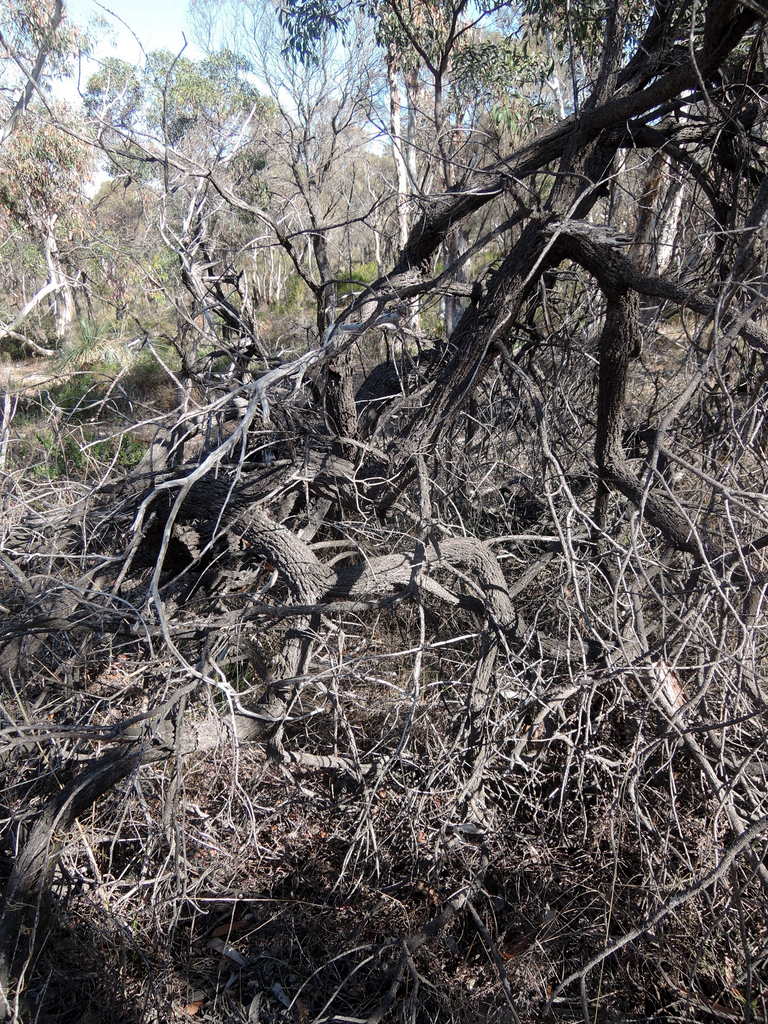
The pictures accompanying today’s posts are photos I’ve taken over the last few years during the South Australian winter. It may look as though I used black-and-white film, but I didn’t. That’s just the way it is.

The one true story

Other people’s words on … writing

He said, ‘What is your job as a writer of fiction?’ And she said that her job as a writer of fiction was to report on the human condition, to tell us who we are and what we think and what we do.

from ‘My name is Lucy Barton
by Elizabeth Strout

When I first began this blog, I was adamant that, though I am a published writer, my blog would not be about writing. A writer can blog about things other than writing, right? A writer isn’t just a writer: a writer is a person; a writer has a life. That’s what I wanted to blog about.

Besides, it seemed to me that blogging about writing would be, in my case, an inexcusably audacious act. My thinking went like this: I have published only two books. I haven’t published anything since 2010. My books have gone out of print. What can I tell anyone about writing? Who would want to read what I had the temerity to say?

Early drafts: an audacious act

I don’t much like the word ‘writer’. Perhaps it’s because I haven’t published much and don’t make a living from my writing, but I feel pretentious and arrogant when I call myself one. I think of myself instead as someone who has written two books, and would like to write another one, but is struggling to do so.

That’s another word I don’t like: ‘struggle’. When I first began writing stories and fiction, the writing was an act of joy. It was a process of humble discovery. Each word that I wrote, each sentence, each chapter, was a journey. I was learning to do something new. I was learning to do something I loved. I was learning.

Writing is a learning process
Lessons in writing: all part of the learning process

So when I first read the words I’ve quoted above from Elizabeth Strout, I thought: Yes! Writing fiction, for me, has always been about opening myself up to sorrow, and to joy, and to humility, and to discovery. It’s about expressing those things, however afraid I am to do so. It’s about making sense of my life. It’s about trying to make something beautiful. It’s about having the temerity — the audacity, the arrogance — to share my words with other people: people who, like me, love reading.

Most of all, writing fiction, like blogging, is about sharing.

And so that’s the reason I’m posting these words about writing today. Call it pretension; call it temerity. Call it audacity; call it arrogance. Call it learning; call it sorrow; call it joy.

Elizabeth Strout again (from the same book):

You will have only one story … You’ll write your one story many ways. Don’t ever worry about story. You have only one.

Maybe this is the only story I have to share, but that doesn’t mean it’s not worth sharing.

The circle of life

I can’t resist coming back to Kim Leine’s ‘The Prophets of Eternal Fjorde’ today to post a couple more quotes. This time, we are not focusing on intestinal discomfort. (Enough already!)

My constitution would seem to be better than I would have thought, for I have survived two attacks upon my life this winter and may thereby once more look forward to further prolongation of my futile destiny.
(p. 406)

Morten Falck, a Danish missionary, struggles with his own fleshly weakness, with his desires and cravings, and with the despair that comes from leading a life whose purpose is not entirely clear to him.

I cannot go back … I can only go forward, in a ceaseless circle, and my only hope  is that when the circle is complete and the motion halts I shall have arrived at the place that is best for me …
(p. 505)

Life as a ceaseless circle:
Don’t you, too, sometimes feel you are pushing forward blindly, hoping — hoping — that you will one day arrive at a place that makes sense?

Autumn sun

April 2016

DSCN2689

In the Northern Hemisphere, they call it Indian summer:
a hot, dry start to Autumn.
That’s what we had here last month —
DSCN2675
— warm, sunny days.
Still nights.
No rain.
DSCN2696
In the bush,
dry twigs crackled beneath my feet,
and the odd flower bloomed.
DSCN2678
Winter stole closer,
like afternoon shadows
creeping across sandy ground.
DSCN2692

Daylight robbery

On Saturday afternoon, I went for a quick stroll on the beach,
shoring the sights up in my memory — and the warmth on my skin — of the last hours of Daylight Saving.

DSCN2658

It was a typical mid-Autumn day.
Windy.
Half-sunny.
Half-dull.

DSCN2661

The sand was wind- and water-rippled.
The gulls’ footprints seemed to blow away as I watched.

DSCN2663

Soon, when I walk on the beach, I’ll wear shoes, socks, a coat, a beanie.
I’ll call the wind ‘bracing’.
DSCN2657
I’ll think of this last long day of light with yearning.
Summer nostalgia — is there a cure?
There should be!

Note:
Okay, a confession: autumn makes me crotchety. I’ll get over it soon, I swear!

Reading Elizabeth Taylor

On the lonely horror of writing

At the thought of work, of the book he was writing, must finish, his stomach lurched, just as if he had come unexpectedly on something repellent. He was scared, too. Nowadays, he was so frightened of sitting down to work that he had to drive himself to grapple with it.

from ‘The Soul of Kindness
by Elizabeth Taylor

I love Elizabeth Taylor’s novels.

Her observations about people, (English) society and life are  acute, pithy and devastating.

Try her sometime!


Note:
Two people drew my attention to the writing of the English novelist, Elizabeth Taylor, who died in 1975. One was my mother, an inveterate and highly intelligent reader. The other was one of my favourite bloggers, Jane Brocket.